How to Know If Your Crochet Tension Is Correct (Too Tight vs Too Loose + Easy Tests)
When Beginners Start Doubting Their Crochet Tension
Many beginners reach a confusing moment while learning crochet.
Your stitches exist.
Your rows look somewhat correct.
But something still feels wrong.
You may start wondering:
- “Is my crochet tension too tight?”
- “Is my crochet tension too loose?”
- “Why does my fabric feel stiff?”
- “Why does my crochet have holes?”
- “Why do my stitches look uneven row to row?”
This uncertainty is extremely common during the early learning stage.
Beginners are still building the physical coordination required to keep loop size, yarn tension, and stitch height consistent. Small variations in hand movement can change the final fabric dramatically.
So the real beginner challenge is not finding a mythical perfect tension.
The real goal is learning how to recognize whether your current tension is producing a healthy crochet fabric.
This article belongs to:
Pillar #8 — Common Crochet Mistakes (and Fixes)
At this stage of learning, beginners are moving beyond “how to make stitches” and starting to evaluate how those stitches behave as fabric.
Understanding tension is a key step in that transition.
- When Beginners Start Doubting Their Crochet Tension
- Quick Answer — How to Know If Your Crochet Tension Is Correct
- What Crochet Tension Really Means (Simple Definition)
- Why Tension Becomes a Problem for Beginners
- Beginner Insight: There Is No Universal “Perfect Tension”
- Signs Your Crochet Tension Is Too Tight
- Signs Your Crochet Tension Is Too Loose
- Crochet Tension Test for Beginners (Fast + Practical)
- Why Yarn Choice Can Hide Tension Problems
- How to Check Crochet Gauge (Beginner Version)
- Why Crochet Tension Varies Row to Row
- How Tension Affects Other Beginner Crochet Problems
- How to Get Even Crochet Stitches Without Hand Pain
- Hook Size vs Tension: Which Should You Change First?
- How to Recognize That Your Tension Is Finally Improving
- Micro Roadmap for This Longtail
- Related Beginner Questions
- FAQ
- Returning to the Bigger Learning Path
Quick Answer — How to Know If Your Crochet Tension Is Correct
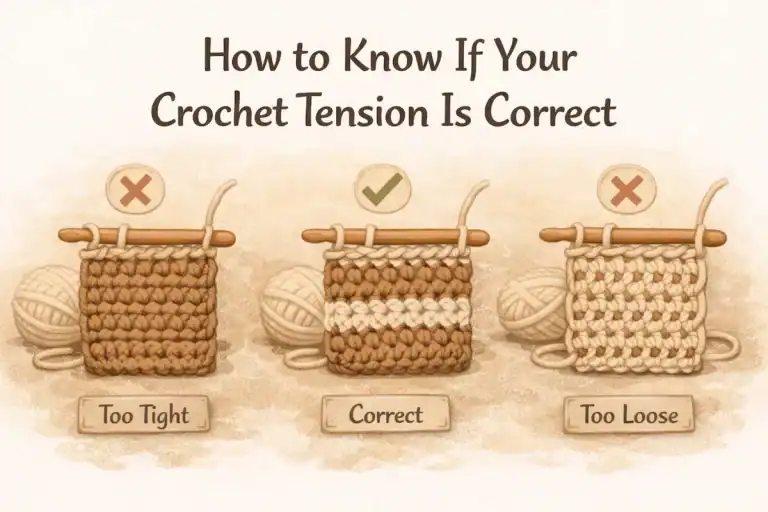
Your crochet tension is generally correct when:
- stitches look consistent in size
- the fabric feels balanced (not stiff, not floppy)
- the hook can enter stitches comfortably
- the fabric matches the pattern gauge when required
- your hands remain relaxed without pain
Signs your tension may be too tight:
- fabric feels stiff
- stitches look compressed
- hook insertion feels difficult
- fabric curls upward
- hands feel strained
Signs your tension may be too loose:
- visible holes or gaps appear between stitches
- fabric feels floppy or unstable
- stitches vary noticeably in height
- edges appear wavy or stretched
Correct crochet tension is not about strict tightness.
It is about consistent stitch formation that produces a stable, usable fabric.
What Crochet Tension Really Means (Simple Definition)
Crochet tension refers to the amount of control applied to the yarn and loops while forming stitches.
It is influenced by three physical actions:
- How tightly you hold the yarn
- How much you pull each loop upward
- How consistently you repeat the stitch motion
These three factors together determine:
- stitch size
- fabric density
- drape
- elasticity
- final project dimensions
Two crocheters using the same yarn and hook can still produce completely different fabrics because their tension habits differ.
This is why patterns often include gauge instructions.
Gauge helps translate a designer’s tension into a reproducible result.
However, beginners often misunderstand tension.
They assume it means “crocheting tightly enough.”
In reality, good tension means controlled and repeatable loop size.
Not tightness.
Why Tension Becomes a Problem for Beginners
Crochet tension becomes unstable during the beginner stage because several physical skills are still developing simultaneously.
These include:
- yarn holding technique
- hook angle control
- loop height control
- stitch rhythm
- hand relaxation
When any one of these changes, the loop size changes too.
This leads to tension problems such as:
- stitches gradually shrinking
- rows getting wider
- edges becoming uneven
- fabric becoming stiff or overly open
Another reason tension problems appear early is overcorrection.
Beginners often react to uneven stitches by:
- squeezing the yarn tighter
- pulling loops aggressively
- gripping the hook harder
Ironically, these reactions usually make tension less consistent, not more.
Beginner Insight: There Is No Universal “Perfect Tension”
A key misconception beginners carry is the idea that crochet has one correct tension level.
This is not true.
Different projects intentionally require different fabric behaviors.
For example:
Dense tension works well for:
- amigurumi
- baskets
- structured items
Looser tension works well for:
- shawls
- lace projects
- lightweight garments
So the true beginner goal is not perfect tightness.
The real goal is achieving:
consistent tension that produces the fabric the project requires.
Understanding how to evaluate that fabric is the next step.
In the sections below, we will look at the most reliable signs that indicate whether your tension is too tight or too loose.
These signs help beginners diagnose tension issues before they affect the entire project.
Signs Your Crochet Tension Is Too Tight
Full micro guide:
Signs crochet tension is too tight
One of the most common beginner mistakes in crochet is tight tension. Many learners unintentionally pull their loops too small because they are concentrating hard on controlling the yarn.
At first glance, tight tension may seem like a good thing. Beginners sometimes assume tight stitches mean their work is neat or secure.
In reality, overly tight tension usually creates several recognizable problems in the fabric.
The most common signs include:
- your hook struggles to enter stitches
- stitches look small and compressed
- fabric feels stiff or rigid
- the project curls upward
- your hands or wrists begin to ache
- the finished piece becomes smaller than expected
These symptoms occur because tight tension reduces loop height during stitch formation. When loops become too small, the stitches cannot expand normally, and the fabric loses flexibility.
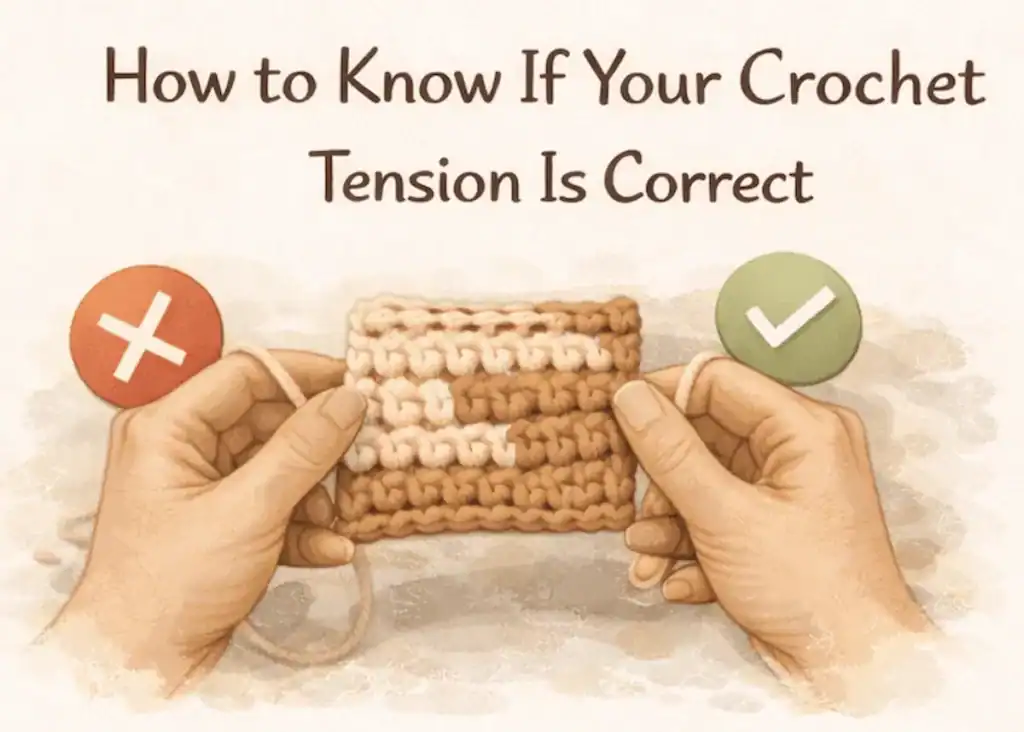
A simple visual check can help beginners identify this problem.
If your crochet fabric bends easily and drapes slightly when held, the tension is likely balanced.
If the fabric behaves more like stiff cardboard, tension is likely too tight.
Common Beginner Misconception
Many beginners believe tightening their stitches will make their work more “correct.”
However, crochet stitches are designed to interlock naturally through structure, not through excessive tightness.
Over-tightening often creates more problems than it solves.
Applicability Boundary
Tighter tension is sometimes intentional in certain projects, such as:
- amigurumi
- dense decorative items
- structured baskets
However, even in those cases, stitches should remain comfortable to work into. If inserting the hook becomes difficult, tension has likely crossed the safe boundary.
Signs Your Crochet Tension Is Too Loose
Full micro guide:
Signs crochet tension is too loose (LT20-M02)
Loose tension produces the opposite fabric behavior.
Instead of stiffness, the fabric becomes overly open and unstable.
Beginners often create loose tension when they attempt to “relax their hands” too much while learning.
The most common signs of loose tension include:
- visible holes or gaps between stitches
- fabric appearing messy or inconsistent
- stitches varying noticeably in height
- edges looking wavy or stretched
- the project becoming larger than expected
Loose tension occurs when loops are pulled too high during stitch formation. Larger loops increase stitch size, which spreads the fabric apart.
This creates the familiar “holey” crochet look that beginners often find frustrating.
Predictive Beginner Difficulty
A common mistake occurs when beginners try to correct tight tension by loosening their hands excessively.
This often leads to the opposite problem.
Balanced tension requires controlled loop height, not simply relaxed hands.
Crochet Tension Test for Beginners (Fast + Practical)
Full micro guide:
Crochet tension test for beginners
One of the easiest ways to evaluate tension is by making a small practice swatch.
This simple test gives beginners immediate feedback without requiring complicated measurements.
Basic tension test
Create a small swatch using:
- chain 16 stitches
- crochet 10 rows of single crochet
Then evaluate the resulting fabric.
If the swatch:
- feels stiff and curls upward, tension may be too tight
- looks holey or floppy, tension may be too loose
- shows even stitches and balanced flexibility, tension is likely within a healthy range
This quick test helps beginners observe how their stitches behave as a complete fabric.
Hook Insertion Test
Another useful indicator involves the ease of hook insertion.
While crocheting your swatch, notice how the hook enters each stitch.
If the hook must be forced into the stitch, tension is likely too tight.
If the hook slides easily but stitches appear unusually large, tension may be too loose.
Comfortable insertion with consistent loop formation is a strong indicator of balanced tension.
Beginner Observation
Experienced crocheters often evaluate tension simply by looking at the fabric structure.
Beginners may need to rely more on physical cues such as hook movement and fabric flexibility.
Both methods become easier with practice.
Why Yarn Choice Can Hide Tension Problems
One factor beginners rarely consider is yarn visibility.
Certain yarn types make tension evaluation much harder.
For example:
- fuzzy yarn hides stitch structure
- dark yarn obscures loop definition
- novelty yarn masks stitch shape
These materials can make tension appear correct even when it is not.
For tension testing, beginners should use yarn that clearly shows stitch formation.
Good testing yarn typically has:
- smooth texture
- light color
- medium thickness
This allows stitches to remain clearly visible.
A common beginner-friendly yarn category is worsted weight (#4).
Clear stitch visibility makes tension diagnosis much easier.
How to Check Crochet Gauge (Beginner Version)
Full micro guide:
How to check crochet gauge (beginner version) (LT20-M04)
Gauge is the method patterns use to ensure your crochet fabric matches the intended project size.
Many beginners worry about gauge too early.
In reality, gauge only becomes critical in certain project types.
When gauge matters most
Gauge is important for:
- garments
- hats
- fitted accessories
- structured items
These projects require precise sizing.
When gauge matters less
Gauge is less important for:
- dishcloths
- scarves
- blankets
- practice swatches
In these projects, small size differences usually do not affect usability.
Simple beginner gauge check
If a pattern states:
“16 single crochet and 20 rows = 4 inches”
You can test this by:
- crocheting a 4×4 inch swatch
- counting stitches and rows
- comparing your numbers to the pattern
If your stitch count is higher, your tension is tighter than the pattern.
If your stitch count is lower, your tension is looser.
Failure Anticipation
Beginners often try to force their hands to match gauge.
This usually leads to tension fatigue and inconsistent stitches.
Instead, adjusting hook size is usually the correct first step.
Why Crochet Tension Varies Row to Row
Full micro guide:
Why crochet tension varies row to row (LT20-M05)
Even experienced crocheters sometimes notice small tension shifts.
For beginners, these changes happen frequently because the muscle memory for crochet has not fully stabilized yet.
Several common factors contribute to tension variation:
- changing yarn grip unconsciously
- speeding up or slowing down while crocheting
- tightening stitches near the edges
- fatigue in hands or wrists
- switching yarn hold style mid-project
These small adjustments change loop size without the crocheter noticing.
Edge Tension Effect
One particularly common beginner pattern occurs at row transitions.
Many beginners unintentionally crochet:
- tighter at the start of a row
- tighter at the end of a row
This pattern gradually distorts the project shape.
It may create:
- uneven edges
- slanted rows
- curling fabric
Edge tension problems are explained in detail in:
Why Are My Crochet Edges Uneven (LT05)
A simple solution is slowing down slightly during row turns and paying attention to the first few stitches.
How Tension Affects Other Beginner Crochet Problems
Crochet tension is connected to many issues beginners encounter while learning.
Some problems appear unrelated at first but often originate from tension inconsistency.
For example:
Curling projects
If tension is too tight, stitches pull the fabric inward, causing the project to curl.
Related guide:
Why Does My Crochet Curl (LT04)
Visible holes in the fabric
Loose tension creates gaps between stitches, producing unwanted holes.
Related guide:
Why My Crochet Fabric Has Holes (LT19)
Messy-looking stitches
Uneven tension can cause stitches to vary in size and height.
Related guide:
Why My Crochet Looks Messy (LT09)
Uneven edges
Tension changes near row turns can distort project edges.
Related guide:
Why Are My Crochet Edges Uneven (LT05)
Hand pain while crocheting
Over-tight tension often leads to muscle strain.
Related guide:
Why Crochet Hurts Your Hands (LT13)
Understanding tension therefore helps beginners prevent several common crochet mistakes at once.
How to Get Even Crochet Stitches Without Hand Pain
Full micro guide:
How to get even crochet stitches without pain (LT20-M06)
Once beginners understand how to recognize tension problems, the next step is learning how to improve stitch consistency without creating strain in the hands.
A common beginner reaction to uneven stitches is to grip the yarn or hook more tightly. Many learners believe stronger control will produce cleaner stitches.
In practice, squeezing harder usually causes the opposite effect.
Excessive grip pressure often leads to:
- tighter tension
- reduced loop flexibility
- uneven stitch formation
- faster hand fatigue
Over time, this can develop into persistent hand discomfort, especially during longer crochet sessions.
Balanced tension is created through controlled movement and relaxed hands, not force.
A beginner-safe method for improving stitch consistency
To encourage more even crochet stitches:
- Use beginner-friendly yarn
Smooth yarn makes stitches easier to see and control. - Use an appropriate hook size
A hook that is too small often forces tighter tension. - Keep loop height consistent
Each new loop should rise to roughly the same height before finishing the stitch. - Slow down slightly
Speed often introduces tension variation. - Relax your grip
Yarn should glide through your fingers rather than being squeezed. - Practice in short sessions
Short, focused practice helps develop muscle memory without fatigue.
These habits allow tension to stabilize naturally as your hands develop familiarity with the stitch motion.
For deeper tension control strategies, see:
How to Control Crochet Tension (Even Stitches)
Hook Size vs Tension: Which Should You Change First?
Full micro guide:
Hook size vs tension: what to change first
One of the most important beginner insights is understanding the relationship between hook size and tension.
When beginners notice tension problems, they often attempt to correct them by forcing their hands to behave differently.
This approach frequently leads to frustration.
Instead, the simplest adjustment usually involves changing hook size first.
Beginner rule of thumb
If tension appears incorrect:
- Too tight → use a slightly larger hook
- Too loose → use a slightly smaller hook
Even a small adjustment of 0.5 mm can noticeably change stitch size and fabric flexibility.
This works because hook size directly influences loop diameter, which controls the final stitch size.
Trying to force your hands into a new tension pattern is far more difficult than adjusting the tool creating the loop.
Boundary insight
Hook size adjustments should still remain within the recommended range for the yarn weight.
If the hook becomes excessively large or small relative to the yarn, stitch structure may become unstable.
For guidance on beginner hook selection, see:
What Size Crochet Hook Should Beginners Use
How to Recognize That Your Tension Is Finally Improving
Crochet tension improves gradually as your hands develop rhythm and muscle memory.
There are several reliable signs that your tension is becoming more stable.
You may notice:
- stitches becoming visually uniform
- hook insertion feeling smooth and predictable
- fabric feeling balanced and flexible
- edges appearing straighter
- fewer sudden tension changes between rows
These signs indicate that your hands are beginning to repeat the stitch motion more consistently.
Resolution Confirmation
If your crochet fabric:
- feels flexible rather than stiff
- does not show large gaps between stitches
- allows comfortable hook insertion
- maintains consistent stitch size
then your tension is likely functioning correctly for that project.
Small variations are still normal, especially for beginners.
Consistency improves naturally with continued practice.
Micro Roadmap for This Longtail
The following micro guides expand the individual tension problems introduced in this article.
These guides focus on specific beginner situations and provide detailed troubleshooting steps.
Micro articles under this longtail include:
- Signs crochet tension is too tight
- Signs crochet tension is too loose
- Crochet tension test for beginners
- How to check crochet gauge (beginner version)
- Why crochet tension varies row to row
- How to get even crochet stitches without pain
- Hook size vs tension: what to change first
Each micro article addresses one specific tension-related situation and connects back to the broader tension concept explained in this longtail.
Related Beginner Questions
As beginners begin evaluating crochet tension, several additional questions commonly appear.
These include:
- Why does my crochet fabric curl even when my stitches look correct?
- Why do my stitches suddenly change size halfway through a project?
- Why does my tension become tighter at the edges of rows?
- Why does my crochet look messy even when I follow the pattern?
- Why do my hands hurt after crocheting for a short time?
Most of these issues are directly related to tension consistency, hook size, or stitch rhythm.
The related troubleshooting guides in Pillar #8 — Common Crochet Mistakes (and Fixes) explore these problems in more detail.
FAQ
How do I know if my crochet tension is correct?
If your stitches appear consistent, the fabric feels balanced (not stiff and not overly holey), and your hook can move comfortably through stitches, your tension is likely working correctly for the project.
Is my crochet tension too tight?
Tension may be too tight if:
- stitches feel difficult to insert the hook into
- fabric feels stiff
- your project curls upward
- your hands begin to feel strained
Detailed guide: Signs crochet tension is too tight (LT20-M01)
Is my crochet tension too loose?
Tension may be too loose if:
- holes or gaps appear between stitches
- fabric feels floppy
- stitches vary significantly in size
Detailed guide: Signs crochet tension is too loose (LT20-M02)
Should beginners fix tension by changing hook size?
Yes. Beginners are usually better off adjusting hook size first, rather than forcing their hands to change tension.
Small hook adjustments can correct gauge and fabric behavior more comfortably.
See: Hook size vs tension: what to change first
Returning to the Bigger Learning Path
Crochet tension is one of the most important skills beginners gradually develop as they move beyond basic stitch formation.
Learning to recognize correct tension helps prevent many common beginner mistakes such as:
- curling projects
- visible holes in fabric
- messy stitches
- uneven edges
- hand strain
These problems are explored across the Common Crochet Mistakes (and Fixes) learning cluster.
Within the broader crochet learning system, tension awareness acts as a bridge between basic stitch formation and controlled fabric creation.
As your tension stabilizes, you will find that patterns become easier to follow and projects become more predictable.
This longtail belongs to:
Pillar #8 — Common Crochet Mistakes (and Fixes)
The pillar organizes the most common beginner problems and explains how each issue fits into the broader learning journey of crochet.
From here, the next step is exploring the specific tension-related troubleshooting guides linked throughout this article or returning to the pillar to continue progressing through the beginner mistake system.