
What Correct Crochet Tension Feels Like: Finding Your Hand Rhythm
Quick Recognition
In What Correct Crochet Tension Looks Like: The Visual Benchmark, we looked at the visual benchmarks of a finished piece. But how do you know you’re on the right track while you’re actually stitching? You’re sitting on your porch in the spring of 2026, yarn in hand, but your wrist is starting to ache and the hook keeps snagging. You wonder, “Is crochet supposed to be this much of a workout?” At Dailyhandmade, we believe crochet should feel more like a dance and less like a wrestling match. Understanding what correct crochet tension feels like is the key to long-term comfort and professional results.
Direct Answer
What correct crochet tension feels like is a state of “fluid resistance.” You should feel enough tension in the yarn to keep the loops snug against the hook’s shaft, but not so much that you have to use force to pull the hook through. In the framework, we describe it as the “Silk Glide”: the hook should enter and exit the stitch with a smooth, effortless motion, and the yarn should slide through your tensioning fingers without leaving a “burn” or requiring a “tug.”
3 Sensory Checkpoints for Your Hands
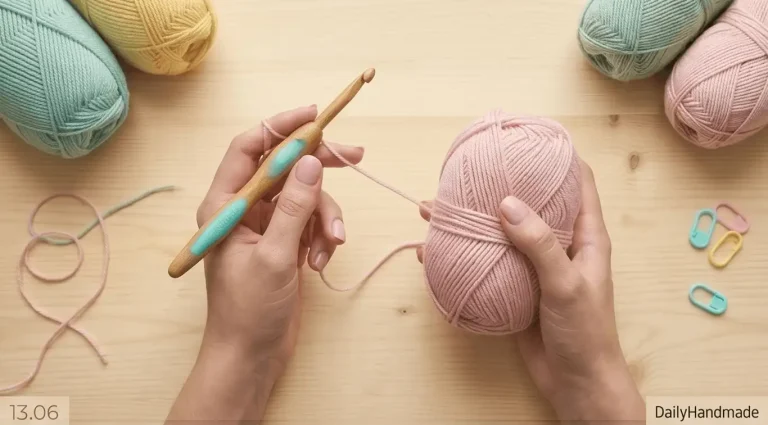
To master How to Know If Your Crochet Tension Is Correct, you must audit the sensations in both your “Hook Hand” and your “Yarn Hand.”
1. The “Hook Glide” (Dominant Hand)
When you insert the hook into a stitch from the previous row, it should find the “V” easily.
- Correct Feel: The hook enters like a hot knife through butter. You shouldn’t have to “wiggle” or “shove” the tool.
- The Red Flag: If you find yourself grunting or using your shoulder muscles to push the hook through, you are in a “Death Grip” (see 5 Signs Crochet Tension is Too Tight: Stop the Struggle).
2. The “Yarn Feed” (Support Hand)
The yarn is “fed” to the hook by your non-dominant hand.
- Correct Feel: The yarn should feel like a steady stream of water. It moves when the hook pulls it, but it stays taut when the hook stops.
- The Red Flag: If the yarn is “jerky”—stopping and starting or snapping into place—your finger wrap is too complex or too tight.
3. The “Muscle Ease” (Overall)
- Correct Feel: Your hands, wrists, and shoulders should be relaxed. You could theoretically crochet for an hour without needing to shake out your hands.
- The Red Flag: If your knuckles are white or your pinky finger is cramping, your tension is physically unsustainable.
Sensory Comparison: Finding the Middle Ground
| The Feeling | Too Tight | Too Loose | Correct Tension |
| Hook Insertion | Like trying to push a nail through stone. | Like stirring a soup with too much water. | Snug but smooth. |
| Yarn Movement | You have to “fight” to get more slack. | The yarn falls off the hook constantly. | Slides with minor resistance. |
| Audible Cue | The Squeak. (Yarn rubbing on hook). | Total silence / “Floppy” sounds. | A soft, rhythmic “swish.” |
| Physical Effort | High; leads to hand fatigue. | Low; leads to loss of control. | Balanced; feels like “flow.” |
The Dailyhandmade “Blind” Test
If you want to know what correct crochet tension feels like, try this diagnostic drill:
The 10-Stitch Blind Drill: Close your eyes and crochet ten single crochet stitches into a practice swatch.
- Do you feel “blind” because you can’t find the holes? (Your tension is Too Tight).
- Do you feel like your fingers are getting lost in huge loops? (Your tension is Too Loose).
- Can you “feel” the structure of the stitch and guide the hook by touch alone? (This is Perfect Tension).
Why the “Feel” Matters
In Longtail #19, we diagnosed “holey” fabric. Here in How to Know If Your Crochet Tension Is Correct, we are fixing the source. If it feels like a struggle, the visual result will always be messy. Once you find that “Silk Glide,” your speed will increase, your stitches will become “twins,” and your love for the craft will grow.
What To Expect Next
You now know the look and the feel. Now, let’s put it to a scientific test. In our next chapter, we perform the ultimate diagnostic: The Crochet Tension Test with Swatch.
Return Path
Mastering the sensory experience of what correct crochet tension feels like is the heart of How to Know If Your Crochet Tension Is Correct. To continue your journey, explore these related guides: