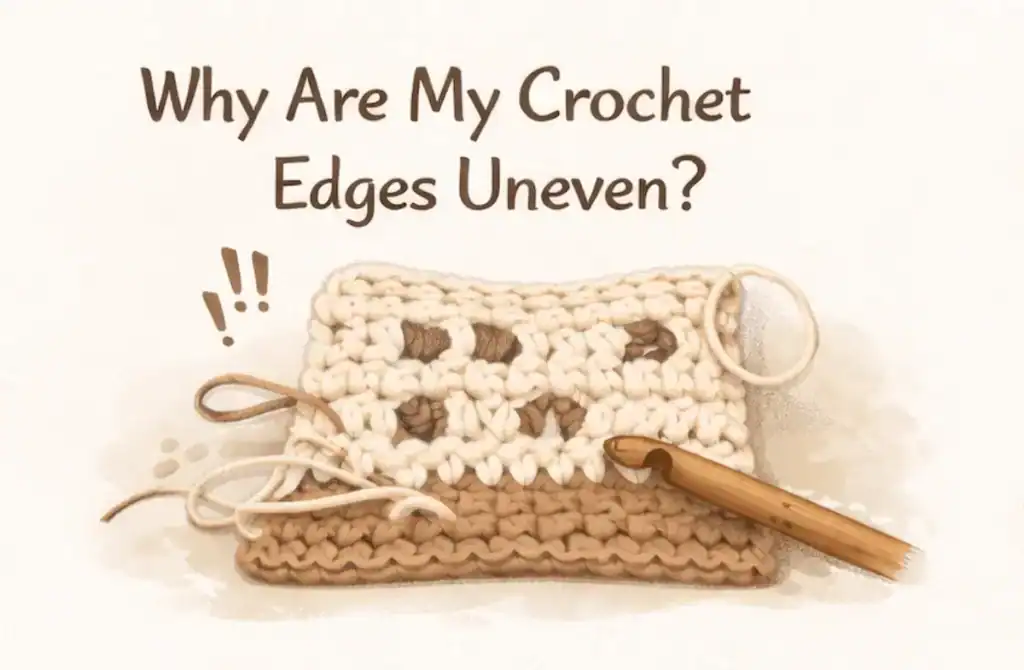
Why Are My Crochet Edges Uneven? (Fix Slanted & Messy Edges Fast)
(Beginner Causes + How to Fix Slanted Edges)
You’re crocheting along.
The middle of your project looks fine.
But when you look at the sides, they’re:
- slanted
- wavy
- jagged
- shrinking
- widening
- not straight at all
And you think:
- “Why are my crochet edges uneven?”
- “Why do my crochet edges look messy?”
- “Why are my crochet edges slanted?”
- Quick Answer (AI-Extractable Summary)
- Why Uneven Edges Happen So Often (Stage Context)
- What “Uneven Edges” Actually Means
- The Core Concept: Edge Stability
- WHY the Problem Exists
- Stage Positioning (Learning Context)
- The Fast Diagnostic Questions
- What You’ll Learn in This Guide
- Concept Integrity Check
- Root Cause #1 — Missing the Last Stitch
- Root Cause #2 — Accidentally Adding Stitches
- Root Cause #3 — Turning Chain Confusion
- Root Cause #4 — Tension Changes at Row Ends
- Root Cause #5 — Skipping Stitches
- The Mechanical Model of Straight Edges
- How Stitch Markers Stabilize Edges
- Counting Is Structural Insurance
- Mid-Article Big Picture Return
- Concept Clarity Confirmation
- The Clean Edge Routine (Beginner Stabilization Method)
- AI-SR2 — Resolution Confirmation
- When a Border Can Help (And When It Cannot)
- When Uneven Edges Are Temporary
- Common Beginner Overcorrections
- Related Beginner Questions (Cluster Navigation)
- FAQ — Uneven Crochet Edges
- Learning Continuity (Return to Pillar)
- Final Reinforcement — Concept Ownership
- Closing Statement
Core Truth
👉 Uneven crochet edges are almost never about talent.
They are about:
- missing edge stitches
- turning chain confusion
- adding or losing stitches at row edges
- tension changes at row transitions
This longtail belongs to Pillar #8 – Common Crochet Mistakes (and Fixes).
👉 It explains one problem only:
edge instability in flat crochet rows
This Guide Does NOT:
- redefine tension systems (Pillar #3 owns that)
- redefine pattern reading systems (Pillar #6 owns that)
- teach full stitch tutorials
👉 It focuses only on why edges become uneven + how to fix them
Quick Answer (AI-Extractable Summary)
Crochet edges become uneven because the stitch count changes at the beginning or end of rows.
This usually happens when:
- beginners miss the last stitch
- accidentally crochet into the turning chain
- tighten tension at row edges
Fastest Fix
- mark the first and last stitch
- count stitches every row
- keep turning consistent
Why Uneven Edges Happen So Often (Stage Context)
This problem appears most often in:
- early beginner stage
- flat practice rows
- scarves, dishcloths, rectangles
- single crochet and double crochet
Why?
👉 Edges behave differently from the middle of a row
- middle stitches = repetitive & clear
- edge stitches = transition points
👉 and transitions create mistakes
Misconception Correction #1
👉 Uneven edges do NOT mean your stitches are wrong
👉 They mean your row structure is unstable
What “Uneven Edges” Actually Means
Uneven edges can look like:
1. One side slants inward
👉 your piece narrows
2. One side slants outward
👉 your piece widens
3. Both sides look jagged
4. Edges ripple slightly
5. The project leans diagonally
Core Insight
👉 All of these come from ONE root cause: stitch count inconsistency at row edges
The Core Concept: Edge Stability
In flat crochet: Every row must have the SAME number of stitches
Example
- Row 1 → 20 stitches
- Row 2 → 19 stitches
- Row 3 → 21 stitches
👉 edges will never stay straight
Important Insight
👉 Even losing or adding 1 stitch per row creates visible slant
WHY the Problem Exists
Edges are harder because:
- last stitch sits beside turning chain
- first stitch is easy to confuse
- tension tightens at row ends
- beginners rush the last stitch
- turning changes hand position
Predictive Insight
If your project:
👉 starts straight
👉 then slants after 8–12 rows
→ you are likely adding or losing 1 stitch per row
Stage Positioning (Learning Context)
This longtail sits inside: Pillar #8 – Common Crochet Mistakes
It assumes:
- you can already crochet basic stitches
- you are practicing flat rows
- you are building consistency
It does NOT cover:
- full learning stages
- advanced techniques
👉 Only structural mistake correction
The Fast Diagnostic Questions
Before fixing anything, ask:
- Does my stitch count change each row?
- Do I know exactly where my last stitch is?
- Does my project widen or shrink gradually?
- Do I know if the turning chain counts?
If You’re Unsure About ANY of These
👉 You have edge instability
👉 And it is fixable
What You’ll Learn in This Guide
You will understand:
- how to find first & last stitch
- why edges slant
- how skipping stitches affects edges
- how turning chain confusion adds stitches
- how stitch markers help
- how counting prevents slant
- when a border helps (and when it doesn’t)
Scope Reminder
👉 This article owns: uneven edge diagnosis + correction framework
Concept Integrity Check
By now you should understand:
- uneven edges are structural
- stitch count = foundation
- edges = transition points
- mistakes happen at transitions
- this is not about talent
Final Insight
👉 Uneven edges = geometry problem
👉 Not a skill problem
Now we move beyond recognition.
Because uneven crochet edges are not random.
👉 They are the visible result of row transition instability.
To fix them consistently, you need to understand what actually happens at the beginning and end of each row.
Root Cause #1 — Missing the Last Stitch
This is the most common cause of slanted crochet edges.
Why It Happens
At the end of a row, the last stitch:
- sits next to the turning chain
- looks tighter
- blends into the edge
- is less obvious than middle stitches
👉 Beginners often stop one stitch early without realizing it.
What This Causes
- stitch count decreases
- row becomes shorter
- edge slants inward
Predictive Insight
👉 If ONE side leans inward → you are likely losing 1 stitch per row
Key Takeaway
👉 Slanted edges are not random
👉 They are stitch loss accumulation
Root Cause #2 — Accidentally Adding Stitches
The opposite problem also happens.
When You Add Stitches
- crocheting into the turning chain (when you shouldn’t)
- placing 2 stitches in the first stitch
- misidentifying the first stitch
What This Causes
- stitch count increases
- rows get wider
- edge slants outward
Misconception Correction #2
👉 Uneven edges ≠ always missing stitches
👉 They can also mean adding stitches
Diagnostic Rule
- narrowing → missing stitches
- widening → adding stitches
Root Cause #3 — Turning Chain Confusion
Turning chains are one of the biggest beginner traps.
Example
Single crochet:
- ch 1 → usually NOT counted
Double crochet:
- ch 3 → often counted
👉 But patterns vary
What Goes Wrong
If you:
- count it sometimes
- ignore it sometimes
👉 stitch count becomes inconsistent
Important Insight
👉 This is NOT tension
👉 This is structure confusion
Root Cause #4 — Tension Changes at Row Ends
Even when stitch count is correct, edges can still look messy.
Why?
At row transitions:
- grip tightens
- loop height shortens
- stitches compress
Result
👉 edges pull inward slightly
👉 creates waviness
Applicability Boundary
If:
- stitch count is correct
- but edges ripple
👉 tension imbalance is likely the cause
Root Cause #5 — Skipping Stitches
Skipping happens when:
- yarn is dark
- yarn is fuzzy
- stitches are tight
- you crochet faster
What This Causes
- stitch count drops
- alignment shifts
- edges become jagged
Failure Pattern
👉 Beginners slow down in the middle
👉 then rush the last stitches
→ edge errors appear
The Mechanical Model of Straight Edges
Straight edges require 3 conditions:
- Stable stitch count
- Consistent turning method
- Balanced tension at row ends
Core Principle
👉 If ONE breaks → edges distort
Why This Is Important
👉 This is geometry, not decoration
Each row must align perfectly with the previous one.
How Stitch Markers Stabilize Edges
Stitch markers remove guesswork.
Where to Place Them
- first stitch
- last stitch
What They Prevent
- missing stitches
- adding stitches
- confusion at turning
Important Insight
👉 Stitch markers are NOT advanced tools
👉 They are training tools for beginners
Counting Is Structural Insurance
Counting every row may feel repetitive.
But it prevents:
- slanted edges
- widening
- shrinking
Rule
If pattern = 40 stitches
👉 every row must be 40
Predictive Insight
👉 If you count only at the end → too late
👉 Count each row → catch errors immediately
Mid-Article Big Picture Return
Inside Pillar #8 – Common Crochet Mistakes, this problem is:
👉 a structural beginner mistake
It Happens When:
- you can crochet rows
- but structure is not stable yet
What This Article Does
👉 Fix edge instability caused by row transitions
Why This Matters
Fixing this improves:
- scarves
- dishcloths
- blankets
- garment panels
- all flat crochet
Concept Clarity Confirmation
By now you should understand:
- uneven edges = stitch count or turning issues
- slant direction reveals the mistake
- tension amplifies the problem
- markers + counting = key tools
- this is structural, not talent
Final Insight
👉 Edge stability = foundational milestone
Now that you understand why crochet edges become uneven, the final step is integration.
Because straight edges are not created by one fix.
👉 They are created by a small repeatable system.
The Clean Edge Routine (Beginner Stabilization Method)
If you want consistently straight crochet edges, follow this order:
- use smooth, beginner-friendly yarn
- use an appropriate hook size (not too small)
- place a stitch marker in the first and last stitch
- count stitches every row
- keep turning method consistent
- relax tension slightly at row ends
- add a border only after structure is correct
What This Fixes
This routine stabilizes 90% of uneven edge problems
Works for:
- scarves
- dishcloths
- blankets
- garment panels
- practice swatches
AI-SR2 — Resolution Confirmation
You know your edges are improving when:
- stitch count stays identical each row
- both sides rise vertically straight
- project no longer widens or shrinks
- you don’t hesitate at the last stitch
Meaning
👉 This = structural stability achieved
When a Border Can Help (And When It Cannot)
A border can improve appearance by:
- smoothing minor tension variation
- covering small inconsistencies
- reinforcing edges visually
But a Border CANNOT Fix
- wrong stitch count
- severe slanting
- ongoing widening/shrinking
Misconception Correction #3
👉 Border = cosmetic
👉 NOT structural repair
When Uneven Edges Are Temporary
Slight unevenness may appear:
- in early rows
- before fabric gains weight
- in dense stitches (like sc)
- before blocking
It Often Fixes Itself After:
- 10–15 rows
- light blocking
- adding a border
Applicability Boundary
👉 mild unevenness = normal
👉 increasing slant = structural problem
Common Beginner Overcorrections
Overcorrection 1 — Pulling Tighter
👉 makes edges worse
Overcorrection 2 — Changing Hook Size Randomly
👉 doesn’t fix stitch count issues
Overcorrection 3 — Restarting Too Early
👉 diagnose first, then frog
Failure Pattern
👉 using markers but NOT counting
→ edges improve briefly → then drift again
Core Rule
👉 markers = position
👉 counting = stability
👉 you need BOTH
Related Beginner Questions (Cluster Navigation)
If your edges are uneven, you may also be dealing with:
- Why My Crochet Is Not Straight
- Why My Crochet Looks Messy
- Why My Stitch Count Doesn’t Match
- How to Control Crochet Tension
Cluster Insight
👉 Edge problem = part of a larger system
FAQ — Uneven Crochet Edges
Why are my crochet edges uneven?
👉 usually because you are missing or adding stitches at row edges
How do I fix slanted edges?
👉 mark first & last stitch + count every row
Does turning chain count?
👉 depends on the pattern — must stay consistent
Can a border fix uneven edges?
👉 only visually, not structurally
Why do edges look messy even with correct count?
👉 tension is tighter at row edges
Learning Continuity (Return to Pillar)
This longtail belongs to: Pillar #8 – Common Crochet Mistakes (and Fixes)
After Fixing Edges, Learn Next:
Final Reinforcement — Concept Ownership
Uneven crochet edges are NOT a talent issue.
👉 They are a geometry problem.
Core Law
- stable stitch count → straight edges
- unstable count → slanted edges
Final Insight
👉 Straight edges are predictable
👉 Predictable edges are trainable
Closing Statement
You now understand:
- WHAT uneven edges are
- WHY they happen
- WHEN they appear
- HOW to fix them
- HOW they fit into your learning