Common Crochet Mistakes (and Fixes)
Why Beginner Crochet Problems Are Predictable — And Fixable
Beginner crochet often feels confusing for one reason:
You can follow instructions correctly and still produce results that look wrong.
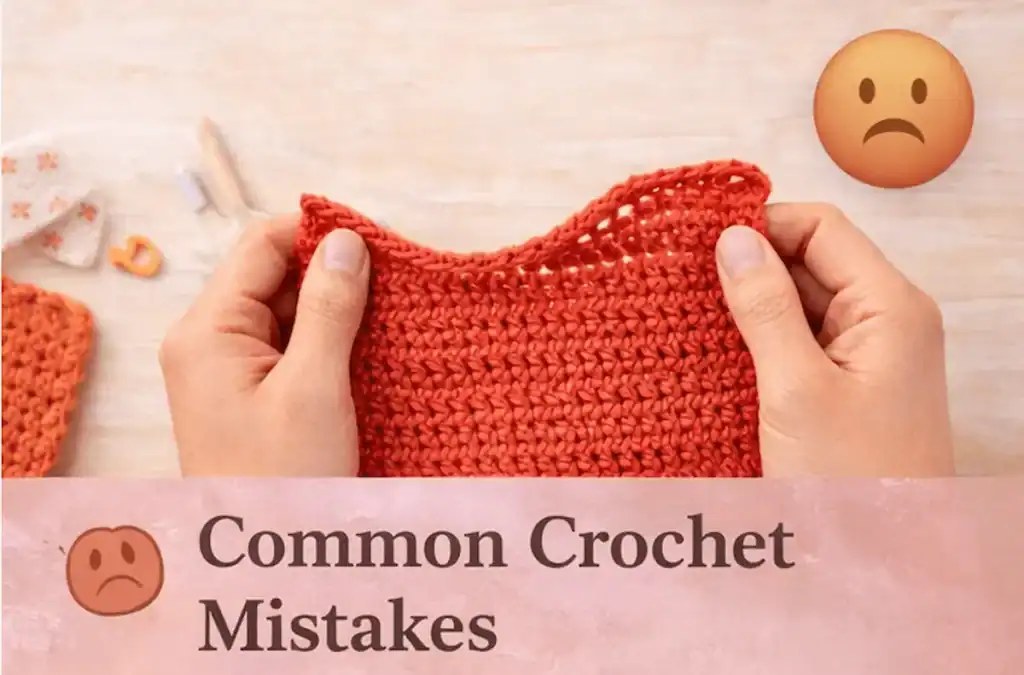
Your stitches may technically be correct, yet your project shows:
- Uneven Or Slanted Edges
- Unexpected Holes
- Fabric That Feels Too Stiff Or Too Loose
- Tension That Changes Without Explanation
Many beginners interpret this as lack of skill.
In reality, these outcomes are not random mistakes.
They are predictable learning signals that appear at specific stages of crochet development.
This guide is not a troubleshooting checklist.
It is a structured system that explains why beginner problems happen and how they connect to skill progression.
Once these patterns become visible, crochet stops feeling unpredictable.
- Why Beginner Crochet Problems Are Predictable — And Fixable
- The Beginner Illusion: “I’m Doing It Wrong”
- The Three Core Beginner Problem Systems
- System 1 — Edge Control
- System 2 — Fabric Structure
- System 3 — Tension Regulation
- Why These Problems Always Appear Together
- The Crochet Diagnosis Model
- Why Beginner Mistakes Are Necessary
- How This Pillar Fits Into the Crochet Learning System
- How to Use This Guide
- Why Beginner Crochet Problems Feel Random (But Aren’t)
- The Three Visible Symptoms Beginners Notice First
- Why Problems Appear After Several Rows (Not Immediately)
- The Beginner Compensation Effect
- The Most Common Misdiagnoses
- The Learning Threshold Moment
- Mapping Problems to Learning Stages
- Why Restarting Rarely Solves the Real Problem
- The Principle of Minimal Correction
- Emotional Normalization: Why Frustration Is Expected
- Transition to Structured Skill Solutions
- Why Crochet Fixes Must Follow a Learning Order
- Stage 1 — Edge Control: Learning Structural Awareness
- Stage 2 — Fabric Control: Understanding Stitch Interaction
- Stage 3 — Tension Control: Coordinating Movement and Feel
- The Integrated Fix System
- Skill Progress Recognition
- Transition to Authority Expansion
- From Individual Mistakes to a Complete Troubleshooting System
- The Three Authority Pathways of Crochet Troubleshooting
- Pathway 1 — Edge Stability Authority
- Pathway 2 — Fabric Structure Authority
- Pathway 3 — Tension Regulation Authority
- How Longtails and Micros Work Together
- Tool and Material Authority Integration
- The Beginner Fix System (Universal Workflow)
- Why This System Accelerates Learning
- Predicting the Next Learning Transition
- Transition to Final Section
- The Crochet Troubleshooting Navigation System
- Start Here Based on What You Notice
- The Beginner Fix Workflow (Repeatable System)
- Progress Recognition: Signs You Are Improving
- When Troubleshooting Becomes Prevention
- How This Pillar Connects to the Crochet Learning System
- System Identity: Learning Through Understanding
- Continue Your Learning Path
The Beginner Illusion: “I’m Doing It Wrong”
Early crochet creates a common psychological mismatch.
Beginners learn stitches individually through tutorials:
- Chain
- Single Crochet
- Double Crochet
But projects introduce interaction between skills:
- Tension Affects Edges
- Hook Size Affects Holes
- Yarn Behavior Affects Structure
Because tutorials isolate techniques, beginners expect success immediately when combining them.
When results differ, they assume failure.
Misconception Correction
Most crochet problems are not caused by incorrect stitches. They are caused by incomplete coordination between otherwise correct actions.
Learning crochet means learning relationships between variables, not memorizing movements.
The Three Core Beginner Problem Systems
Across beginner projects, nearly all visible issues fall into three interconnected systems:
- Edge Control Problems (Shape Instability)
- Fabric Structure Problems (Holes And Gaps)
- Tension Regulation Problems (Density Inconsistency)
These systems form the foundation of this pillar.
Understanding them transforms troubleshooting from guessing into diagnosis.
System 1 — Edge Control
Edges reveal counting awareness and stitch recognition.
Common Symptoms
- Leaning Rectangles
- Widening Or Shrinking Rows
- Zig-Zag Sides
Edges act as visual feedback for structural accuracy.
Predictive Insight
Edge problems usually appear before beginners consciously understand stitch placement. This is a normal developmental stage, not a failure.
System 2 — Fabric Structure
Fabric structure describes how stitches sit together.
Symptoms Include
- Visible Gaps
- Unexpected Holes
- Uneven Stitch Spacing
- Fabric That Feels Unstable
Structure depends on interaction between:
- Stitch Height
- Hook Size
- Yarn Thickness
- Tension Consistency
Beginners often blame skipped stitches when the real cause is material interaction.
System 3 — Tension Regulation
Tension is the invisible system controlling all crochet outcomes.
Incorrect tension causes multiple symptoms simultaneously:
- Curling
- Stiffness
- Holes
- Uneven Edges
- Inconsistent Sizing
Authority Clarification
Tension is not a single skill learned once. It stabilizes gradually through repeated finished projects.
This explains why problems often appear even when stitches look correct individually.
Why These Problems Always Appear Together
Beginners often treat edge issues, holes, and tension as separate problems.
In reality, they influence each other continuously.
Example Relationships
- Loose Tension → Larger Loops → Visible Holes → Unstable Edges
- Tight Tension → Stiff Fabric → Pulling Edges → Curling Rows
- Incorrect Hook Size → Tension Compensation → Uneven Structure
System Clarification
Crochet behaves like a balanced system. Adjusting one variable changes several outcomes simultaneously.
Learning to diagnose crochet means identifying which system is creating the visible symptom.
The Crochet Diagnosis Model
This pillar introduces a simple diagnostic framework used throughout the Crochet Hub:
Observe → Identify System → Apply Minimal Fix
Instead of restarting projects immediately, beginners learn to interpret visual signals.
Common Mapping
| Visible Problem | Likely System |
|---|---|
| Edges Slanted | Edge Control |
| Random Holes | Fabric Structure |
| Stiff Or Floppy Fabric | Tension Regulation |
| Multiple Issues Together | Tension Root Cause |
Failure Anticipation
Beginners often apply large fixes (changing yarn, restarting entirely) when small adjustments would solve the issue faster.
The system prioritizes least-destructive solutions first.
Why Beginner Mistakes Are Necessary
Crochet skill develops through feedback visibility.
Mistakes serve as learning markers:
- Edges Teach Counting
- Holes Teach Material Awareness
- Tension Teaches Hand Coordination
Applicability Boundary
Perfect early results can actually slow learning because they hide developing weaknesses that appear later in complex projects.
Imperfection accelerates understanding.
How This Pillar Fits Into the Crochet Learning System
Within the Crochet Hub structure:
- Earlier Pillars Teach Tools, Yarn, And Stitches
- Project Pillars Teach Application
- This Pillar Teaches Diagnosis And Correction
It acts as the troubleshooting authority hub connecting beginner experience to technical understanding.
This pillar governs three longtail learning paths:
- Uneven Edges And Row Structure
- Holes And Fabric Gaps
- Correct Crochet Tension
Each expands into detailed conceptual guides and micro-level fixes for specific beginner situations.
You are not expected to memorize solutions.
Instead, you learn how to recognize patterns and choose the correct next step.
How to Use This Guide
You can navigate this pillar based on what you currently see in your crochet.
- If Edges Look Messy → Start With Edge Control
- If Fabric Has Holes → Explore Structure Causes
- If Everything Feels Inconsistent → Focus On Tension Understanding
Predictive Guidance
Most beginners discover that tension is the hidden cause behind multiple visible problems. This pillar gradually reveals that relationship rather than introducing it all at once.
Crochet becomes easier when problems feel explainable instead of mysterious.
Why Beginner Crochet Problems Feel Random (But Aren’t)
One of the most frustrating parts of learning crochet is inconsistency.
A project may look fine one day and suddenly appear wrong the next.
Edges lean. Holes appear. Tension changes without warning.
Beginners often assume they are making different mistakes each time.
In reality, most problems follow predictable developmental patterns.
Crochet learning progresses through stages where specific issues naturally emerge. These issues are not interruptions — they are indicators of skill growth.
Understanding the beginner problem landscape allows you to recognize problems as signals rather than failures.
The Three Visible Symptoms Beginners Notice First
Although crochet involves many variables, beginners typically notice problems in three visible ways.
1. Shape Problems
Projects stop looking rectangular or symmetrical.
Common Observations
- Edges Drift Inward Or Outward
- Rows Appear Uneven
- Shapes Lean Diagonally
These symptoms are visually alarming because they affect the overall appearance of the project, even when individual stitches look correct.
Shape problems almost always relate to edge awareness and stitch counting rather than stitch execution.
2. Fabric Problems
The fabric itself looks different from expectations.
You May Notice
- Gaps Between Stitches
- Inconsistent Density
- Areas That Appear Loose Or Stretched
- Sections That Look Overly Tight
Beginners frequently interpret holes as skipped stitches, but fabric problems usually arise from interaction between hook size, yarn, and tension.
Conceptual Comparison
Two crocheters using identical stitches can produce completely different fabrics depending on tension behavior.
3. Feel Problems
Sometimes the project looks acceptable but feels wrong.
Examples Include
- Fabric Feels Stiff
- Hands Feel Strained
- Hook Catches Frequently
- Stitches Resist Movement
These tactile signals often appear before visual problems become obvious.
Authority Insight
Experienced crocheters diagnose tension issues by feel long before they become visible. Beginners learn this awareness gradually through repetition.
Why Problems Appear After Several Rows (Not Immediately)
A common beginner question is:
“Why did my project start fine but become messy later?”
Crochet errors accumulate.
Small variations that are invisible in early rows compound over time.
Examples
- Slightly Loose Tension Becomes Visible Gaps After Repetition
- One Missed Stitch Creates Gradual Edge Slant
- Inconsistent Turning Changes Row Alignment
Predictive Insight
Problems appearing later in a project usually began much earlier. Crochet reveals patterns slowly, which makes diagnosis difficult without a framework.
This pillar provides that framework.
The Beginner Compensation Effect
When beginners notice problems, they instinctively compensate.
Typical Reactions Include
- Pulling Yarn Tighter
- Changing Hand Position
- Forcing Stitches
- Adjusting Hook Pressure
These adjustments often solve one symptom while creating another.
Example
Tightening tension to remove holes may cause stiff fabric or curling edges.
System Clarification
Crochet systems seek balance. Overcorrecting one variable shifts stress elsewhere.
Learning effective fixes requires identifying root causes rather than reacting to symptoms.
The Most Common Misdiagnoses
Beginners frequently misinterpret problems because symptoms overlap.
Misdiagnosis 1: “My Stitches Are Wrong”
Often the stitches are correct, but tension or hook size is not aligned.
Misdiagnosis 2: “I Skipped Stitches”
Sometimes true — but holes can also result from loose tension or tall stitches.
Misdiagnosis 3: “This Yarn Is Bad”
Yarn behavior influences results, but coordination between yarn and hook usually matters more.
Misconception Correction
Crochet problems rarely have a single cause. They emerge from interaction between technique and materials.
The Learning Threshold Moment
Every beginner reaches a moment where crochet suddenly becomes more understandable.
This occurs when learners recognize that:
- Edges Show Counting Accuracy
- Holes Reveal Tension Behavior
- Fabric Feel Predicts Future Problems
At this stage, crochet shifts from imitation to understanding.
Authority Insight
The goal of beginner troubleshooting is not eliminating mistakes but learning to interpret feedback faster.
Once interpretation improves, correction becomes easier and less stressful.
Mapping Problems to Learning Stages
Problems tend to appear in a consistent sequence during early learning.
| Learning Stage | Typical Problem |
|---|---|
| Early Practice | Uneven Tension |
| First Projects | Uneven Edges |
| Repeated Projects | Holes Or Gaps |
| Longer Projects | Fatigue-Related Tension Changes |
| Developing Confidence | Inconsistent Yarn Adaptation |
Recognizing this order reassures beginners that challenges are temporary phases.
Why Restarting Rarely Solves the Real Problem
Restarting projects feels productive because early rows often look cleaner.
However, restarting removes the opportunity to understand how problems develop.
Without seeing progression, beginners repeat the same mistake unknowingly.
Failure Anticipation
Repeated restarting delays tension stabilization because hands never adapt to extended repetition.
Small adjustments during continuation usually teach more than starting over.
The Principle of Minimal Correction
Effective crochet troubleshooting follows a hierarchy:
- Observe Carefully
- Identify System (Edges, Fabric, Tension)
- Apply Smallest Possible Change
- Continue Crocheting
- Reevaluate After Several Rows
Large corrections should be rare.
This principle prevents beginners from disrupting developing muscle memory.
Emotional Normalization: Why Frustration Is Expected
Crochet combines motor learning and visual judgment.
Motor learning naturally includes inconsistency.
Beginners may experience:
- Sudden Improvement Followed By Regression
- Projects That Look Better One Day Than The Next
- Fluctuating Tension
These fluctuations are signs of adaptation, not decline.
Applicability Boundary
If frustration persists across many completed projects without improvement, the issue may relate to tools or yarn rather than technique.
Transition to Structured Skill Solutions
Now that the beginner problem landscape is clear, the next step is understanding how solutions should be introduced.
Fixes must follow learning order.
Correcting edges, fabric gaps, and tension requires addressing underlying skill systems progressively rather than simultaneously.
The next section explains how these three problem systems form a structured skill progression — and how each correction prepares you for the next level of crochet control.
Why Crochet Fixes Must Follow a Learning Order
Beginners often try to fix every visible problem at once.
They tighten tension, change hook size, adjust technique, and restart rows simultaneously.
This approach usually creates new problems instead of solving existing ones.
Crochet improvement works best when corrections follow a progressive skill order.
Each correction stabilizes one system before introducing the next adjustment.
Within beginner crochet, problem-solving develops in three stages:
- Edge Control
- Fabric Control
- Tension Control
Although tension influences everything, beginners understand it most clearly only after edges and fabric behavior become recognizable.
Stage 1 — Edge Control: Learning Structural Awareness
Edges are the first system beginners learn to control because they provide clear visual feedback.
If stitch count changes, edges immediately reveal it.
What Edge Control Teaches
Edge-focused learning develops:
- Stitch Recognition
- Row Awareness
- Counting Consistency
- Turning Accuracy
These skills form the structural foundation of crochet.
Without edge awareness, later tension adjustments become unreliable because structure itself is unstable.
Why Edges Become Uneven
Uneven edges almost always result from small structural inconsistencies:
- Missing The Final Stitch
- Adding An Extra Stitch At Turning Chains
- Inconsistent Turning Habits
- Tension Shifts At Row Transitions
Predictive Insight
Beginners commonly improve stitch appearance before improving edges. This mismatch makes projects look incorrect even when skill is increasing.
Edges improve after recognition skills mature.
The Edge Stabilization Strategy
Instead of chasing perfection, beginners stabilize edges using simple systems:
- Marking First And Last Stitches
- Counting Stitches Periodically
- Maintaining Consistent Turning Methods
These practices reduce decision uncertainty.
Conceptual Clarification
Edge control is less about skill and more about visibility. Once stitches become easy to identify, edge problems decrease naturally.
Why Edge Control Comes First
Edges must stabilize before addressing holes or tension because:
- Stitch Count Determines Fabric Shape
- Shape Influences Tension Distribution
- Tension Corrections Fail If Structure Changes Constantly
This explains why tension fixes often appear ineffective when edge problems remain unresolved.
Stage 2 — Fabric Control: Understanding Stitch Interaction
After edges stabilize, beginners begin noticing fabric characteristics.
Fabric control focuses on how stitches sit together rather than how they are formed individually.
What Fabric Control Teaches
This stage develops understanding of:
- Hook Size Influence
- Stitch Height Relationships
- Yarn Behavior
- Density Consistency
Beginners begin recognizing that crochet fabric is adjustable rather than fixed.
Why Holes Appear in Crochet Fabric
Holes and gaps typically result from interaction between three variables:
- Hook Size Relative To Yarn Thickness
- Loop Height During Stitch Formation
- Natural Openness Of Certain Stitches
Conceptual Comparison
Single crochet forms dense fabric naturally. Double crochet creates openness by design. Problems occur when openness exceeds intended structure.
Misconception Correction
Not all holes are mistakes. Some are structural properties of stitches.
Learning fabric control means distinguishing intentional openness from unintended gaps.
Fabric Stabilization Techniques
Beginners learn to adjust fabric gradually through:
- Slight Hook Size Changes
- Consistent Loop Height
- Improved Yarn Feeding
- Appropriate Stitch Selection
Failure Anticipation
Over-tightening to eliminate holes often causes stiffness and hand fatigue, introducing tension problems prematurely.
Balanced adjustments produce better long-term results.
Why Fabric Control Comes Before Tension Mastery
Fabric teaches visual interpretation.
Before beginners can regulate tension consciously, they must learn how different fabrics look and behave.
This stage builds visual literacy:
- Recognizing Normal Stitch Spacing
- Identifying Excessive Gaps
- Understanding Density Expectations
Once visual understanding develops, tension adjustments become meaningful rather than guesswork.
Stage 3 — Tension Control: Coordinating Movement and Feel
Tension regulation represents the integration stage of beginner crochet.
Here, movement becomes automatic and adjustments become subtle.
What Tension Control Teaches
Tension mastery develops:
- Hand Relaxation
- Consistent Yarn Feeding
- Hook Rhythm
- Adaptive Pressure Control
Unlike edges or fabric, tension is felt as much as seen.
Authority Insight
Tension cannot be forced into consistency. It stabilizes when movements become efficient and relaxed.
Recognizing Correct Tension
Correct tension usually produces:
- Fabric That Lies Flat
- Stitches That Move Slightly But Hold Shape
- Smooth Hook Movement
- Minimal Hand Strain
Both overly tight and overly loose tension create resistance — either physical or visual.
Applicability Boundary
Correct tension varies slightly between crocheters. Consistency matters more than matching another person’s exact gauge.
Fixing Tension Without Restarting
A key progression milestone occurs when beginners learn to adjust tension mid-project.
Small corrections include:
- Slightly Changing Hook Grip
- Adjusting Yarn Feed Tension
- Switching Hook Size For Future Rows
- Adding Borders Or Blocking Later
These adjustments teach adaptive control — an essential long-term crochet skill.
The Integrated Fix System
Once all three stages are understood, troubleshooting becomes systematic.
Step 1 — Check Structure (Edges)
Confirm stitch count and turning consistency.
Step 2 — Check Fabric (Holes)
Evaluate hook size and stitch openness.
Step 3 — Check Tension
Assess feel, movement, and density.
This order prevents unnecessary corrections.
System Clarification
Most visible crochet problems resolve when fixes follow structural hierarchy instead of emotional reaction.
Skill Progress Recognition
You are progressing when:
- Edge Problems Become Predictable
- Holes Become Explainable
- Tension Adjustments Feel Intentional
Beginners often notice that problems stop feeling mysterious before they fully disappear.
This shift marks the transition from beginner imitation to technical understanding.
Transition to Authority Expansion
Now that the correction sequence is clear, the next section expands outward.
You will see how specific mistake categories connect to dedicated learning pathways, longtail guides, and micro solutions within the Crochet Hub.
Understanding this network ensures that every problem leads directly to a structured next step instead of isolated troubleshooting.
From Individual Mistakes to a Complete Troubleshooting System
Beginner crochet advice often appears as scattered tips:
- Count Your Stitches
- Change Hook Size
- Loosen Tension
- Try Different Yarn
While helpful, isolated tips do not explain when or why each fix applies.
This pillar expands beginner troubleshooting into a structured authority system where every visible problem connects to a defined learning pathway.
Instead of memorizing fixes, learners understand which system governs each mistake and where to go next.
The Three Authority Pathways of Crochet Troubleshooting
All beginner crochet troubleshooting inside this hub expands from three conceptual pathways:
- Edge Stability
- Fabric Structure
- Tension Regulation
Each pathway corresponds to a longtail authority guide that develops the concept in depth.
This pillar introduces the system.
Longtails teach the concepts.
Micro articles resolve precise symptoms.
Pathway 1 — Edge Stability Authority
Why Are My Crochet Edges Uneven
Edge problems represent the earliest structural challenge beginners face.
Edges expose hidden learning gaps:
- Stitch Placement Uncertainty
- Inconsistent Turning Decisions
- Incomplete Stitch Recognition
Because edges frame the entire project, even small inconsistencies become visually obvious.
Key Learning Outcomes
- Identifying First And Last Stitches
- Preventing Accidental Stitch Loss Or Addition
- Stabilizing Row Transitions
- Correcting Edge Appearance Without Restarting
Authority Insight
Edge stability teaches beginners how crochet builds structure row by row. Once understood, many “random” problems disappear automatically.
Micro Guides Cover
- Slanted Edges
- Turning Chain Confusion
- Stitch Marker Usage
- Counting Strategies
- Border Corrections
Each micro solves a single observable issue while reinforcing structural awareness.
Pathway 2 — Fabric Structure Authority
Why My Crochet Fabric Has Holes
After edges improve, beginners begin noticing fabric density.
This stage introduces interaction between materials and technique.
Fabric Structure Depends On
- Hook-To-Yarn Ratio
- Stitch Height
- Yarn Texture
- Loop Consistency
Many beginners incorrectly assume holes indicate mistakes, when in fact some stitches are intentionally open.
Conceptual Comparison
| Stitch Type | Expected Density |
|---|---|
| Single Crochet | Dense |
| Half Double Crochet | Medium |
| Double Crochet | Open |
Understanding intended fabric behavior prevents unnecessary corrections.
Learning Outcomes
- Diagnosing Hole Causes
- Distinguishing Structural Openness From Errors
- Adjusting Density Without Restarting
- Recognizing Yarn Influence On Appearance
Failure Anticipation
Beginners often tighten tension excessively to remove holes, creating stiffness and fatigue. Proper diagnosis prevents this compensation cycle.
Micro Guides Cover
- Hook Size Mismatch
- Loose Tension Gaps
- Yarn Splitting
- Double Crochet Spacing
- Blocking Expectations
Pathway 3 — Tension Regulation Authority
(How to Know If Your Crochet Tension Is Correct — LT20)
Tension represents the integration stage of beginner learning.
Unlike edges or fabric, tension cannot be corrected through a single rule.
It develops through awareness of both visual and physical signals.
This Pathway Teaches
- How Stitches Look
- How Crochet Feels
- How Yarn Responds
- How Changes Affect Outcomes
Authority Clarification
Correct tension is not identical for all crocheters. Consistency matters more than strict uniformity.
Core Learning Outcomes
- Recognizing Tight Vs Loose Tension
- Performing Tension Swatch Tests
- Adapting Tension To New Yarn
- Fixing Tension Mid-Project Safely
Micro Guides Provide
- Visual Tension Checks
- Tactile Evaluation
- Swatch Testing Methods
- Adjustment Strategies Without Frogging
How Longtails and Micros Work Together
The DH248 learning architecture distributes knowledge intentionally.
| Content Level | Role |
|---|---|
| Pillar | Defines System |
| Longtail | Explains Concept |
| Micro | Solves Symptom |
This prevents cognitive overload.
Beginners encountering a problem do not need to learn everything immediately. They move gradually from symptom to understanding.
Example Learning Flow
Uneven edge noticed → micro explains stitch counting → longtail explains structural logic → pillar reinforces learning system.
Authority grows through repetition of this pathway.
Tool and Material Authority Integration
Troubleshooting cannot exist independently from tools and materials.
Certain problems persist because equipment is mismatched to beginner learning needs.
Common Examples
- Oversized Hooks Creating Gaps
- Dark Yarn Hiding Stitch Structure
- Splitty Yarn Increasing Visual Confusion
Supporting Buying Guides
Applicability Boundary
Changing tools should follow diagnosis, not replace it. Equipment solves material problems, not coordination problems.
The Beginner Fix System (Universal Workflow)
Across all crochet problems, a consistent workflow applies:
Step 1 — Check Stitch Count
Structure must be correct first.
Step 2 — Check Hook Size
Fabric density depends on proportion.
Step 3 — Check Tension
Movement coordination determines consistency.
Step 4 — Apply Minimal Fix
Adjust only what is necessary.
Authority Insight
Experienced crocheters rarely restart immediately. They diagnose first because most issues are correctable forward.
Why This System Accelerates Learning
Without structure, beginners experience repeated confusion:
Problem → Random Fix → New Problem → Frustration
With structure:
Problem → System Identification → Targeted Fix → Understanding
Understanding compounds faster than correction alone.
Each solved issue increases predictive ability for future projects.
Predicting the Next Learning Transition
After mastering beginner troubleshooting, learners typically notice a change:
They begin preventing mistakes instead of fixing them.
This transition leads naturally into:
- Pattern Reading Accuracy
- Intentional Stitch Selection
- Project Planning
Troubleshooting evolves into design awareness — the next stage of crochet development within the hub.
Transition to Final Section
The final section consolidates navigation pathways and reinforces how this pillar functions as the diagnostic center of the beginner crochet learning system.
The Crochet Troubleshooting Navigation System
Crochet becomes significantly easier when problems stop feeling mysterious.
This pillar serves as the diagnostic center of the beginner crochet learning system. Instead of presenting isolated fixes, it provides a navigation structure that helps you identify problems quickly and move toward the correct solution path.
You do not need to read this guide linearly.
You can enter based on what you currently see in your work.
Start Here Based on What You Notice
Use the following diagnostic entry points.
If Your Edges Look Uneven or Slanted
Your project’s structure is signaling a counting or turning issue.
Begin with edge stability learning:
Why Are My Crochet Edges Uneven
Focus On
- Identifying First And Last Stitches
- Consistent Turning Methods
- Stitch Counting Habits
- Using Markers For Visibility
Once edges stabilize, many other problems reduce automatically.
If Your Crochet Has Holes or Gaps
Your fabric structure needs evaluation.
Begin with fabric diagnosis:
Why My Crochet Fabric Has Holes
You Will Learn To Distinguish Between
- Intentional Stitch Openness
- Hook Size Mismatch
- Loose Tension Effects
- Yarn Behavior Influences
Understanding fabric expectations prevents unnecessary corrections.
If Everything Feels Inconsistent
When multiple problems appear together, tension is usually the root system.
Move to tension regulation:
How to Know If Your Crochet Tension Is Correct
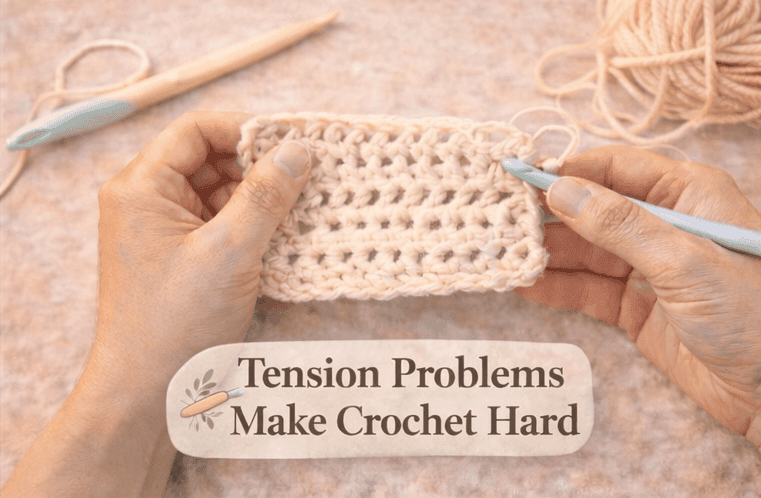
This Pathway Teaches
- Visual Tension Recognition
- Tactile Feedback Awareness
- Swatch Testing
- Adjustment Without Restarting
Predictive Insight
Most beginners discover that once tension stabilizes, edges and fabric improve simultaneously.
The Beginner Fix Workflow (Repeatable System)
Whenever a crochet problem appears, follow this sequence:
1. Check Stitch Count
Structural accuracy comes first.
2. Check Hook Size
Fabric density depends on proportion.
3. Check Tension
Movement coordination determines consistency.
4. Apply Smallest Possible Fix
Continue crocheting before making large changes.
This workflow transforms troubleshooting into a repeatable habit rather than trial and error.
Progress Recognition: Signs You Are Improving
Crochet improvement is subtle but measurable.
You are progressing when:
- Mistakes Become Easier To Identify
- Problems Feel Explainable
- Fewer Rows Need Restarting
- Tension Changes Feel Intentional
- Projects Finish More Often
Resolution Confirmation
If you can look at a project and understand why something happened, you have already moved beyond the earliest beginner stage.
Understanding precedes perfection.
When Troubleshooting Becomes Prevention
A major learning shift occurs when beginners begin anticipating problems before they appear.
You may notice yourself:
- Counting Stitches Automatically
- Adjusting Tension Unconsciously
- Selecting Better Hook Sizes
- Recognizing Yarn Compatibility Early
At this stage, troubleshooting evolves into planning.
Mistakes still occur, but they no longer interrupt progress.
Applicability Boundary
Even advanced crocheters encounter uneven edges or tension changes when using new yarns or techniques. Troubleshooting remains part of long-term skill development.
How This Pillar Connects to the Crochet Learning System
Within the Crochet Hub progression:
- Tool And Yarn Pillars Establish Setup
- Stitch Pillars Teach Execution
- Project Pillars Build Experience
- This Pillar Teaches Diagnosis And Correction
It bridges beginner uncertainty and confident problem-solving.
After this stage, learners typically move toward:
- Reading Crochet Patterns
- Selecting Projects Intentionally
- Refining Technique Rather Than Fixing Errors
System Identity: Learning Through Understanding
The Crochet Hub is designed as a structured learning environment rather than a collection of tutorials.
Core System Principles Reinforced In This Pillar
- Mistakes Are Learning Signals
- Problems Follow Predictable Patterns
- Fixes Should Be Minimal And Intentional
- Understanding Accelerates Progress
- Completion Matters More Than Perfection
Crochet becomes enjoyable when learners trust that every problem has an explanation.
This pillar establishes that trust.
Continue Your Learning Path
After understanding beginner crochet mistakes, continue strengthening skills through related pillars:
Or explore the longtail guides connected to this pillar for deeper conceptual learning and micro-level fixes.
Every crochet problem you encounter now has a clear next step inside the system.