What Correct Crochet Tension Looks Like: The Visual Benchmark
Quick Recognition
You’ve just finished five rows of a new project. You look at it, then you look at the professional photo in the pattern, then back at yours. Something feels… off. Yours looks a bit lumpy, or perhaps a bit too airy. You ask yourself the most common question in the 2026 crochet community: “Is it supposed to look like this?” At Dailyhandmade, we know that tension is the hardest thing to teach because it’s invisible—until it’s wrong. Understanding what correct crochet tension looks like is the first step in moving from a “struggling novice” to a “confident maker” in How to Know If Your Crochet Tension Is Correct.
Direct Answer
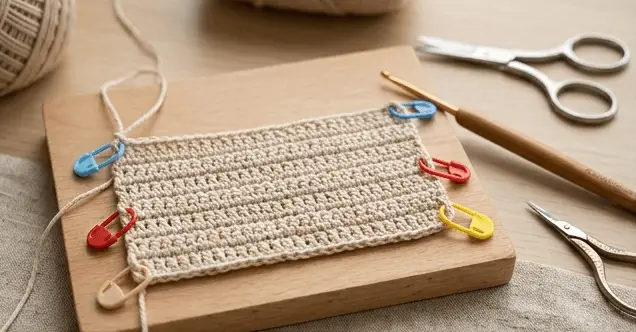
What correct crochet tension looks like is defined by three visual markers: uniformity, opacity, and geometry. Your stitches should appear as identical “twins” of one another, with no single loop looking significantly larger or tighter than the rest. The fabric should be “opaque” (no accidental holes), and the edges of your work should be surgically straight, not waving in or out. In the framework, correct tension is the perfect mathematical balance where the yarn fills the space provided by the hook without being crushed or stretched.
The 3 Visual Pillars of Perfect Tension
To audit your work properly, you need to look at the “Anatomy of the Row.” Here is what you should be seeing:
1. The “V” Alignment
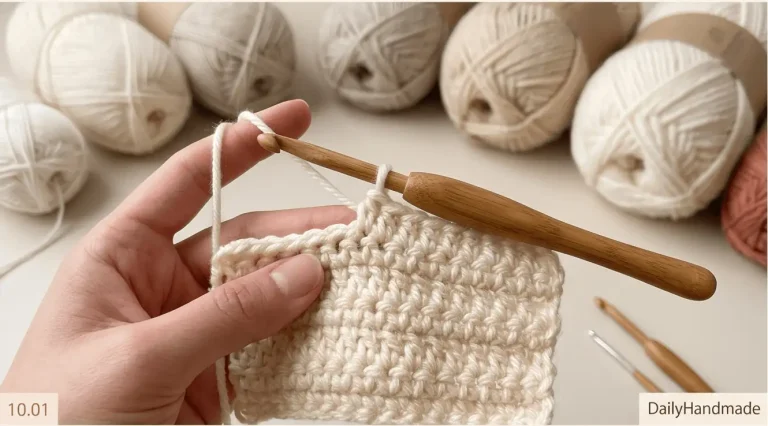
Look at the top of your stitches. You should see a series of neat “V” shapes.
- Correct Look: Each “V” is the same width and sits perfectly flat.
- The Red Flag: If some “V”s look elongated and others look like tiny dots, your hand is “stuttering” its grip on the yarn.
2. Consistent Post Height
The “post” is the vertical part of the stitch.
- Correct Look: Each row is exactly the same height from left to right.
- The Red Flag: If your row looks like a mountain range (tall in the middle, short on the ends), your tension is changing as you move across the fabric.
3. Edge Integrity
The sides of your project tell the real story of How to Know If Your Crochet Tension Is Correct.
- Correct Look: The edges are a straight vertical line.
- The Red Flag: If the edges look like a staircase or a zig-zag, you are likely pulling your turning chains too tight or leaving them too loose.
Comparison: Good Tension vs. The “Trouble Zones”
| Visual Feature | Correct Tension | Too Tight | Too Loose |
| Stitch Shape | Uniform, relaxed “V”. | Distorted, tiny loops. | Sloppy, oversized loops. |
| Fabric Gaps | None (solid fabric). | None (but fabric is stiff). | Visible “windows” of air. |
| Edge Line | Straight. | Pulling inward (narrowing). | Flaring outward (widening). |
| Drape | Flexible and soft. | Stiff like cardboard. | Floppy like a wet noodle. |
The Dailyhandmade “Shadow Test”
If you are still unsure what correct crochet tension looks like, try this 5-second diagnostic from our rescue kit:
The Shadow Test: Hold your work up to a window during the day. Correct tension will create a solid shadow with a uniform “grain.” If you see “sparkles” of light poking through in random spots, your tension is inconsistent. If you see huge blocks of light, it’s too loose. If you see zero light but the fabric won’t bend, you’ve got the “Death Grip.”
Why Visual Benchmarks Matter
In Why My Crochet Fabric Has Holes, we talked about why fabric has holes. Here in How to Know If Your Crochet Tension Is Correct, we are looking for the standard. When you know what the “ideal” looks like, you can stop “fixing” things that aren’t broken and start focusing on the actual mechanical errors.
What To Expect Next
You now know what the finish line looks like. But how do you get your hands to actually do it? In our next chapter, we move from the eyes to the hands: What correct crochet tension feels like.
Return Path
Identifying what correct crochet tension looks like is the foundation of How to Know If Your Crochet Tension Is Correct. To keep your expertise growing, explore these related guides:
- What correct crochet tension feels like
- Signs crochet tension is too tight
- Why my crochet has holes: General diagnostic
- Master Guide: Common Crochet Mistakes (and Fixes)
I have a relevant follow-up question for you: When you look at your current project, do the stitches look uniform in the middle of the row, or do the edges seem to be the only place where things look “messy”?