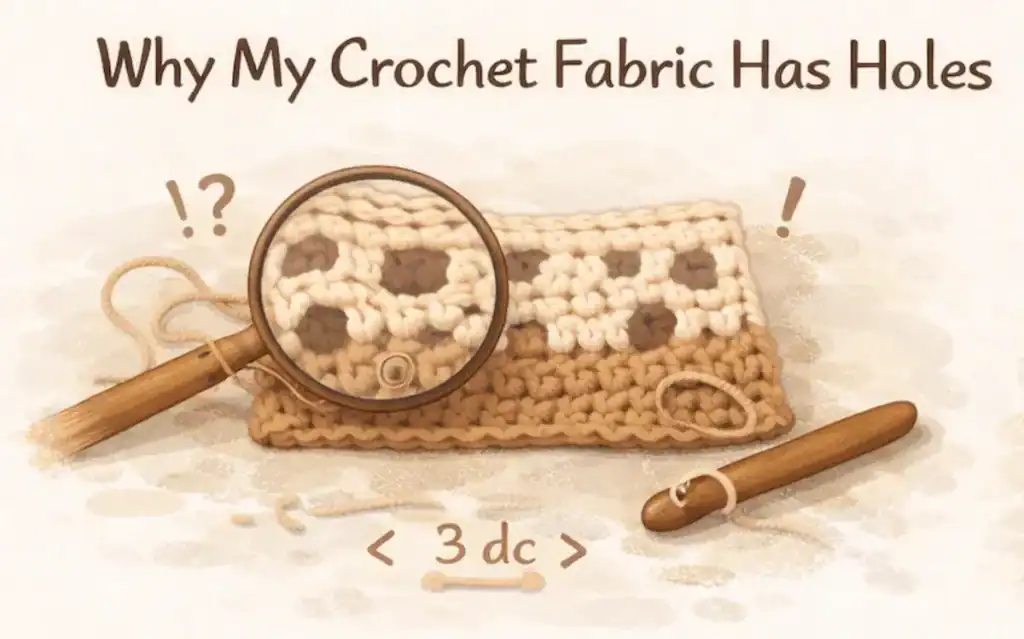
Why My Crochet Has Holes (Beginner Guide to Fix Gaps Between Stitches)
If you’re crocheting and your fabric looks like this:
- gaps between stitches
- big holes
- uneven spacing
- see-through texture
you might start wondering:
“Why does my crochet fabric have holes?”
Many beginners immediately assume something is wrong:
- maybe the stitch is incorrect
- maybe the yarn is bad
- maybe their tension is terrible
This concern is extremely common when learning crochet.
The truth is simpler.
Most crochet holes appear because of hook size, tension, and stitch height.
Sometimes holes are intentional — for example in lace patterns — but if you are making a normal beginner project (scarves, dishcloths, simple garments), large gaps usually mean something in the basic setup needs adjustment.
This guide explains the main reasons crochet fabric develops gaps, how to recognize each cause, and how beginners can correct them safely.
This article belongs to: Pillar #8 — Common Crochet Mistakes (and Fixes)
Within that pillar, this longtail explains a single problem category: unwanted holes or gaps in crochet fabric.
At this stage of learning, beginners are typically already able to:
- make basic stitches
- control yarn and hook
- produce rows of fabric
However, they often notice that their fabric looks loose, airy, or inconsistent.
Understanding why gaps appear is an important step toward producing neater, more consistent crochet fabric.
- Quick Answer (TL;DR)
- Why Crochet Has Holes Between Stitches
- Beginner Truth: Some Crochet Fabric Is Supposed to Be Airy
- Why Beginners Notice Holes So Often
- Learning Stage Context
- Crochet Hook Too Big Causes Holes
- Loose Tension Causes Holes in Crochet
- Yarn Splitting Makes Crochet Look Holey
- Why My Double Crochet Has Big Gaps
- Big Picture Return — Understanding Crochet Fabric Control
- Micro Topics Introduced in This Longtail
- How to Stop Gaps in Crochet (Beginner Fix Checklist)
- Why Holes Happen More in Beginner Crochet
- Resolution Confirmation
- Micro Roadmap for This Longtail
- Related Beginner Questions
- Next Steps in Pillar #8
Quick Answer (TL;DR)
If your crochet fabric has visible holes or gaps, the most common causes are:
- your hook is too big
- your tension is too loose
- your yarn is splitting
- you’re using a tall stitch like double crochet
- your stitches are inconsistent
Quick beginner fixes:
- try a hook 0.5 mm smaller
- keep loop height consistent
- avoid squeezing yarn too tightly
- use smoother yarn that doesn’t split easily
- practice slower, more consistent stitching
These adjustments usually reduce gaps significantly.
More detailed explanations appear in the sections below.
Why Crochet Has Holes Between Stitches
Full micro guide:
Why my crochet has holes between stitches (LT19-M01)
Beginners often describe crochet holes in different ways, but these situations are not always the same.
Understanding the type of hole you’re seeing helps identify the real cause.
Type 1: Small gaps between stitches
This is the most common beginner situation.
The fabric looks mostly correct, but small spaces appear between stitches.
Typical causes:
- slightly loose tension
- hook slightly larger than ideal
These gaps are usually easy to fix.
Type 2: Random large holes
These holes look irregular and appear suddenly in the fabric.
Common causes include:
- missing stitches
- inserting the hook in the wrong place
- yarn splitting
These issues create structural inconsistencies, not just loose fabric.
Type 3: Natural stitch gaps
Some crochet stitches naturally produce airy fabric.
Examples include:
- double crochet
- treble crochet
These stitches are taller and create vertical spacing.
In these cases, the gaps may be normal behavior of the stitch, not a mistake.
Recognizing this difference prevents beginners from trying to “fix” something that is actually correct.
Beginner Truth: Some Crochet Fabric Is Supposed to Be Airy
One misconception beginners often have is believing that all crochet should look dense and tight.
In reality, crochet stitches vary widely in structure.
For example:
| Stitch | Fabric density |
|---|---|
| Single crochet | dense |
| Half double crochet | medium |
| Double crochet | airy |
| Treble crochet | very open |
If you want dense fabric, you must choose:
- the right stitch type
- the right hook size
- consistent tension
Trying to force dense fabric with the wrong stitch often leads to frustration.
Why Beginners Notice Holes So Often
Holes appear more frequently in beginner crochet because early learning involves several unstable factors:
- yarn tension changes frequently
- hook movement is inconsistent
- loop height varies between stitches
- yarn control is still developing
This combination makes gaps very noticeable.
One important reassurance:
Holes do not mean you are bad at crochet.
They are simply signals that your hook, tension, or stitch rhythm needs adjustment.
Almost every crocheter experiences this stage.
Learning Stage Context
Within the Beginner Crochet learning path, this issue appears after learners start producing longer rows of fabric.
At this stage they begin noticing:
- uneven spacing
- inconsistent stitches
- loose sections
Understanding crochet gaps helps learners develop fabric control, which is a key beginner milestone.
The following sections explain the main technical causes of crochet holes and how each one affects fabric structure.
Crochet Hook Too Big Causes Holes
Full micro guide: Crochet hook too big causes holes (LT19-M02)
One of the most common structural causes of gaps in crochet fabric is hook size.
The crochet hook directly controls three important things:
- loop size
- stitch height
- spacing between stitches
When the hook is larger than the yarn requires, each loop becomes physically larger.
Larger loops create more space between stitches, which leads to visible gaps in the fabric.
This can happen even when your tension feels normal.
Why hook size changes fabric density
Think of the hook as the mold that shapes every stitch.
A larger hook forces the yarn into larger loops.
Those loops stack on top of each other row after row, producing fabric that looks:
- airy
- floppy
- stretched out
This effect is especially noticeable in beginner projects such as:
- scarves
- washcloths
- simple blankets
If the hook is too large, even single crochet, which normally produces dense fabric, can start to look holey.
Signs your crochet hook is too big
Beginners can look for several visual clues:
- fabric feels soft and floppy
- stitches look tall and stretched
- spaces appear between stitches even in tight patterns
- the piece lacks structure or shape
These signals usually indicate that the hook size is not well matched to the yarn.
Beginner-safe adjustment
Instead of dramatically changing your technique, start with a small adjustment:
- reduce hook size by 0.5 mm
If the fabric still looks too loose, try reducing by 1.0 mm.
Small hook adjustments often solve the majority of gap problems.
Hook selection basics are explained in:
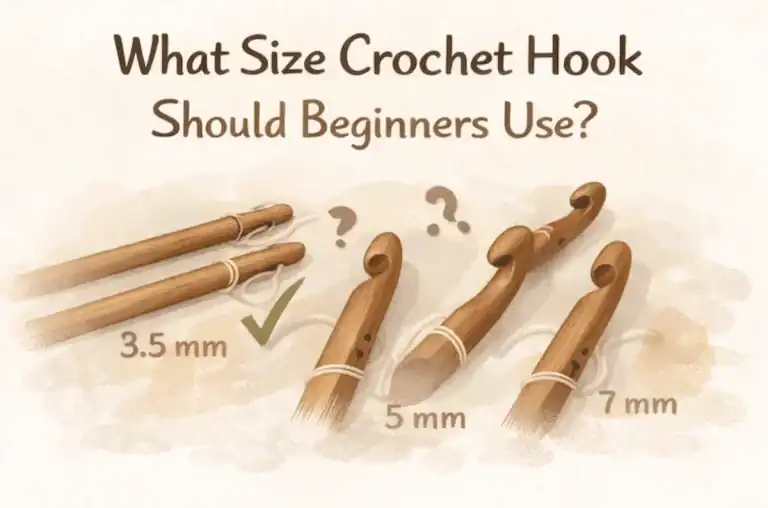
What Size Crochet Hook Should Beginners Use (LT12)
Loose Tension Causes Holes in Crochet
Full micro guide: Loose tension causes holes in crochet (LT19-M03)
Another major cause of crochet gaps is loose tension.
Tension describes how tightly or loosely the yarn is held while forming stitches.
Loose tension produces:
- taller loops
- uneven stitch height
- wide spacing between stitches
When this happens repeatedly, the fabric develops visible gaps.
What loose tension looks like
Beginners often notice several patterns:
- loops sit high above the row
- stitches vary in size
- rows look uneven
- fabric feels stretchy or unstable
These characteristics create the impression that the project is messy or holey.
Why beginners develop loose tension
Loose tension is extremely common during early learning.
Several factors contribute:
- beginners try to “relax their hands” too much
- yarn hold changes frequently
- loop height becomes inconsistent
- slippery yarn slides easily on the hook
The result is stitches that grow taller and wider than intended.
Fixing loose tension safely
A common beginner mistake is trying to solve loose tension by squeezing the yarn tightly.
This usually creates a new problem: hand strain and inconsistent stitches.
Instead, focus on these adjustments:
- keep yarn hold stable
- maintain consistent loop height
- slow down slightly while crocheting
- use a slightly smaller hook if needed
These methods correct tension without creating physical strain.
For deeper guidance see:
How to Control Crochet Tension (LT08)
Yarn Splitting Makes Crochet Look Holey
Full micro guide:
Yarn splitting makes crochet look holey (LT19-M04)
Another issue beginners sometimes overlook is yarn splitting.
Yarn splitting happens when the hook catches only part of the yarn strand instead of the full strand.
For example, if a yarn has four strands twisted together, the hook may catch only two.
When this happens, the stitch becomes structurally weak.
Why yarn splitting creates holes
Split stitches produce several problems:
- loops become uneven
- stitches lose structure
- gaps appear randomly
- stitch definition becomes messy
Because some stitches are weaker than others, the fabric may look inconsistent or full of holes.
What causes yarn splitting
Several factors increase the chance of splitting:
- yarn with low twist
- soft cotton yarns
- sharp hook angles
- crocheting too quickly
Some yarns are simply more prone to splitting, especially budget cotton yarns or loosely twisted fibers.
Beginner solutions
Beginners can reduce splitting with simple adjustments:
- choose smoother yarn with tighter twist
- crochet slightly slower
- adjust the hook angle to enter the stitch cleanly
- use hooks with smoother heads
Yarn quality also plays a role.
More detail about beginner-friendly yarn appears in:
Best Yarn for Crochet Beginners (LT10)
Why My Double Crochet Has Big Gaps
Full micro guide:
Why my double crochet has big gaps (LT19-M05)
Many beginners become worried when they see large gaps in double crochet stitches.
However, this stitch is naturally more open than other beginner stitches.
Why double crochet creates space
Double crochet is taller than single crochet because it includes an additional yarn over.
This creates:
- taller stitches
- vertical space between rows
- more airflow through the fabric
As a result, double crochet fabric often looks lighter and more open.
This is normal behavior.
When the gaps become too large
However, gaps become excessive when several factors combine:
- hook size is too large
- tension is loose
- loops are pulled very tall
- stitch finishing becomes inconsistent
When these factors overlap, the natural openness of double crochet becomes large visible holes.
Practical beginner adjustments
To reduce large gaps in double crochet:
- use a slightly smaller hook
- keep loop height controlled
- maintain steady rhythm while crocheting
- consider switching to half double crochet for denser fabric
Half double crochet often produces a balanced fabric that is not too dense and not too airy, making it beginner-friendly.
If your fabric also curls while you crochet, that is a separate structural issue explained in:
Why Does My Crochet Curl (LT04)
Big Picture Return — Understanding Crochet Fabric Control
At this stage of learning, beginners are moving from simply making stitches to understanding how stitches form fabric.
Gaps in crochet fabric are not random mistakes.
They are signals about three underlying mechanics:
- hook size
- tension control
- stitch structure
Learning how these factors interact is a key step toward producing clean, even crochet fabric.
This concept belongs to the broader learning framework explained in:
Common Crochet Mistakes (and Fixes) — Pillar #8
Within that pillar, each longtail explains a different category of beginner mistakes, while micro guides address specific troubleshooting situations.
Micro Topics Introduced in This Longtail
This article introduces several specific troubleshooting situations that are explained separately in micro guides.
These include:
- Why My Crochet Has Holes: Holes Between Stitches for Beginners
- Crochet Hook Too Big Causes Holes? Finding Your Perfect Match
- Loose Tension Causes Holes in Crochet: How to Steady Your Feed
- Yarn Splitting Crochet Holes: The Invisible Mistake
- Double Crochet Big Gaps? 3 Ways to Close the Stitches
- Make Crochet Stitches Tighter Without Changing Hook: Pro Hacks
- Can Blocking Fix Holes in Crochet? The Final Finish Audit
Each micro article focuses on diagnosing and fixing a single specific situation.
Together, they help beginners identify the exact cause of holes in their crochet fabric.
How to Stop Gaps in Crochet (Beginner Fix Checklist)
Full micro guide:
How to stop gaps in crochet (LT19-M06)
After understanding the causes of crochet holes, the next step is learning how to reduce gaps consistently.
The most reliable fixes involve adjusting stitch choice, hook size, tension control, and yarn selection.
Below is a beginner-friendly checklist that helps eliminate most unwanted gaps in crochet fabric.
Fix #1 — Choose the Right Stitch for Dense Fabric
Different crochet stitches naturally produce different fabric densities.
If your goal is tight, solid fabric, choose stitches that create compact structures.
Good stitches for dense fabric include:
- single crochet
- half double crochet
These stitches stack closer together and produce fewer natural gaps.
More open stitches include:
- double crochet
- treble crochet
These stitches are taller and naturally produce more airflow and spacing.
If your project requires solid fabric, switching stitches may solve the issue immediately.
Fix #2 — Match Yarn and Hook Correctly
Crochet fabric structure depends heavily on the relationship between yarn thickness and hook size.
A good beginner baseline is:
- worsted weight (#4) yarn
- 5.0 mm hook
From there, small adjustments can be made depending on the project.
For example:
- smaller hook → denser fabric
- larger hook → more open fabric
Beginners often get better results by adjusting hook size first instead of forcing tension changes.
Yarn selection also matters.
See: Best Yarn for Crochet Beginners (LT10)
For fiber comparisons: Cotton vs Acrylic Yarn
Fix #3 — Adjust Hook Size Before Tightening Tension
Many beginners try to eliminate holes by gripping the yarn more tightly.
This approach often leads to new problems:
- hand fatigue
- stiff stitches
- inconsistent tension
Instead, try adjusting hook size first.
A smaller hook naturally reduces loop size and produces denser stitches without strain.
A simple rule beginners often follow:
If fabric looks too holey → try a hook 0.5 mm smaller.
This small adjustment often improves fabric appearance dramatically.
Fix #4 — Practice Tension Using Small Swatches
Another helpful method is practicing tension using small test swatches.
Before starting a large project, crochet a small sample such as:
- 10–15 rows
- using single crochet
Then observe:
- stitch size
- fabric density
- consistency between rows
If the fabric looks too loose, adjust:
- hook size
- yarn hold
- loop height
Small swatches allow beginners to test adjustments quickly without restarting large projects.
Fix #5 — Improve Stitch Consistency
Even when hook size and yarn are correct, holes may appear if stitches vary in height.
Inconsistent stitches create:
- uneven spacing
- irregular rows
- loose areas in fabric
Beginners often improve consistency by:
- slowing down slightly
- keeping loop height uniform
- maintaining steady rhythm while crocheting
Consistency improves naturally with practice.
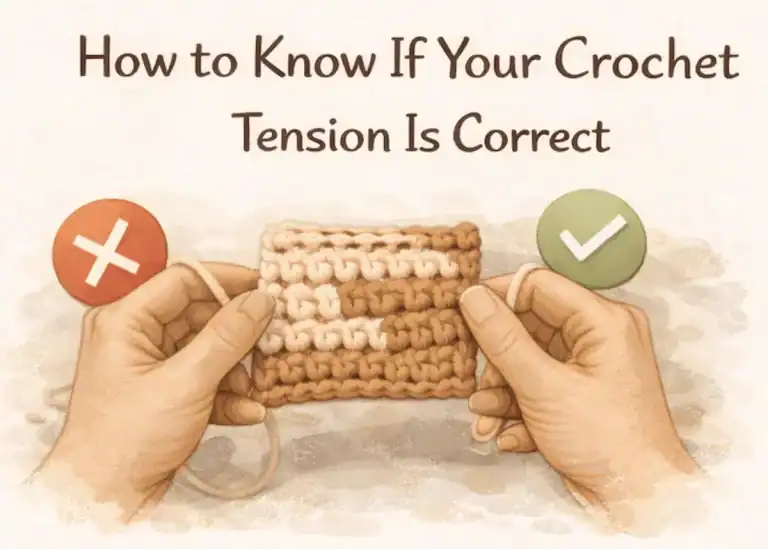
If you’re unsure whether your tension is correct, see: How to Know If Your Crochet Tension Is Correct (LT20)
Why Holes Happen More in Beginner Crochet
Many beginners worry that holes in crochet mean they are “doing something wrong.”
In reality, these gaps appear frequently during early learning because several skills are still developing simultaneously.
Beginners commonly:
- change tension mid-row
- experiment with different hooks
- struggle with yarn control
- choose yarn that splits easily
- use stitches that naturally create space
These conditions make gaps much more noticeable.
This is a normal stage of the learning process.
With practice, beginners gradually develop:
- stable tension
- consistent loop height
- smoother hook movement
As those skills improve, crochet fabric naturally becomes more even and structured.
Resolution Confirmation
You can usually tell that the problem is fixed when:
- stitches sit evenly next to each other
- the fabric feels more stable
- gaps between stitches become smaller and more consistent
- rows appear visually uniform
At this point your crochet fabric should look balanced rather than holey, even if the stitch pattern itself still includes small natural spaces.
Micro Roadmap for This Longtail
These micro guides diagnose the specific causes introduced in this article:
- Why My Crochet Has Holes: Holes Between Stitches for Beginners
- Crochet Hook Too Big Causes Holes? Finding Your Perfect Match
- Loose Tension Causes Holes in Crochet: How to Steady Your Feed
- Yarn Splitting Crochet Holes: The Invisible Mistake
- Double Crochet Big Gaps? 3 Ways to Close the Stitches
- Make Crochet Stitches Tighter Without Changing Hook: Pro Hacks
- Can Blocking Fix Holes in Crochet? The Final Finish Audit
Each micro focuses on one precise troubleshooting situation, helping beginners identify exactly what is causing gaps in their fabric.
Related Beginner Questions
Why does my crochet have holes between stitches?
This usually happens because the hook size is slightly too large or the tension is too loose, creating extra space between loops.
See: Crochet hook too big causes holes
Are holes in crochet normal?
Some crochet stitches naturally create open fabric.
For example, double crochet and treble crochet often include visible spacing.
However, random holes usually indicate tension or hook size issues.
See: Why my double crochet has big gaps
How do I make crochet stitches tighter?
Instead of squeezing the yarn harder, try:
- using a slightly smaller hook
- maintaining consistent loop height
- practicing tension with small swatches
These adjustments usually create neater stitches without causing hand strain.
See: How to stop gaps in crochet
Why does my double crochet look so holey?
Double crochet is naturally taller and creates more vertical space in the fabric.
If the gaps look excessive, the cause is often:
- large hook size
- loose tension
- tall loops
See: Why my double crochet has big gaps
Next Steps in Pillar #8
Now that you understand why crochet fabric develops holes, the next important beginner skill is learning how to evaluate your tension correctly.
Next longtail in this pillar: How to Know If Your Crochet Tension Is Correct (LT20)
Pillar roadmap: Common Crochet Mistakes (and Fixes) — Pillar #8
Related learning guides:
- How to Control Crochet Tension
- Why My Crochet Looks Messy
- What Size Crochet Hook Should Beginners Use
These guides continue building the skills needed to produce consistent, balanced crochet fabric while avoiding common beginner mistakes.