
Why Crochet Feels Hard Some Days (Tension, Fatigue & Quick Reset Guide)
This is one of the most common “quiet” crochet problems.
Some days:
- your stitches look smooth
- your hands move naturally
- your tension feels perfect
And other days:
- you can’t keep tension consistent
- you drop loops
- you miscount
- everything looks messy
- crochet suddenly feels hard again
You might think:
“Why does crochet feel hard some days? Am I getting worse?”
No.
You’re not getting worse.
Crochet is a motor skill, not just a craft.
That means it depends on three systems working together:
- Your nervous system (focus + coordination)
- Your physical state (hands, posture, fatigue)
- Your visual processing (lighting + stitch visibility)
When any of these change, crochet can suddenly feel harder — even if your skill level hasn’t changed.
This is completely normal.
Understanding why this happens will help you reset quickly instead of getting frustrated.
In this guide, you’ll learn:
- why crochet feels harder at night
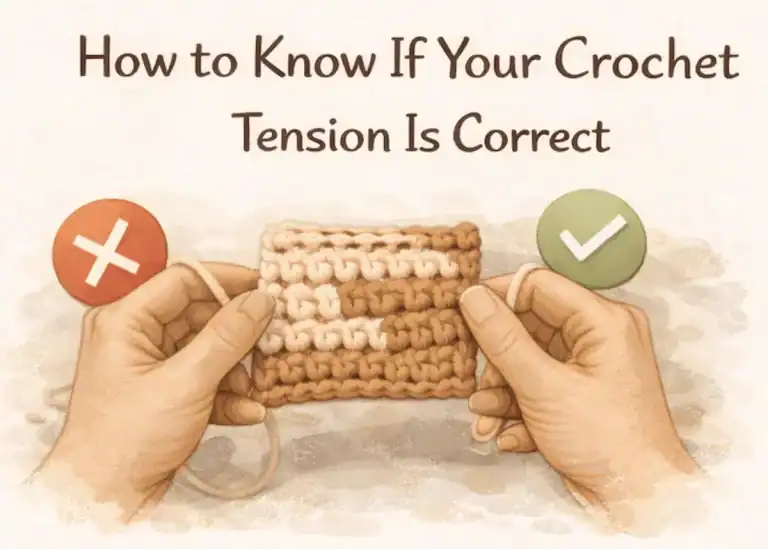
- why tension is worse some days
- why you make more mistakes when crocheting tired
- why crochet feels harder when learning a new stitch
- how to reset your crochet focus in 5 minutes
- how to practice without frustration
- when to take a break from crochet
This article belongs to:
Pillar #9 – Crochet FAQ & Troubleshooting
This pillar explains the most common beginner crochet problems and how to diagnose them.
Add a header to begin generating the table of contents
Quick Answer (TL;DR)
Crochet feels hard some days because your focus, tension control, and hand coordination change throughout the day.
Common causes include:
- fatigue affecting fine motor control
- stress tightening your hands
- poor lighting making stitches harder to see
- learning a new stitch that breaks your muscle memory
- frustration causing tension changes
In most cases, the solution is simple:
- improve lighting
- stretch your hands
- crochet easy stitches for 5 minutes
- switch to a simpler project
- take a short break
Once your hands and brain reset, crochet usually becomes easy again.
This longtail explains the concept behind those bad crochet days, while the detailed solutions live in the micro guides below.
Why Crochet Feels Harder at Night
Full micro guide:
Why crochet feels harder at night (LT21-M01)
One of the most common beginner observations is this:
“Crochet feels fine during the day… but at night everything suddenly gets harder.”
This happens for two reasons.
1. Your brain is more fatigued
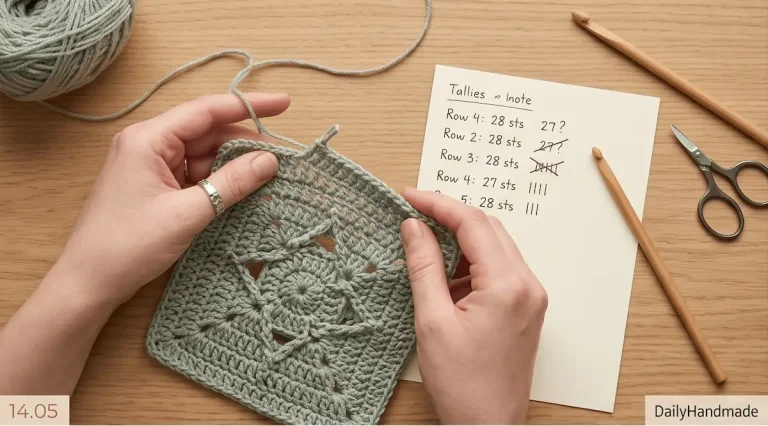
Crochet requires continuous micro-decisions:
- where to insert the hook
- how many stitches you’ve made
- where the next repeat starts
- whether tension feels correct
When your brain is tired, these tiny decisions become slower and less accurate.
So you start to:
- skip stitches
- miscount
- miss loops
- lose rhythm
This is not a skill problem.
It’s a cognitive fatigue problem.
2. Stitches are harder to see
At night:
- shadows increase
- contrast decreases
- yarn texture becomes harder to read
Even if you feel like you can see clearly, your brain has to work harder to identify:
- stitch tops
- turning chains
- correct insertion points
This extra visual effort makes crochet feel clumsy.
Beginner Fix
If crochet feels harder at night, try:
- placing a bright lamp directly over your work
- using light-colored yarn
- switching to a larger hook
- choosing simpler stitches
These changes reduce visual strain and make stitches easier to track.
The “Night Crochet” Truth
Night crochet is great for:
- relaxing
- repetitive stitches
- comfort projects
But it’s not ideal for learning new stitches or fixing complicated mistakes.
For learning sessions, daytime crochet is usually much easier.
Why My Tension Is Worse Some Days
Full micro guide:
Why my tension is worse some days (LT21-M02)
Many beginners assume tension is purely a skill issue.
But tension is actually strongly influenced by your nervous system and muscle state.
Your hands respond automatically to:
- stress
- caffeine
- sleep quality
- anxiety
- mood
- muscle fatigue
So on some days you crochet:
- tighter
or - looser
without realizing it.
This explains why a project that looked perfect yesterday may suddenly look uneven today.
Signs Your Tension Changed Today
You may notice:
- edges look uneven
- fabric curls unexpectedly
- holes appear between stitches
- stitches look messy
- hook insertion feels harder
These symptoms don’t necessarily mean you’re doing the stitch wrong.
They often mean your tension baseline changed that day.
Beginner Fix
Instead of fighting your hands, try resetting them.
Good tension reset strategies include:
- crocheting a small swatch first
- adjusting hook size slightly
- doing a few rows of easy stitches
- relaxing your grip on yarn and hook
Most tension problems improve once your hands re-establish rhythm.
Important Boundary
If tension problems happen every time you crochet, the issue may be technique.
But if tension changes randomly between sessions, it’s usually caused by:
- fatigue
- stress
- posture
- warm-up time
This difference is important because it changes how you fix the problem.
At this point we’ve identified the first two major causes of difficult crochet days:
- visual + brain fatigue
- nervous system tension changes
In the next section, we’ll examine deeper causes such as:
- why mistakes increase when you’re tired
- why learning a new stitch temporarily makes crochet harder
- why frustration itself makes tension worse
These factors explain most of the remaining “bad crochet days.”
Why I Make More Mistakes When Crocheting Tired
Full micro guide:
Why I make more mistakes when crocheting tired (LT21-M03)
Many beginners notice something confusing:
“When I’m tired, I suddenly start making mistakes I normally never make.”
You might:
- skip stitches
- misread pattern repeats
- insert the hook in the wrong place
- forget what row you’re on
This can make it feel like your crochet ability suddenly disappeared.
But what’s really happening is mental fatigue interfering with precision skills.
Crochet is not just a hand movement.
It’s a combination of several small processes happening at the same time:
- fine motor control
- pattern reading
- counting stitches
- visual pattern recognition
- rhythm timing
When you’re tired, your brain struggles to manage all of these simultaneously.
As a result, your brain starts dropping small tasks.
Usually the first things that fail are:
- counting accuracy
- stitch recognition
- pattern tracking
That’s why mistakes suddenly increase.
A Common Beginner Misconception
Many beginners assume:
“If I make mistakes, it means I need to practice more.”
But this is not always true.
If the mistakes appear only when you’re tired, practicing more in that moment will usually make the problem worse.
This is an important learning boundary:
Crochet improvement happens during focused practice, not during fatigue practice.
When you’re tired, the goal is not skill building.
The goal is relaxation or recovery stitching.
Better Project Choices When You’re Tired
If you want to crochet while tired, choose projects that require low cognitive load.
Good choices include:
- single crochet rows
- half double crochet rows
- simple scarves
- dishcloths
- repetitive blankets
Avoid:
- complex pattern repeats
- stitch charts
- lace patterns
- counting-heavy designs
These require too much concentration and increase frustration.
Failure Anticipation
If you ignore fatigue and continue crocheting complex patterns, the most common outcomes are:
- repeated frogging
- uneven tension
- pattern mistakes that appear several rows later
This is why experienced crocheters often switch to simple “comfort projects” at night.
How to Reset Your Crochet Focus in 5 Minutes
Full micro guide:
How to reset your crochet focus in 5 minutes (LT21-M04)
One of the most useful beginner skills is learning how to reset quickly when crochet starts feeling difficult.
Most bad crochet sessions are not caused by poor skill.
They’re caused by temporary tension and focus disruption.
Fortunately, these can often be fixed within minutes.
The 5-Minute Crochet Reset Routine
This routine is simple and surprisingly effective.
Step 1 — Pause (30 seconds)
Put your hook down and stop crocheting.
This interrupts the frustration cycle.
Step 2 — Stretch (1 minute)
Stretch your:
- fingers
- wrists
- shoulders
Crochet creates small muscle tension that builds gradually.
Stretching releases that tension and restores movement precision.
Step 3 — Hydrate (1 minute)
Drink water.
Hydration affects muscle control and concentration more than many people expect.
Even mild dehydration can reduce focus and coordination.
Step 4 — Adjust your environment (1 minute)
Improve at least one of these:
- lighting
- posture
- chair position
- yarn visibility
Small ergonomic changes can make stitches significantly easier to read.
Step 5 — Crochet easy stitches (2 minutes)
Before returning to your main project, crochet:
10–20 stitches of something easy.
Examples:
- single crochet
- half double crochet
- double crochet rows
This helps your hands regain rhythm and tension consistency.
Why This Reset Works
The routine resets three systems simultaneously:
- Muscle tension
- Visual clarity
- Cognitive focus
Once these stabilize, your crochet rhythm usually returns quickly.
Many crocheters notice that after a reset, the same project that felt impossible suddenly feels easy again.
Why Crochet Feels Harder When Learning a New Stitch
Full micro guide:
Why crochet feels harder when learning a new stitch (LT21-M05)
Another common moment when crochet suddenly feels difficult is when you learn a new stitch.
You might notice:
- your speed slows down
- your stitches look uneven
- tension becomes inconsistent
- you forget steps repeatedly
This can be frustrating, especially if you previously felt confident with simpler stitches.
But this experience is actually a normal part of skill development.
The Brain Is Building New Movement Patterns
Crochet relies heavily on muscle memory.
When you repeat the same stitch many times, your brain gradually automates the movements.
Eventually, you stop thinking about:
- yarn over timing
- hook rotation
- loop pulling
Your hands simply perform the movement automatically.
But when you learn a new stitch, this automation disappears.
Your brain must consciously control every movement again.
This temporary loss of automation makes crochet feel:
- slower
- more awkward
- less consistent
What This Usually Looks Like
During the first learning stage, beginners often experience:
- uneven stitch size
- inconsistent tension
- repeated frogging
- forgetting the stitch sequence
This is not failure.
It’s simply the learning phase before muscle memory forms.
Applicability Boundary
If a stitch still feels extremely difficult after many hours of practice, the issue might be:
- unclear stitch instructions
- yarn that is difficult to see
- hook size mismatch
In those cases, switching to smooth yarn and a larger hook often helps.
But in most cases, the difficulty disappears after short practice sessions across multiple days.
A Helpful Learning Strategy
Instead of trying to master a new stitch in one long session, use short focused practice sessions.
For example:
- 10–20 minutes per session
- small swatches
- clear stitch markers if needed
This allows your brain to build muscle memory gradually.
Trying to force long practice sessions usually leads to fatigue and frustration.
At this stage, we’ve identified four major causes of difficult crochet days:
- brain fatigue and lighting problems
- tension changes caused by the nervous system
- increased mistakes when tired
- temporary awkwardness when learning new stitches
There is one final factor that often makes bad crochet days even worse:
frustration itself.
Frustration changes how tightly you hold the yarn and hook, which can quickly destabilize tension and rhythm.
Understanding how to practice without frustration — and when to take a break — is the final step in managing difficult crochet sessions.
How to Practice Crochet Without Frustration
Full micro guide:
How to practice crochet without frustration
One reason crochet suddenly feels hard is not technical difficulty — it’s practice strategy.
Many beginners unknowingly practice in ways that create frustration instead of progress.
Common beginner practice mistakes include:
- choosing projects that are too complex
- practicing for very long sessions
- trying to learn multiple stitches at once
- working on patterns that require constant counting
When practice becomes overwhelming, your hands naturally tighten.
This causes:
- tighter tension
- uneven stitches
- more mistakes
- loss of rhythm
And once frustration begins, tension problems usually get worse.
A Better Beginner Practice Method
Instead of long, difficult sessions, experienced crocheters often recommend micro practice.
Micro practice means:
- short sessions (10–20 minutes)
- simple stitches
- very small learning goals
For example, one session might focus only on:
- keeping edges straight
- improving tension consistency
- making stitch height even
This type of focused practice produces faster improvement because your brain can concentrate on one skill at a time.
Good Practice Projects for Beginners
Some projects are especially useful for relaxed practice.
Examples include:
- dishcloths
- coasters
- simple scarves
- headbands
- small swatches
These projects repeat the same stitch many times, which allows your hands to develop rhythm without constant problem-solving.
Projects that require heavy pattern tracking should usually be saved for times when your focus is high.
Failure Anticipation
If beginners push themselves through long, difficult crochet sessions, the most common result is:
- tension tightening
- repeated frogging
- frustration building quickly
At that point, even simple stitches may start to feel difficult.
This is why experienced crocheters often stop before frustration becomes strong.
Stopping early keeps crochet enjoyable and prevents tension habits from forming.
When to Take a Break From Crochet
Full micro guide:
When to take a break from crochet
Taking breaks is not a sign of failure.
In fact, breaks are a normal part of skill development in any hand craft.
You should consider taking a break when:
- your hands begin to hurt
- your tension keeps getting tighter
- you make the same mistake repeatedly
- you feel frustrated or overwhelmed
- you lose track of stitches frequently
These signals usually mean your focus and motor control are temporarily overloaded.
Continuing to crochet through this state rarely improves results.
The “Stop Rule”
A simple rule many crocheters use is:
If you frog the same row twice, stop.
At that point, it’s usually more productive to:
- take a short break
- stretch your hands
- come back later with fresh focus
A 20-minute break can prevent hours of frustration.
Resolution Confirmation
You’ll know your crochet session has reset successfully when:
- your stitches begin to look even again
- your hook moves smoothly through stitches
- counting becomes easier
- tension feels natural rather than forced
These signs indicate your focus, muscle tension, and rhythm have stabilized.
Micro Roadmap for This Longtail (Internal Links)
This longtail introduces several smaller troubleshooting situations.
Each one is explained in a dedicated micro article:
- Why crochet feels harder at night
- Why my tension is worse some days
- Why I make more mistakes when crocheting tired
- How to reset your crochet focus in 5 minutes
- Why crochet feels harder when learning a new stitch
- How to practice crochet without frustration
- When to take a break from crochet
Each micro article focuses on one specific beginner situation, while this guide explains the broader concept of why crochet difficulty changes from day to day.
Related Beginner Questions
Many beginners searching for this problem also ask questions like:
- Why does crochet suddenly feel harder even though I practiced yesterday?
- Why is my crochet tension different every day?
- Is it normal for crochet to feel easy one day and difficult the next?
- Why do I crochet worse when I’m tired?
- Should I stop crocheting when I keep making mistakes?
These questions all relate to the same underlying idea:
Crochet performance changes depending on your focus, physical condition, and environment.
Learning to recognize these factors helps you manage difficult crochet sessions more calmly.
FAQ
Why does crochet feel harder some days?
Crochet depends on several factors including focus, lighting, fatigue, stress, and tension consistency.
When any of these change, your hands may temporarily lose rhythm, making stitches harder to control.
Why is my crochet tension different every day?
Tension is influenced by your nervous system and muscle state.
Stress, caffeine, sleep quality, and fatigue can all change how tightly you hold yarn and your hook.
See: Why my tension is worse some days
Why do I crochet worse at night?
At night your brain is often more fatigued, and stitches can be harder to see because of reduced lighting and contrast.
See: Why crochet feels harder at night (LT21-M01).
How do I reset when crochet suddenly feels hard?
A quick reset usually works:
- pause for a moment
- stretch your hands
- improve lighting or posture
- crochet a few easy stitches
This helps restore rhythm and tension control.
See: How to reset your crochet focus in 5 minutes
Learning Continuity (Return to the Pillar)
This article explained why crochet sometimes feels harder from one session to another.
However, other troubleshooting topics in this pillar cover more specific technical problems, such as:
- recognizing when tension is too tight or too loose
- diagnosing uneven edges or fabric curling
- learning how to join crochet pieces correctly
These guides help beginners identify and solve practical crochet mistakes step by step.
To continue learning within the same troubleshooting system, move to the next guide:
How to Tell If You’re Crocheting Too Tight or Too Loose
Or return to the full troubleshooting system here:
Pillar #9 — Crochet FAQ & Troubleshooting
This pillar organizes the most common beginner crochet problems into clear diagnostic guides, helping you identify the cause of issues and improve your crochet skills with confidence.