
Why Tension Changes When Switching Yarn Crochet (And How to Adapt)
Quick Recognition
You’ve finally mastered your tension on that cozy acrylic blanket. You feel like a pro. Then, you decide to start a summer tote bag using 100% cotton yarn. Suddenly, your stitches are tight, your fingers ache, and the hook keeps getting stuck. You think, “What happened? Did I lose my skill overnight?” At Dailyhandmade, we want to put your mind at ease: your hands haven’t failed you. You’ve simply encountered the “Fiber Variable.” Understanding why tension changes when switching yarn crochet is the secret to becoming a truly “universal” maker who can handle any material with ease.
Direct Answer
Tension changes when switching yarn crochet because different fibers have varying levels of elasticity, friction, and weight. For example, wool is elastic and “springy,” allowing for a more forgiving tension, while cotton is inelastic and “grabby,” which naturally tightens your stitches. In the framework, we teach that your tension is a dialogue between your hand and the fiber. When the fiber properties change, you must consciously adjust your “yarn feed” or your hook material to compensate.
The Fiber Friction Audit
In the technical world of How to Know If Your Crochet Tension Is Correct, we categorize yarn by how it interacts with your hook. Use this table to understand your current struggle:
| Fiber Type | Elasticity (Stretch) | Surface Texture | Resulting Tension |
| Wool / Protein | High (Springy) | Scaly (Grabs itself) | Very consistent; easy to stay even. |
| Acrylic / Synthetic | Medium | Smooth / Slippery | Can become too loose if not careful. |
| Cotton / Plant | Zero | High Friction (“Grabby”) | Usually becomes too tight. |
| Silk / Bamboo | Low | Ultra-Slippery | Tends to drop or sag (loose). |
3 Ways to Adapt When Your Tension Shifts
If you’ve noticed that tension changes when switching yarn crochet in your latest project, use these strategy drills to fix your rhythm:
1. The “Hook Material” Swap
In 2026, professional makers don’t just use one hook type.
- If your yarn is too slippery (Silk/Acrylic): Switch to a wooden or bamboo hook. The natural grain of the wood provides “grip” that helps tighten loose tension.
- If your yarn is too grabby (Cotton/Linen): Switch to a polished metal or ergonomic resin hook. The slick surface allows the stubborn yarn to glide without snagging.
2. The “Finger Wrap” Recalibration
Your hand memory is currently set to your previous yarn. You need to manually “reset” it.
- Switching to Cotton? Relax your pinky wrap. Cotton has no “give,” so if you wrap it as tightly as wool, you’ll end up with the “Death Grip” we warned about in 5 Signs Crochet Tension is Too Tight: Stop the Struggle.
- Switching to Silk? Add an extra loop around your index finger. You need more surface contact to keep the slippery yarn from sliding out of control.
3. The “Pre-Project” Swatch Audit
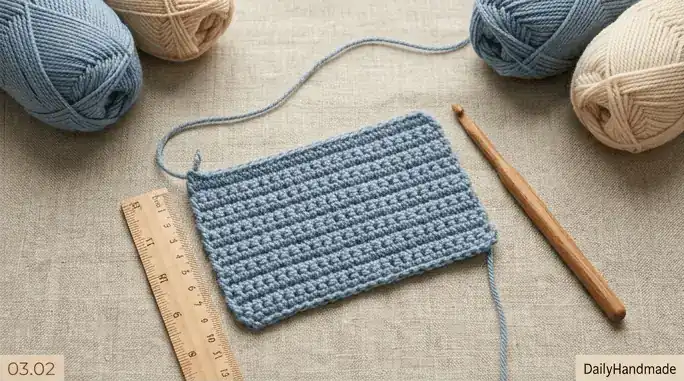
Never assume your tension is the same across different brands, even if the weight (e.g., #4 Worsted) is the same. Always perform the crochet tension test with swatch whenever you start a new ball of yarn. This 5-minute check reveals if the new fiber is going to “stretch” or “shrink” your usual stitch size.
Dailyhandmade Expert Rescue Signal
The “Dye Lot” Factor: Believe it or not, even the color of the yarn can change your tension. Darker dyes (like black or deep navy) can sometimes make yarn feel slightly “stiff” or “thicker” than the cream version of the exact same brand. If you switch colors in a striped project and notice the row height is changing, it’s not you—it’s the dye!
What To Expect Next
You now understand the variables. You know the look, the feel, and the fiber science. But what if you’re already 50% done with a project and the tension is visibly uneven? Is it too late? In our final chapter of How to Know If Your Crochet Tension Is Correct, we reveal the “No-Frog” emergency kit: How to Fix Crochet Tension Without Starting Over.
Return Path
Understanding why tension changes when switching yarn crochet is a high-level insight in How to Know If Your Crochet Tension Is Correct. To keep your journey on track, explore these related guides:
- Fix crochet tension without starting over
- Signs crochet tension is too tight
- Signs crochet ten
- Master Guide: Common Crochet Mistakes (and Fixes)
I have a relevant follow-up question for you: Are you currently switching from a stretchy fiber (like wool or acrylic) to something “stiff” (like cotton or twine), or are you experiencing the opposite problem?