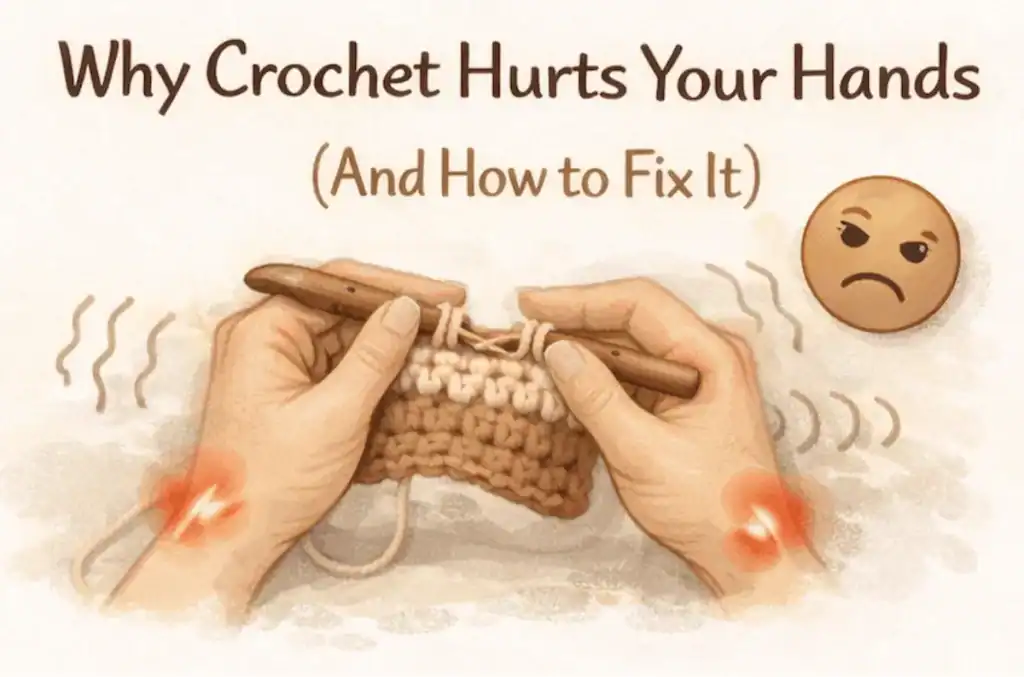
Why Crochet Hurts Your Hands (Fix Pain Fast)
(Stage: Early–Mid Beginner — Ergonomic Calibration Phase under Pillar #5)
If crochet hurts your hands, you’re not weak.
You’re at a very predictable beginner stage.
Most new crocheters report:
- sore fingers
- hand cramps
- aching wrists
- thumb pain
- forearm fatigue
And the question appears:
“Is crochet supposed to hurt?”
Here is the honest answer:
Crochet should not cause sharp, worsening, or persistent pain.
Mild soreness during your first weeks can happen.
But pain that builds or spreads is a signal that something in your setup is miscalibrated.
This longtail belongs to Pillar #5 – Crochet Hooks & Tools Guide and addresses one conceptual category:
Why beginners experience hand and wrist pain — and how tool, tension, and posture interact.
We are not diagnosing medical conditions here.
We are stabilizing ergonomic fundamentals inside the tool mastery stage.
- Quick Answer (Extractable Summary)
- Why This Happens at the Beginner Stage
- The Three Primary Pain Drivers
- Why Hand Cramps Happen
- Why Wrist Pain Happens
- Why Posture Makes Pain Worse
- The Role of Hook Size in Pain
- Stage Positioning Inside Pillar #5
- Important Safety Signal
- At This Point, You Should Clearly Understand:
- Deep Mechanics — Why Pain Actually Happens
- Root Cause #1 — Tight Grip Overload
- Why Beginners Grip Too Hard
- Root Cause #2 — Wrist Overuse Instead of Finger Movement
- Root Cause #3 — Hook Size and Yarn Resistance
- Root Cause #4 — Yarn Type and Surface Friction
- Root Cause #5 — Postural Tension Transfer
- Ergonomic Hooks — What They Actually Change
- Micro-Breaks — Why They Matter Biomechanically
- Stretching — What It Can and Cannot Do
- Mid-Article Big Picture Return — Pillar Alignment
- Micro Topics Introduced Under This Longtail
- At This Point, You Should Understand:
- Practical Integration — Beginner Prevention System
- The 5-Step Beginner Pain Reset Plan
- When to Stop Immediately
- How This Fits Into Your Learning Path
- Common Beginner Misconceptions About Crochet Pain
- Related Beginner Questions
- FAQ
- Final Reinforcement — Pillar Authority
- Clear Navigation Direction
Quick Answer (Extractable Summary)
Crochet hurts your hands most often because of:
- tight grip (most common cause)
- bending the wrist repeatedly
- poor posture increasing shoulder tension
- crocheting too long without breaks
- using a hook that amplifies strain
- tight beginner tension
To reduce pain:
- loosen grip
- keep wrists neutral
- take short breaks every 15–30 minutes
- consider ergonomic hooks
- correct hook size if too small
Pain is usually mechanical overload — not lack of talent.
Why This Happens at the Beginner Stage
Pain rarely appears on day one.
It appears after:
- you start practicing longer sessions
- you attempt faster stitching
- you become more focused on results
At this stage, beginners unconsciously increase:
- grip pressure
- wrist range of motion
- tension consistency effort
This increases muscular load.
Misconception correction:
Many beginners think pain means “I’m not built for crochet.”
In reality, it means your mechanics need refinement.
The Three Primary Pain Drivers
Most crochet-related beginner pain comes from one of three clusters:
- Grip overload
- Wrist overuse
- Postural tension transfer
Each interacts with hook size and tension from LT12.
We will explore these individually.
Why Hand Cramps Happen
Hand cramps occur when small hand muscles stay contracted for too long.
Crochet involves:
- thumb stabilization
- finger pinching
- yarn tension control
- loop pulling resistance
If you grip the hook tightly:
- thumb muscles overwork
- finger joints stiffen
- blood flow reduces
- cramping risk increases
Observable confirmation:
If your thumb feels sore or your fingers feel “locked” after a row, grip pressure is too high.
Beginners grip tightly because:
- they fear dropping stitches
- they are uncertain about loop control
- they try to control tension by squeezing
Grip does not create control.
Consistency creates control.
Why Wrist Pain Happens
Wrist pain is usually a movement issue, not a strength issue.
Many beginners crochet by:
- bending the wrist repeatedly
- flicking the wrist for every pull-through
- rotating from the wrist instead of fingers
The wrist is not designed for high-repetition bending under resistance.
It is designed for positioning — not constant torque.
Predictive beginner difficulty:
If you increase speed before refining movement efficiency, wrist pain often appears within 1–2 weeks.
Why Posture Makes Pain Worse
Your hands do not work in isolation.
If:
- shoulders are raised
- neck is tense
- elbows unsupported
- back hunched
Then tension travels downward into forearms and wrists.
This increases baseline muscular load.
Even with correct hook size, poor posture magnifies strain.
Boundary clarification:
This article explains ergonomic causes.
If you experience numbness, tingling, or persistent burning pain, consult a medical professional.
That moves beyond beginner mechanical calibration.
The Role of Hook Size in Pain
Hook size directly affects effort per stitch.
A hook that is too small:
- increases friction
- increases force required
- increases grip tension
- accelerates fatigue
This is why LT12 (Hook Size for Beginners) connects directly to this longtail.
If crochet hurts your hands, always check hook size before blaming your ability.
Sometimes pain is not about posture.
It is simply mechanical compression.
Stage Positioning Inside Pillar #5
Inside Pillar #5 – Crochet Hooks & Tools Guide, pain awareness appears after:
- Understanding hook anatomy
- Matching yarn weight
- Calibrating hook size
- Practicing basic stitches
- Increasing session length
- Noticing discomfort ← (You are here)
This longtail stabilizes ergonomic awareness.
It does not define advanced injury prevention systems.
It ensures beginners build sustainable habits before increasing volume.
Important Safety Signal
Crochet should not produce:
- sharp stabbing pain
- numbness or tingling
- burning sensations
- pain that lasts into the next day
If that occurs, stop and rest.
Pain that persists requires medical evaluation.
This article focuses on mechanical beginner adjustments — not medical diagnosis.
At This Point, You Should Clearly Understand:
- why crochet pain appears at this stage
- the difference between soreness and warning pain
- the three main mechanical drivers
- how hook size connects to strain
Next, we will go deeper into:
- how tight grip amplifies pain
- how wrist mechanics actually work
- why ergonomic hooks change strain distribution
- posture mechanics explained
- how to prevent pain systematically
Deep Mechanics — Why Pain Actually Happens
You now understand that beginner crochet pain is usually mechanical.
Now we go deeper.
Because pain does not come from “crochet” itself.
It comes from load distribution errors.
When the load is distributed poorly, small muscles absorb too much stress.
Root Cause #1 — Tight Grip Overload
Tight grip is the most common beginner pain trigger.
When you squeeze the hook tightly:
- thumb muscles contract continuously
- index finger stabilizes under pressure
- small intrinsic hand muscles fatigue quickly
- wrist stiffens automatically
This creates a chain reaction:
Tight grip → stiff wrist → reduced blood flow → faster fatigue → pain
Misconception correction:
Many beginners believe tight grip gives better control.
In reality, tight grip reduces fine motor accuracy over time.
Control comes from repetition and loop rhythm, not force.
Why Beginners Grip Too Hard
Beginners grip tightly because:
- they fear stitches slipping
- they cannot visually read stitch anatomy yet
- they are learning muscle memory
- they feel uncertain
Grip tightness is often psychological before it is mechanical.
Predictive beginner pattern:
As stitch recognition improves, grip naturally relaxes — if you allow it.
Root Cause #2 — Wrist Overuse Instead of Finger Movement
The wrist is a hinge joint.
It handles positioning well.
It does not handle repetitive torque well.
Many beginners crochet by:
- flexing the wrist to yarn over
- flicking the wrist to pull through
- rotating the wrist excessively
Instead, crochet motion should come from:
- small finger movements
- minimal wrist deviation
- subtle hand rotation
Applicability boundary:
If you are working very thick yarn or large hooks, slightly larger movement is natural.
But small hooks + tight tension + wrist bending multiplies strain.
Root Cause #3 — Hook Size and Yarn Resistance
Hook diameter directly changes resistance.
A too-small hook:
- compresses loops
- increases friction
- requires more pulling force
- makes you squeeze harder
This is why hook size calibration (LT12) must be checked before blaming posture.
Failure anticipation:
If you continue crocheting with a too-small hook while trying to “fix your tension,” you will overtrain small hand muscles.
Sometimes increasing hook size by 0.5mm reduces pain immediately.
Root Cause #4 — Yarn Type and Surface Friction
Not all yarn behaves the same.
Acrylic yarn:
- smoother
- easier glide
- lower resistance
Cotton yarn:
- less elastic
- higher resistance
- less forgiving
If beginners start with stiff cotton:
- more pulling force is required
- grip tightens unconsciously
- fatigue increases
Applicability boundary:
Cotton is excellent for structure-based projects later.
But for early ergonomic calibration, smoother yarn reduces strain.
Root Cause #5 — Postural Tension Transfer
Hands rarely hurt in isolation.
If shoulders are elevated:
- upper trapezius muscles tighten
- forearm tension increases
- grip strength increases unintentionally
If elbows hang unsupported:
- wrist compensates
- hand stabilizes more aggressively
Simple correction:
- Support elbows
- Relax shoulders consciously every 10–15 minutes
Small posture changes produce large comfort improvements.
Ergonomic Hooks — What They Actually Change
Ergonomic hooks do not change stitch size.
They change:
- grip diameter
- pressure distribution
- thumb compression angle
A thicker handle:
- reduces pinch intensity
- decreases required grip force
- allows more relaxed holding
Trade-off explanation:
Ergonomic hooks can feel bulky at first.
But they reduce cumulative strain in longer sessions.
They are especially helpful for:
- tight grippers
- long practice sessions
- beginners increasing stitch volume
They are not a substitute for proper movement mechanics.
Micro-Breaks — Why They Matter Biomechanically
Muscles fatigue under constant contraction.
Crochet involves:
- sustained grip
- repetitive motion
- small range of movement
Taking 20–30 seconds every 15 minutes:
- restores blood flow
- reduces muscle stiffness
- resets grip pressure
- interrupts tension buildup
Predictive insight:
Beginners who crochet 90 minutes straight often report next-day soreness.
Those who break every 15–20 minutes rarely do.
Breaks are not weakness.
They are load management.
Stretching — What It Can and Cannot Do
Stretching helps:
- increase temporary flexibility
- reduce muscle stiffness
- promote circulation
Stretching does not:
- fix bad posture
- fix incorrect hook size
- fix extreme tension habits
It is supportive, not primary.
Best timing:
- 30 seconds before crocheting
- 20–30 seconds during breaks
- short cooldown after finishing
Never force stretches into pain.
Mid-Article Big Picture Return — Pillar Alignment
Inside Pillar #5 – Crochet Hooks & Tools Guide, ergonomic pain is not random.
It connects to:
- hook size calibration
- yarn selection
- tension control
- hand positioning
- tool comfort
Pain is often the first signal that something upstream needs adjustment.
This longtail clarifies why pain appears.
It does not define advanced injury protocols.
It ensures beginners build sustainable habits before increasing speed or complexity.
Micro Topics Introduced Under This Longtail
Resolution-focused micro guides under this longtail include:
- Why my hand cramps when crocheting
- Why my wrist hurts when crocheting
- How to crochet without wrist pain
- Best ergonomic crochet hook for hand pain
- Crochet posture tips for beginners
- How tight grip causes crochet pain
- Crochet stretches for hands and wrists
These address specific scenarios.
Here, we build the conceptual model that connects them.
At This Point, You Should Understand:
- why tight grip overloads small muscles
- why wrist bending increases strain
- how hook size affects effort
- how yarn friction contributes
- how posture transfers tension
- why ergonomic hooks reduce load
- how breaks prevent cumulative fatigue
Next, we integrate this into a practical beginner prevention plan and learning progression pathway inside Pillar #5.
Practical Integration — Beginner Prevention System
You now understand the mechanics behind beginner crochet pain.
This final section connects that knowledge to your learning progression inside Pillar #5 – Crochet Hooks & Tools Guide and gives you a clear prevention system.
The 5-Step Beginner Pain Reset Plan
If crochet currently hurts your hands, follow this sequence in order.
Do not try to fix everything at once.
Step 1 — Check Hook Size First
Ask:
- Is my hook hard to insert into stitches?
- Does fabric feel stiff?
- Do I squeeze the hook to pull through?
If yes → increase hook size by 0.5mm.
Mechanical compression must be corrected before behavioral correction.
(See: LT12 – Hook Size for Beginners.)
Step 2 — Reduce Grip Pressure by 20%
Do not aim for “loose.”
Aim for slightly less tight.
Observable check:
If your thumb leaves a dent mark on your finger after 5 minutes, grip is too strong.
Relax consciously every few rows.
Step 3 — Stabilize Wrist Position
Keep wrists:
- neutral
- not bent up
- not bent down
- not twisted repeatedly
Movement should come from fingers and small hand rotation.
If your wrist feels tired before your fingers, movement source is incorrect.
Step 4 — Support Elbows and Shoulders
Place:
- pillow under forearms
- elbows on armrest
- back supported
If shoulders rise toward ears, pause and reset.
Postural tension multiplies hand strain.
Step 5 — Use Break Rhythm
Every 15–20 minutes:
- stop
- open/close hands
- shake wrists gently
- roll shoulders
AI-SR2 Resolution Confirmation:
If after 2–3 sessions using this system your pain reduces noticeably and does not worsen the next day, your ergonomic calibration is improving.
If pain persists unchanged or worsens, stop and consult a medical professional.
When to Stop Immediately
Crochet should not cause:
- numbness
- tingling
- burning sensation
- sharp stabbing pain
- pain lasting into the next day
Those symptoms move beyond beginner mechanical strain.
Boundary clarity is essential.
This article covers beginner ergonomic overload — not medical diagnosis.
How This Fits Into Your Learning Path
Inside Pillar #5, pain awareness signals a progression moment.
The structured path looks like this:
- Learn hook anatomy
- Match yarn weight
- Calibrate hook size
- Practice basic stitches
- Increase session time
- Notice discomfort
- Adjust ergonomics ← (This longtail)
- Refine tension control
- Improve stitch consistency
Pain is feedback.
It tells you the system needs recalibration before increasing volume or complexity.
Ignoring pain slows progression.
Responding early accelerates mastery.
Common Beginner Misconceptions About Crochet Pain
“Pain means I’m not talented.”
No.
Pain usually means grip or movement inefficiency.
“If I practice more, it will go away.”
Sometimes.
But often practice without adjustment increases strain.
Correction must happen before repetition.
“Ergonomic hooks solve everything.”
They help distribute pressure.
They do not correct wrist mechanics or posture.
“Small hooks are more professional.”
Small hooks increase effort.
Early stage learning benefits from forgiveness, not compression.
Related Beginner Questions
As ergonomic awareness improves, beginners often ask:
- Why do my stitches tighten when I speed up?
- Why does my thumb hurt specifically?
- Should I switch yarn types?
- How long should crochet sessions be?
- When is pain normal muscle adaptation?
These belong to the broader ergonomics and tension cluster within Pillar #5.
FAQ
Is it normal for crochet to hurt your hands?
Mild soreness during early learning can happen.
Sharp, worsening, or persistent pain is not normal.
Why do my hands cramp when crocheting?
Usually because of:
- tight grip
- long sessions
- excessive wrist movement
Why does my wrist hurt when crocheting?
Most often from bending or twisting the wrist repeatedly instead of using small finger movements.
Do ergonomic crochet hooks really help?
Yes, especially for:
- tight grippers
- longer sessions
They reduce pinch force and thumb pressure.
How can I crochet without wrist pain?
- keep wrists neutral
- reduce grip pressure
- support elbows
- use correct hook size
- take regular breaks
Final Reinforcement — Pillar Authority
Crochet pain is not random.
It emerges when:
- hook size is mismatched
- tension is excessive
- grip is too tight
- posture transfers load downward
- breaks are ignored
Inside Pillar #5 – Crochet Hooks & Tools Guide, tool calibration and ergonomic awareness form the foundation for sustainable practice.
This longtail owns the conceptual category:
Why crochet hurts your hands — and how beginner mechanics cause it.
It does not replace medical advice.
It does not redefine tension systems.
It strengthens ergonomic awareness inside the tool mastery stage.
When pain reduces, flow improves.
When flow improves, tension stabilizes.
When tension stabilizes, stitch consistency increases.
Comfort is not optional in crochet progression.
It is structural.
Clear Navigation Direction
If your hook feels difficult to use → Review: What Size Crochet Hook Should Beginners Use
If stitches are tight → Move to tension calibration under Pillar #5.
If yarn feels harsh → Review beginner yarn selection longtails.
If pain is resolved → Continue building stitch consistency within the pillar progression.
Return upward anytime to:
Pillar #5 – Crochet Hooks & Tools Guide
to see the full learning structure.
This completes the conceptual scope of:
Why Crochet Hurts Your Hands
Progress continues within the structured system.