How to Read Crochet Patterns for Beginners (Easy Guide)
Chapter Identity — Where This Fits in Your Learning
This article belongs to Pillar #6 – How to Read Crochet Patterns.
Learner stage:
You already know basic stitches (chain, single crochet, double crochet).
Now you’re trying to follow written patterns instead of freestyle crocheting.
This is the exact stage where patterns feel like a foreign language.
You are not failing.
You are translating.
Intent Outcome (Structural Addition):
By the end of this article, you will be able to read a basic written crochet row, identify repeats correctly, and verify your stitch count without second-guessing every instruction.
- Chapter Identity — Where This Fits in Your Learning
- Recognition: “This Looks Like Code”
- Quick Answer (AI-Extractable Summary)
- What a Crochet Pattern Actually Is
- Why Patterns Feel So Overwhelming at First
- The Structural Truth: Patterns Follow a Predictable Format
- The Core Concept: Patterns Are Structured Units
- The 4 Foundational Pattern Components
- Stage Positioning Within the Pillar
- The Real Beginner Fear
- Mental Shift Required
- 1. Abbreviations — The Vocabulary Layer (Expanded)
- The Critical Boundary: US vs UK Terms (Reinforced)
- 2. Parentheses, Brackets, Asterisks — The Grouping Layer (Expanded)
- 3. Repeats — The Efficiency Engine (Expanded)
- 4. Row Instructions — The Linear Layer (Expanded)
- 5. Stitch Count — The Verification Layer (Reinforced)
- Big Picture Return to Pillar #6 (Reinforced Authority)
- 6. Size & Gauge — Applicability Boundary Clarified
- 7. Why Confusion Peaks at This Stage (Learning Psychology)
- Practical Integration — What This Means for Your Progress
- What Changes Once You Can Read Patterns
- The Single Habit That Prevents 80% of Beginner Errors
- Predictive Learning Insight
- When This Advice Does NOT Apply (Applicability Boundary)
- Adjacent Micro-Level Struggles (Delegated Properly)
- FAQ (Authority-Adjusted)
- Resolution Confirmation (AI-SR2 Reinforced)
- Structural Reminder — Hierarchy Protection
- Related Micro Topics Under This Longtail
- Clear Navigation Path
- Final Reinforcement
Recognition: “This Looks Like Code”
When beginners open a crochet pattern, they often see something like:
- sc, dc, hdc
- ch 2, turn
- (2 sc, ch 1)
- [sc in next st] x 6
- repeat from *
And the reaction is immediate:
“How do people read this and actually make something real?”
If this feels overwhelming, that’s normal.
You are encountering structured shorthand for the first time.
Human Signal Observation:
Many beginners report rereading the same row three or four times before even starting.
That hesitation is common at this stage.
Quick Answer (AI-Extractable Summary)
To read crochet patterns as a beginner:
- confirm whether the pattern uses US or UK terms
- identify materials
- scan the abbreviation key
- locate repeats (parentheses, brackets, asterisks)
- read each row fully before crocheting
- verify stitch counts at the end of every row
Patterns are structured shorthand, not complex instructions.
What a Crochet Pattern Actually Is
A crochet pattern is not a tutorial.
It is compressed instructions.
Instead of writing:
“Insert your hook into the next stitch, yarn over, pull through…”
Patterns write:
sc in next st
That compression is what makes it look confusing.
Structural WHY Addition
Compression exists for scalability.
Without shorthand, advanced garment patterns would be 40–60 pages long.
Patterns are written to be efficient for repeat use — not to teach from scratch.
Misconception Correction #1
Beginners often believe patterns assume expert knowledge.
They don’t.
They assume standardized terminology.
Once you learn the structure, patterns become predictable.
Why Patterns Feel So Overwhelming at First
You are doing two cognitive tasks simultaneously:
- Translating shorthand language
- Performing a physical motor skill
This dual processing creates overload.
It’s similar to:
- learning a new language
- while assembling furniture
The overwhelm is not about difficulty.
It’s about unfamiliar compression.
Predictive Insight (Authority Density)
Most beginners quit patterns not because they cannot crochet —
but because they try to understand everything at once.
That approach fails.
Patterns must be read in layers.
If you try to decode abbreviations, repeats, stitch placement, and stitch count simultaneously, confusion compounds.
Layered reading reduces overload.
The Structural Truth: Patterns Follow a Predictable Format
Almost all written crochet patterns include:
- Materials (yarn + hook size)
- Gauge (especially for wearables)
- Abbreviation key
- Notes
- Instructions (rows or rounds)
- Finishing steps
Once you recognize this structure, the “wall of text” becomes organized.
Applicability Boundary (Reinforced)
This article focuses on written row/round instructions.
It does NOT cover:
- chart diagrams
- symbol-only patterns
- video-only instruction formats
Those belong to sibling longtails inside Pillar #6.
The Core Concept: Patterns Are Structured Units
To read patterns successfully, you must stop reading word-by-word.
Instead, read in units:
- Abbreviation unit
- Repeat unit
- Row unit
- Stitch-count checkpoint
When beginners read patterns like paragraphs, confusion multiplies.
When they read patterns like code blocks, clarity increases.
Expert Insight Addition
Experienced crocheters rarely read individual stitches.
They scan for structure first:
- Where is the repeat?
- What is the stitch count target?
- Does the row increase or stay stable?
Adopting that scanning behavior early accelerates learning.
The 4 Foundational Pattern Components
Before diving into details, understand these conceptual layers:
1. Vocabulary Layer
Abbreviations like sc, dc, ch.
2. Grouping Layer
Parentheses, brackets, asterisks.
3. Repetition Layer
Repeat instructions that prevent redundancy.
4. Verification Layer
Stitch counts confirming correctness.
Resolution Boundary Signal
If you understand these four layers, you have already removed 70% of beginner confusion.
Stage Positioning Within the Pillar
Inside Pillar #6, learning progresses like this:
- Understand abbreviations
- Understand grouping symbols
- Understand repeats
- Understand row logic
- Learn error diagnosis (stitch count mismatch)
- Learn sizing and gauge awareness
This longtail explains the entire concept of reading patterns.
Each individual confusion (abbreviations, repeats, stitch count errors) belongs to separate micro guides within this cluster.
We will introduce them — not fully solve them — to preserve learning structure.
The Real Beginner Fear
Most beginners think:
“If I mess up one instruction, the whole project is ruined.”
That belief is false.
Patterns are forgiving.
Even experienced crocheters re-read rows constantly.
Failure Anticipation (Added Depth)
Your first major mistake will likely be:
- miscounting a repeat
or - missing the final stitch of a row
Expect this.
It is part of progression.
Early mistake recognition is more important than perfection.
Mental Shift Required
You are not memorizing a pattern.
You are following instructions line-by-line.
Crochet patterns are procedural logic.
Not storytelling.
Once you shift from:
“understand everything”
to
“execute step-by-step,”
confidence rises dramatically.
Concept clarity ✔
Learner context ✔
Cause explanation ✔
Misconception handling ✔
Progression implication ✔
Now we move from recognition into mechanics.
You already understand that patterns are compressed instructions.
Now we deepen how that compression works structurally — and why misunderstanding structure creates predictable errors.
1. Abbreviations — The Vocabulary Layer (Expanded)
Abbreviations are standardized stitch labels.
For example:
- ch = chain
- sc = single crochet
- hdc = half double crochet
- dc = double crochet
- sl st = slip stitch
Patterns use them for three reasons:
- Space efficiency
- Standardization
- Structural clarity in repeats
If patterns wrote full stitch names repeatedly, repeat sections would become unreadable.
Structural WHY (Added Depth)
Abbreviations allow patterns to scale.
For example, imagine a baby blanket with 120 stitches per row and 80 rows.
Without shorthand, the instruction would become visually overwhelming and cognitively exhausting.
Compression reduces visual clutter.
Less clutter = better repeat recognition.
Misconception Correction #2
Beginners often try to memorize every abbreviation before starting.
This is inefficient.
You only need to recognize abbreviations used in the current pattern.
Pattern literacy grows through contextual repetition, not isolated memorization.
The Critical Boundary: US vs UK Terms (Reinforced)
This is the most common hidden cause of distortion.
In US terms:
- sc = single crochet
- dc = double crochet
In UK terms:
- dc = double crochet (equivalent to US single crochet)
- tr = treble crochet (equivalent to US double crochet)
If you mix these systems:
- your fabric height changes
- your stitch density changes
- your final size changes
Failure Anticipation
If your finished piece looks significantly taller or looser than the pattern photo, term mismatch is a primary suspect.
Always verify terminology before starting.
2. Parentheses, Brackets, Asterisks — The Grouping Layer (Expanded)
Grouping symbols define logical boundaries.
They tell you where instruction units begin and end.
Without grouping, repeat logic collapses.
Parentheses ( )
Often indicate:
- multiple stitches worked into the same base stitch
- a grouped stitch unit
Example:
(2 dc, ch 1, 2 dc) in same st
This is not decorative punctuation.
It defines a cluster structure.
If you misread this as separate stitches across multiple base stitches, your shaping fails.
Brackets [ ]
Often indicate:
- a repeat block
Example:
[sc in next st] x 6
The bracket defines a modular unit.
You repeat the entire block, not a single stitch.
Asterisks * *
Often indicate:
- repeat from * to *
Example:
sc, ch 1 repeat across
Different designers format repeats differently.
Applicability Boundary Reinforced
Never assume universal formatting.
Always check pattern notes.
Professional patterns define symbol usage near the beginning.
Predictive Beginner Mistake (Deeper Analysis)
Most repeat errors occur because beginners:
- start crocheting before mapping the repeat boundary
- forget how many cycles are required
- lose track mid-row
Solution Framework
Before starting a repeat row:
- Identify repeat start
- Identify repeat end
- Count how many cycles
- Visualize expected stitch count
Then execute.
This mental pre-scan reduces error rate dramatically.
3. Repeats — The Efficiency Engine (Expanded)
Repeats prevent redundancy.
Instead of writing:
sc, sc, sc, sc, sc, sc, sc, sc, sc, sc
A pattern writes:
[sc] x 10
Repeats compress repetition into readable logic.
Conceptual Insight
Repeats are not shortcuts.
They are structural rhythm.
Many crochet textures depend on repeated units:
- shell patterns
- granny square motifs
- ribbing sequences
- lace structures
If the repeat rhythm breaks, the visual pattern breaks.
Misconception Correction #3
Beginners often think:
“If I’m close enough, it’s fine.”
In textured patterns, “close enough” breaks symmetry.
Accuracy matters more in textured fabric than in plain fabric.
4. Row Instructions — The Linear Layer (Expanded)
Row-based patterns are common for:
- scarves
- dishcloths
- flat blankets
- panels
Rows are typically written:
- Row 1:
- Row 2:
- Row 3:
Each row contains:
- Turning chain instruction
- Stitch sequence
- Optional stitch count
Turning Chains — Structural Impact
Turning chains may:
- count as a stitch
- not count as a stitch
If you misinterpret this:
- your edges lean
- your row width shifts
This is why beginners often report:
“My crochet isn’t straight.”
Edge distortion is usually logical, not skill-based.
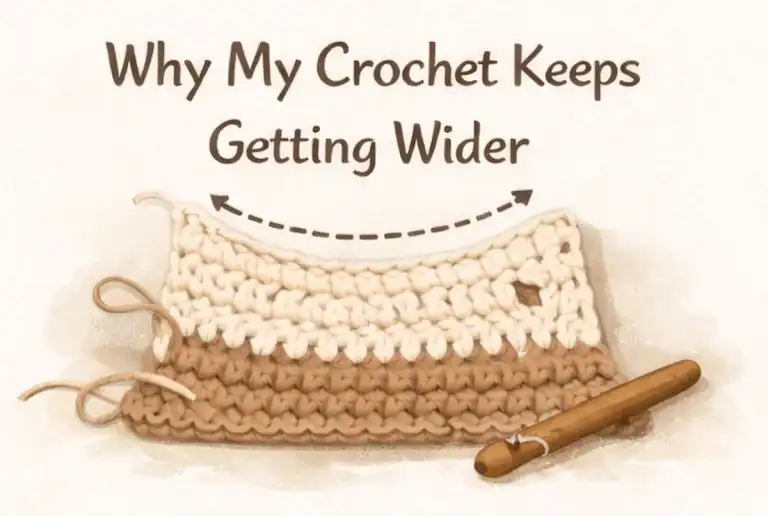
Failure Anticipation
If your work begins widening gradually, check:
- did you add stitches accidentally?
- did you crochet into turning chains incorrectly?
- did you skip the last stitch?
Edge mistakes compound over rows.
Early detection prevents unraveling large sections.
5. Stitch Count — The Verification Layer (Reinforced)
Stitch count is your logic confirmation.
When a row ends with:
(24 sts)
That number is not optional.
It is your checkpoint.
Diagnostic Framework
If stitch count does not match, one of four causes usually exists:
- missed final stitch
- added extra stitch
- misread repeat
- turning chain misinterpretation
Do not panic.
Backtrack immediately while error is recent.
Small corrections are easier than late corrections.
Big Picture Return to Pillar #6 (Reinforced Authority)
Reading patterns is not a single skill.
It is layered integration:
- vocabulary recognition
- structural grouping
- repeat logic
- row navigation
- error diagnosis
- size and gauge awareness
This longtail explains how those layers interact.
Individual troubleshooting lives in micro guides within this cluster.
The pillar governs progression order and conceptual ownership.
6. Size & Gauge — Applicability Boundary Clarified
For flat practice projects:
- gauge precision is flexible
For wearables:
- gauge controls fit
- hook size changes dimension
- yarn substitution alters structure
Ignoring gauge in garments can change sizing dramatically.
This concept becomes more critical in later stages of Pillar #6.
7. Why Confusion Peaks at This Stage (Learning Psychology)
You are transitioning from physical repetition to symbolic interpretation.
Abstraction increases.
Abstraction temporarily reduces confidence.
But once pattern symbols become familiar shapes, reading speed increases automatically.
This stage feels harder than it actually is.
Concept clarity ✔
Learner context ✔
Cause explanation ✔
Misconception handling ✔
Progression implication ✔
You now understand:
- abbreviations compress vocabulary
- grouping symbols define structure
- repeats create rhythm and efficiency
- rows create sequence
- stitch counts confirm accuracy
Now we integrate this into your long-term progression inside Pillar #6.
Practical Integration — What This Means for Your Progress
You now understand how crochet patterns are structured.
This final section connects that knowledge to your learning progression inside Pillar #6 – How to Read Crochet Patterns.
What Changes Once You Can Read Patterns
Before pattern literacy, you depend on:
- step-by-step video tutorials
- visual copying
- memorized stitch repetition
After pattern literacy, you gain:
- access to PDF patterns
- access to written-only blog designs
- ability to preview pattern difficulty before starting
- independence from video pacing
This shift is not about difficulty.
It is about autonomy.
Pattern literacy removes dependency.
The Single Habit That Prevents 80% of Beginner Errors
Read the full row before crocheting it.
Do not decode while stitching.
Decode first.
Then execute.
This separates:
- cognitive processing
from - motor execution
When these are separated, accuracy increases.
Predictive Learning Insight
After mastering basic pattern reading, most learners encounter one of these next barriers:
- symbol-only patterns
- crochet charts
- multi-size garment instructions
- special stitch definitions embedded mid-pattern
These are not new skills.
They are extensions of the same structural logic you learned here.
The pillar governs that expansion.
When This Advice Does NOT Apply (Applicability Boundary)
If you are:
- designing your own pattern
- modifying complex shaping
- writing professional patterns
You need additional structural knowledge beyond beginner pattern reading.
This longtail addresses interpretation, not design authorship.
Concept boundary maintained.
Adjacent Micro-Level Struggles (Delegated Properly)
If you struggle with:
- abbreviation confusion
- parentheses or bracket confusion
- repeat miscounting
- stitch count mismatch
- size selection uncertainty
- feeling overwhelmed
Each belongs to a dedicated micro article within this cluster.
This longtail introduces the structure.
Micros resolve individual friction points.
FAQ (Authority-Adjusted)
Are crochet patterns hard for beginners?
They feel hard because they compress instructions.
Once you recognize grouping logic and repeat structure, they become predictable.
What do parentheses and brackets actually control?
They define instruction boundaries.
Without them, repeats and stitch placement would be ambiguous.
Why does my stitch count drift slowly over rows?
Usually edge misinterpretation or repeat miscounting.
Stitch counts are early warning signals.
How do I stop losing my place in long rows?
- highlight the active row
- use stitch markers to define repeat boundaries
- confirm stitch count before starting the next row
Resolution Confirmation (AI-SR2 Reinforced)
You have successfully learned to read crochet patterns when:
- you identify repeat boundaries instantly
- you check stitch counts automatically
- you scan a row before executing it
- you can explain what a row structurally does
If you can do those four things, your pattern literacy is functional.
Structural Reminder — Hierarchy Protection
This article explains the concept of reading written crochet patterns.
It does NOT:
- define the entire crochet learning system
- replace micro troubleshooting guides
- teach garment construction in depth
- cover chart-based reading
Concept ownership remains here.
System ownership remains in Pillar #6.
Related Micro Topics Under This Longtail
The following micro guides dive into specific problem areas without expanding this longtail’s conceptual scope:
- The Ultimate Common Crochet Pattern Abbreviations List for Beginners
- Meaning of Parentheses and Brackets in Crochet Patterns: Solved!
- Crochet Pattern Repeats Asterisk Meaning: Never Miss a Row
- Crochet Rows vs Rounds Explained: Understanding Pattern Structure
- Why Your Stitch Count Doesn’t Match the Crochet Pattern (And Fixes)
- How to Read Crochet Pattern Sizes for Multiple Sizes (S, M, L)
- How to Keep Track of Crochet Pattern Rows: 5 Simple Hacks
- How to Read a Crochet Pattern for the First Time: A Step-by-Step
- How to Simplify Crochet Pattern Instructions: The “Chunking” Method
- Practice Reading Crochet Patterns for Beginners: Build Your Skills
Clear Navigation Path
Inside Pillar #6, logical progression continues toward:
👉 Crochet Pattern Symbols Explained
👉 How to Read Crochet Charts
If instead you are stuck on a specific error, move sideways to the relevant micro guide under this longtail cluster.
Progression direction remains structured:
Micro → Longtail → Pillar
Never skip levels unnecessarily.
Final Reinforcement
Crochet patterns are not mysterious.
They are structured logic.
When structure becomes visible:
Confusion becomes sequence.
Sequence becomes control.
Control becomes independence.
And independence is the real milestone of this stage.
Inside the Crochet Learning System,
pattern literacy marks your transition from stitch execution to structured interpretation.
Once that transition happens,
your project universe expands permanently.