Cotton vs Acrylic Yarn for Crochet: Which One Should You Choose?
If You’re Stuck Between Cotton and Acrylic…
Soon after starting crochet, most beginners face this question:
“Should I use cotton yarn or acrylic yarn?”
Both are everywhere.
Both are recommended.
Both appear in patterns.
But they behave very differently.
And at the beginner stage, those differences affect:
- tension control
- stitch clarity
- curling
- drape
- durability
- frustration level
This longtail belongs to: Pillar #4 – Best Yarn for Crochet Projects
It sits in the Fiber Behavior Comparison stage, which comes after you understand beginner structural yarn.
At this stage, you are no longer just asking:
“What yarn is easiest?”
You are asking:
“How do fiber behaviors change crochet results?”
This article explains one concept category only:
How cotton and acrylic differ in crochet behavior, and when each is appropriate.
It does NOT define the entire fiber system.
That remains pillar-level authority.
Quick Answer (Extractable Summary)
For most beginners, acrylic yarn is easier to learn with because it stretches slightly, forgives uneven tension, and slides more smoothly. Cotton yarn is better for dishcloths and structured projects because it is absorbent and heat-resistant, but it has less stretch and can feel stiffer. Acrylic is usually preferred for blankets and beginner practice; cotton is better for kitchen use and breathable items.
The Big Behavioral Difference
The simplest comparison:
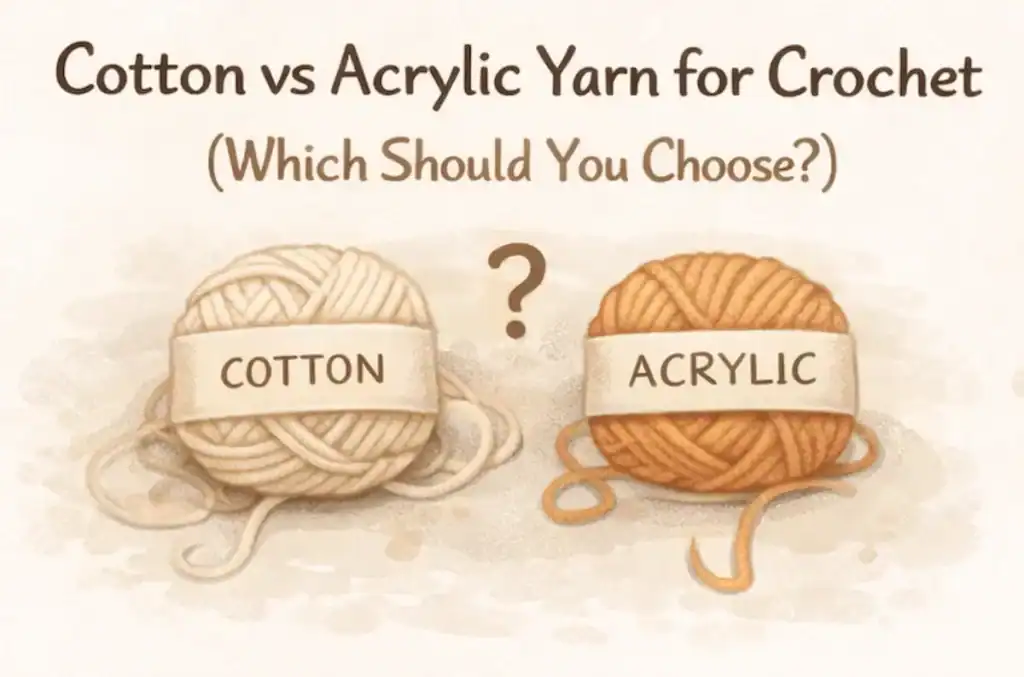
Cotton Yarn
- Low stretch
- High structure
- Absorbent
- Firm hand feel
- Shows tension changes clearly
- Can split if loosely twisted
Acrylic Yarn
- Moderate stretch
- Softer feel
- Lightweight warmth
- More forgiving tension
- Often smoother
- Can pill under friction
Neither is universally better.
They are better for different outcomes.
The mistake beginners make is choosing based on label — not behavior.
WHY Fiber Behavior Matters at This Stage
When you move beyond “beginner yarn basics,” fiber properties begin affecting:
- how flat your fabric lays
- how much edges curl
- how wearable items feel
- how projects hold shape
- how washing affects texture
If you do not understand fiber behavior, you may:
- blame your tension for curling
- blame your pattern for stiffness
- blame yourself for uneven fabric
Often, the fiber is the cause.
Understanding fiber behavior reduces misdiagnosis.
Stage Positioning Inside Pillar #4
Pillar #4 progression:
- Beginner structural yarn
- Fiber comparison and behavior
- Project-based yarn selection
- Specialty fiber control
This article sits at Stage 2.
You already understand:
- why smooth worsted acrylic helps beginners
- why fuzz hides stitches
- why twist matters
Now you are learning:
- why cotton curls more
- why acrylic stretches more
- why dishcloths require cotton
- why blankets prefer acrylic
This builds decision-making skill.
It does not redefine the pillar.
Stretch Comparison: The Core Structural Difference
The biggest mechanical difference between cotton and acrylic is stretch.
Acrylic
Acrylic fibers have elasticity.
This means:
- stitches can expand slightly
- fabric relaxes after tension changes
- hook insertion feels smoother
- tight crocheters experience less resistance
This elasticity makes acrylic more forgiving.
(Delegated micro: Which yarn stretches more cotton or acrylic
Cotton
Cotton has minimal stretch.
When you pull tight:
- stitches stay tight
- hook insertion becomes harder
- fabric feels stiff
Cotton does not compensate for tension mistakes.
It reveals them.
Misconception correction:
“Cotton makes cleaner stitches.”
Cotton makes visible stitches.
Clean stitches still depend on tension skill.
Cotton is honest.
Acrylic is forgiving.
That distinction matters.
Why Cotton Feels Harder for Beginners
Many beginners try cotton dishcloth yarn early.
They often report:
- splitting
- stiffness
- curling
- tight rows
This happens because:
- Beginners tend to crochet tightly.
- Cotton does not stretch to compensate.
- Tight cotton becomes rigid.
That rigidity increases hook resistance.
Increased resistance increases tension.
This creates a loop of tightness.
Cotton is not wrong.
It is less forgiving.
(Delegated micro: Which yarn is easier for beginners
Why Acrylic Feels Easier
Acrylic:
- stretches slightly
- slides smoothly
- rebounds after tension shifts
So when a beginner pulls too tight:
- the fabric still moves
- the hook still enters
- mistakes are less punishing
This psychological difference matters.
Acrylic reduces early frustration.
But it also hides minor tension inconsistencies.
Applicability boundary:
If you want to train strict tension control later, cotton can become useful.
But not at absolute beginner stage.
Dishcloths: Function Over Comfort
Dishcloths require:
- absorbency
- heat resistance
- durability when wet
Cotton fibers absorb water naturally.
Acrylic does not absorb well.
Acrylic can also soften under high heat.
This is why cotton dominates dishcloth use.
(Delegated micro: Cotton vs acrylic yarn for dishcloths
But here is the beginner conflict:
Dishcloth yarn is often cotton.
Cotton is less forgiving.
So beginners sometimes choose the “right project fiber” but struggle with execution.
Understanding this tradeoff prevents confusion.
Blankets: Warmth and Weight
Blankets require:
- warmth
- softness
- manageable weight
- easy washing
- affordability
Acrylic meets those conditions well.
Cotton blankets:
- feel heavier
- drape differently
- feel cooler
They are beautiful.
But they behave differently.
(Delegated micro: Cotton vs acrylic yarn for blankets
Curling: Fiber vs Tension Interaction
Cotton curls more often when:
- tension is tight
- stitch pattern is dense
- hook size is small
Because cotton lacks elasticity.
Acrylic tends to relax more naturally.
Predictive beginner mistake:
If your cotton project curls,
you may think the pattern is wrong.
Often, tension + low stretch fiber is the real cause.
(Delegated micro: Does cotton yarn curl more than acrylic
At this point we have clarified:
- WHAT the fiber difference is
- WHY cotton feels stiffer
- WHY acrylic feels easier
- HOW stretch affects crochet structure
- WHERE each fiber is typically used
Next, we go deeper into:
- pilling mechanics
- tension learning implications
- friction behavior
- durability tradeoffs
- decision frameworks
Awaiting continuation command: CONTINUE LONGTAIL.
Now we move deeper into fiber mechanics.
At this stage inside Pillar #4, you are not just choosing yarn for comfort.
You are learning how fiber properties interact with:
- friction
- tension
- drape
- durability
- long-term wear
This is where many beginners misinterpret fiber behavior as skill failure.
Pilling: Why Acrylic Forms Fuzz Balls
Acrylic yarn is made from synthetic polymer fibers.
These fibers are smooth but not strongly bonded to each other.
When a finished project experiences friction (rubbing against clothing, couches, hands), the fibers:
- loosen
- tangle together
- form small surface balls
This is called pilling.
Common high-friction items:
- blankets
- sweaters
- scarves
- hats
- bags
(Delegated micro: Does acrylic yarn pill in crochet projects – LT11-M06)
Misconception Correction
“If acrylic pills, it must be bad quality.”
Not necessarily.
All acrylic pills to some degree.
Lower-quality acrylic pills faster, but pilling is a known synthetic behavior.
Cotton pills less visibly because its fibers break differently.
This does not make cotton superior.
It makes it structurally different.
Durability Under Washing
Cotton:
- becomes stronger when wet
- tolerates high washing temperatures
- resists melting
- shrinks slightly depending on construction
Acrylic:
- dries quickly
- resists shrinking
- should avoid very high heat
- can soften under extreme heat
Applicability boundary:
For kitchen cloths and potholders, cotton is safer.
For machine-washed blankets and baby items, acrylic is often more convenient.
This is a functional tradeoff — not a quality ranking.
Friction and Hook Interaction
Hook friction changes how crochet feels.
Cotton:
- grips the hook more
- resists sliding
- creates clearer stitch definition
Acrylic:
- slides more easily
- moves quickly
- reduces hand strain for beginners
Predictive difficulty:
If you switch from acrylic to cotton suddenly, you may feel like your tension changed overnight.
It did not.
Friction changed.
This is why fiber switching requires adjustment.
Tension Learning: Which Fiber Teaches Better?
There are two phases of tension learning:
Phase 1 — Basic Control
Goal: Stop crocheting too tight or too loose.
Acrylic helps here because:
- it forgives tension shifts
- hook insertion remains manageable
- stitches remain flexible
This reduces frustration.
(Delegated micro: Best yarn choice for learning tension
Phase 2 — Precision Control
Goal: Maintain consistent stitch height and fabric density.
Cotton helps here because:
- it reveals inconsistency immediately
- it does not mask tightness
- it forces deliberate control
But Phase 2 belongs after foundational control exists.
Misconception correction:
“Cotton teaches better discipline.”
Cotton teaches faster feedback.
Discipline still requires skill development.
Curling Mechanics: Fiber + Stitch Density
Curling is often blamed on pattern.
But fiber plays a role.
Cotton curls more when:
- stitch density is high
- tension is tight
- hook size is small relative to yarn
Because cotton has low elasticity.
The fabric cannot relax outward.
Acrylic often relaxes slightly after completion or blocking.
That relaxation reduces curling.
But acrylic can still curl if tension is extremely tight.
Fiber influences curling.
Tension still controls it.
Related longtail: Why Does My Crochet Curl
Weight and Drape Differences
Cotton is denser than acrylic.
That means:
- cotton projects feel heavier
- cotton blankets drape more firmly
- cotton garments hang differently
Acrylic is lighter for the same yardage.
So acrylic blankets feel warmer without excessive weight.
Learning insight:
If a cotton blanket feels “too heavy,” that is not poor crochet.
It is fiber density.
Understanding density prevents wrong conclusions.
Beginner Failure Pattern: Project–Fiber Mismatch
Common example:
A beginner makes a dishcloth with acrylic.
Result:
- low absorbency
- feels slippery
- melts near high heat
They conclude:
“My dishcloth is bad.”
The problem is fiber selection.
Another example:
A beginner makes a blanket in cotton dishcloth yarn.
Result:
- stiff fabric
- heavy weight
- hand fatigue
They conclude:
“My tension is terrible.”
Often, fiber density is the factor.
Fiber choice shapes outcome.
Skill refines it.
Big Picture Return to Pillar #4
Inside Pillar #4 – Best Yarn for Crochet Projects, fiber comparison builds decision-making clarity.
This article owns:
- cotton vs acrylic behavior
- stretch comparison
- pilling mechanics
- dishcloth vs blanket suitability
- tension stage implications
It does NOT define:
- full yarn taxonomy
- plant vs animal fiber chemistry
- blocking science in depth
- climate-based fiber systems
Those remain pillar-level.
Here, we refine practical fiber decisions.
Micro Topics Introduced (Not Fully Resolved Here)
This longtail introduces and connects to the following micro articles:
- Cotton vs acrylic yarn for dishcloths
- Cotton vs acrylic yarn for blankets
- Which yarn stretches more cotton or acrylic
- Which yarn is easier for beginners
- Does cotton yarn curl more than acrylic
- Does acrylic yarn pill
- Best yarn choice for learning tension
Each micro resolves one focused beginner question.
This longtail explains the comparison category.
At this stage, we have clarified:
- WHAT differs between cotton and acrylic
- WHY they feel different
- HOW they affect tension and drape
- WHEN each fiber is appropriate
- WHERE beginners often misdiagnose problems
Next, we integrate this into progression guidance and decision clarity.
Learning Integration & Exit Path
You now understand:
- why acrylic stretches more
- why cotton feels firmer
- why cotton is better for dishcloths
- why acrylic dominates blankets
- how pilling happens
- how curling relates to fiber and tension
Now we integrate this into clear decision-making inside Pillar #4 – Best Yarn for Crochet Projects.
A Practical Decision Framework
Instead of asking:
“Which yarn is better?”
Ask:
“What does this project require?”
Then match fiber behavior to function.
Choose Cotton When You Need:
- Absorbency
- Heat resistance
- Firm structure
- Breathable fabric
- Crisp stitch definition
Common examples:
- Dishcloths
- Washcloths
- Kitchen items
- Summer tops
- Structured bags
Cotton excels when function is practical.
Choose Acrylic When You Need:
- Warmth
- Lightweight softness
- Stretch forgiveness
- Easy washing
- Budget efficiency
Common examples:
- Blankets
- Scarves
- Hats
- Beginner practice swatches
- Warm garments
Acrylic excels when comfort and ease matter.
Beginner Progression Guidance
Inside Pillar #4, fiber learning follows progression:
Stage 1 — Structural Learning (LT10)
Use smooth worsted acrylic to build:
- stitch recognition
- tension control
- edge consistency
Stage 2 — Fiber Behavior Awareness (This article – LT11)
Understand:
- stretch differences
- curling behavior
- pilling mechanics
- function-based selection
Stage 3 — Intentional Fiber Switching
Begin choosing fiber based on:
- project purpose
- climate
- fabric behavior
- washing needs
At this stage, cotton becomes a useful tension-training tool rather than a frustration source.
Failure Anticipation: What Happens Next
After reading this, many beginners try switching fiber immediately.
Predictable reactions:
- Cotton suddenly feels stiff
- Tension feels tighter
- Edges curl more
This is normal.
Fiber friction changed.
Your muscle memory needs adjustment.
Do not interpret that as skill regression.
It is adaptation.
Applicability Boundary
This comparison applies to:
- Standard 100% cotton yarn
- Standard 100% acrylic yarn
- Common worsted weights
Blended fibers (cotton-acrylic blends) behave differently.
High-end treated acrylic behaves differently.
Mercerized cotton behaves differently.
Those belong to more advanced fiber discussions.
This longtail covers foundational fiber comparison only.
Quick Decision Cheat Sheet
If unsure, apply this rule:
- If the item touches water often → choose cotton
- If the item touches skin often → choose acrylic (or soft blend)
- If you are practicing stitches → choose acrylic first
- If you want structure and crisp edges → choose cotton
- If you want warmth and flexibility → choose acrylic
Clarity removes hesitation.
Resolution Confirmation
You know you understand cotton vs acrylic when:
- you can predict whether a project will feel stiff or flexible
- you expect curling behavior based on tension
- you understand why dishcloths prefer cotton
- you know why blankets commonly use acrylic
- you stop blaming yourself for fiber-based behavior
When fiber behavior becomes predictable, decision-making becomes easier.
Related Beginner Questions (Search Journey Capture)
Natural next questions include:
- Why does my cotton project feel stiff?
- Why does my acrylic blanket pill?
- Why does my cotton square curl?
- Which yarn is best for summer garments?
- How does yarn stretch affect wearable fit?
Each of those maps to micro-level problem articles within this cluster.
Longtail explains the comparison.
Micros resolve specific panic questions.
FAQ
Is cotton or acrylic better for beginners?
Acrylic is usually easier for beginners because it stretches slightly and forgives uneven tension.
Is cotton or acrylic better for dishcloths?
Cotton is better for dishcloths because it is absorbent and heat-resistant.
Is cotton or acrylic better for blankets?
Acrylic is usually preferred for blankets because it is soft, warm, lightweight, and affordable.
Does cotton curl more than acrylic?
Cotton can curl more, especially when tension is tight, because it lacks elasticity.
Does acrylic always pill?
Acrylic can pill with friction, especially in high-contact items. Higher-quality acrylic reduces pilling.
Structural Reinforcement
Within the DH248 learning system:
- Pillar defines the full yarn progression.
- Longtail explains a specific concept category (fiber comparison).
- Micro resolves individual fiber-related panic questions.
This article owns cotton vs acrylic behavior comparison.
It does not replace the pillar.
It strengthens decision clarity within it.
Next Logical Step in Pillar #4
If you completed LT10 and LT11, you now understand:
- beginner yarn basics
- fiber comparison fundamentals
Next progression is usually:
- Project-based yarn selection
or - Deeper fiber application per project category
Return to:
Pillar #4 – Best Yarn for Crochet Projects
to continue structured yarn mastery.
You are no longer guessing between cotton and acrylic.
You are choosing intentionally.