Best Yarn for Learning Crochet Tension: Why Material Matters
Quick Recognition
You’ve mastered the chain and the double crochet, but your fabric looks… bipolar. One row is tight and stiff like cardboard; the next is so loose you could catch fish with it. You’re practicing every day, but your “tension” just won’t stabilize. Before you blame your fingers, look at your yarn. Most beginners don’t realize that tension isn’t just a hand skill—it’s a physical interaction between your skin and the fiber. Finding the best yarn for learning crochet tension is the secret “cheat code” to reaching Pillar #03 mastery faster.
Direct Answer
The best yarn for learning crochet tension is a Wool-Acrylic Blend or a Premium Acrylic. Why? Because these fibers have Elasticity. In the context of Cotton vs Acrylic Yarn for Crochet, acrylic acts as a “shock absorber” for your hands. If you pull a little too hard, the yarn stretches slightly to accommodate the mistake. Cotton, having zero elasticity, is the most difficult for learning tension because it provides no “give”—every micro-movement of your hand is permanently locked into the stitch.
Technical Deep Dive: The “Elastic Buffer” vs. “The Friction Brake”
At Dailyhandmade, we view yarn as a training tool. To understand why material matters, we have to look at the physics of how the yarn slides through your fingers:
- The Elastic Buffer (Acrylic/Wool): Synthetic and animal fibers have a natural “crimp” (a microscopic wave). When you tension the yarn over your index finger, this crimp provides a consistent, spongy resistance. This “buffer” smooths out the jerky movements of a beginner’s hand, leading to more uniform stitches.
- The Friction Brake (Cotton): Cotton is a plant fiber. It is smooth but has high surface friction. If your hands are slightly sweaty or if you hold the yarn too tight, cotton “grabs” your skin. This causes the yarn to move in fits and starts, resulting in the dreaded “one-tight, one-loose” stitch pattern.
The Tension Diagnostic: Cotton vs. Acrylic
| Feature | Acrylic (The Stabilizer) | Cotton (The Truth-Teller) |
| Elasticity | High. Forgives inconsistent pulls. | Zero. Records every mistake. |
| Grip on Hook | Smooth; slides easily. | Can “squeak” or drag if tight. |
| Hand Fatigue | Low; the yarn does some of the work. | High; your muscles control 100% of the tension. |
| Visibility | Good (if smooth). | Perfect. Shows every tension flaw clearly. |
The Dailyhandmade “Calibration” Protocol
If you are struggling to find your rhythm in Best Yarn for Crochet Projects, follow this 3-step yarn calibration:
- Step 1: The “Goldilocks” Start. Don’t start with 100% cotton. Use a 60/40 Cotton-Acrylic blend. This gives you the “look” of cotton but the “elasticity” of acrylic to keep your tension steady.
- Step 2: The Glide Test. If your yarn feels “sticky” on your finger, your tension will never be even. Switch to a smoother, premium acrylic. A yarn that glides consistently is the best yarn for learning crochet tension.
- Step 3: The Weight Check. Ensure you are using a Worsted Weight (#4). Anything thinner makes it harder for your brain to feel the resistance, leading to accidental “tightening.”
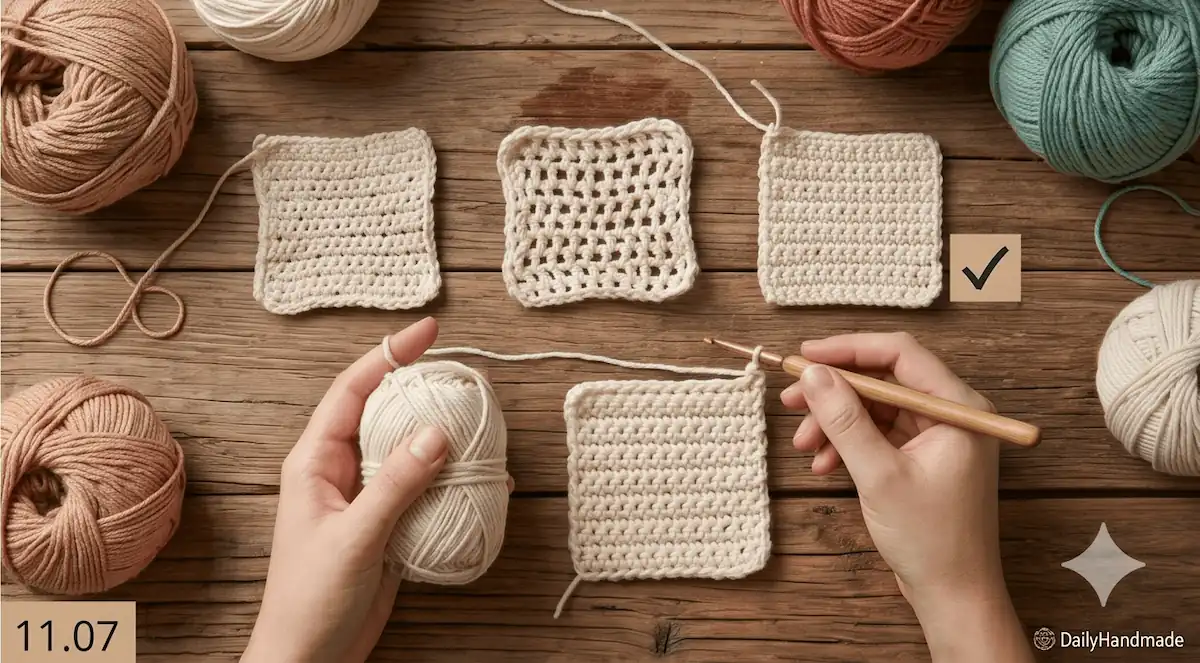
Expert Signal: Once your tension is consistent with Acrylic, then move to 100% Cotton. Think of Acrylic as your “training wheels” and Cotton as the “final exam.” If you can make a flat, even square in cotton, you have officially mastered your tension.
What To Expect Next
When you use a yarn that stabilizes your tension, your “muscle memory” develops twice as fast. You’ll stop thinking about your fingers and start focusing on the beauty of the design. You will know you’ve mastered the best yarn for learning crochet tension when you can look at a 10-inch row and see that every single stitch is the exact same height.
Return Path
This concludes our deep dive into Cotton vs Acrylic Yarn for Crochet. You now have the technical knowledge to choose the right tool for any job, from dishcloths to heirloom blankets.
To review the full material strategy of Best Yarn for Crochet Projects, revisit our core guides: