How to Fix Stretched Crochet (After Washing + Acrylic & Cotton Guide)
If your crochet stretched out after washing, you probably feel:
• annoyed
• disappointed
• worried that the project is ruined
Many beginners immediately think:
“Did I destroy my crochet project? Can stretched crochet actually be fixed?”
In many cases, the answer is yes.
Crochet fabric is made from flexible loops, not rigid fibers.
Because of that, stitches can relax, move, and reshape when they become wet.
That means stretching is often reversible, especially when it happened during washing or drying.
However, the success of fixing stretched crochet depends on several factors:
• the fiber type (acrylic vs cotton)
• how wet the project was when it stretched
• whether the project was hung while drying
• how loose the stitches were originally
Some crochet items return almost completely to their original shape.
Others may not return perfectly — but they can often be improved significantly.
Understanding how crochet fabric behaves after washing is an important part of the Crochet Care & Maintenance system explained in:
👉 Pillar #10 – Crochet Care & Maintenance Guide
This article focuses specifically on how to fix stretched crochet and restore its shape whenever possible.
- Quick Answer (TL;DR)
- What “Stretched Crochet” Actually Means
- Why Crochet Stretches After Washing
- Where This Problem Appears in the Learning Journey
- Important Beginner Misconception
- Recognizing When Crochet Can Be Fixed
- What This Guide Will Teach You
- The Key Idea Before Fixing Anything
- Crochet Stretched Out After Washing Fix (Beginner Method)
- How to Reshape Crochet After Washing
- Can You Fix Stretched Acrylic Crochet?
- Can You Fix Stretched Cotton Crochet?
- Big Picture Return — Why This Matters for Crochet Care
- Special Case: Crochet Blanket Stretched
- Related Micro Topics Introduced in This Article
- When Stretched Crochet Is Permanent (And What to Do)
- Special Case: Crochet Blanket Stretched (Best Recovery Strategy)
- Resolution Confirmation — How to Know the Fix Worked
- Preventing Stretching Next Time (Quick Rules)
- Micro Roadmap for This Longtail
- Related Beginner Questions
- FAQ
- Learning Continuity — Where This Fits in the Crochet System
- Next Step in the Learning Path
Quick Answer (TL;DR)
If your crochet stretched out after washing, the most reliable fix is to reset the stitches and reshape the fabric while it dries.
Basic recovery method:
- Re-wet the crochet item using cool water
- Press water out gently using towels (never wring)
- Lay the project flat on a surface
- Reshape it back to the intended dimensions
- Allow it to dry fully while supported
This process works because wet stitches can relax and move back toward their original structure.
Acrylic yarn often reshapes very well.
Cotton yarn stretches more easily and may sometimes keep part of the stretched shape if it was hung while wet.
Even when crochet cannot fully return to its original size, reshaping usually improves the structure significantly.
What “Stretched Crochet” Actually Means
When people say crochet has “stretched,” they usually mean one of these things:
• the project became longer than before washing
• the fabric looks looser and thinner
• edges or corners look distorted
• a wearable piece no longer fits correctly
This happens because crochet stitches are formed as interlocking loops.
When those loops become wet:
• fibers soften
• tension relaxes
• gravity pulls the loops downward
If the item is unsupported while wet, the loops rearrange under weight.
This is why large items like blankets stretch much more easily than small items.
Understanding this mechanism explains an important principle:
Stretching rarely means stitches are damaged — it usually means the loops simply moved into a different position.
That’s why reshaping can work.
Why Crochet Stretches After Washing
For a deeper explanation, see:
• Why Crochet Stretches After Washing (LT24)
But the short version is simple.
Crochet fabric stretches because three forces interact:
1. Water relaxes fiber tension
When yarn absorbs water, fibers soften and lose some stiffness.
This allows stitches to slide more easily against each other.
2. Crochet fabric has open structure
Unlike woven fabric, crochet has visible loops and gaps.
Those loops can expand when weight pulls on them.
3. Gravity pulls wet yarn downward
Wet yarn becomes heavier than dry yarn.
If the project hangs or is unsupported, gravity slowly pulls stitches downward.
Over time, this makes the project longer and looser.
Where This Problem Appears in the Learning Journey
This issue typically appears when beginners first start caring for finished crochet projects.
Within the crochet learning progression, this topic belongs to:
Pillar #10 — Crochet Care & Maintenance
At this stage, learners begin understanding:
• how crochet behaves after washing
• how different yarn fibers react to water
• how drying methods affect final shape
Fixing stretched crochet is not just about saving a project.
It’s also about learning how crochet fabric responds to moisture, weight, and handling.
Those insights help prevent the same problem in future projects.
Important Beginner Misconception
Many beginners assume stretching means the yarn has been permanently damaged.
That is usually not true.
In most cases:
• the yarn fibers are intact
• the stitches are simply out of alignment
Because crochet is flexible, reshaping while drying can often restore much of the original structure.
However, there are limits.
Some fiber types — especially cotton — can hold stretched shapes more easily.
Understanding those boundaries helps set realistic expectations.
Recognizing When Crochet Can Be Fixed
Before trying to fix stretched crochet, it helps to identify what type of stretching occurred.
Crochet is often recoverable if:
• the stretching happened during drying
• the item was hung briefly while wet
• the yarn is acrylic or wool
• stitches were not extremely loose
Crochet is harder to restore if:
• the project hung for many hours while soaking wet
• the yarn is heavy cotton
• the stitches were already very loose
Even in those situations, reshaping may still improve the appearance and structure.
Later in this article, we will also cover what to do if stretching becomes permanent.
What This Guide Will Teach You
In this guide you will learn:
• how to reshape crochet after washing
• how to shrink crochet back toward its original size
• how acrylic and cotton behave differently
• how to fix stretched blankets and larger projects
• what to do when stretching cannot be fully reversed
Along the way, we will also introduce several specific micro-guides that cover individual situations in more detail.
These micro articles handle precise beginner questions such as:
- Can You Shrink Stretched Crochet? The Fiber Truth
- How to Fix Stretched Crochet Blanket: Restoring Straight Edges
- How to Fix Stretched Crochet Sweater: Rescuing Your Fit
- How to Reshape Crochet After Washing: The Tactile Method
- Why Crochet Stretches Permanently: Identifying Unfixable Damage
- Dry Crochet Without Stretching Guide: The Gravity-Free Zone
- Blocking to Fix Stretched Crochet: The Professional Secret
Those articles focus on specific troubleshooting cases, while this longtail explains the overall concept and recovery approach.
The Key Idea Before Fixing Anything
Before attempting to fix stretched crochet, remember this:
The goal is not to “shrink” the yarn — it is to reset the position of the stitches.
Crochet fabric behaves more like a flexible mesh than a rigid textile.
When you re-wet and reshape the item, the loops can settle back into a more balanced position.
That process is what allows many projects to recover.
Understanding this concept helps beginners avoid one dangerous mistake:
Trying to force crochet to shrink using heat or aggressive drying methods.
In most cases, gentle reshaping works far better.
Crochet Stretched Out After Washing Fix (Beginner Method)
Full micro guide:
• Crochet stretched out after washing fix (LT25-M01)
For most beginners, fixing stretched crochet does not require complicated tools. The most reliable method is simply resetting the stitches and letting the project dry while supported.
This method works because wet stitches can relax and move again, allowing the fabric to return closer to its original shape.
Step 1 — Re-wet the project
Place the crochet item in cool water and allow it to soak for about 5–10 minutes.
The goal is not deep washing.
The goal is to relax the stitches again so they can be repositioned.
Important beginner insight:
If you try to reshape crochet while it is already dry, the loops will resist moving.
Wet stitches move much more easily.
This is why re-wetting the project is almost always the first step.
Step 2 — Press out water with towels
After soaking, remove the project and press the water out gently.
Never twist or wring crochet.
Instead:
- Lay the item flat on a towel
- Roll the towel with the crochet inside
- Press gently to absorb excess water
Why this matters:
Wringing pulls on the loops unevenly and can stretch stitches even more.
Pressing with towels removes water without stressing the fabric structure.
Step 3 — Reshape immediately
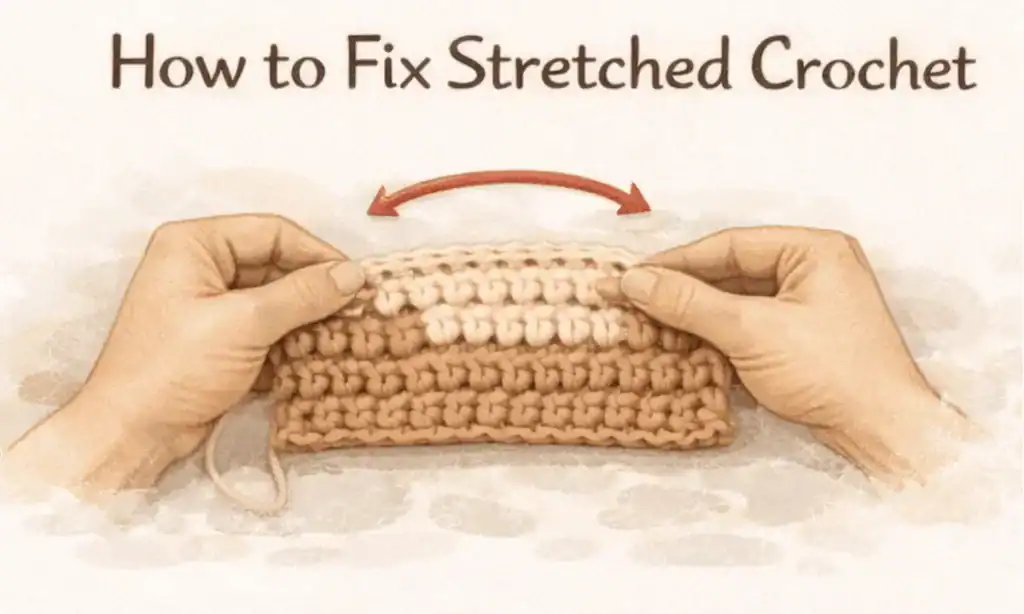
While the crochet is still damp, lay it flat and begin reshaping it to the intended dimensions.
Use your hands to:
• pull edges back into alignment
• square corners
• smooth the surface
• adjust length and width gradually
This step works because crochet stitches behave like flexible hinges.
When wet, they can move slightly until they settle again during drying.
However, beginners should avoid one common mistake:
Over-stretching the fabric while trying to “fix” it.
Pull only enough to restore the intended shape, not to stretch the project tighter than before.
Step 4 — Dry flat with full support
Place the reshaped project on a surface where gravity cannot pull it out of shape again.
Good drying surfaces include:
• towels on a table
• foam blocking mats
• a flat drying rack covered with towels
Avoid drying on surfaces with gaps or uneven support.
If sections hang downward while drying, gravity will stretch those stitches again.
Step 5 — Repeat if needed
Some crochet items require two reshape cycles to recover their structure.
This happens when:
• the fabric stretched significantly
• the yarn absorbed large amounts of water
• the project is very large (like a blanket)
Repeating the process often restores more structure than trying to force the shape in one attempt.
This gradual approach protects the yarn and helps the stitches settle evenly.
How to Reshape Crochet After Washing
Full micro guide:
• How to reshape crochet after washing (LT25-M02)
Reshaping crochet is essentially a manual form of blocking.
Blocking normally uses pins or mats to control shape.
Reshaping simply relies on hand positioning and flat drying.
The process includes three actions:
• guiding the fabric into correct dimensions
• aligning edges and corners
• allowing stitches to dry in that position
Because crochet stitches are flexible loops, drying locks them into their new resting position.
Key reshaping techniques beginners should know
Measure wearables before reshaping
If you are fixing a sweater, hat, or garment, measure the expected dimensions before reshaping.
This prevents accidental stretching while adjusting the fabric.
Align edges carefully
For blankets or squares, straighten:
• the top edge
• the bottom edge
• both sides
• the corners
Even small misalignments can become noticeable once the project dries.
Smooth edges with your hands
Run your hands gently across the crochet surface while reshaping.
This redistributes stitches and helps the loops settle evenly.
Predictive beginner difficulty
Many beginners focus only on length when reshaping.
But crochet distortion often happens diagonally, not just vertically.
That means correcting:
• corners
• side edges
• row alignment
is just as important as adjusting overall length.
If edges remain uneven after reshaping, the problem may relate to tension rather than washing.
Related concept:
• Why Are My Crochet Edges Uneven (LT05)
Can You Fix Stretched Acrylic Crochet?
Full micro guide:
• Can you fix stretched acrylic crochet (LT25-M03)
Acrylic yarn is often the easiest fiber to reshape after stretching.
This happens because acrylic fibers are lightweight and tend to bounce back when supported during drying.
Acrylic typically responds well to the beginner rescue method:
• re-wet the item
• remove water gently
• reshape carefully
• dry flat
Because acrylic absorbs less water than cotton, the stitches usually do not remain stretched for long periods.
Important boundary: heat and acrylic
Some tutorials online suggest shrinking acrylic using heat.
This is risky.
Acrylic fibers are essentially plastic polymers.
High heat can:
• melt the fibers
• flatten stitch texture
• permanently distort the fabric
Once acrylic fibers melt, the stitches cannot be repaired.
For beginners, the safest rule is simple:
Avoid heat shrinking acrylic entirely.
Gentle reshaping during drying is far safer and usually effective.
Can You Fix Stretched Cotton Crochet?
Full micro guide:
• Can you fix stretched cotton crochet (LT25-M04)
Cotton behaves very differently from acrylic.
Cotton fibers:
• absorb much more water
• become heavy when wet
• stretch easily under gravity
Because of this, cotton projects often stretch more dramatically during drying.
Cotton also has less elastic recovery than acrylic.
This means stretched stitches may retain their shape longer.
Why cotton stretching can become permanent
Cotton yarn lacks natural elasticity.
When loops stretch and dry in that stretched position, they may remain in that shape.
This is especially common when:
• a cotton project is hung while wet
• a blanket stretches under its own weight
• stitches were loose originally
Even so, reshaping still improves many cotton projects.
Repeated reshape-and-dry cycles can often reduce visible stretching.
Cotton recovery strategy
For cotton projects, patience matters more than force.
The most effective approach is:
• re-wet the item
• reshape slowly
• dry completely flat
• repeat if necessary
Some cotton projects improve significantly after blocking, which helps restore edges and structure.
Blocking is explained in:
• How to Block Crochet Projects (LT30)
Big Picture Return — Why This Matters for Crochet Care
Understanding how to fix stretched crochet connects directly to the broader crochet care system explained in:
👉 Pillar #10 – Crochet Care & Maintenance Guide
In this pillar stage, learners begin recognizing that finished crochet projects require:
• correct washing methods
• proper drying support
• fiber-specific care strategies
Stretching is one of the most common problems beginners encounter after washing.
Learning how to reshape projects teaches a deeper principle:
Crochet fabric behaves dynamically — stitches move, relax, and settle depending on how the fabric is handled.
This understanding helps prevent future mistakes such as:
• hanging heavy blankets while wet
• using aggressive drying methods
• reshaping items incorrectly
Special Case: Crochet Blanket Stretched
Blankets are the crochet projects most likely to stretch.
This happens simply because they are large and heavy when wet.
A wet blanket can weigh several times more than when dry.
That weight pulls downward on every stitch.
The best recovery method for blankets is:
- Re-wet the blanket
- Press out excess water using towels
- Lay it flat on a large surface
- Reshape the corners carefully
- Allow 24–48 hours of drying
During drying, rotate the blanket every few hours.
This prevents uneven stretching and helps the fabric settle evenly.
Related Micro Topics Introduced in This Article
Several specific troubleshooting situations exist within the stretched crochet category.
Those situations are covered by dedicated micro guides:
- Can You Shrink Stretched Crochet? The Fiber Truth
- How to Fix Stretched Crochet Blanket: Restoring Straight Edges
- How to Fix Stretched Crochet Sweater: Rescuing Your Fit
- How to Reshape Crochet After Washing: The Tactile Method
- Why Crochet Stretches Permanently: Identifying Unfixable Damage
- Dry Crochet Without Stretching Guide: The Gravity-Free Zone
- Blocking to Fix Stretched Crochet: The Professional Secret
These micro articles handle specific beginner problems, while this longtail explains the broader concept of reshaping and recovery.
When Stretched Crochet Is Permanent (And What to Do)
Full micro guide:
• When stretched crochet is permanent (LT25-M05)
Although many crochet projects can be reshaped successfully, there are situations where stretching becomes partially or fully permanent.
This usually happens when the fabric has stayed stretched long enough for the yarn fibers to dry in the extended position.
Common situations where permanent stretching occurs include:
• the project was hung while soaking wet
• a heavy item stayed stretched for many hours or overnight
• the yarn is cotton or another low-elasticity fiber
• the stitches were very loose to begin with
• the item is large and heavy, such as a blanket
When this happens, the stitches are no longer simply relaxed — they have settled into a new resting structure.
Even in these cases, the project is rarely “ruined.”
It simply means the goal shifts from full restoration to structural improvement.
Option 1 — Improve the shape
Even if the project cannot return to its original size, reshaping can still improve how it looks and functions.
Try:
• re-wetting the item
• reshaping it carefully
• drying it flat with full support
Often this reduces the stretching enough that the project becomes balanced and usable again.
Option 2 — Add structural support
If stretching affected the edges or openings of a project, additional structure can help restore stability.
Possible fixes include:
• adding a border around a blanket or garment
• adding a lining inside bags
• inserting elastic into wearable edges
These methods reinforce the fabric so gravity cannot continue pulling stitches downward.
A border can also visually correct slightly uneven edges.
Option 3 — Repurpose the project
Sometimes a stretched project simply changes form rather than becoming unusable.
For example:
• a blanket that stretched longer can become a throw
• a stretched square blanket can become a cushion cover
• a stretched scarf can become a wrap
Many crocheters repurpose projects this way rather than discarding them.
This reflects an important principle in handmade crafts:
Imperfect projects often remain beautiful and functional.
Special Case: Crochet Blanket Stretched (Best Recovery Strategy)
Blankets behave differently from smaller crochet items.
Because they contain more yarn, they become significantly heavier when wet.
That weight pulls downward across the entire fabric structure.
If your crochet blanket stretched after washing, the most reliable recovery process is:
- Re-wet the blanket in cool water
- Press out excess water using towels
- Lay it flat on a large surface
- Reshape the corners and edges carefully
- Allow 24–48 hours of drying time
During drying, rotate or flip the blanket every few hours.
This ensures that moisture leaves the fabric evenly and prevents certain areas from stretching further.
Resolution Confirmation — How to Know the Fix Worked
You can confirm that reshaping has worked if the following signs appear after the project fully dries:
• the project’s length and width are closer to the original size
• the stitches appear balanced and evenly spaced
• the edges lie flat rather than curling or sagging
• the fabric feels stable rather than loose
If these conditions are visible, the crochet structure has successfully reset during drying.
If the project still appears uneven, repeating the reshape-and-dry process may improve the result further.
Preventing Stretching Next Time (Quick Rules)
Once beginners understand why crochet stretches, preventing it becomes much easier.
Basic prevention guidelines include:
• wash crochet items in cold water
• use gentle cycles or hand washing
• avoid aggressive spinning
• support the project fully when wet
• never hang wet crochet
• always dry flat with full support
Following these rules prevents gravity from pulling stitches downward while the yarn fibers are relaxed.
For detailed washing methods, see:
• How to Wash Crochet Projects Safely (LT23)
• Why Crochet Stretches After Washing (LT24)
Micro Roadmap for This Longtail
The following micro articles belong to this longtail and cover specific troubleshooting situations:
- Can You Shrink Stretched Crochet? The Fiber Truth
- How to Fix Stretched Crochet Blanket: Restoring Straight Edges
- How to Fix Stretched Crochet Sweater: Rescuing Your Fit
- How to Reshape Crochet After Washing: The Tactile Method
- Why Crochet Stretches Permanently: Identifying Unfixable Damage
- Dry Crochet Without Stretching Guide: The Gravity-Free Zone
- Blocking to Fix Stretched Crochet: The Professional Secret
These micro guides address specific beginner questions, while this article explains the overall concept of restoring stretched crochet fabric.
Related Beginner Questions
Beginners often ask several related questions when learning about crochet stretching.
These questions help expand understanding of crochet fabric behavior.
Why did my crochet stretch so much after washing?
Crochet stitches relax when wet, and gravity pulls loops downward if the item is unsupported.
Why do cotton crochet projects stretch more than acrylic?
Cotton absorbs more water and becomes heavier, which increases gravitational pull on the stitches.
Does blocking fix stretched crochet?
Blocking can help reshape the fabric, especially for cotton projects, but it does not always restore the original dimensions completely.
Is stretched crochet always permanent?
Not always. Many projects recover significantly through reshaping and proper drying.
FAQ
Can you fix stretched crochet after washing?
Often yes.
Re-wetting the project, reshaping it, and drying it flat with full support can restore much of the original structure.
See: Crochet stretched out after washing fix (LT25-M01)
Can you shrink crochet back to its original size?
Sometimes.
Acrylic yarn usually reshapes more easily, while cotton yarn may keep part of the stretched shape because it lacks elasticity.
Why did my crochet blanket stretch so much?
Large blankets become very heavy when wet.
Gravity pulls the stitches downward, which lengthens the loops.
See: Why Crochet Stretches After Washing (LT24)
Is stretched crochet permanently ruined?
Rarely.
Even when stretching cannot be fully reversed, reshaping, borders, or repurposing often make the project usable again.
See: When stretched crochet is permanent (LT25-M05)
Learning Continuity — Where This Fits in the Crochet System
Understanding how to fix stretched crochet is one step in learning how finished crochet projects behave over time.
Within the crochet learning progression, this topic belongs to:
Pillar #10 — Crochet Care & Maintenance Guide
At this stage, learners begin managing real-world issues that occur after projects are completed, including:
• washing finished crochet
• reshaping stretched fabric
• blocking projects for stability
These skills help crocheters protect the time and effort invested in handmade work.
Next Step in the Learning Path
The next concept in this pillar explains a technique used to intentionally shape and stabilize crochet projects.
👉 Next Longtail:
How to Block Crochet Projects
Related topics within this pillar include:
• How to Wash Crochet Projects Safely
• Why Crochet Stretches After Washing
Together, these guides form the Crochet Care & Maintenance system, which helps crocheters maintain the shape, durability, and appearance of their finished projects.