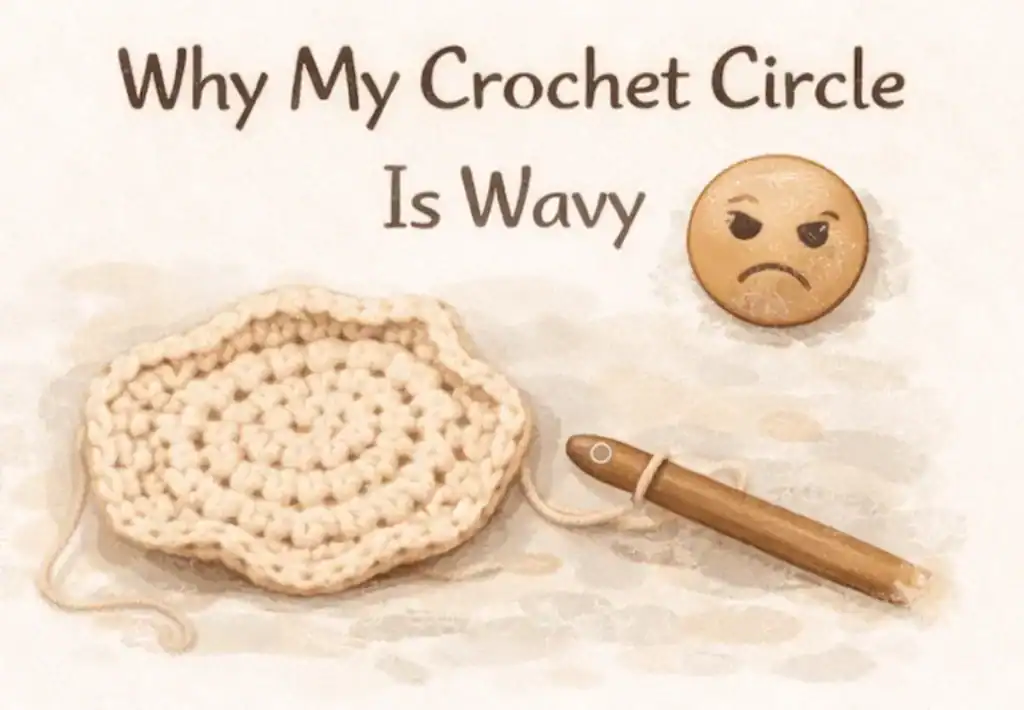
Why Is My Crochet Circle Wavy? (Too Many Increases + Easy Fix Guide)
If you’re crocheting a circle in the round and the edges start looking like:
- ripples
- waves
- ruffles
- lettuce-like edges
- a circle that refuses to lie flat
you might immediately think:
“Why is my crochet circle wavy? I followed the pattern exactly.”
This situation confuses many beginners because the project often looks correct for the first few rounds, then suddenly begins to ripple.
In most cases, the problem is not random.
A wavy crochet circle usually means the outer edge contains more fabric than the circle can distribute evenly.
When that happens, the extra fabric pushes outward and forms ripples or waves instead of lying flat.
This guide explains the full concept behind the problem so you can understand:
- why crochet circles become wavy
- why too many increases create ripples
- how stitch growth affects circle shape
- how to fix a wavy crochet circle safely
- why circles may ripple only after several rounds
- when blocking helps (and when it cannot fix the issue)
This article belongs to:
Pillar #11 – Working in the Round (Stitches + FAQ)
Within the learning progression of that pillar, this topic appears after beginners learn basic circular stitches, because shape problems typically appear once projects grow past the first few rounds.
Understanding this concept helps beginners diagnose shape issues early before they continue building the project.
- The Geometry Behind Flat Crochet Circles
- The Increase Formula That Keeps Circles Flat
- Why the Increase Formula Changes With Stitch Height
- Common Beginner Increase Mistakes
- Why Crochet Circles Ripple After a Few Rounds
- When Hook Size Contributes to Ripples
- When Blocking Can Help (And When It Cannot)
- Yarn Choice Can Influence Circle Stability
- Big Picture Return — How This Concept Fits Into Circular Crochet
- How to Fix a Wavy Crochet Circle (Beginner-Safe Methods)
- Resolution Confirmation
- Extra Beginner Habits That Prevent Wavy Circles
- Micro Roadmap for This Longtail
- Related Beginner Questions
- FAQ
- Next Steps in Pillar #11 — Working in the Round
Quick Answer (TL;DR)
Your crochet circle becomes wavy or rippled when the outer rounds grow faster than the center can support.
The most common causes are:
- too many increases
- increases placed in the wrong stitches
- stitch count growing faster than the circle formula
- tension becoming looser as the project expands
- yarn and hook combination producing overly loose stitches
Fast beginner fix
- Undo the last 1–2 rounds.
- Re-check the increase formula for your stitch type.
- Count stitches carefully each round.
- Maintain consistent tension.
- Use an appropriate hook size for your yarn.
When the correct increase rhythm returns, the circle usually flattens naturally again.
What “Wavy” Really Means in Crochet
A well-made crochet circle is balanced fabric expansion.
Three things must grow together:
- the stitch count
- the circumference
- the fabric tension
When those stay balanced, the circle remains flat.
When the balance breaks, shape problems appear.
A wavy circle means:
- the outer edge contains too many stitches
- the circumference expands too quickly
- the fabric must fold or ripple to absorb the extra width
Visually, the circle begins to look like:
- a ruffled skirt
- a lettuce leaf edge
- small waves along the outer round
This effect is not a random mistake.
It is a geometry problem created by stitch growth.
Understanding that relationship helps beginners stop guessing and start diagnosing the real cause.
Beginner Reality: Most Wavy Circles Come From One Cause
Although several things can influence circle shape, beginners should remember a simple rule:
Most wavy crochet circles happen because of too many increases.
In practice, this accounts for roughly 80–90% of beginner cases.
Other issues — such as tension drift or hook size — can contribute, but they usually magnify an increase problem rather than create it alone.
Common beginner mistakes include:
- accidentally increasing in the wrong stitch
- repeating the increase section too many times
- miscounting stitches at the end of a round
- adding extra stitches because the fabric “feels tight”
When these happen repeatedly across multiple rounds, the stitch count quietly grows larger than the pattern expects.
That extra fabric eventually has nowhere to go — so it forms ripples.
If you often struggle with counting stitches correctly, another related issue is:
Why my stitch count doesn’t match the pattern (LT14-M05)
That micro guide focuses specifically on counting errors that gradually distort round shapes.
Why This Problem Appears At This Learning Stage
This issue becomes common once beginners start working on larger circular pieces, such as:
- coasters
- hats
- amigurumi bases
- granny circles
- bag bases
During the first few rounds, the circle is very small, so even incorrect increases may not show immediately.
But as the diameter grows, the geometry of the circle becomes stricter.
Small counting errors or extra increases suddenly become visible.
That is why many beginners say:
“It looked fine for the first three rounds, then suddenly it became wavy.”
Understanding the increase rhythm of circular crochet is the key skill that prevents this.
Later sections of this guide explain how the increase formula controls circle growth.
Why Too Many Increases Create Ripples
Full micro guide:
Too many increases make crochet circle wavy (LT26-M02)
In crochet circles, increases are necessary because the project must grow outward.
Each round must add stitches so the circumference becomes larger.
However, there is a precise balance.
If increases are added too frequently, the outer round grows faster than the center.
This creates excess fabric along the edge.
The edge cannot stretch flat, so it forms:
- ripples
- waves
- ruffles
This effect becomes more visible as the circle grows larger.
Think of it like adding too much fabric to the hem of a skirt.
If the waistband stays the same size but the hem becomes much larger, the extra material naturally forms folds.
Crochet behaves the same way.
Visual Confirmation Signal
You can usually recognize a true increase problem by observing the edge.
Signs include:
- the outer round lifting off the table
- ripples forming evenly around the circle
- the circle refusing to lie flat even when gently stretched
If these symptoms appear immediately after a round containing many increases, the cause is usually clear.
The next sections will explain how beginners can correct the increase pattern and restore a flat circle.
The Geometry Behind Flat Crochet Circles
To understand why circles become wavy, it helps to understand a simple geometric rule.
Every crochet circle must grow in controlled expansion.
Each new round must add just enough stitches to allow the fabric to expand outward without folding.
If too few stitches are added, the circle cups into a bowl.
If too many stitches are added, the circle ripples outward.
This balance is controlled by the increase formula.
In crochet circles, the increase formula determines:
- how many stitches must be added
- how quickly the circumference grows
- whether the fabric remains flat
Beginners often assume increases are flexible, but in circular crochet the pattern follows a consistent mathematical rhythm.
Breaking that rhythm creates visible shape distortion.
The Increase Formula That Keeps Circles Flat
Full micro guide:
Crochet circle increase formula for beginners (LT26-M04)
A flat crochet circle follows a predictable increase pattern.
For example, a basic single crochet circle often begins like this:
Round 1
6 stitches into the center
Round 2
Increase in every stitch → 12 stitches
Round 3
(1 sc, inc) repeat → 18 stitches
Round 4
(2 sc, inc) repeat → 24 stitches
Round 5
(3 sc, inc) repeat → 30 stitches
Each round adds the same number of increases as Round 1.
So if the circle starts with 6 stitches, each round increases by 6 additional stitches.
This maintains the correct ratio between:
- circle diameter
- circumference
- stitch size
When this ratio stays consistent, the circle remains flat.
Why the Increase Formula Changes With Stitch Height
Many beginners become confused because different stitches use different formulas.
The reason is simple:
taller stitches create more fabric height and width.
Because of that, they require more increases to maintain a flat circle.
Typical beginner formulas look like this:
Single crochet circles
≈ 6 increases per round
Half double crochet circles
≈ 8 increases per round
Double crochet circles
≈ 12 increases per round
If a beginner uses the single crochet formula while crocheting double crochet, the circle will almost always ripple.
That is because the fabric grows much faster than the increase rhythm allows.
This misunderstanding explains why some circles look correct for a few rounds and then suddenly become wavy.
Common Beginner Increase Mistakes
Several small mistakes can quietly add extra stitches to a circle.
These mistakes accumulate over several rounds and eventually create ripples.
Typical beginner errors include:
Increasing twice in the same stitch accidentally
Misreading the repeat section in a pattern
Forgetting the starting chain or slip stitch
Losing track of the first stitch of the round
Adding “extra” stitches because the circle feels tight
The last mistake is especially common.
Beginners sometimes think a circle needs more stitches if the fabric feels tight, but this often leads to over-expansion.
In circular crochet, the formula should control the shape, not intuition.
Why Crochet Circles Ripple After a Few Rounds
Full micro guide:
Why my crochet circle ripples after a few rounds (LT26-M05)
A very common beginner experience is this:
“My circle looked perfect for three rounds, then suddenly it started rippling.”
This usually happens because of tension drift.
Tension drift occurs when stitch size gradually changes during the project.
At the beginning of a project, beginners often crochet tightly because they are concentrating.
As the rounds continue, the hands relax and stitches become slightly looser.
When stitches become larger, the fabric expands faster.
Even if the stitch count remains correct, the circle can start to ripple.
This is why circles sometimes flatten again when tension returns to normal.
Guides that explain tension control in detail include:
Both topics belong to earlier learning stages in the crochet system because tension control affects many crochet shapes.
When Hook Size Contributes to Ripples
Another factor that can exaggerate ripples is the hook size used for the yarn.
If the hook is significantly larger than recommended, stitches become:
- taller
- looser
- more flexible
That extra looseness creates additional fabric width, which can exaggerate even small increase mistakes.
In this case the circle may ripple even if the stitch count is correct.
A smaller hook often tightens the structure enough to stabilize the shape.
The beginner hook selection guide that explains this relationship in detail is:
What Size Crochet Hook Should Beginners Use (LT12)
This topic is related but belongs to a separate concept cluster in the crochet learning system.
When Blocking Can Help (And When It Cannot)
Full micro guide:
Can blocking flatten a wavy crochet circle (LT26-M06)
Blocking is a finishing technique used to shape crochet fabric.
In some cases, blocking can flatten small ripples caused by:
- minor tension variation
- slightly uneven stitches
- soft yarn fibers
However, blocking cannot remove extra stitches.
If a circle contains significantly more stitches than the correct formula requires, the fabric still contains too much material.
In those cases, blocking will not solve the problem.
A simple beginner rule helps identify the difference.
If the circle shows small soft ripples, blocking may help.
If the edge looks like ruffled lettuce leaves, the circle almost certainly contains too many stitches and must be corrected earlier in the project.
The full blocking process is explained in:
How to Block Crochet Projects (LT30)
Yarn Choice Can Influence Circle Stability
Full micro guide:
Best yarn for flat crochet circles (LT26-M07)
Yarn characteristics can also affect how easy it is to maintain a flat circle.
Some yarn types make increases difficult to see or control.
Common beginner challenges include yarn that is:
very fuzzy
very dark
very thin
split easily
highly elastic
When stitches are difficult to see, beginners are more likely to misplace increases or lose track of stitch counts.
For learning circular crochet, the easiest yarn characteristics are:
smooth texture
light color
medium thickness
clear stitch definition
A common beginner recommendation is worsted weight acrylic yarn, which allows stitches and increases to remain clearly visible.
More detailed comparisons are explained in:
- Best Yarn for Crochet Beginners (LT10)
- Cotton vs Acrylic Yarn (LT11)
These topics belong to the yarn selection cluster in the crochet learning system.
Big Picture Return — How This Concept Fits Into Circular Crochet
This guide focuses on one concept:
why crochet circles become wavy.
Within the broader crochet learning system, this concept sits inside the pillar:
Working in the Round (Stitches + FAQ)
That pillar explains the full structure of round crochet, including:
- magic rings
- spiral vs joined rounds
- increase formulas
- shape troubleshooting
Understanding the causes of wavy circles helps beginners recognize when the increase formula is breaking down.
But it is only one part of learning circular crochet.
Other shape problems also appear at this stage, including:
- circles turning into hexagons
- visible seam lines
- gaps in magic rings
Each of those topics belongs to a separate longtail explanation within the same pillar.
How to Fix a Wavy Crochet Circle (Beginner-Safe Methods)
Full micro guide:
How to fix a wavy crochet circle (LT26-M03)
Once you recognize that a crochet circle is becoming wavy, the next question is how to fix it without ruining the project.
In most cases, beginners have two practical options.
Fix Method #1 — Frog Back One or Two Rounds (Most Reliable)
This is the safest and most accurate fix.
If the circle becomes wavy after finishing a round:
- Undo the last 1–2 rounds of stitches.
- Return to the last round where the circle still lies flat.
- Re-work the next round using the correct increase formula.
This works because the error usually occurs when extra increases appear during a specific round.
Correcting that round restores the balance between stitch count and circumference.
Although beginners sometimes hesitate to frog stitches, undoing a few rounds often saves more time than continuing with a distorted shape.
Fix Method #2 — Reduce Increases in the Next Round
Sometimes mild ripples can be corrected by adjusting the next round.
For example:
If the pattern says:
(3 sc, inc) repeat
you might instead try:
(4 sc, inc) repeat
This slightly slows the growth of the circumference and can flatten minor waves.
However, this method requires understanding the increase pattern, which is why beginners are usually better off correcting the previous round instead.
Fix Method #3 — Adjust Hook Size
If the stitch count is correct but the fabric still looks loose and wavy, the hook size may be contributing to the issue.
Using a hook that is too large can create:
- looser stitches
- wider fabric expansion
- exaggerated ripples
Trying a hook 0.5–1 mm smaller can tighten the fabric enough to stabilize the circle.
However, hook adjustments should only be used after confirming that the increase formula is correct.
Resolution Confirmation
You can recognize that the problem has been solved when:
- the circle lies flat on a table without curling
- the edges no longer form ripples
- the stitch count matches the expected round total
- the circle expands smoothly with each round
If these signals appear, the circle is once again following the correct increase rhythm.
This confirmation step helps beginners avoid continuing a project that already contains shape distortion.
Extra Beginner Habits That Prevent Wavy Circles
Many circle problems disappear when beginners adopt a few simple habits.
Use Stitch Markers
Mark the first stitch of each round.
This prevents common mistakes such as:
- accidentally adding extra stitches
- losing track of the round start
- increasing in the wrong position
Related micro guide:
How to use stitch markers for straight edges (LT05-M05)
Count Stitches Every Round (At Least While Learning)
Counting stitches may feel slow at first, but it prevents small mistakes from accumulating across several rounds.
Skipping this step often leads to:
- unexpected increases
- distorted shapes
- patterns that stop matching the instructions
Related micro guide:
How to count stitches (LT05-M06)
Follow the Formula Instead of Guessing
One beginner habit that causes many circle problems is adding increases because the fabric “feels tight.”
In circular crochet, intuition often leads to mistakes.
The increase formula controls the shape, not the feeling of the fabric.
Following the pattern consistently keeps the circle balanced.
Micro Roadmap for This Longtail
The following micro guides expand on specific problems introduced in this article.
These pages focus on single troubleshooting situations related to wavy crochet circles.
• Why my crochet circle is wavy
• Too many increases make crochet circle wavy
• How to fix a wavy crochet circle
• Crochet circle increase formula for beginners
• Why my crochet circle ripples after a few rounds
• Can blocking flatten a wavy crochet circle
• Best yarn for flat crochet circles
Each micro article addresses a single beginner situation, while this longtail provides the broader conceptual explanation behind the problem.
Related Beginner Questions
Beginners working on crochet circles often ask several related questions.
These topics appear within the same learning stage of circular crochet.
Why does my crochet circle turn into a hexagon?
Why does my crochet circle start cupping like a bowl?
Why do my increases create visible corners?
Why does my magic ring leave a hole in the center?
Each of these questions corresponds to a different troubleshooting concept within the Working in the Round learning cluster.
FAQ
Why is my crochet circle wavy?
A crochet circle usually becomes wavy because too many stitches were added during increases.
This creates extra fabric around the outer edge, which forms ripples instead of lying flat.
How do I fix a wavy crochet circle?
The most reliable fix is to undo the last one or two rounds and redo them using the correct increase count.
See: How to fix a wavy crochet circle
Can blocking fix a wavy crochet circle?
Blocking can flatten mild ripples caused by tension differences, but it cannot remove extra stitches.
If the circle contains too many increases, the stitches must be corrected instead.
See: Can blocking flatten a wavy crochet circle
What is the increase formula for a flat crochet circle?
The formula depends on the stitch type.
A common beginner example for single crochet circles is:
Start with 6 stitches, then add 6 increases each round.
See: Crochet circle increase formula for beginners
Next Steps in Pillar #11 — Working in the Round
This longtail explained one of the most common shape problems in circular crochet:
wavy or rippling circles caused by excess increases.
Within the broader crochet learning system, the next troubleshooting topics include other shape distortions beginners encounter when working in the round.
Next longtail in the pillar:
LT27 — Why Crochet Circle Turns Into a Hexagon
Then continue with:
LT28 — Why My Magic Ring Has a Hole
These topics remain part of the same pillar:
Working in the Round (Stitches + FAQ)
That pillar organizes the full learning sequence for beginners who want to master circular crochet structures.