Why Crochet Stretches After Washing (Acrylic vs Cotton + Prevention Guide)
If you’ve ever washed a crochet project and then thought:
- “Why did my crochet get bigger?”
- “Why did it grow longer?”
- “Why does it feel stretched out?”
You are not alone.
This is one of the most common crochet care problems beginners experience, especially after washing blankets, sweaters, or scarves.
The surprising part is that nothing is actually “wrong” with your crochet.
Most stretching happens because of how crochet fabric behaves when it gets wet.
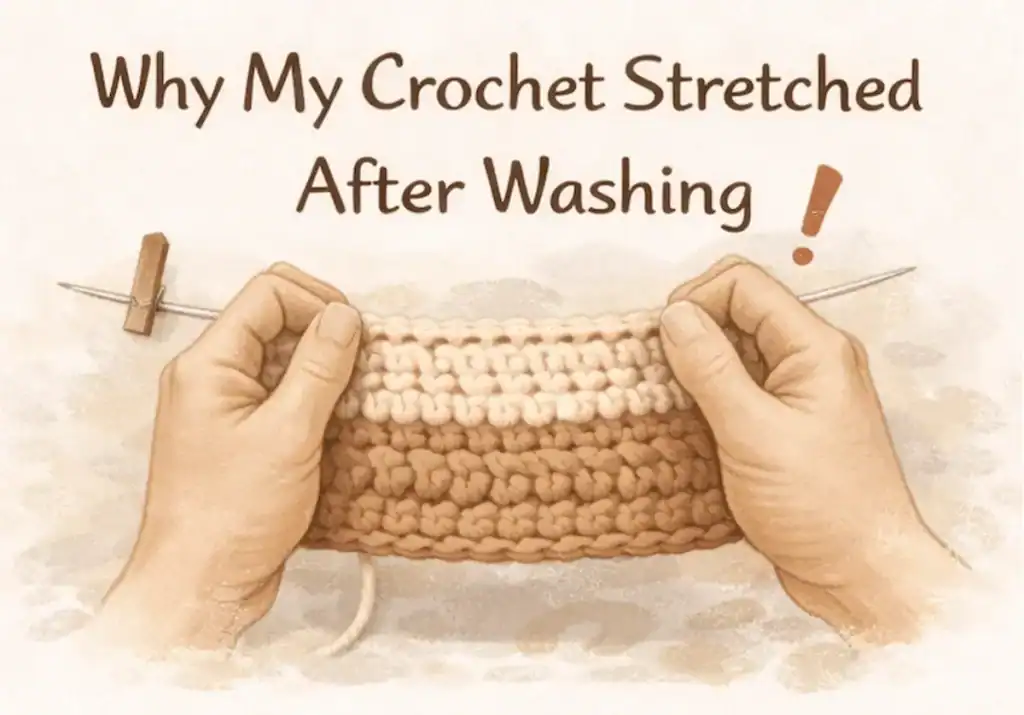
Crochet stretches after washing because crochet fabric is made of loops — and loops relax and shift when wet.
But stretching isn’t random.
It usually happens because of:
- fiber type (cotton vs acrylic)
- water weight
- agitation
- heat
- how you dry it
In this guide, you’ll learn:
- why crochet stretches after washing
- whether acrylic yarn stretches after washing
- whether cotton crochet stretches after washing
- why crochet grows longer after washing
- how to prevent crochet stretching in the wash
This longtail belongs to:
Pillar #10 – Crochet Care & Maintenance Guide
At this stage of learning, beginners are starting to care for finished crochet projects, and understanding how washing affects crochet structure becomes essential.
Quick Answer (TL;DR)
Crochet stretches after washing because wet crochet becomes heavier and the loops that form the fabric relax. As water fills the yarn, stitches loosen slightly and gravity can pull the fabric longer—especially in large items like blankets or sweaters.
Cotton yarn stretches more because it absorbs more water, while acrylic stretches mainly when large projects become heavy or when heat is used. Proper washing and drying techniques can prevent most stretching.
What Crochet Fabric Really Is (Concept Definition)
To understand stretching, it helps to understand how crochet fabric is built.
Crochet is not made from interlocking threads like woven fabric.
Instead, crochet fabric is made from:
one continuous yarn forming a chain of loops.
Each stitch is essentially:
- a loop
- pulled through another loop
- stacked into rows
Because of this loop structure:
- crochet fabric is flexible
- stitches can shift slightly
- the fabric can expand under tension
This flexibility is one of crochet’s strengths, but it also means crochet responds strongly to water, weight, and gravity.
Why Washing Changes Crochet Fabric
When crochet gets wet, several things happen at the same time.
1. Water adds weight
Yarn absorbs water.
Some fibers (like cotton) absorb a lot of water.
A wet crochet blanket can weigh several times more than when dry.
That extra weight pulls on the loops in the fabric.
2. Stitches relax
When yarn becomes wet:
- fibers soften
- tension inside the yarn relaxes
- stitches become more flexible
This relaxation allows stitches to shift slightly in shape.
3. Gravity stretches the fabric
Once crochet is heavy and flexible, gravity starts pulling downward.
This is why stretching usually appears as:
- longer projects
- sagging edges
- stretched rows
Not necessarily wider fabric.
Beginner Misconception
Many beginners assume stretching means they crocheted incorrectly.
In reality:
Stretching after washing is a structural behavior of crochet fabric, not a mistake.
What matters most is how the project is handled while wet.
Why Stretching Is Worse in Large Crochet Projects
Another pattern beginners notice:
Small crochet items rarely stretch much.
But large projects often do.
Examples:
- blankets
- sweaters
- shawls
- long scarves
These projects become much heavier when wet, and that weight multiplies the effect of gravity.
A wet crochet blanket can easily weigh 2–4 times more than when dry, which is enough to slowly pull stitches longer if the fabric is unsupported.
This is why how you lift or dry crochet matters so much.
Learning Stage Context (Why This Appears Now)
This topic appears in the Crochet Care & Maintenance stage of the learning path.
Earlier stages focus on:
- making stitches
- controlling tension
- finishing projects
But once beginners start washing their crochet items, they encounter new problems such as:
- stretching
- distortion
- uneven edges
- shape loss
Understanding why stretching happens helps prevent the common panic moment:
“I ruined my crochet after washing it.”
In most cases, the project is still completely recoverable.
Later in this guide we’ll explain:
- why different yarn fibers behave differently
- why crochet sometimes grows longer after washing
- how to prevent stretching in the wash
And we’ll introduce the specific fixes beginners use when stretching already happened.
Does Acrylic Yarn Stretch After Washing?
Many beginners assume acrylic yarn cannot stretch because it is a synthetic fiber.
But in crochet projects, stretching rarely comes from the fiber alone.
It mostly comes from the crochet structure itself.
Even though acrylic fibers absorb very little water, the loops that form crochet stitches still relax when wet.
That means acrylic crochet can stretch when:
- the project becomes heavy while wet
- stitches soften after washing
- the fabric is pulled while damp
- the item hangs under its own weight
So the short answer is:
Yes, acrylic crochet can stretch after washing.
However, acrylic usually stretches less dramatically than cotton, and it is often easier to reshape after drying.
Why Acrylic Usually Recovers Shape Better
Acrylic fibers are made from plastic-based polymers, which behave differently from plant fibers.
Key characteristics of acrylic yarn:
- absorbs very little water
- dries faster than cotton
- has elastic recovery
Because the fiber itself holds less water, acrylic crochet projects usually become less heavy when wet compared with cotton.
That reduces the downward pull that causes stretching.
But beginners should know one important limitation.
Applicability Boundary — Acrylic’s Real Weakness: Heat
Acrylic yarn does not like high heat.
Heat can cause:
- fiber distortion
- limp fabric texture
- stitch flattening
- permanent structural damage
Common mistakes that cause problems include:
- putting acrylic crochet in a hot dryer
- washing with hot water
- ironing acrylic crochet
Unlike stretching, which can sometimes be fixed, heat damage to acrylic yarn is usually permanent.
This is why most crochet care guides recommend:
- cold water washing
- gentle cycle
- drying flat whenever possible
For a complete washing guide see:
How to Wash Crochet Projects Safely (LT23)
Does Cotton Crochet Stretch After Washing?
Cotton behaves very differently from acrylic.
Cotton yarn is a plant fiber, which means it absorbs water extremely well.
When cotton gets wet:
- the fibers swell
- the yarn becomes heavier
- the fabric becomes more flexible
Because of this, cotton crochet projects often stretch more dramatically after washing.
This is especially noticeable in:
- market bags
- summer tops
- large dishcloths
- lightweight blankets
Cotton yarn can hold several times its own weight in water, which makes gravity stretching much stronger.
Why Cotton Crochet Is Most Vulnerable to Stretching
There are three main reasons cotton stretches more easily.
1. High water absorption
Cotton fibers soak up water quickly.
This increases the total weight of the project.
2. Low elastic recovery
Unlike acrylic or wool, cotton fibers do not bounce back strongly after stretching.
This means that if the crochet fabric stretches under weight, it may stay stretched longer.
3. Dense stitch structure
Many cotton crochet projects use tight stitches such as:
- single crochet
- half double crochet
- textured stitches
These stitches hold water inside the fabric longer, increasing weight.
Misconception Correction — Stretching Does Not Always Mean Damage
Many crocheters panic when cotton projects grow longer after washing.
But stretching can be temporary.
When the fabric dries and is reshaped, the stitches often return closer to their original form.
Permanent stretching usually happens only when:
- the item was hung while wet
- the project stayed stretched during drying
- the fabric experienced long periods under gravity
This is why the drying method is often more important than the washing method.
Why My Crochet Grew Longer After Washing
Another common beginner question is:
“Why did my crochet get longer instead of wider?”
This usually happens because of directional gravity stretch.
When a wet crochet project is lifted or hung, gravity pulls downward.
The fabric stretches along the stitch rows, creating length instead of width.
Typical situations that cause this include:
- lifting a wet blanket by one corner
- hanging a scarf over a drying rack
- hanging sweaters on hangers while damp
When the project hangs vertically, stitches slowly shift and elongate.
That creates the appearance that the crochet “grew longer overnight.”
Predictive Beginner Difficulty
Beginners often notice stretching after the first wash, even if the project looked perfect before.
This happens because:
- yarn relaxes slightly during its first wash
- stitches settle into their final shape
- tension differences become more visible
This effect is similar to what happens when blocking crochet for the first time.
In many cases, the first wash simply reveals the fabric’s true relaxed structure.
Big Picture Return to Pillar
Understanding why crochet stretches is part of a broader skill:
learning how to care for finished crochet projects.
Inside the Crochet Care & Maintenance Guide (Pillar #10), crocheters learn:
- how to wash crochet safely
- how different yarn fibers behave
- how to fix stretched crochet
- how blocking reshapes finished work
Stretching after washing is not a failure.
It is simply one of the normal behaviors of loop-based fabric, and once you understand the causes, it becomes easy to prevent.
Micro Topics Introduced in This Longtail
Several specific beginner problems branch out from this concept.
These are covered in micro guides linked to this longtail:
- Why crochet stretches after washing
- Does acrylic yarn stretch after washing
- Does cotton crochet stretch after washing
- Why my crochet grew longer after washing
- How to prevent crochet stretching in the wash
- Does Blocking Stretch Crochet? Friend vs. Foe for Your Stitches
- How to Reshape Stretched Crochet After Washing: The Rescue Protocol
Each micro article solves one precise situation, while this longtail explains the conceptual cause behind them.
How to Prevent Crochet Stretching in the Wash
Once you understand why crochet stretches, prevention becomes much easier.
The key principle is simple:
Wet crochet must be handled in a way that prevents gravity from pulling on the stitches.
Most stretching happens after washing, not during the wash itself.
The following care habits dramatically reduce stretching risk.
Rule 1: Always Wash Crochet in Cold Water
Cold water keeps yarn fibers more stable.
Hot water increases:
- fiber relaxation
- stitch distortion
- fabric flexibility
When stitches become too relaxed, they shift more easily under weight.
Cold water washing helps the crochet fabric maintain its structure.
Rule 2: Use Gentle Washing
Crochet fabric is made of interconnected loops.
Strong agitation pulls those loops out of alignment.
To avoid this problem:
- use a gentle machine cycle, or
- wash the project by hand
Gentle washing protects the structure of the stitches.
Rule 3: Support the Crochet Project When It Is Wet
This is one of the most important rules beginners often miss.
Never lift a wet crochet blanket or sweater by one corner.
Doing this concentrates all the weight in a single point, which stretches the fabric.
Instead:
- scoop the item up with both hands
- support it evenly
- move it like you would move a soft folded blanket
This prevents the fabric from stretching under its own weight.
Rule 4: Never Hang Crochet to Dry
Hanging is the number one cause of permanent crochet stretching.
When a wet project hangs vertically:
- gravity pulls continuously on the stitches
- rows slowly elongate
- the fabric dries in a stretched shape
Instead, crochet projects should always be dried flat.
Place the item on:
- a towel
- a blocking mat
- a flat drying rack
Then reshape the fabric gently while it is still damp.
Rule 5: Press Water Out Instead of Wringing
Wringing twists the yarn and stretches the stitches.
It also distorts the crochet structure.
A safer method is the towel press technique:
- Lay the crochet item on a dry towel
- Roll the towel with the project inside
- Press gently along the roll
- Unroll and reshape the project
This removes excess water without pulling on the stitches.
Rule 6: Reshape the Project While Damp
Crochet stitches are easier to adjust while slightly damp.
Before the project dries completely:
- straighten edges
- align rows
- adjust corners
This small step helps the crochet fabric settle back into its intended shape.
When Blocking Helps
If a crochet project stretched slightly during washing, blocking can help restore its structure.
Blocking allows crocheters to:
- reshape edges
- align stitches
- correct minor stretching
Blocking works especially well with:
- cotton
- wool
- acrylic blends
Guide:
How to Block Crochet Projects (LT30)
Blocking is part of the broader maintenance system described in the Crochet Care & Maintenance Guide (Pillar #10).
What If My Crochet Already Stretched?
If your crochet already stretched after washing, the situation is usually not permanent.
Many projects can be improved by:
- reshaping the fabric
- blocking the project
- allowing the stitches to dry in the correct position
In some fibers, minor shrinkage may even occur during drying.
However, if stretching happened while the project was hung to dry, the change may be harder to reverse.
A full step-by-step recovery guide is covered here:
👉 How to Fix Stretched Crochet (LT25)
Learning Continuity
At this stage in the crochet care learning path, beginners are starting to understand how finished crochet projects behave over time.
The key ideas learned in this longtail are:
- crochet fabric stretches because it is made from loops
- wet yarn increases fabric weight
- gravity causes directional stretching
- fiber type affects how strongly stretching appears
Once these mechanics are understood, crocheters can confidently move to the next stage of maintenance skills.
The next important skill is learning how to repair or reshape crochet projects that already changed shape.
Related Beginner Questions
Many beginners encountering this issue also ask:
- Why did my crochet blanket get bigger after washing?
- Does acrylic yarn stretch after washing?
- Why did my crochet project grow longer instead of wider?
- How do I dry crochet without stretching it?
- Can stretched crochet be fixed?
These questions are answered across the micro guides connected to this longtail, each addressing a specific situation.
Micro Roadmap for This Longtail
The following micro articles resolve the most common situations related to crochet stretching:
- Why crochet stretches after washing
- Does acrylic yarn stretch after washing
- Does cotton crochet stretch after washing
- Why my crochet grew longer after washing
- How to prevent crochet stretching in the wash
- Does Blocking Stretch Crochet? Friend vs. Foe for Your Stitches
- How to Reshape Stretched Crochet After Washing: The Rescue Protocol
These micro guides solve specific problems, while this longtail explains the underlying concept behind them.
FAQ
Why did my crochet stretch after washing?
Crochet stretches because the fabric is made from loops. When yarn becomes wet, stitches relax and the fabric becomes heavier. Gravity can then pull the loops longer, especially if the item is hung while drying.
Does acrylic crochet stretch after washing?
Yes. Acrylic projects can stretch when wet because the crochet structure relaxes. However, acrylic usually stretches less than cotton and is often easier to reshape.
Does cotton crochet stretch after washing?
Yes. Cotton absorbs a lot of water and becomes heavy, which increases the chance of gravity stretching during drying.
How do I stop crochet from stretching in the wash?
Wash in cold water, use a gentle cycle, support the project while wet, remove water with towels, and always dry crochet projects flat.
Next Steps in Pillar #10
Now that you understand why crochet stretches after washing, the next skill is learning how to repair or reshape stretched projects.
Continue with:
👉 LT25 — How to Fix Stretched Crochet
Then move to:
👉 LT30 — How to Block Crochet Projects
These guides continue the learning path inside:
Crochet Care & Maintenance Guide (Pillar #10)
This pillar organizes the full system for washing, repairing, and maintaining crochet projects so they keep their shape over time.