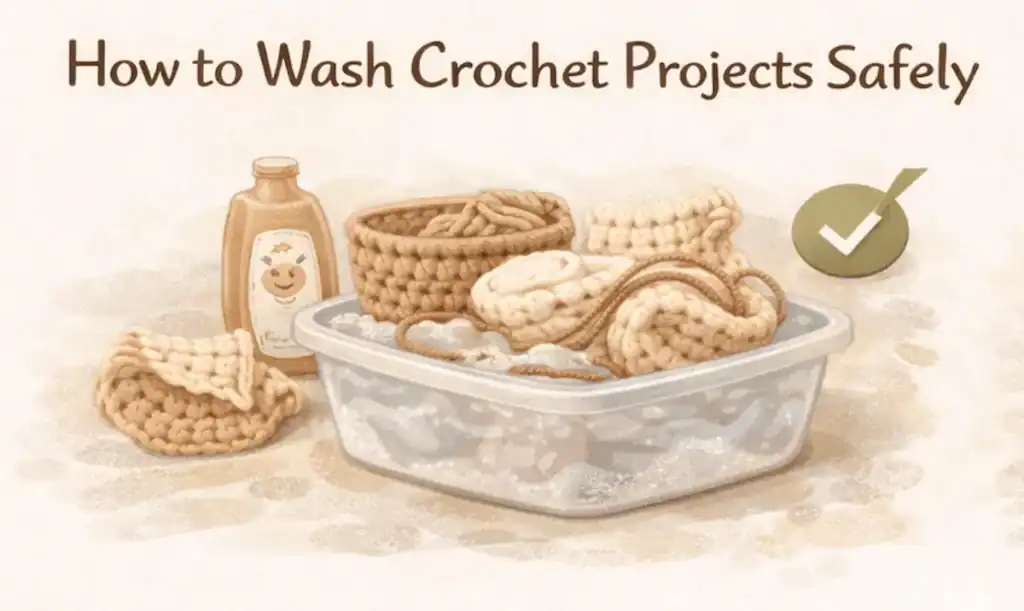
How to Wash Crochet Projects Safely (Without Stretching or Damage)
The first time you wash a crochet project can feel surprisingly stressful.
Many beginners hesitate before putting their finished item anywhere near water because they worry something might go wrong.
Common fears include:
- “What if the stitches stretch?”
- “What if the project shrinks?”
- “What if the yarn becomes fuzzy or rough?”
- “What if the shape gets distorted?”
Those concerns are completely valid.
Crochet projects can change shape during washing if they are handled incorrectly. But most crochet washing problems are not caused by water itself — they are caused by treating crochet fabric like normal clothing.
Crochet behaves very differently from woven fabrics.
A crochet project is built from interlocking loops, not tightly woven threads. Because of that structure, crochet fabric:
- stretches more easily
- absorbs more water
- becomes heavier when wet
- can distort under its own weight
When beginners wash crochet items using regular laundry habits — high heat, rough agitation, or hanging to dry — those structural differences create problems.
The good news is that crochet projects are actually quite washable when you understand how the fabric behaves.
Once you know a few basic care principles, washing crochet becomes simple and predictable.
In this guide you will learn:
- when crochet projects can be machine washed
- how to hand wash crochet safely
- how to wash crochet blankets without stretching
- how cotton yarn and acrylic yarn behave differently
- which detergents are safest for handmade items
- when blocking after washing helps restore shape
This article is part of: Pillar #10 — Crochet Care & Maintenance Guide
Within that pillar, this longtail focuses on safe washing methods before moving into deeper troubleshooting topics like stretching, reshaping, and blocking.
- Quick Answer (TL;DR)
- The Core Concept: Why Washing Crochet Requires Special Care
- Stage Position in the Crochet Learning Path
- A Common Beginner Misconception
- Safe Machine Washing Rules for Crochet
- How to Hand Wash Crochet Projects Safely
- Failure Anticipation: The Wringing Mistake
- How to Wash Crochet Blankets Without Stretching
- Critical Drying Rule for Crochet Blankets
- Fiber Behavior: Cotton vs Acrylic
- Choosing the Best Detergent for Crochet Items
- Big Picture Return to the Pillar
- When Blocking After Washing Helps Restore Shape
- Common Crochet Washing Mistakes Beginners Make
- How Washing Connects to the Next Crochet Maintenance Skills
- Micro Roadmap for This Longtail
- Related Beginner Questions
- FAQ
- Continue Learning Inside Pillar #10
Quick Answer (TL;DR)
Most crochet projects can be washed safely if you follow a few key rules:
- check the yarn label first
- use cold or cool water
- avoid high heat
- avoid aggressive agitation
- never hang heavy crochet while wet
- always dry flat with support
For most projects, the safest washing methods are:
Option 1 — Gentle hand washing
or
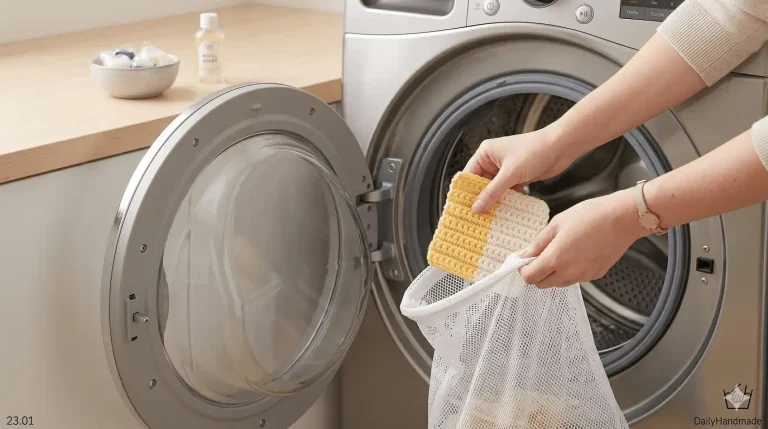
Option 2 — Machine washing on a delicate cycle inside a mesh laundry bag
Blankets and large projects require extra care because wet crochet becomes significantly heavier, which increases the risk of stretching.
A detailed breakdown of machine washing appears in:
Micro guide:
Can you machine wash crochet projects (LT23-M01)
The Core Concept: Why Washing Crochet Requires Special Care
Many beginners assume that yarn behaves the same way as regular clothing fabric.
But crochet items are built very differently.
A typical shirt or towel is made from woven fabric, where threads cross tightly in a stable grid. That structure holds shape well during washing.
Crochet fabric, however, is made from loops connected in a chain-like structure.
This loop structure creates three important characteristics:
1. Crochet fabric stretches more easily
Because the stitches are loops rather than fixed intersections, crochet fabric can expand under tension. When the item becomes wet and heavy, gravity alone can stretch it.
This is one of the reasons blankets sometimes grow longer after washing.
Later in this pillar, this issue is explained in detail in:
Longtail:
Why My Crochet Stretched After Washing
2. Crochet holds more water
The open structure of crochet stitches traps water between loops.
This means crochet items often become much heavier when wet, especially if the project is large.
Heavy wet fabric increases stress on the stitches.
This is why beginners are often surprised when a blanket that looked perfect before washing suddenly appears longer or looser afterward.
3. Crochet fabric can distort under its own weight
Unlike woven fabric, crochet fabric can shift slightly while drying.
If the item is hung or supported unevenly, the stitches may stretch in one direction.
That distortion is often mistaken for “ruined crochet,” but in many cases it is simply a result of improper drying support.
Understanding this behavior helps prevent most washing problems before they occur.
Stage Position in the Crochet Learning Path
Safe washing is introduced at this stage because it directly affects finished projects.
Many beginners first encounter washing concerns after completing their first wearable or blanket.
At this point in the learning journey, crocheters typically need to understand:
- how yarn fibers behave when wet
- how to clean projects without damaging stitches
- how drying methods affect shape
- when reshaping or blocking is necessary
This article focuses specifically on washing safety principles.
Later topics in this pillar will expand on related issues such as:
- Why projects stretch after washing
- How to fix stretched crochet
- How to block crochet items properly
Understanding safe washing is the first step before those advanced maintenance techniques make sense.
A Common Beginner Misconception
One of the most common mistakes beginners make is believing that machine washing is always dangerous for crochet.
In reality, many crochet items — especially those made with acrylic yarn — can be machine washed safely.
The real issue is how the washing process is done.
Problems usually happen when beginners use:
- hot water
- aggressive wash cycles
- high-heat dryers
- mixed loads with heavy fabrics like jeans or towels
When those factors are controlled, washing crochet becomes much safer than many people expect.
The next section explains how machine washing works for crochet projects and when it should — and should not — be used.
Can You Machine Wash Crochet Projects?
Full micro guide:
Can you machine wash crochet projects (LT23-M01)
Many beginners assume that crochet must always be hand washed.
That advice is common in older crochet books, but modern yarn fibers have changed the situation.
Today, many crochet items can be machine washed safely — especially when they are made from durable yarns like acrylic.
However, machine washing depends on several factors:
- the fiber type of the yarn
- the structure of the stitches
- how delicate the project design is
- whether the project includes fringe, lace, or decorative elements
Understanding these variables helps determine when machine washing is appropriate.
Machine washing works best when three conditions are true
Machine washing is generally safe when the project:
- Uses machine-washable yarn
- Has dense, stable stitches
- Does not include delicate decorative structures
Projects that usually tolerate machine washing well include:
- acrylic blankets
- simple scarves
- hats
- basic wearables
- dishcloths made with durable cotton
But some crochet items are structurally more fragile.
Items that should usually be hand washed include:
- lace crochet
- delicate cotton lace projects
- heirloom pieces
- items with long fringe
- projects with loose surface textures
- non-superwash wool
These projects rely on delicate stitch tension that can shift under machine agitation.
A deeper explanation of safe machine washing appears in the micro article:
Can you machine wash crochet projects (LT23-M01)
Safe Machine Washing Rules for Crochet
If you decide to machine wash crochet, the goal is to reduce friction, heat, and weight stress.
Beginner-safe rules include:
• use cold water
• select delicate or gentle cycle
• place the item inside a mesh laundry bag
• use mild detergent only
• avoid fabric softener
• avoid high-spin cycles
• avoid high-heat drying
The mesh laundry bag is particularly important.
It prevents crochet stitches from being pulled by other items in the washing machine. This reduces tension on the loops and helps maintain stitch structure.
Another beginner mistake is washing crochet together with heavy fabrics such as:
- jeans
- bath towels
- thick hoodies
These items create strong mechanical friction during the wash cycle.
Even sturdy crochet fabrics can become fuzzy when washed with rough materials.
How to Hand Wash Crochet Projects Safely
Full micro guide:
How to hand wash crochet projects safely (LT23-M02)
When beginners are unsure about washing safety, hand washing is the safest default method.
Hand washing reduces the three biggest risks in crochet washing:
- aggressive agitation
- friction from other fabrics
- uncontrolled stretching during spinning
Hand washing is particularly recommended for:
- lace crochet
- granny square projects
- cotton garments
- handmade gifts
- vintage crochet pieces
Beginner-friendly hand washing method
- Fill a basin with cool or cold water
- Add a small amount of mild detergent
- Submerge the crochet item fully
- Let it soak for 10–15 minutes
- Gently press water through the stitches
- Rinse with clean cool water
- Press excess water out using a towel
- Lay the item flat to dry
The key action is pressing, not wringing.
Failure Anticipation: The Wringing Mistake
A very common beginner mistake happens during the drying step.
Many people instinctively wring crochet like a towel to remove water.
This causes two problems:
- The twisting motion stretches the loops.
- The tension becomes uneven across the fabric.
Once stitches stretch unevenly, the project may appear distorted.
Even worse, twisting yarn fibers can weaken them over time.
Instead of wringing, the safest method is:
towel pressing
Lay the crochet item on a dry towel, roll the towel up, and gently press to absorb moisture.
This removes water without distorting stitch tension.
How to Wash Crochet Blankets Without Stretching
Full micro guide:
How to wash crochet blankets without stretching (LT23-M03)
Blankets require special attention because size multiplies every washing risk.
A blanket that weighs 800 grams when dry can weigh several kilograms when wet.
That extra weight pulls on the stitch structure.
When unsupported, wet blankets may:
- sag
- stretch
- become longer
- lose shape temporarily
This is why beginners often believe their blanket was “ruined” after washing.
In many cases the real cause is improper drying position, not the washing process itself.
Safe washing approach for blankets
The safest method is:
• cold water wash
• delicate cycle
• low spin
• remove promptly from washer
If hand washing a blanket, support the fabric carefully.
Never lift a heavy wet blanket by one corner.
That concentrates weight in one area and stretches stitches permanently.
Instead, lift it from multiple points or slide it onto a towel for support.
Critical Drying Rule for Crochet Blankets
The most important rule for blankets is simple:
Never hang a wet crochet blanket.
Hanging creates vertical tension from gravity.
That tension pulls stitches downward and stretches the entire project.
Instead:
- lay the blanket flat
- spread it across towels
- reshape the edges
- rotate occasionally while drying
This distributes weight evenly and protects the stitch structure.
If a blanket does stretch slightly, later sections of this pillar explain how to restore shape.
Those topics are covered in:
• Why My Crochet Stretched After Washing (LT24)
• How to Fix Stretched Crochet (LT25)
Fiber Behavior: Cotton vs Acrylic
Understanding yarn fiber behavior is one of the most useful maintenance skills for crocheters.
Different fibers react differently to water.
Two of the most common yarn types beginners use are cotton and acrylic, and they behave very differently when washed.
Washing Cotton Crochet Projects
Full micro guide:
How to wash cotton crochet projects (LT23-M04)
Cotton yarn absorbs significantly more water than synthetic fibers.
Because of this, cotton projects:
- become heavier when wet
- stretch more easily under weight
- sometimes shrink under high heat
- can temporarily lose shape during drying
Cotton crochet items should therefore follow stricter washing rules.
Safe cotton washing guidelines include:
• cool water
• mild detergent
• gentle washing motion
• avoid hot dryer
• reshape while damp
• always dry flat
Cotton garments and blankets often benefit from reshaping before drying.
While the item is still damp, gently adjust the edges back into their intended shape.
This helps stitches settle evenly as the project dries.
Washing Acrylic Crochet Projects
Full micro guide:
How to wash acrylic crochet projects (LT23-M05)
Acrylic yarn is one of the most beginner-friendly fibers because it is designed for durability.
Acrylic projects are often:
- machine washable
- resistant to shrinking
- resistant to water damage
- easy to maintain
This is why acrylic yarn is commonly recommended for beginners.
However, acrylic still has a few limitations.
Acrylic yarn can:
- stretch slightly when wet
- become fuzzy if washed roughly
- melt or warp under high heat
The biggest risk with acrylic is heat exposure, not water.
Hot dryers can soften the plastic fibers in acrylic yarn.
If the yarn softens under heat, the stitch structure may permanently deform.
For this reason, most crocheters prefer air drying acrylic items even if the yarn label allows machine drying.
Choosing the Best Detergent for Crochet Items
Full micro guide:
Best detergent for washing crochet items (LT23-M06)
Crochet fabric interacts closely with skin, especially for wearables and baby items.
Because of this, detergent choice matters.
Crochet-safe detergents should be:
- mild
- low fragrance
- free from strong whitening chemicals
- free from heavy softeners
Harsh detergents can slowly weaken yarn fibers.
Over time they may:
- strip softness from the yarn
- roughen the texture
- fade color
- irritate sensitive skin
For handmade gifts, many crocheters prefer gentle or baby-safe detergents.
These cleaners preserve yarn texture and reduce chemical exposure.
Big Picture Return to the Pillar
Washing is only one stage of crochet maintenance.
Even when washing is done correctly, crochet projects may still experience:
- mild stretching
- edge distortion
- uneven stitch settling
These changes are normal for loop-based fabrics.
The broader maintenance system inside Pillar #10 — Crochet Care & Maintenance Guide explains how crocheters restore and maintain finished projects.
The next major topics in this pillar address:
• why crochet stretches after washing
• how to repair stretched stitches
• how blocking restores shape and symmetry
Understanding safe washing prepares crocheters for those next steps.
In the final section of this article, we will connect washing knowledge with those follow-up maintenance techniques and introduce the related micro guides that expand this topic further.
When Blocking After Washing Helps Restore Shape
Full micro guide:
Should you block after washing crochet (LT23-M07)
After a crochet project is washed and dried, many beginners notice that the stitches look slightly different.
The edges might appear uneven, the fabric may feel looser, or the project may look slightly distorted compared to how it looked when it first came off the hook.
In many cases, nothing is actually wrong.
Crochet stitches naturally settle and relax after their first wash. This is especially true for projects made from cotton or natural fibers.
Blocking is a technique used to help the stitches settle into their intended shape.
Blocking after washing can:
- smooth uneven edges
- improve stitch alignment
- restore symmetry
- improve drape
- help granny squares become even
- shape lace patterns clearly
For example, lace crochet almost always looks better after washing and blocking because the open stitch pattern becomes properly defined.
However, blocking is not always necessary.
You usually do not need to block projects such as:
- dense acrylic scarves
- tightly stitched hats
- simple accessories that already hold shape well
Blocking becomes most useful when the project needs structural reshaping, not just cleaning.
The full technique for reshaping projects after washing appears in:
Longtail: How to Block Crochet Projects (LT30)
Common Crochet Washing Mistakes Beginners Make
Even when beginners follow general washing advice, a few mistakes still appear repeatedly.
Most crochet washing problems come from habits learned from regular laundry, not from crochet itself.
Here are the mistakes that cause the majority of crochet washing disasters.
Using Hot Water
Heat affects yarn fibers differently depending on their composition.
Hot water can:
- shrink cotton
- weaken delicate fibers
- distort certain yarn blends
Cold or cool water is almost always the safest option for crochet items.
Using a Hot Dryer
High heat dryers are one of the biggest risks for crochet fabric.
Heat can cause:
- cotton to shrink
- acrylic to soften and deform
- yarn fibers to lose elasticity
Many experienced crocheters avoid dryers entirely and prefer flat air drying instead.
Hanging Crochet to Dry
This is one of the most common beginner mistakes.
When a wet crochet item is hung to dry, gravity pulls downward on the loops.
That tension stretches stitches unevenly.
Large projects like blankets are especially vulnerable to this problem.
The safest drying method is always:
dry flat with full support.
Wringing Crochet Fabric
Twisting or wringing crochet fabric stretches the loops and disturbs stitch tension.
Instead of wringing, use towel pressing to remove water safely.
Washing Delicate Crochet with Heavy Fabrics
Crochet should never be washed together with rough fabrics such as:
- denim
- heavy towels
- jackets
These fabrics create friction that can cause yarn fibers to fuzz.
If machine washing is used, the crochet item should be placed inside a mesh laundry bag.
Not Supporting Large Projects When Wet
Wet crochet becomes significantly heavier than dry crochet.
If a large blanket is lifted by one corner, the weight of the water pulls down on the stitches.
This concentrated tension can permanently stretch the fabric.
Large projects should always be supported evenly during washing and drying.
How Washing Connects to the Next Crochet Maintenance Skills
Learning how to wash crochet safely is only the first step in understanding crochet care.
Once beginners begin washing finished projects, they may encounter new questions such as:
- Why did my crochet project stretch after washing?
- Can stretched crochet be fixed?
- Why do my edges look uneven after drying?
- When should blocking be used?
These questions are normal because crochet fabric changes slightly when exposed to water and gravity.
The next longtails in Pillar #10 — Crochet Care & Maintenance Guide explain these topics in depth.
The learning progression inside the pillar continues with:
LT24 — Why My Crochet Stretched After Washing
This article explains the mechanical reasons behind stitch stretching and why certain yarn fibers react differently.
Then the pillar continues with:
LT25 — How to Fix Stretched Crochet
This guide teaches practical methods for restoring shape when stretching occurs.
Finally, the maintenance system concludes with:
LT30 — How to Block Crochet Projects
Blocking is one of the most powerful tools crocheters use to reshape finished work and improve stitch definition.
Understanding washing first makes those techniques much easier to apply.
Micro Roadmap for This Longtail
This longtail introduces several specific washing topics that are explained in dedicated micro guides.
These micro articles solve individual washing questions in greater detail.
Micro cluster for LT23 — How to Wash Crochet Projects Safely
- Can you machine wash crochet projects
- How to hand wash crochet projects safely
- How to wash crochet blankets without stretching
- How to wash cotton crochet projects
- How to wash acrylic crochet projects
- Best detergent for washing crochet items
- Should you block after washing crochet
Each of these micro guides focuses on a single practical washing scenario and connects back to this longtail for the broader washing framework.
Related Beginner Questions
Many beginners search for variations of the same washing question.
Here are some of the most common beginner concerns related to crochet washing:
- Can crochet blankets go in the washing machine?
- Why did my crochet project stretch after washing?
- Do I need to hand wash crochet items?
- Can acrylic yarn go in the dryer?
- How do I reshape crochet after washing?
- Should crochet always be blocked after washing?
These related questions help guide readers deeper into the crochet care system explained throughout the pillar.
FAQ
Can you machine wash crochet projects?
Yes, many crochet projects can be machine washed if they are made with machine-washable yarn such as acrylic.
Use cold water, a gentle cycle, and a mesh laundry bag to reduce agitation and friction.
More details:
Can you machine wash crochet projects (LT23-M01)
How do I wash a crochet blanket without stretching it?
Wash the blanket using cold water and a delicate cycle, then remove it promptly and dry it flat with full support.
Never hang a wet crochet blanket.
Detailed guide:
How to wash crochet blankets without stretching (LT23-M03)
How do I wash cotton crochet items?
Cotton crochet should be washed in cool water with gentle detergent and dried flat.
Cotton absorbs water easily and can stretch under its own weight when wet.
More details:
How to wash cotton crochet projects (LT23-M04)
Should I block crochet after washing?
Blocking is often helpful, especially for lace, granny squares, and cotton projects.
Blocking reshapes stitches and smooths uneven edges.
Guide:
Should you block after washing crochet (LT23-M07)
Continue Learning Inside Pillar #10
This article explained how to wash crochet projects safely.
The next stage of crochet maintenance focuses on what happens after washing.
Continue with the next learning step in the pillar:
👉 LT24 — Why My Crochet Stretched After Washing
Then continue with:
👉 LT25 — How to Fix Stretched Crochet
And finally:
👉 LT30 — How to Block Crochet Projects
Full maintenance roadmap: Pillar #10 — Crochet Care & Maintenance Guide
Understanding washing, stretching, and blocking together forms the core system for keeping crochet projects clean, stable, and long-lasting.