Crochet for Beginners — How to Hold Your Hook & Yarn (Without Pain)
Quick Answer: How Should Beginners Hold a Crochet Hook and Yarn?
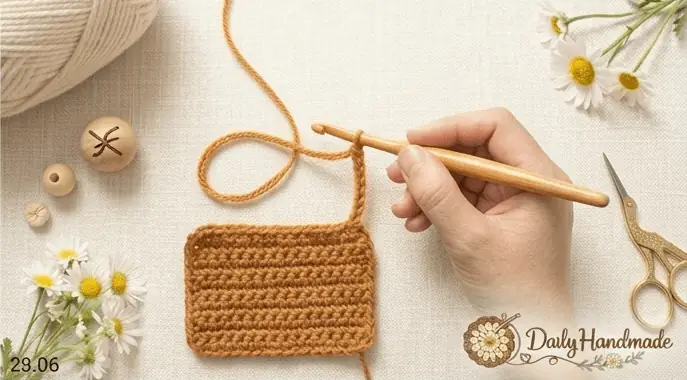
Hold the hook in a way that feels stable, relaxed, and repeatable.
Most beginners naturally settle into either a pencil grip or a knife grip, while allowing yarn to move with gentle, consistent resistance rather than tight control.
However, learning how to hold a crochet hook is not a minor beginner detail.
It is the physical foundation that determines how every later crochet skill develops, stabilizes, and eventually becomes effortless.
Before stitches become consistent.
Before patterns make sense.
Before speed appears naturally.
The body must first learn how to interact with tools and materials without strain.
This pillar explains not only how beginners hold a hook and yarn, but also why physical setup forms the first learning system inside crochet itself.
- Quick Answer: How Should Beginners Hold a Crochet Hook and Yarn?
- 1. Stability
- 2. Flow
- 3. Feedback Awareness
- The Hook Hand Creates Motion
- The Yarn Hand Regulates Resistance
- The Hook Hand Generates Motion
- The Yarn Hand Regulates Resistance
- 1. Wrist-Dominant Motion
- 2. Stabilizing Through Force
- 3. Tool Friction Mismatch
- 4. Practice Duration Mismatch
- Pattern 1 — The Control Spiral
- Pattern 2 — Tutorial Switching
- Pattern 3 — The Pain Push
- Pattern 4 — Tool Substitution
- 1. Reduced Grip Pressure
- 2. Smoother Yarn Movement
- 3. Decreased Hand Fatigue
- 4. Predictable Stitch Formation
- 5. Natural Posture Stability
- Is there one correct way to hold a crochet hook?
- Why does my tension keep changing?
- Should crochet hurt at the beginning?
- Do ergonomic hooks help beginners?
- How long until holding the hook feels natural?
- Beginner Hand Mechanics Cluster
- Beginner Tools
The Role of Hand Mechanics Inside the Crochet Learning System
Most beginner tutorials treat hook grip as an isolated technique — a small adjustment made before “real learning” begins.
Within the DailyHandmade learning system, this assumption is reversed.
Crochet develops through layered physical and cognitive adaptation:
comfort → control → consistency → fluency → independence
Hand mechanics belong to the first two stages:
- comfort
- control
These stages determine whether later learning becomes smooth or continuously frustrating.
When beginners struggle with stitches, patterns, or tension, the underlying cause is rarely misunderstanding instructions.
More often, the learner’s physical system has not yet stabilized.
Hand mechanics influence:
- tension regulation
- stitch formation accuracy
- movement rhythm
- endurance during practice
- long-term injury prevention
Because these effects propagate through every later skill, beginner hand setup functions as a pillar-level concept, not a small technical tip.
Learning Crochet Begins With the Body — Not the Stitch
A common misconception is that crochet learning starts with mastering stitches.
In reality, stitches are outputs produced by coordinated movement systems.
Before stitches can become predictable, beginners must develop three physical capabilities.
1. Stability
Holding tools without excessive muscular effort.
2. Flow
Allowing yarn to move continuously through the hands.
3. Feedback Awareness
Sensing tension through touch rather than visual correction.
Without these capabilities:
- stitches vary unpredictably
- hook insertion feels difficult
- wrists compensate with force
- fatigue appears quickly
- progress feels inconsistent despite practice
Two beginners can follow the same tutorial and produce completely different results.
The difference is usually coordination, not intelligence or effort.
Crochet learning therefore begins as motor adaptation, not technical memorization.
Why This Topic Requires a Pillar (System-Level) Explanation
Within the DH248 learning architecture, each content level serves a specific educational role.
- Pillars define learning systems
- Longtails explain individual concepts
- Micros resolve specific problems
Hand mechanics cannot be fully understood at the micro level because many beginner problems share the same underlying cause.
Examples include:
- tight tension
- wrist pain
- uneven stitches
Explaining each symptom separately without defining the system creates fragmented learning.
This pillar establishes the governing framework for the Beginner Hand Mechanics cluster, including:
- grip selection
- yarn tension behavior
- posture alignment
- fatigue prevention
- ergonomic adaptation
Longtail and micro articles expand individual components, but this guide defines how they connect within the beginner learning journey.
The Beginner Coordination Shift
Crochet introduces a coordination pattern unfamiliar to most people.
Each hand performs a different responsibility simultaneously.
The Hook Hand Creates Motion
- inserting into stitches
- rotating the hook
- drawing loops through space
The Yarn Hand Regulates Resistance
- feeding yarn
- adjusting tension continuously
- stabilizing fabric
- responding to movement feedback
Early learners attempt to consciously control both systems at once.
Because the brain has not yet divided responsibility between hands, beginners compensate by gripping harder or moving rigidly.
This produces the universal beginner experience:
“This feels unnatural.”
That feeling is not failure.
It is the nervous system building a new coordination map.
Crochet as a Physical Language
Crochet is often described as a craft.
From a learning perspective, it behaves more like acquiring a physical language.
The brain must synchronize:
- finger pressure
- rotational micro-movements
- visual tracking of loops
- tactile feedback from yarn tension
At first, these processes compete for attention.
Beginners often try to regain control by:
- tightening grip
- slowing movement excessively
Ironically, this increases instability.
Crochet relies on controlled relaxation rather than force.
With repetition, conscious effort transitions into automatic motion.
The moment beginners learn to hold hook and yarn comfortably marks the beginning of this transition.
Comfort Is a Learning Signal — Not Personal Preference
Another misconception suggests that comfort simply reflects personal style.
In motor learning science, comfort indicates efficiency.
When grip, posture, and tension align correctly:
- muscles activate only when needed
- movement becomes repeatable
- practice sessions extend naturally
- improvement accelerates without intentional effort
Discomfort signals compensation.
The body is working harder than necessary to achieve the same result.
This explains why beginners who ignore early discomfort often plateau despite frequent practice.
Comfort is therefore not optional.
It is a measurable indicator that learning is progressing correctly.
The Hidden Foundation of All Beginner Problems
Many early crochet frustrations appear unrelated.
Examples include:
- uneven stitches
- confusing tension
- hand fatigue
- slow progress
- difficulty following tutorials
Yet these problems share a common origin:
unstable physical setup.
When foundational coordination stabilizes:
- stitches improve automatically
- instructions feel clearer
- practice feels calmer
- confidence increases rapidly
This pillar exists to make that invisible foundation visible.
Rather than teaching isolated fixes, it organizes beginner experience into a predictable system learners can recognize and trust.
Why Crochet Feels Awkward at the Beginning
Nearly every beginner shares the same first reaction when holding a crochet hook:
“This doesn’t feel natural.”
This reaction is not a sign of poor coordination or lack of creativity.
It is a predictable response to learning a completely new motor system.
Most daily hand activities use synchronized motion, where both hands perform similar roles.
Crochet requires asymmetrical coordination, where each hand performs a different function simultaneously.
The Hook Hand Generates Motion
The hook hand is responsible for creating movement:
- entering stitches
- rotating the hook
- pulling loops through controlled pathways
The Yarn Hand Regulates Resistance
The yarn hand controls the flow of yarn and stabilizes the fabric:
- feeding yarn continuously
- adjusting pressure moment by moment
- stabilizing the developing fabric
- responding to tactile feedback
At the beginning, the brain attempts to consciously control both systems at the same time.
Because responsibility between hands has not yet separated, movements feel:
- rigid
- slow
- awkward
Awkwardness is not a mistake.
It is the first observable stage of coordination development.
The Control Illusion: Why Beginners Grip Too Tight
When humans encounter uncertainty, the nervous system automatically increases muscular tension.
Tightening muscles creates the feeling of control, even when it actually reduces precision.
Many beginners believe:
tighter grip = better control
In crochet, the opposite happens.
Excessive grip pressure creates several cascading effects:
- yarn cannot flow smoothly
- loops shrink unpredictably
- wrists compensate with force
- fatigue develops quickly
- stitch formation slows down
Crochet depends on guided movement, not forced movement.
The correct sensation is not looseness, but controlled relaxation.
This means:
- enough stability to guide the hook
- enough freedom for yarn to move smoothly
A useful observation:
Experienced crocheters appear relaxed not because they are careless, but because their coordination system has learned efficiency.
Why Yarn Tension Feels Impossible to Understand
Beginners often describe yarn tension as mysterious or inconsistent.
This confusion occurs because tension is not a single action.
It is a continuous feedback loop.
Your hands constantly respond to multiple signals:
- how easily yarn slides
- the size of newly formed loops
- resistance felt during pull-through
- fabric elasticity
- hook angle and movement speed
Early in learning, the brain cannot interpret these signals quickly enough.
Adjustments happen too late or too aggressively, producing alternating tight and loose stitches.
This creates the illusion that tension is unpredictable.
In reality, tension becomes stable only after sensory interpretation improves.
A critical transition occurs when learners stop trying to control tension directly.
Instead, they allow movement rhythm to regulate tension naturally.
This shift marks one of the most important milestones in beginner crochet.
Why Wrist Discomfort Appears So Quickly
Many beginners feel surprised when wrist discomfort appears even after following tutorials carefully.
Pain is rarely caused by crochet itself.
It usually results from movement compensation patterns.
1. Wrist-Dominant Motion
Beginners often move primarily from the wrist because it feels precise.
However, repetitive wrist motion concentrates strain in a small joint designed for flexibility rather than endurance.
Efficient crochet distributes movement across:
- fingers
- forearm rotation
- small hand adjustments
2. Stabilizing Through Force
When grip feels uncertain, learners unconsciously tighten muscles to stabilize the hook.
This transfers load into tendons instead of allowing balanced motion.
3. Tool Friction Mismatch
Different materials require different pressure levels.
For example:
- smooth metal hooks
- textured yarn fibers
Beginners unaware of this difference often compensate with excessive force.
4. Practice Duration Mismatch
Motor learning improves through short repetition cycles.
Long practice sessions overload muscles before coordination develops.
Pain is not a required part of learning.
It is feedback indicating that setup or movement patterns need adjustment.
Why Tutorials Sometimes Increase Beginner Frustration
Online tutorials usually demonstrate movements performed by experienced crocheters.
These experts operate using procedural memory developed through thousands of repetitions.
Their movements appear smooth because decision-making is no longer conscious.
Beginners attempting to copy visible motion alone often struggle because they are missing the invisible adaptation phase.
Tutorials rarely show:
- inconsistent early movement
- tension experimentation
- coordination errors
- gradual stabilization
Without understanding this hidden phase, beginners may assume they are failing.
In reality, they are simply earlier in the learning timeline.
Recognizing this gap protects motivation and prevents unnecessary switching between tutorials.
The Hidden Cognitive Load of Beginner Crochet
Crochet challenges not only muscles but also working memory.
During early practice, beginners simultaneously manage several mental tasks:
- counting stitches
- remembering instructions
- controlling tension
- guiding hook movement
- monitoring loop structure
This creates high cognitive load, which explains why beginners feel mentally tired after short sessions.
As coordination improves, several processes become automatic:
- hand positioning
- loop formation
- tension adjustment
Mental effort decreases dramatically.
Crochet eventually feels relaxing not because tasks become simpler, but because the brain delegates them to automatic systems.
Predictable Beginner Failure Patterns
Across many learning experiences, several patterns appear consistently.
Recognizing them early prevents unnecessary frustration.
Pattern 1 — The Control Spiral
The learner tightens grip to fix inconsistency.
This increases inconsistency, which leads to even tighter gripping.
Pattern 2 — Tutorial Switching
Changing instructional sources repeatedly instead of allowing motor adaptation time.
Pattern 3 — The Pain Push
Continuing practice despite discomfort rather than adjusting posture or grip mechanics.
Pattern 4 — Tool Substitution
Assuming new equipment will solve coordination issues before foundational movement stabilizes.
These patterns are not personal weaknesses.
They are natural responses to uncertainty during skill acquisition.
Awareness allows earlier correction.
Why Progress Feels Inconsistent From Day to Day
Beginners often notice crochet feels easier one day and difficult the next.
This fluctuation reflects how motor learning develops neurologically.
The brain alternates between two phases:
- exploration — where movement appears messy
- consolidation — where neural pathways strengthen during rest
Improvement frequently appears after breaks, not during practice.
This phenomenon explains sudden “better days” following periods of frustration.
Inconsistent performance is therefore evidence of adaptation, not regression.
The Emotional Reality of Early Crochet Learning
Frustration appears because visible results lag behind effort.
Beginners invest concentration and energy before improvement becomes noticeable.
Without understanding learning mechanics, this delay can feel discouraging.
Emotional difficulty is predictable during coordination learning because confidence depends on physical predictability.
Once hand comfort stabilizes:
- repetition increases
- mistakes feel manageable
- learning becomes enjoyable
Comfort acts as the emotional turning point in beginner crochet.
The System Connection Behind Every Beginner Problem
All challenges described above share a common learning stage:
physical setup and control development.
When grip, yarn flow, and posture stabilize:
- stitches improve automatically
- tutorials become easier to follow
- cognitive load decreases
- progress accelerates
This explains why resolving hand mechanics early produces disproportionately large improvements across all later crochet skills.
The learning system now moves from understanding problems to understanding progression — how beginners develop hand mechanics in the correct order.
The Correct Learning Order for Beginner Hand Mechanics
Beginners commonly try to solve discomfort by changing many variables at once.
They may:
- switch grips repeatedly
- buy different hooks
- adjust yarn tension constantly
- follow multiple tutorials simultaneously
Although this feels productive, it often slows learning.
Hand mechanics improve fastest when developed through structured progression, because each physical adaptation prepares the nervous system for the next one.
Within the DailyHandmade learning system, beginner hand coordination evolves through a layered sequence:
comfort → tension → efficiency → endurance → automaticity
Each stage builds upon stability established in the previous stage.
Skipping stages often creates instability that later appears as:
- tension problems
- uneven stitches
- fatigue
- inconsistent progress
Understanding this progression transforms practice from trial-and-error experimentation into guided development.
Stage 1 — Establishing a Stable Hook Grip
The first objective is not choosing the “best” grip style.
The objective is repeatable stability.
Many beginners frequently switch between pencil grip and knife grip in search of instant comfort.
However, constant switching interrupts motor learning because the brain must rebuild coordination patterns every time the hand position changes.
Both grips are valid.
Pencil Grip
Encourages fine finger control and smaller hand movements.
Knife Grip
Distributes movement through the hand and forearm, often reducing wrist strain.
Neither grip guarantees success.
Consistency is what matters most.
A stable grip allows:
- smooth hook insertion
- relaxed finger positioning
- small rotational movement without strain
- brief muscle relaxation between stitches
Progress Signal
You stop consciously thinking about how you are holding the hook during every stitch.
This indicates early motor automation beginning.
Stage 2 — Yarn Flow Before Perfect Tension
A common beginner misconception is attempting to control tension immediately.
However, tension is not learned directly.
Tension emerges from controlled yarn movement.
At this stage, learners should focus on continuous yarn flow, not perfect stitch size.
Healthy yarn flow feels like:
- gentle resistance instead of pulling
- continuous sliding rather than jerking
- minimal finger correction between stitches
Trying to force consistent tension too early usually leads to:
- tighter gripping
- increased fatigue
- inconsistent loops
Predictability matters more than perfection.
Material Consideration
Different yarn fibers behave differently.
For example:
- cotton yarn creates stronger resistance
- acrylic yarn often slides more easily
- wool blends offer moderate elasticity
Beginners may require slightly different pressure levels depending on the material.
The goal remains the same:
uninterrupted yarn movement.
Progress Signal
Loops form easily without deliberate adjustment.
Stage 3 — Bilateral Coordination and Rhythm Formation
Once grip stability and yarn flow exist independently, the brain begins synchronizing both hands.
This stage introduces rhythm.
Crochet movement becomes cyclical:
insert → yarn over → pull through → reset
Instead of separate actions, movements begin connecting into a continuous loop.
Many beginners experience sudden improvement at this stage because coordination shifts from conscious sequencing to patterned motion.
Mistakes still occur, but recovery becomes faster because the hands start anticipating movement.
Common Misconception
Learners often believe improvement happens because they understand instructions better.
In reality, improvement here results from neurological synchronization between both hands.
Progress Signal
Stitches begin looking similar even when attention briefly shifts away from hand position.
Stage 4 — Posture Alignment and Energy Efficiency
Once coordination stabilizes, posture becomes the dominant factor affecting endurance.
Poor posture forces small muscles to compensate for larger structural imbalance.
Even correct technique becomes tiring when body alignment is inefficient.
Efficient crochet posture allows:
- shoulders to remain relaxed
- wrists to stay neutral rather than bent
- elbows to support movement naturally
- breathing to remain unrestricted
Energy efficiency matters because crochet learning depends on repetition volume.
Learners improve through comfortable accumulated practice, not intense sessions.
Failure Anticipation Insight
Many beginners improve quickly at Stage 3 and begin practicing longer sessions.
Without posture awareness, discomfort may return unexpectedly.
This is not regression.
It is a new physical demand emerging at a later stage of learning.
Progress Signal
You can crochet longer without discomfort increasing.
Stage 5 — Ergonomic Adaptation
Only after movement patterns stabilize do ergonomic tools provide meaningful benefits.
Many beginners purchase ergonomic hooks early expecting instant improvement.
However, tools cannot replace coordination.
Ergonomic tools enhance an existing system; they do not create one.
Useful ergonomic adaptations include:
- thicker hook handles reducing grip pressure
- soft-touch materials improving stability
- supportive seating alignment
- arm or elbow support reducing wrist load
When introduced at the correct stage, ergonomic adjustments can:
- extend endurance
- reduce cumulative strain
- improve long-term comfort
Important Boundary
Some crocheters never require ergonomic hooks if their natural movement patterns remain efficient.
Ergonomic tools solve strain problems, not skill development.
Progress Signal
Longer crochet sessions feel sustainable without increasing effort.
How These Stages Influence Every Crochet Skill
Hand mechanics are not separate from crochet ability.
They directly influence:
- stitch consistency
- edge straightness
- gauge control
- pattern readability
- movement speed
- creative confidence
Many problems appearing later — such as uneven shaping or inconsistent rows — often trace back to unresolved early mechanics.
Returning to foundational stages frequently resolves advanced frustrations faster than learning new techniques.
Why Beginners Should Not Chase Speed
Speed is the result of efficiency, not effort.
Attempting to crochet faster too early often produces:
- tighter tension
- exaggerated wrist movement
- reduced stitch accuracy
- increased fatigue
Slow, relaxed repetition builds neural precision.
Once motion becomes efficient, speed appears automatically without intentional acceleration.
Predictive Insight
Beginners who prioritize relaxation typically become faster than those who intentionally practice speed.
Progress Signal
Your pace increases naturally without trying to move faster.
Practice as Physical Calibration
Practice should be viewed as calibration rather than production.
Short, focused sessions allow the nervous system to refine movement patterns more effectively than long sessions aimed at finishing projects.
A productive calibration session might include:
- relaxed chaining practice
- slow stitch repetition
- periodic posture checks
- short rest intervals
Consistency across days produces stronger learning signals than intensity within a single session.
Recognizing Readiness to Advance
Learners are ready to move beyond foundational hand mechanics when several signals appear simultaneously:
- grip feels automatic
- yarn tension adjusts subconsciously
- discomfort rarely appears
- stitches form smoothly
- attention shifts from hands to fabric structure
At this moment, crochet transitions from coordination training into intentional creation.
This transition connects directly to the broader beginner roadmap introduced in Crochet Learning Roadmap.
The Relationship Between Physical Predictability and Confidence
Confidence in crochet does not come from knowing many stitches.
Confidence emerges from predictability.
When hands behave consistently:
- mistakes feel solvable
- experimentation feels safe
- patterns feel understandable
- learning becomes self-directed
Stable mechanics reduce uncertainty.
Curiosity begins replacing frustration.
This shift marks the psychological transition from beginner survival to beginner growth.
How Beginners Know Their Hand Mechanics Are Improving
One of the most confusing aspects of early crochet learning is that improvement rarely appears dramatic.
Beginners often expect a clear moment when everything suddenly feels correct.
In reality, progress reveals itself through subtle physical changes long before visible project quality improves.
Understanding these signals prevents premature self-judgment and helps learners recognize real development as it happens.
Instead of evaluating progress through finished pieces, beginners should observe mechanical indicators — changes in how the body interacts with the hook and yarn.
The Hand Comfort Progress Framework
Improvement in beginner hand mechanics follows recognizable patterns.
These signals appear gradually but reliably.
1. Reduced Grip Pressure
Early practice often involves squeezing the hook unconsciously.
The hand attempts to stabilize unfamiliar movement through force.
Progress Signal
The hook begins to rest naturally in the hand rather than being actively gripped.
This indicates that stabilization muscles are learning efficiency and unnecessary tension is decreasing.
2. Smoother Yarn Movement
At first, yarn feeding feels uneven.
Beginners frequently pause to adjust finger placement or manually pull yarn.
Progress Signal
Yarn moves continuously with minimal correction.
At this stage, sensory feedback between hands begins operating automatically rather than consciously.
3. Decreased Hand Fatigue
Fatigue during early sessions usually results from inefficient muscle activation.
Progress Signal
Practice duration increases without stiffness or soreness increasing proportionally.
Endurance improves because movement efficiency reduces energy expenditure.
4. Predictable Stitch Formation
Beginners often focus intensely on every stitch because outcomes feel uncertain.
Progress Signal
Stitches begin forming consistently even when attention shifts briefly away from hand position.
Recognition replaces correction.
Learners start noticing mistakes earlier because stitch structure becomes familiar.
5. Natural Posture Stability
Early learners repeatedly remind themselves to relax shoulders or adjust wrist position.
Progress Signal
Comfortable posture occurs automatically without conscious monitoring.
This reflects whole-body adaptation, not just isolated technical improvement.
Why Comfort Accelerates Learning Speed
Comfort is frequently misunderstood as a luxury rather than a learning mechanism.
In motor learning science, comfort enables repetition, and repetition enables neural development.
The relationship follows a predictable chain:
comfort → longer practice → repetition → neural strengthening → consistency → confidence
When discomfort exists, learners shorten practice sessions regardless of motivation.
Learning slows not because effort decreases, but because repetition volume drops.
Comfort therefore acts as a multiplier across all future crochet skills.
Predictable Challenges After Initial Improvement
As coordination stabilizes, beginners often encounter new frustrations that feel unexpected.
Common examples include:
- tension temporarily tightening again
- speed increasing faster than accuracy
- longer sessions creating renewed fatigue
- curiosity about advanced techniques appearing early
These experiences signal progression, not regression.
Each learning stage introduces new physical demands.
Temporary instability occurs because the nervous system recalibrates movement efficiency.
Failure Anticipation Insight
Improvement often creates new mistakes because learners begin moving faster before coordination fully stabilizes.
Slowing down briefly restores balance.
Why Returning to Fundamentals Solves Advanced Problems
Even experienced crocheters occasionally revisit grip and tension fundamentals.
Many problems that appear technical actually originate from subtle mechanical drift.
Examples include:
- uneven edges caused by gradual grip tightening
- wrist soreness resulting from posture changes
- inconsistent gauge linked to pressure variation
Recalibrating hand mechanics often resolves these issues faster than learning new techniques.
Fundamentals remain active throughout the entire crochet journey, not only at the beginner stage.
Applicability Boundaries in Hand Mechanics
Not every recommendation applies identically to every crocheter.
Variation occurs due to:
- hand size and flexibility
- dominant hand strength
- yarn fiber texture
- hook material and weight
- individual movement style
A correct setup does not need to look identical to demonstrations.
A setup is effective when it meets three functional criteria:
- stable
- pain-free
- repeatable
Appearance matters far less than outcome.
Ergonomics and Long-Term Sustainability
Crochet is inherently repetitive.
Small inefficiencies accumulate over time, making ergonomic awareness increasingly important as skill level grows.
Sustainable crochet habits include:
- maintaining neutral wrist alignment
- allowing shoulders to relax naturally
- taking periodic breaks
- using supportive seating
- selecting appropriate hook sizes
Ergonomics should be viewed as prevention rather than correction.
Healthy movement patterns established early allow crochet to remain enjoyable across months and years of practice.
Predicting the Next Learning Transition
Once hand mechanics stabilize, learners typically notice several shifts occurring simultaneously.
For example:
- tension improves automatically
- stitches become easier to read visually
- tutorials feel clearer
- attention moves from hand movement to fabric structure
This transition marks movement from coordination learning to skill construction.
At this stage, learners become ready to engage more deeply with:
- crochet patterns
- shaping techniques
- project planning
Mechanical effort decreases, allowing creative attention to expand.
Why This Pillar Exists Inside the Learning System
Many crochet resources treat grip and posture as optional beginner advice.
Within the DailyHandmade learning system, they function as foundational infrastructure.
Physical resistance is the most common reason beginners abandon crochet early.
By stabilizing mechanics first, learners remove the largest barrier to long-term progress.
Comfort creates continuity.
Continuity enables mastery.
This pillar therefore establishes the conditions required for sustainable learning, rather than teaching isolated techniques.
Progress Recognition as Authority Knowledge
A defining difference between random tutorials and structured learning systems is the ability to recognize progress independently.
When learners understand progress signals, they no longer rely entirely on external validation.
They can answer questions such as:
- Am I improving?
- Is this difficulty normal?
- Should I adjust something or continue practicing?
Providing these answers transforms learning from reactive problem-solving into guided self-development.
This is one of the core objectives of the DailyHandmade learning system.
How to Use This Guide Within Your Crochet Learning Journey
This pillar is not intended to be read once and then forgotten.
Instead, it functions as a reference point that learners return to whenever crochet begins to feel:
- uncomfortable
- inconsistent
- physically tiring
As skills expand, challenges change. However, many difficulties continue to originate from foundational mechanics.
When crochet suddenly feels harder, learners can recalibrate by asking a few simple questions:
- Is my grip relaxed and stable?
- Is the yarn moving smoothly without force?
- Is my posture supporting movement rather than resisting it?
- Am I practicing longer than my current endurance allows?
These questions reconnect practice to the physical foundation established in this pillar.
Returning to fundamentals is not regression.
It is maintenance of the learning system.
Navigation Pathways Inside the Beginner Hand Mechanics System
The crochet learning ecosystem is intentionally structured so that each content level solves a different learning need.
Understanding how to navigate between them prevents random learning and preserves progression clarity.
Pillar Guides — Understanding the Foundation
Pillar articles explain how skills connect across the learning journey.
They answer system-level questions such as:
- Why does this skill matter?
- When should I focus on it?
- How does it influence future learning?
This article serves as the governing pillar for Beginner Hand Mechanics and Physical Setup.
Its purpose is orientation and understanding, not troubleshooting individual problems.
Longtail Guides — Deep Concept Understanding
Longtail articles expand individual concepts introduced in this pillar.
They provide deeper explanation within a single learning category.
Learners move to longtail guides when they want conceptual clarity rather than quick fixes.
Examples within this cluster include:
- How to Hold Crochet Hook and Yarn (Beginner Setup)
- Crochet Tension for Beginners
- Beginner Crochet Posture Principles
Longtail guides explain:
- why problems occur
- how concepts connect to learning progression
They deepen understanding without fragmenting the system.
Micro Guides — Immediate Problem Resolution
Micro articles solve specific problems quickly, allowing learners to return to practice without interruption.
Use micro guides when encountering clear issues such as:
- hand cramps
- tight yarn tension
- wrist discomfort
- uncertainty choosing a grip
After resolving the issue, learners return to this pillar to maintain orientation within the broader system.
This creates a structured authority flow:
Micro → Longtail → Pillar
and preserves learning continuity.
Recommended Learning Flow for Beginners
A sustainable beginner workflow follows a repeatable cycle.
- Understand the foundation through this pillar.
- Explore a longtail guide for deeper conceptual understanding.
- Use micro guides to solve specific obstacles.
- Return to hands-on practice.
- Revisit this pillar whenever comfort or consistency changes.
This loop prevents scattered learning and reinforces skill development through structured progression.
How This Pillar Connects to the Crochet Learning Roadmap
Hand mechanics represent the physical starting point of crochet learning.
Once grip, tension, and posture stabilize, learners are ready to expand into structured skill acquisition.
The next step is continuing through the broader roadmap:
Crochet Learning Roadmap: What to Learn First
That pillar explains:
- the full beginner progression
- correct sequencing of skills
- how mechanical comfort evolves into creative independence
Together, these two pillars form the dual foundation of beginner crochet education:
Pillar #1 — Learning progression (conceptual path)
Pillar #2 — Physical mechanics (execution foundation)
One defines direction.
The other enables movement.
Signs You Have Mastered Beginner Hand Setup
Learners are ready to move forward when several signals appear consistently.
For example:
- the hook feels stable without conscious adjustment
- yarn tension regulates automatically
- hands remain relaxed during practice
- discomfort rarely appears
- attention shifts from hand motion to stitch structure
At this stage, crochet transitions from coordination training into creative construction.
The learner begins shaping fabric intentionally rather than managing tools.
Why Comfortable Mechanics Lead to Faster Progress
Beginners often assume improvement comes from learning more stitches or techniques.
In reality, progress accelerates when friction decreases.
When hands operate comfortably:
- practice becomes enjoyable
- repetition increases naturally
- mistakes feel manageable
- experimentation feels safe
- learning compounds over time
Comfort is not a shortcut.
It is the condition that makes consistent learning possible.
Frequently Asked Beginner Questions
Is there one correct way to hold a crochet hook?
No.
A correct grip is stable, relaxed, and pain-free, rather than visually identical to others.
Why does my tension keep changing?
Because your tension hand is still developing feedback awareness.
Consistency emerges through repetition, not conscious control.
Should crochet hurt at the beginning?
Mild fatigue may occur, but pain indicates that adjustment is needed.
Pain is feedback, not a normal requirement of learning.
Do ergonomic hooks help beginners?
They can reduce strain and extend comfortable practice, especially once coordination begins stabilizing.
However, tools cannot replace foundational mechanics.
How long until holding the hook feels natural?
Most beginners notice improvement after several short, consistent practice sessions, rather than long practice periods.
Continue Learning — Recommended Next Reads
Beginner Hand Mechanics Cluster
- How to Hold Crochet Hook and Yarn (Beginner Setup)
- Pencil Grip vs Knife Grip Crochet
- How to Hold Yarn for Crochet Tension
- Why My Hand Cramps When Holding a Crochet Hook
- How Tight Should You Hold Yarn When Crocheting
- Best Beginner Crochet Posture
- How to Crochet Without Wrist Pain
- Best Ergonomic Crochet Hooks for Beginners
Beginner Tools
These resources expand understanding while preserving structured progression within the crochet learning hub.
System Identity — The DailyHandmade Learning Approach
This article belongs to the DailyHandmade learning system, a structured framework for handmade skill education designed to replace random tutorial consumption with guided progression.
The system is built on a simple principle:
Understanding creates predictable learning.
When learners understand how their hands interact with tools and materials:
- crochet becomes physically sustainable
- mistakes become understandable
- improvement becomes measurable
- confidence develops naturally
Crochet stops feeling frustrating and begins to feel reliable.
And when learning becomes reliable, independence follows.