Best Yarn for Crochet Projects — The Beginner Guide That Actually Helps
Quick Answer: What Is the Best Yarn for Crochet Beginners?
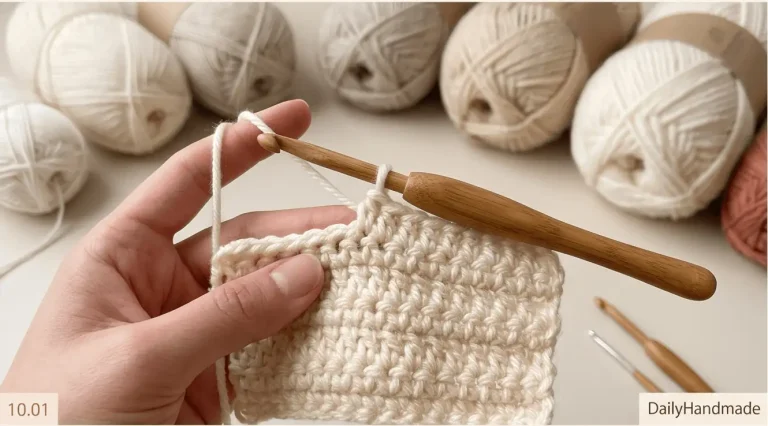
The best yarn for crochet beginners is typically smooth, light-colored, worsted weight (#4) yarn made from acrylic or acrylic blends, because it allows clear stitch visibility, forgiving tension control, and consistent learning feedback.
However, beginner yarn choice is not simply about fiber preference or softness.
Yarn determines how easily beginners can see, control, and understand crochet structure. The right yarn accelerates learning. The wrong yarn creates friction that feels like lack of skill.
This pillar explains how yarn functions inside the crochet learning system — not just what to buy, but why certain yarns make learning easier or harder.
Why Yarn Choice Is a Foundational Skill — Not a Shopping Decision
Many beginners believe yarn selection belongs to supplies or aesthetics.
Within the DailyHandmade learning system, yarn selection is treated as a learning infrastructure decision.
Before beginners master stitches or patterns, they must receive clear feedback from their materials.
Yarn directly affects:
- Stitch Visibility
- Tension Stability
- Hook Movement Friction
- Mistake Detection
- Learning Speed
- Physical Comfort
Two beginners practicing identical stitches can experience completely different difficulty levels depending only on yarn choice.
This is why yarn selection belongs at pillar level rather than as a simple buying guide.
- Quick Answer: What Is the Best Yarn for Crochet Beginners?
- Why Yarn Choice Is a Foundational Skill — Not a Shopping Decision
- The Role of Yarn Inside the Crochet Learning System
- Why Beginner Yarn Feels Confusing
- The Core Principle: Yarn Controls Learning Feedback
- The Beginner Learning Problem This Pillar Solves
- Yarn as the Hidden Variable in Crochet Difficulty
- How This Pillar Fits Inside the Crochet Knowledge Structure
- The Central Insight of This Guide
- What You Will Learn in This Pillar
- Why Yarn Causes So Many Beginner Problems
- The Beginner Yarn Confusion Cycle
- Why Some Yarn Makes Crochet Feel “Impossible”
- Why Pretty Yarn Often Slows Learning
- The Visibility Problem: Why Dark Yarn Is So Difficult
- Why Yarn Weight Changes Learning Speed
- Fiber Behavior and Beginner Expectations
- The Texture Trap
- Why Beginners Often Tighten Tension With Difficult Yarn
- Yarn Problems as Learning Signals
- Connecting Yarn Problems to Earlier Pillars
- The Hidden Goal of Beginner Yarn Selection
- The Correct Learning Order for Choosing Yarn
- Stage 1 — Visibility: Learning to See Stitch Structure
- Stage 2 — Control: Supporting Tension Development
- Stage 3 — Behavior: Understanding Fiber Response
- Stage 4 — Project Suitability
- Stage 5 — Personal Preference and Style
- The Three Beginner Yarn Features That Matter Most
- Why Worsted Weight (#4) Supports Learning Best
- Fiber Comparison as a Learning Tool
- Why Beginners Should Avoid Complexity Early
- Yarn Choice as Learning Calibration
- Recognizing Readiness to Expand Yarn Choices
- How Beginners Know Their Yarn Choices Are Improving
- The Yarn Awareness Progress Framework
- Why Yarn Knowledge Accelerates Skill Development
- Predictable Yarn Challenges After Early Improvement
- The Relationship Between Yarn Knowledge and Troubleshooting
- Applicability Boundaries: Why No Yarn Is Universally “Best”
- Why Beginners Often Improve Suddenly After Changing Yarn
- Yarn Knowledge as a Bridge Toward Independence
- From Choosing Yarn to Designing Experience
- Authority Insight: Yarn Is the Hidden Teacher
- How to Use This Yarn Guide Throughout Your Crochet Journey
- Navigation Pathways Inside the Beginner Yarn System
- Pillar Guides — Understanding the System
- Longtail Guides — Deep Concept Understanding
- Micro Guides — Fast Decision Support
- Recommended Beginner Learning Flow
- Beginner Yarn Decision Checklist
- Signs You Are Moving Beyond Beginner Yarn Needs
- How This Pillar Connects to the Complete Crochet Learning System
- Why Yarn Choice Builds Long-Term Confidence
- Continue Learning — Recommended Next Reads
- System Identity — The DailyHandmade Learning Approach
The Role of Yarn Inside the Crochet Learning System
Crochet learning develops through three interacting foundations established across the beginner pillars:
- Pillar #1 — Learning Progression
Defines what skills develop and when. - Pillar #2 — Hand Mechanics
Establishes how the body controls tools and yarn. - Pillar #3 — Fabric Behavior & Troubleshooting
Explains how stitches respond physically.
Pillar #4 — Yarn Selection (this guide) introduces the material layer:
how yarn influences every physical and visual outcome in crochet learning.
Yarn sits between hands and fabric.
It translates movement into structure.
When yarn provides clear feedback, beginners learn quickly.
When yarn obscures feedback, learning slows regardless of effort.
Why Beginner Yarn Feels Confusing
Entering a yarn store often feels overwhelming because yarn labeling describes manufacturing properties rather than learning usefulness.
Beginners encounter:
- Yarn Weights (#1–#6)
- Fiber Types (Cotton, Acrylic, Wool, Blends)
- Textures (Smooth, Boucle, Chenille)
- Ply Structures
- Marketing Labels (“Baby Soft,” “Luxury,” “Chunky”)
None directly answer the beginner’s real question:
“Which yarn will help me learn crochet fastest?”
The industry organizes yarn by production categories.
Beginners need yarn organized by learning function.
This pillar reframes yarn selection around learning clarity rather than product description.
The Core Principle: Yarn Controls Learning Feedback
Crochet is a feedback-driven skill.
Beginners improve by observing relationships between:
- Hand Movement
- Loop Formation
- Stitch Structure
- Fabric Response
Yarn determines how visible and understandable that feedback becomes.
Good beginner yarn:
- Reveals Stitch Anatomy Clearly
- Allows Smooth Hook Movement
- Forgives Tension Variation
- Makes Mistakes Easy To Correct
Difficult beginner yarn:
- Hides Stitches
- Increases Friction
- Exaggerates Errors
- Slows Diagnosis
Therefore, yarn selection does not change crochet rules — it changes how clearly beginners perceive those rules.
The Beginner Learning Problem This Pillar Solves
Many early frustrations blamed on skill actually originate from material mismatch.
Common beginner experiences include:
- Stitches Looking Messy Despite Correct Technique
- Tension Feeling Impossible To Control
- Difficulty Seeing Insertion Points
- Repeated Splitting Of Yarn Strands
- Fatigue Appearing Quickly
These are often interpreted as personal failure.
In reality, they frequently result from yarn that provides poor learning conditions.
This pillar organizes yarn knowledge into a system that helps beginners understand:
- What Makes Yarn Beginner-Friendly
- Why Some Yarn Slows Learning
- How Yarn Interacts With Tension And Visibility
- How To Choose Yarn Intentionally For Specific Learning Goals
Yarn as the Hidden Variable in Crochet Difficulty
Unlike hooks or stitches, yarn changes multiple variables simultaneously:
- Resistance Against The Hook
- Elasticity
- Visual Contrast
- Structural Stability
- Friction Between Fibers
Because several variables change at once, beginners struggle to identify why a project suddenly feels harder or easier.
A key insight of this pillar:
Yarn does not merely support crochet — it actively shapes the learning experience.
Recognizing yarn as a system component allows learners to diagnose problems earlier and avoid unnecessary frustration.
How This Pillar Fits Inside the Crochet Knowledge Structure
Within the crochet hub hierarchy:
- Pillars Define Systems
- Longtails Explain Concepts Deeply
- Micros Resolve Precise Questions
This pillar governs the Beginner Yarn Selection cluster, including:
Longtail Guides:
Micro Topics:
- Yarn Weight Decisions
- Fiber Comparison
- Yarn Splitting
- Yarn Texture Effects
- Color Visibility
- Twist Structure
- Tension-Learning Yarn Choices
Detailed fixes and comparisons live in longtail and micro articles.
This pillar establishes the conceptual framework connecting them.
The Central Insight of This Guide
Crochet learning becomes easier when three elements align:
- Hands Move Comfortably
- Fabric Responds Predictably
- Materials Provide Clear Feedback
Pillars #2 and #3 addressed the first two.
This pillar completes the system by explaining the third.
When beginners choose yarn intentionally, they remove one of the largest hidden barriers to progress.
Learning stops feeling random and begins feeling controllable.
What You Will Learn in This Pillar
By completing this guide, beginners will understand:
- The Three Yarn Features That Matter Most For Learning
- Why Worsted Weight Is Usually Ideal
- How Fiber Type Affects Tension And Comfort
- Why Smooth Yarn Accelerates Skill Development
- Which Yarns Beginners Should Avoid
- How Yarn Influences Neat Stitches
- And How Yarn Choice Connects To Real Crochet Projects
More importantly, learners will understand how yarn selection supports long-term skill progression rather than short-term project success.
The next section explores the beginner yarn problem landscape — explaining why certain yarn types make crochet feel harder and why these struggles are predictable parts of early learning.
Why Yarn Causes So Many Beginner Problems
Most beginners assume crochet difficulty comes from stitches or technique.
In reality, yarn is often the first hidden obstacle.
Unlike mistakes in counting or hand movement, yarn problems are difficult for beginners to recognize because the material itself feels neutral — it does not appear “wrong.” Yet yarn continuously influences how stitches form, how tension behaves, and how clearly structure can be seen.
Early crochet learning combines three unstable systems:
- Developing Hand Coordination
- Incomplete Stitch Recognition
- Unfamiliar Material Behavior
When yarn reduces clarity or increases friction, all three systems become harder simultaneously.
The result feels like personal struggle, even though the learning environment itself is creating resistance.
The Beginner Yarn Confusion Cycle
Many beginners unintentionally follow a predictable pattern:
- Choose yarn based on appearance.
- Experience unexpected difficulty.
- Assume technique is incorrect.
- Tighten grip or slow excessively.
- Become frustrated or restart projects.
Because yarn properties are invisible concepts at first, learners rarely identify material choice as the cause.
This pillar interrupts that cycle by making yarn behavior understandable.
Why Some Yarn Makes Crochet Feel “Impossible”
Certain yarn characteristics amplify beginner difficulty.
Reduced Stitch Visibility
Learning crochet depends on recognizing stitch anatomy:
- Top Loops
- Insertion Points
- Row Structure
- Edge Boundaries
Dark or textured yarn hides these visual cues.
When stitches cannot be seen clearly:
- Counting Becomes Harder
- Insertion Mistakes Increase
- Tension Corrections Happen Too Late
- Confidence Decreases
The learner is not slower — feedback is simply unclear.
High Friction or Unpredictable Glide
Yarn interacts constantly with the hook surface.
If friction is too high:
- Pulling Through Loops Requires Force
- Wrists Compensate With Pressure
- Tension Becomes Tight Unintentionally
If yarn is overly slippery:
- Loops Loosen Unpredictably
- Stitch Size Varies
- Rhythm Becomes Inconsistent
Beginners require moderate glide — not extreme smoothness or resistance.
Yarn Splitting and Structural Instability
Splitty yarn separates into individual strands when the hook enters a stitch.
For beginners still learning insertion accuracy, this produces several cascading problems:
- Incomplete Stitches
- Snagged Strands
- Messy Appearance
- Slowed Rhythm
- Repeated Corrections
Many learners interpret splitting as lack of skill, when it often reflects yarn construction.
Why Pretty Yarn Often Slows Learning
A common beginner instinct is choosing yarn that looks beautiful or soft.
Marketing labels such as:
- “Luxury Soft”
- “Baby Yarn”
- “Hand-Dyed”
- “Art Yarn”
prioritize aesthetic experience rather than learning clarity.
These yarns frequently include:
- Fuzzy Halos
- Irregular Thickness
- Complex Textures
- Low Twist Structures
While visually appealing, they obscure stitch structure — exactly the information beginners need most.
Misconception Correction
Beautiful yarn is not beginner-friendly yarn.
Learning yarn emphasizes clarity over appearance.
The Visibility Problem: Why Dark Yarn Is So Difficult
Dark yarn introduces a visual limitation unrelated to skill level.
Crochet relies on shadows to define stitch boundaries. Dark colors absorb light, removing contrast between loops.
Consequences include:
- Difficulty Locating Insertion Points
- Delayed Mistake Recognition
- Increased Eye Strain
- Slower Learning Pace
Even experienced crocheters slow down when working with very dark yarn.
For beginners, this creates unnecessary cognitive load during an already demanding stage.
Why Yarn Weight Changes Learning Speed
Yarn thickness directly affects cognitive and physical learning demands.
Thin Yarn
Thin yarn creates:
- Tiny Stitches
- Difficult Counting
- Increased Tension Tightness
- Slower Visual Recognition
Beginners must manage precision before coordination stabilizes.
Bulky Yarn
Bulky yarn creates:
- Oversized Stitches
- Restricted Hook Movement
- Exaggerated Tension Swings
- Hidden Stitch Anatomy
Movement becomes clumsy rather than instructive.
Medium Weight (Worsted #4)
Worsted weight balances visibility and control:
- Stitches Are Large Enough To See
- Movement Remains Flexible
- Tension Adjustments Feel Manageable
This balance explains why worsted weight consistently supports early learning.
Fiber Behavior and Beginner Expectations
Fiber type changes how yarn responds to tension.
Acrylic Fibers
Acrylic provides slight elasticity.
This stretch absorbs small tension inconsistencies, making mistakes less visible and easier to correct.
Beginners often experience smoother progress because yarn cooperates with developing coordination.
Cotton Fibers
Cotton lacks elasticity.
Every tension variation appears immediately in fabric structure.
This honesty can frustrate beginners but becomes valuable later for precision work.
Learning Insight
Cotton does not create mistakes — it reveals them earlier.
The Texture Trap
Textured yarns introduce irregular surfaces that disrupt feedback clarity.
Examples include:
- Boucle
- Chenille
- Eyelash Yarn
- Heavily Brushed Fibers
These textures:
- Hide Stitch Anatomy
- Resist Frogging
- Distort Loop Shape Visually
Beginners lose the ability to diagnose problems accurately.
Texture becomes decoration before understanding exists.
Why Beginners Often Tighten Tension With Difficult Yarn
When feedback becomes unclear, the nervous system compensates by increasing control.
Beginners unconsciously:
- Grip Tighter
- Slow Movement
- Pull Yarn Harder
This response increases tension problems rather than solving them.
The learner attempts to stabilize uncertainty through force.
Understanding yarn behavior prevents this compensation cycle.
Yarn Problems as Learning Signals
A critical perspective shift occurs when learners recognize:
Difficulty caused by yarn is information, not failure.
Examples:
- Frequent Splitting → Yarn Twist Unsuitable For Learning
- Inability To See Stitches → Visibility Issue
- Constant Tight Tension → Friction Imbalance
- Messy Appearance → Feedback Clarity Problem
Recognizing these signals allows beginners to change environment instead of blaming ability.
Connecting Yarn Problems to Earlier Pillars
Yarn issues connect directly to the previous foundations:
- Pillar #2 (Hand Mechanics): yarn affects grip pressure and motion.
- Pillar #3 (Fabric Behavior): yarn influences visible results.
- This pillar: explains why material choices create those outcomes.
When learners understand this relationship, troubleshooting becomes faster and more logical.
The Hidden Goal of Beginner Yarn Selection
The purpose of beginner yarn is not producing perfect projects.
It is accelerating understanding.
Good beginner yarn:
- Teaches Stitch Anatomy
- Stabilizes Tension Learning
- Reduces Cognitive Overload
- Supports Motor Adaptation
Once these skills stabilize, yarn variety becomes an advantage rather than a barrier.
The next section introduces the structured yarn learning progression — explaining how beginners should evaluate yarn features in the correct order and how yarn choice evolves alongside skill development.
The Correct Learning Order for Choosing Yarn
Beginners often try to understand yarn by learning every category at once — weight numbers, fiber types, textures, brands, and project recommendations.
This approach creates overload because yarn knowledge only becomes meaningful when learned in the correct sequence.
Within the DailyHandmade learning system, yarn understanding develops progressively, just like hand mechanics and troubleshooting skills.
Beginner yarn learning follows this order:
visibility → control → behavior → project suitability → personal preference
Each stage builds the perception needed to understand the next.
Skipping stages leads to confusion because beginners attempt aesthetic decisions before developing material awareness.
Stage 1 — Visibility: Learning to See Stitch Structure
The first function of yarn is visual clarity.
Before tension, speed, or technique improve, learners must clearly see:
- Where Stitches Begin And End
- Where To Insert The Hook
- How Rows Align
- How Mistakes Appear
Yarn that supports visibility typically has:
- Smooth Texture
- Solid Light Color
- Clear Stitch Definition
- Medium Thickness
At this stage, yarn acts as a teaching tool.
Progress Signal
You can identify stitches without guessing or relying heavily on tutorials.
Misconception Correction
Softness does not equal beginner-friendliness. Visibility matters more than comfort during early learning.
Stage 2 — Control: Supporting Tension Development
Once stitches become visible, yarn must support consistent movement.
Beginners are still calibrating:
- Grip Pressure
- Yarn Feeding Speed
- Loop Size
- Hook Rotation
Yarn that stretches slightly and glides smoothly helps stabilize this learning.
Acrylic yarn often works well here because it:
- Forgives Tension Variation
- Frogs Easily
- Maintains Consistent Structure
Applicability Boundary
Highly elastic yarn can hide tension mistakes temporarily. Beginners should still observe fabric behavior rather than relying solely on feel.
Progress Signal
Tension begins stabilizing without constant correction.
Stage 3 — Behavior: Understanding Fiber Response
After basic control develops, learners begin noticing that different yarns behave differently.
At this stage, yarn becomes a learning comparison tool.
Beginners start recognizing:
- Cotton Feels Firm And Honest
- Acrylic Feels Forgiving
- Blends Balance Stability And Softness
- Wool Introduces Elasticity And Recovery
This stage develops material awareness — understanding that crochet outcomes depend on interaction between hands and fiber.
Predictive Insight
Learners often experience sudden improvement here because they stop expecting identical behavior from all yarn types.
Stage 4 — Project Suitability
Once fiber behavior becomes understandable, yarn selection expands into purpose-driven decisions.
Beginners begin asking:
- Does This Yarn Suit Dishcloths?
- Will This Yarn Hold Shape?
- Is This Comfortable For Wearables?
- Will This Wash Easily?
Material choice becomes intentional rather than experimental.
Examples:
- Cotton For Absorbent Items
- Acrylic For Blankets
- Blends For Balanced Wearables
At this stage, yarn supports project success rather than learning survival.
Stage 5 — Personal Preference and Style
Only after understanding visibility, control, and behavior should aesthetic preferences dominate decisions.
Now learners can choose yarn based on:
- Texture
- Drape
- Luxury Feel
- Color Complexity
- Artistic Goals
Because foundational understanding exists, challenging yarn becomes exploration rather than frustration.
This marks transition from beginner learning to creative expression.
The Three Beginner Yarn Features That Matter Most
Across all stages, three features consistently determine beginner success.
1. Stitch Visibility
If stitches cannot be seen clearly, learning slows dramatically.
Avoid yarn that hides structure:
- Very Dark Colors
- Fuzzy Halos
- High-Contrast Variegation
- Novelty Textures
Visible stitches accelerate recognition and confidence.
2. Smoothness (Controlled Friction)
Smooth yarn allows:
- Easier Hook Insertion
- Consistent Pull-Through
- Predictable Tension
- Clean Frogging
Excessive texture interrupts movement rhythm.
3. Stable Ply Structure (Low Splitting)
Well-twisted yarn stays cohesive during stitching.
Low-twist yarn separates easily, causing:
- Snagged Stitches
- Uneven Appearance
- Hesitation During Movement
Stable structure supports rhythm development.
Why Worsted Weight (#4) Supports Learning Best
Among yarn weights, worsted weight provides the most balanced learning environment.
It offers:
- Clear Stitch Size
- Manageable Movement Scale
- Compatibility With Common Hooks
- Forgiving Tension Response
Thin yarn increases precision demands too early.
Bulky yarn reduces structural clarity.
Worsted weight sits at the center of visibility and control.
Predictive Insight
Many advanced crocheters still use worsted yarn for testing patterns because of its clarity and predictability.
Fiber Comparison as a Learning Tool
Understanding fiber differences strengthens diagnostic skill.
Acrylic — Forgiving Teacher
- Slight Stretch
- Smooth Glide
- Easy Correction
- Affordable Experimentation
Ideal for early coordination development.
Cotton — Honest Teacher
- Minimal Stretch
- Clear Tension Feedback
- Strong Structure
Excellent after basic control stabilizes.
Wool — Responsive Teacher
- Elastic Recovery
- Refined Stitch Appearance
- Adaptive Tension Behavior
Best appreciated after beginners gain consistency.
Blends — Transitional Teacher
Blends combine strengths and reduce extremes, helping learners transition between stages.
Why Beginners Should Avoid Complexity Early
Complex yarn introduces multiple variables simultaneously:
- Texture Variation
- Inconsistent Thickness
- Visual Noise
- Unpredictable Friction
When too many variables change, beginners cannot isolate cause and effect.
Learning slows because feedback becomes ambiguous.
Reducing variables early accelerates understanding.
Yarn Choice as Learning Calibration
Selecting yarn intentionally functions like calibrating an instrument.
Correct calibration allows learners to:
- Detect Mistakes Earlier
- Understand Fabric Response Faster
- Build Muscle Memory Efficiently
Poor calibration forces learners to compensate physically and cognitively.
Yarn therefore becomes part of skill development rather than a passive material.
Recognizing Readiness to Expand Yarn Choices
Learners are ready to experiment beyond beginner yarn when:
- Stitches Remain Consistent Across Sessions
- Tension Adjusts Automatically
- Mistakes Are Recognized Quickly
- Unfamiliar Yarn Feels Interpretable Rather Than Confusing
At this point, yarn variety enhances learning rather than obstructing it.
The next section expands into authority-level understanding — helping learners recognize progress signals, anticipate yarn-related challenges, and understand how material knowledge contributes to long-term crochet independence.
How Beginners Know Their Yarn Choices Are Improving
One of the least obvious milestones in crochet learning is improvement in yarn selection.
Unlike stitch mastery, yarn understanding develops quietly. Beginners rarely notice the moment when yarn stops feeling confusing and starts feeling predictable.
Progress appears through changes in decision-making rather than visible technique.
Instead of asking, “Is this yarn good?” learners begin asking:
- “What Will This Yarn Do?”
- “How Will This Behave With My Tension?”
- “Is This Suitable For This Project?”
This shift marks growing material literacy — an essential component of crochet independence.
The Yarn Awareness Progress Framework
Across beginner experiences, yarn understanding develops through recognizable signals.
1. Faster Yarn Evaluation
Early beginners rely heavily on labels or recommendations.
Progress signal:
You can evaluate yarn quickly by observing texture, twist, and thickness.
Learners begin recognizing beginner-friendly yarn without needing detailed instructions.
2. Reduced Frustration With New Yarn
Previously, switching yarn often caused unexpected problems.
Progress signal:
When difficulties appear, you suspect material behavior before blaming technique.
This indicates integration between yarn knowledge and troubleshooting skills from Pillar #3.
3. Predictable Tension Adjustment
Beginners initially expect identical tension behavior across yarn types.
Progress signal:
You automatically adjust grip or speed when switching fibers.
The hands begin adapting proactively rather than reactively.
4. Improved Stitch Appearance Across Projects
Neater stitches begin appearing even without deliberate effort.
This improvement often results from selecting yarn that supports clarity and control rather than from learning new stitches.
Yarn choice quietly amplifies skill expression.
5. Intentional Project Planning
Instead of choosing yarn first, learners begin choosing yarn for a purpose.
Examples:
- Cotton For Durability
- Acrylic For Warmth And Washability
- Blends For Balanced Wearables
Material decisions become strategic rather than aesthetic.
Why Yarn Knowledge Accelerates Skill Development
Yarn affects multiple learning variables simultaneously:
- Visibility
- Friction
- Elasticity
- Structure Stability
- Fatigue Level
When yarn aligns with skill level, beginners experience:
- Faster Feedback Loops
- Fewer Corrections
- Longer Comfortable Practice Sessions
- Clearer Understanding Of Mistakes
This creates compound learning effects.
Small improvements in material choice produce large improvements in progress speed.
Predictable Yarn Challenges After Early Improvement
As learners gain confidence, new yarn-related challenges naturally appear.
Common next-stage experiences include:
- Curiosity About Textured Yarn
- Experimenting With Darker Colors
- Trying Thinner Yarns
- Switching Fibers For Specific Projects
These experiments may temporarily reintroduce earlier frustrations.
This is not regression.
It reflects expanding learning boundaries.
Failure Anticipation Insight
Each new yarn type introduces a new feedback system. Temporary instability indicates adaptation, not loss of skill.
The Relationship Between Yarn Knowledge and Troubleshooting
Yarn understanding strengthens diagnostic ability.
Learners begin recognizing patterns such as:
- Curling Linked To Stiff Fiber
- Messy Stitches Linked To Splitting Yarn
- Uneven Tension Linked To Slippery Texture
- Fatigue Linked To Friction Imbalance
Material awareness shortens troubleshooting time because root causes become easier to isolate.
Instead of adjusting technique repeatedly, learners adjust environment intelligently.
Applicability Boundaries: Why No Yarn Is Universally “Best”
A critical authority insight is that no yarn works best for all situations.
Effectiveness depends on:
- Learning Stage
- Project Goal
- Stitch Density
- Personal Tension Style
- Environmental Conditions
For example:
- Cotton Excels In Structured Projects But Challenges Tight Tension
- Acrylic Forgives Beginners But May Pill Under Friction
- Wool Adapts Well But Requires Maintenance Awareness
Understanding boundaries prevents rigid rules and encourages informed flexibility.
Why Beginners Often Improve Suddenly After Changing Yarn
Many learners experience dramatic improvement after switching yarn.
This occurs because clearer feedback reduces cognitive load.
When stitches become easier to see and control:
- Counting Improves
- Tension Stabilizes
- Rhythm Develops Faster
- Confidence Increases
The learner did not suddenly become more skilled.
The learning environment became clearer.
This reinforces a core principle of the DailyHandmade system:
Progress depends on clarity as much as effort.
Yarn Knowledge as a Bridge Toward Independence
Instruction-based learning depends on following recommendations.
Material understanding enables adaptation.
Once learners understand yarn behavior, they can:
- Substitute Yarn Confidently
- Adjust Hook Sizes Intelligently
- Predict Fabric Outcomes
- Modify Patterns Safely
This marks the transition from beginner dependency toward creative autonomy.
From Choosing Yarn to Designing Experience
Advanced crocheters no longer choose yarn only for outcome.
They choose yarn for experience:
- Relaxing Rhythm
- Structured Precision
- Lightweight Drape
- Textured Expression
This shift begins here — when beginners understand how yarn shapes learning itself.
Material awareness becomes creative control.
Authority Insight: Yarn Is the Hidden Teacher
Throughout crochet learning, yarn continuously teaches:
- How Tension Behaves
- How Structure Forms
- How Movement Influences Fabric
Beginners often attribute improvement solely to practice, but practice succeeds because materials provide understandable feedback.
Choosing appropriate yarn means choosing a clearer teacher.
The final section connects this pillar to the broader crochet ecosystem, navigation pathways, and the learner’s next steps within the DailyHandmade learning system.
How to Use This Yarn Guide Throughout Your Crochet Journey
This pillar is not meant to be used only when buying yarn.
It functions as a reference framework you return to whenever crochet begins to feel:
- Harder Than Expected
- Visually Messy
- Difficult To Control
- Physically Tiring
- Or Inconsistent Across Projects
As skills grow, yarn stops being a background decision and becomes an active learning variable.
When a project feels frustrating, revisit this guide and ask:
- Can I Clearly See My Stitches?
- Is This Yarn Helping Or Fighting My Tension?
- Is The Fiber Forgiving Enough For My Current Skill Stage?
- Am I Choosing Yarn For Learning Or Only For Appearance?
These questions reconnect material choice to learning progression.
Returning to fundamentals strengthens mastery rather than restarting learning.
Navigation Pathways Inside the Beginner Yarn System
The DailyHandmade crochet hub organizes content so each level answers a different type of question.
Understanding navigation prevents overwhelm and preserves structured progression.
Pillar Guides — Understanding the System
Pillar articles explain how crochet works as an integrated learning environment.
They provide:
- Conceptual Frameworks
- Learning Context
- Decision Logic
- Progression Clarity
This article governs Beginner Yarn Selection, explaining how materials influence learning and results across all crochet projects.
Pillars answer:
“Why does this choice matter in the larger learning system?”
Longtail Guides — Deep Concept Understanding
Longtail articles expand individual yarn concepts introduced here.
Use longtail guides when you want complete understanding of one decision area.
Core longtails governed by this pillar include:
These guides explain:
- Detailed Comparisons
- Use-Case Reasoning
- Fiber Behavior Differences
- Beginner Decision Strategies
They deepen knowledge without overwhelming the learner at the pillar level.
Micro Guides — Fast Decision Support
Micro articles answer precise beginner questions encountered during real practice or shopping decisions.
Examples include:
- Best Yarn Weight For Beginners
- Why Fuzzy Yarn Causes Problems
- Whether Cotton Yarn Splits Easily
- Best Yarn Color For Visibility
- Yarn Twist Effects
- Smooth Vs Textured Yarn Decisions
Micro guides allow quick problem resolution so learners can continue crocheting without losing momentum.
After resolving a question, learners return to this pillar to maintain system understanding.
Authority flow remains:
Micro → Longtail → Pillar
which strengthens learning continuity across the hub.
Recommended Beginner Learning Flow
A structured workflow keeps yarn decisions aligned with skill development:
- Start With The Crochet Learning Roadmap.
- Develop Comfortable Hand Mechanics.
- Understand Fabric Reactions.
- Use This Pillar To Choose Learning-Friendly Yarn.
- Explore Longtail Guides For Deeper Comparisons.
- Use Micro Guides For Quick Decisions During Projects.
- Return To Practice With Adjusted Materials.
This loop prevents random experimentation and accelerates progress.
Beginner Yarn Decision Checklist
When selecting yarn in a store or online, apply this simple system:
- Visibility
Can I Clearly See Stitches? - Smoothness
Does The Yarn Glide Without Fuzz Or Texture? - Weight
Is It Medium Weight (#4)? - Structure
Does The Yarn Stay Together Without Splitting? - Color
Is The Color Light Enough For Learning?
If most answers are yes, the yarn likely supports beginner learning.
Signs You Are Moving Beyond Beginner Yarn Needs
Learners often notice subtle shifts indicating readiness to explore wider yarn choices:
- Stitches Remain Consistent Across Yarn Types
- Tension Adapts Automatically
- Mistakes Are Recognized Quickly
- Unfamiliar Yarn Feels Understandable Rather Than Confusing
- Aesthetic Preferences Become Easier To Execute
At this stage, yarn variety enhances creativity rather than creating obstacles.
How This Pillar Connects to the Complete Crochet Learning System
Each beginner pillar supports one dimension of crochet mastery:
- Pillar #1 — Learning Roadmap
Establishes Direction. - Pillar #2 — Hook & Yarn Mechanics
Builds Physical Control. - Pillar #3 — Fabric Behavior & Troubleshooting
Teaches Interpretation. - Pillar #4 — Yarn Selection (This Guide)
Optimizes The Learning Environment.
Together they form a complete beginner foundation:
Understand → Control → Interpret → Optimize
This sequence transforms crochet from trial-and-error into structured skill development.
Why Yarn Choice Builds Long-Term Confidence
Confidence grows when results become predictable.
Choosing appropriate yarn allows beginners to:
- See Progress Clearly
- Correct Mistakes Earlier
- Practice Longer Without Frustration
- Experience Consistent Outcomes
Confidence therefore emerges not only from practice but from supportive learning conditions.
Yarn becomes a partner in learning rather than an obstacle.
Continue Learning — Recommended Next Reads
Longtail Guides
Micro Guides (Yarn Decisions)
- Best Yarn Weight For Crochet Beginners
- Best Yarn Fiber For Crochet Beginners
- Why Fuzzy Yarn Is Hard For Beginners
- Does Cotton Yarn Split Easily
- Best Acrylic Yarn For Beginner Crochet
- What Yarn Beginners Should Avoid
- Best Yarn Color For Beginners
- Smooth Vs Textured Yarn
- Best Yarn Choice For Learning Tension
Helpful Buying Guides
System Identity — The DailyHandmade Learning Approach
This article is part of the DailyHandmade learning system, a structured approach to handmade education designed to replace random tutorials with clear progression.
The system teaches beginners to understand relationships:
- Between Hands And Tools
- Between Yarn And Fabric
- Between Decisions And Outcomes
When materials become understandable, crochet becomes predictable.
And when learning becomes predictable, creativity becomes sustainable.