Crochet Stitches Explained — Why Your Crochet Curls, Widens, Isn’t Straight (and How to Fix It)
Quick Answer: Why Does Crochet Go Wrong Even When You Follow Tutorials?
Most crochet problems are not caused by performing a stitch incorrectly.
They happen because three underlying systems interact at the same time:
- tension control
- stitch counting
- tool–material compatibility
When one of these systems becomes unstable, the fabric reacts visibly.
You may see:
- curling inward
- widening outward
- leaning edges
- uneven or messy stitches
These are not random mistakes.
They are structural feedback from how crochet behaves under physical conditions.
This guide teaches you how to read that feedback instead of fighting it.
- Quick Answer: Why Does Crochet Go Wrong Even When You Follow Tutorials?
- Pillar #1 — Learning Progression
- Pillar #2 — Hand Mechanics and Comfort
- Pillar #3 — Fabric Behavior and Troubleshooting
- Root System 1 — Tension
- Root System 2 — Stitch Count Geometry
- Root System 3 — Tool–Material Interaction
- What Curling Really Means
- Important Insight
- Common Beginner Causes
- Why It Feels Sudden
- Common Causes
- Resulting Shapes
- Messiness Comes From:
- Key Insight
- When Bias Becomes Visible
- Important Insight
- What Beginners Feel
- What Happens Over Time
- Important Distinction
- Why This Matters
- Key Insight
- What to Observe
- Why This Matters
- Key Insight
- Quick Mapping
- Key Insight
- The Correct Rule
- Examples of Good Adjustments
- Why This Works
- Key Insight
- What to Do
- Key Insight
- Progress Signals
- Important Shift
- Why Tension Feels Confusing
- Key Insight
- Examples
- Key Insight
- Valid Signs You Should Change Tools
- Why Tools Help
- Examples
- Key Insight
- Key Insight
- The Big Shift
- 1. Faster Recognition
- 2. Reduced Emotional Frustration
- 3. Smaller Corrections
- 4. Increased Predictability
- 5. Confidence With New Patterns
- The Difference
- Why Problems Always Exist
- Key Insight
- Common Next-Stage Issues
- Important Insight
- Failure Anticipation Insight
- Creativity Requires Safety
- What Changes
- Key Insight
- What Affects Results
- Examples
- Key Insight
- Why This Happens
- Key Insight
- How Everything Connects
- Full System
- What You Start Doing Naturally
- Result
- Key Insight
- When You Understand Fabric
- Final Insight of This Section
- When Something Goes Wrong, Follow This Process
- Key Insight
- This Article Covers
- Pillars Answer:
- Core Longtail Topics
- What Longtails Do
- Use Micro When
- Example Micro Topics
- Key Insight
- Authority Flow
- Key Insight
- If Your Crochet Curls
- If Your Project Gets Wider
- If Your Piece Is Not Square
- If Stitches Look Messy
- If Edges Are Not Straight
- Key Insight
- What This Means
- Pillar #1 — Learning Roadmap
- Pillar #2 — Hand Mechanics
- Pillar #3 — Fabric Behavior
- Full System
- When You Understand Fabric
- Final Insight
- Troubleshooting Longtail Guides
- Beginner Foundations
- What You Learn Here
- Final Conclusion
This Guide Is About Understanding Fabric Behavior — Not Memorizing Fixes
Most beginner content treats crochet problems as separate issues:
- fix curling
- fix widening
- fix messy stitches
- fix uneven edges
This works temporarily, but it creates fragmented learning.
You end up searching for new fixes every time something goes wrong.
Inside the DailyHandmade system, troubleshooting is different.
Crochet follows consistent physical rules.
Visible problems always come from interactions between:
- tension
- repetition
- material resistance
Instead of memorizing fixes, you learn a system:
observe → interpret → adjust → continue
Once you understand this, problems stop feeling random.
They become predictable.
The Role of Troubleshooting Inside the Crochet Learning System
Crochet learning develops through three core pillars:
Pillar #1 — Learning Progression
Defines what to learn and when.
Pillar #2 — Hand Mechanics and Comfort
Controls how your body interacts with hook and yarn.
Pillar #3 — Fabric Behavior and Troubleshooting
Explains how stitches respond to those actions.
This article is Pillar #3.
At this stage, crochet shifts from:
- following instructions
to:
- understanding behavior
You stop asking:
“What step did I do wrong?”
and start asking:
“What is my fabric telling me?”
Why This Topic Needs a Pillar (Not Just Tips)
Crochet problems are rarely isolated.
Many issues come from the same root causes, for example:
- curling
- widening
- leaning edges
- uneven texture
- distorted shapes
These are different expressions of the same systems.
If you fix them separately, learning becomes fragmented.
This pillar introduces the Fabric Behavior Framework, which connects everything:
- crochet curling behavior
- stitch count geometry
- shape stability
- tension control
- visual consistency
Longtail articles go deeper into each topic.
Micro articles fix specific problems.
This pillar shows how everything connects.
Crochet Fabric Is a Feedback System
Every stitch creates tension inside the yarn.
As rows repeat, small forces accumulate and shape the fabric.
Tiny variations in:
- loop size
- insertion point
- yarn elasticity
- hook size
- consistency
create predictable outcomes.
For example:
- tighter tension → fabric compresses → curling
- extra stitches → width increases → widening
- uneven loops → rhythm breaks → messy stitches
- skipped stitches → alignment shifts → leaning edges
Crochet does not hide mistakes.
It amplifies them.
Once you understand this, troubleshooting becomes logical instead of confusing.
The Beginner Mental Model Shift
Most beginners ask:
“What did I do wrong?”
This assumes the problem is a mistake.
A better question is:
“What signal is my fabric showing?”
Every visible issue is information.
This pillar organizes problems into three root systems that explain almost everything beginners experience.
The Three Root Systems Behind Most Crochet Problems
Nearly every crochet issue connects to one of these.
Root System 1 — Tension
Tension controls:
- stitch size
- flexibility
- edge behavior
- overall balance
Unstable tension causes:
- curling
- gaps
- uneven rows
- inconsistent stitches
This links directly to hand mechanics.
Root System 2 — Stitch Count Geometry
Crochet builds structure through repetition.
Each stitch adds width and height.
If stitch count changes, shape changes immediately.
This leads to:
- widening projects
- diagonal drift
- distorted shapes
- pieces that won’t stay square
Crochet behaves like math — even when you don’t notice it.
Root System 3 — Tool–Material Interaction
Tools and materials affect how clearly you can crochet.
Examples:
- split yarn hides stitches
- small hooks increase tension
- dark yarn reduces visibility
- stiff fibers exaggerate errors
Sometimes technique is correct — but tools make it feel wrong.
Changing tools can instantly improve results because feedback becomes clearer.
Why Diagnosis Changes Everything
Most beginners react like this:
- restart rows repeatedly
- tighten or loosen randomly
- switch tutorials
- buy new tools
This creates temporary fixes.
But problems return.
Diagnosis changes the process:
observe → identify → adjust → verify
Now learning becomes structured.
Instead of guessing, you understand.
How to Use This Pillar
You don’t need to read this from top to bottom every time.
Use it like a system:
- Identify what your fabric is doing
- Match it to a category
- Find the root cause
- adjust one thing
- continue and observe
Over time, this becomes automatic.
That’s when crochet starts feeling predictable and controllable.
The Core Insight of This Pillar
Crochet does not fail randomly.
Every result comes from interaction between:
- physical control (Pillar #2)
- learning stage (Pillar #1)
- structural response (this pillar)
When you understand all three:
- crochet becomes predictable
- frustration becomes curiosity
- you stop copying — and start understanding
Why Beginner Crochet Problems Appear So Quickly
Many beginners feel surprised by how fast problems show up.
A project may look fine at first, then suddenly:
- starts curling
- begins widening
- leans to one side
This feels random.
But it actually follows a very predictable pattern.
Crochet Amplifies Small Inconsistencies
At the beginner stage, three systems are developing at the same time:
- hand coordination
- stitch recognition
- tension control
None of them are stable yet.
Small variations happen in every stitch:
- loop slightly tighter
- pull slightly uneven
- insertion slightly off
Individually, these differences are invisible.
But crochet repeats them across rows.
Over time, they become visible structural changes.
Crochet doesn’t hide inconsistency.
It amplifies it through repetition.
The First Learning Stage: Mechanical Instability
Early crochet is not about “doing it right”.
It’s about building coordination.
Common signs of this stage:
- inconsistent loop height
- changing grip pressure
- uneven pulling
- pauses between stitches
- irregular rhythm
Each of these slightly changes stitch geometry.
After many stitches, those small differences become:
- curling
- widening
- uneven edges
This is not failure.
It is learning in progress.
Why Curling Is Often the First Problem
Curling usually appears before anything else.
That’s because edges form first — and edges show imbalance fastest.
When tension is too tight:
- stitches lose flexibility
- rows stack vertically
- fabric bends inward
Result:
curling
What Curling Really Means
Curling does NOT mean:
- you’re doing crochet wrong
- you need to restart immediately
It simply means:
tension is stronger than fabric flexibility
Important Insight
Curling often appears right when beginners improve.
Why?
Because:
- confidence increases
- grip tightens unconsciously
- tension increases
So curling is often a progress signal, not a failure.
Why Crochet Gradually Gets Wider
Widening doesn’t happen suddenly.
It happens slowly — then becomes noticeable.
This is because:
Each extra stitch changes width slightly.
Over many rows:
→ width expands
Common Beginner Causes
- crocheting into turning chain
- repeating first stitch
- missing last stitch
- losing count during rhythm
Each row may only add 1 stitch.
But after 10–20 rows, the change becomes obvious.
Why It Feels Sudden
Because:
- the error started early
- but only became visible later
Crochet is cumulative.
Small errors become big shapes over time.
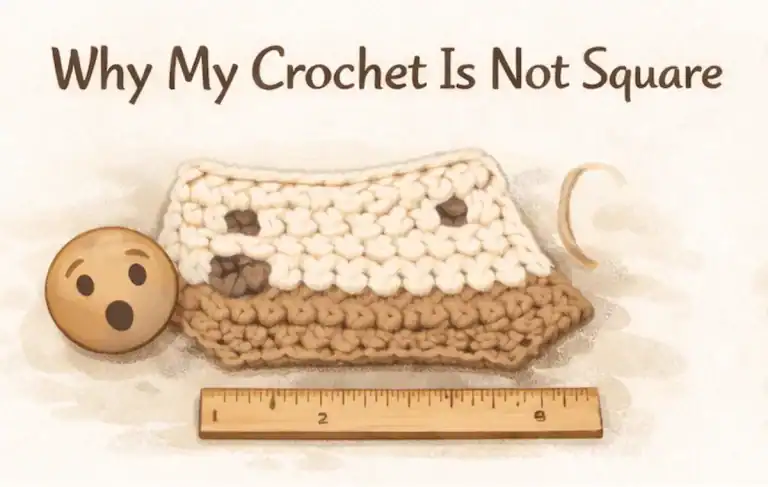
Why Crochet Stops Being Square
A square depends on balance:
- vertical growth (row height)
- horizontal growth (stitch count)
When this balance shifts, shapes distort.
Common Causes
- tighter tension at start of row
- looser tension at end
- inconsistent turning chains
- small counting errors
These differences are subtle while crocheting.
But the fabric reacts clearly.
Resulting Shapes
- trapezoid
- diamond
- stretched rectangle
This is not incorrect technique.
It is imbalance made visible.
Why Crochet Looks Messy (Even When You Did It Right)
Many beginners think:
“Messy stitches = wrong stitch”
But often, the stitch is correct.
The issue is consistency.
Messiness Comes From:
- uneven loop height
- changing tension speed
- yarn splitting
- hook mismatch
- unstable rhythm
Key Insight
Understanding a stitch happens faster than mastering movement.
So you may:
- know what to do
- but still produce uneven results
This is normal.
Visual neatness improves when rhythm stabilizes, not when you change stitches.
Why Crochet Pieces Lean or Don’t Stay Straight
Crochet is not perfectly vertical.
Each stitch connects slightly offset.
This creates a natural directional bias.
When Bias Becomes Visible
Small inconsistencies increase this effect:
- skipped stitches
- uneven edge tension
- inconsistent turning
- misaligned insertion
Over many rows, this creates:
- leaning edges
- diagonal drift
Important Insight
Leaning does not mean you’re failing.
It means:
alignment is slightly off — and repeating
The Cognitive Overload Phase
Beginner crochet is mentally demanding.
You are doing multiple things at once:
- counting stitches
- controlling tension
- remembering instructions
- moving hands correctly
- tracking loops visually
This creates high cognitive load.
What Beginners Feel
- mentally tired quickly
- overwhelmed
- slow progress
This is NOT lack of ability.
It is the brain managing too many processes at once.
What Happens Over Time
With repetition:
- hand movement becomes automatic
- tension becomes intuitive
- stitch recognition speeds up
Mental effort drops dramatically.
That’s when crochet starts feeling relaxing.
Why Tutorials Alone Don’t Solve Problems
Tutorials show what to do.
They don’t build coordination.
Two people can follow the same tutorial and get different results.
Why?
Because they are at different stages of adaptation.
Important Distinction
- Instructions = direction
- Practice = stability
Switching tutorials too often interrupts learning.
The real progress happens in repetition, not variation.
The Emotional Pattern of Beginner Crochet
Most beginners go through the same cycle:
- Excitement — starting something new
- Confusion — results don’t match expectations
- Self-doubt — “I’m doing this wrong”
- Experimentation — random fixes
- Understanding — patterns start making sense
Why This Matters
Without structure, many people get stuck in:
- confusion
- self-doubt
This pillar helps you move faster to:
understanding
Problems Are Signals of Progress
This is one of the most important mindset shifts.
Problems often appear because skill is improving.
Examples:
- curling → tension awareness increasing
- widening → speed increasing
- messiness → rhythm forming
Key Insight
New coordination introduces new variables.
Fabric shows these immediately.
So problems are not setbacks.
They are transitions between learning stages.
Connecting Problems Back to the Learning System
Every issue connects to the full system:
- Pillar #1 → learning stage
- Pillar #2 → hand mechanics
- Pillar #3 → fabric behavior
Together:
understand → control → interpret
When you see problems this way:
- crochet becomes logical
- mistakes become useful
- learning becomes predictable
The Crochet Troubleshooting Skill: Diagnose Before Fixing
Most beginners try to fix problems immediately.
They:
- restart rows
- change hooks
- tighten or loosen randomly
- switch tutorials
This feels productive, but it skips the most important step:
diagnosis
Troubleshooting Is a Skill — Not a Quick Fix
Inside the DailyHandmade system, troubleshooting is not about memorizing solutions.
It is a learning progression.
It develops through four stages:
observation → identification → adjustment → verification
Each stage builds independence.
Instead of reacting emotionally, you begin understanding structurally.
Stage 1 — Observation: Learn to See Without Judging
The first step is simple:
look at your fabric without trying to fix it
What to Observe
Describe only what you see:
- edges curling inward
- rows getting wider
- shape leaning sideways
- stitches uneven
- random holes appearing
Do NOT label it as “wrong” yet.
Why This Matters
Most beginners skip observation and jump straight to fixing.
This leads to:
- repeating the same mistake
- confusion
- wasted time
Key Insight
Clarity comes before correction.
Stage 2 — Identification: Connect Signal to Root Cause
Now connect what you see to the 3 root systems.
Quick Mapping
| Visible Problem | Likely Cause |
|---|---|
| Curling | Tension imbalance |
| Widening | Stitch count change |
| Leaning edges | Edge placement / counting |
| Messy stitches | Tension or rhythm |
| Random holes | Yarn split / insertion inconsistency |
Key Insight
You don’t fix problems.
You identify systems.
Stage 3 — Adjustment: Change One Thing Only
This is where most beginners go wrong.
They change everything at once:
- hook size
- yarn grip
- tension
- posture
- technique
The Correct Rule
Change ONE variable at a time
Examples of Good Adjustments
- relax grip slightly
- go up one hook size
- mark first and last stitch
- slow down movement
Why This Works
If you change multiple things:
→ you don’t know what worked
If you change one thing:
→ you learn cause and effect
Key Insight
Small adjustments create real learning.
Stage 4 — Verification: Let the Fabric Respond
After adjusting, don’t judge immediately.
Crochet needs repetition to show results.
What to Do
- crochet a few rows
- observe changes
Ask:
- Is curling reduced?
- Are edges straighter?
- Are stitches more consistent?
- Is tension easier?
Key Insight
Crochet responds gradually — not instantly.
Why Troubleshooting Is a Learning Stage
Many beginners think troubleshooting means:
“something went wrong”
Actually, it means:
you are advancing
Progress Signals
- you notice problems earlier
- you adjust faster
- you understand causes
- you rely less on tutorials
Important Shift
Crochet becomes:
- interactive
instead of - instructional
The Central Role of Tension
Tension connects almost everything.
Small changes affect:
- stitch size
- flexibility
- edge shape
- overall geometry
Why Tension Feels Confusing
Because it interacts with:
- speed
- yarn type
- hook size
- hand movement
Key Insight
Don’t “fix tension directly”
Instead:
→ improve movement
→ tension stabilizes naturally
Related: How to Control Crochet Tension
Crochet Is Geometry (Not Just Craft)
Each stitch adds:
- width
- height
If these grow unevenly:
→ shape distorts
Examples
- tight stitches → less width → curling
- extra stitches → more width → widening
- uneven edges → alignment shifts → leaning
Key Insight
Crochet is physical math.
Once you see this:
→ problems become predictable
When Tools Are the Right Fix
Beginners often change tools too early.
But sometimes tools ARE the correct adjustment.
Valid Signs You Should Change Tools
- tension stays tight even when relaxed
- stitches are hard to see
- yarn splits constantly
- hands get tired quickly
Why Tools Help
They improve feedback clarity, not skill.
Developing Predictive Awareness
This is a major milestone.
You begin noticing problems BEFORE they appear.
Examples
- chain feels tight → curling will happen
- count feels off → widening will happen
- tension feels uneven → stitches will look messy
Key Insight
You stop reacting.
You start predicting.
Why You Frog Less Over Time
Beginners frog a lot because:
- they notice mistakes late
As skill improves:
- you catch mistakes early
- you fix mid-row
- projects stay stable
Key Insight
Frogging becomes intentional — not emotional.
Troubleshooting Leads to Independence
At this stage:
- you don’t rely on tutorials
- you understand your fabric
- you fix your own mistakes
The Big Shift
From:
- copying instructions
To:
- understanding systems
How to Know Your Troubleshooting Skills Are Improving
One of the biggest changes in crochet learning happens quietly.
At first, problems feel:
- random
- confusing
- frustrating
Later, the same problems feel:
- familiar
- understandable
- manageable
This shift means you are developing diagnostic awareness.
The Crochet Problem Recognition Framework
Progress in troubleshooting is not about perfect projects.
It’s about how you:
- notice
- interpret
- respond
1. Faster Recognition
Beginners often notice problems late.
After many rows, they suddenly see:
- curling
- widening
- uneven edges
Progress Signal
You notice issues within:
- 1–2 rows
What This Means
Your brain is improving at:
- pattern recognition
- visual detection
2. Reduced Emotional Frustration
Early reaction:
“I ruined this.”
Later reaction:
“This looks like a tension issue.”
Progress Signal
You feel:
- calm
- curious
instead of - frustrated
Key Insight
Understanding replaces emotion.
3. Smaller Corrections
Beginners often:
- restart entire projects
Progress Signal
You:
- adjust mid-row
- fix small sections
- avoid full restart
Key Insight
Precision replaces trial-and-error.
4. Increased Predictability
You begin anticipating problems.
Examples
- chain feels tight → curling coming
- stitch count feels off → widening coming
- tension feels uneven → messy stitches coming
Progress Signal
You predict, not react.
5. Confidence With New Patterns
Before:
- new patterns feel overwhelming
After:
- you trust your ability to fix issues
Progress Signal
You continue even when:
- things are not perfect
Key Insight
Confidence comes from recoverability, not perfection.
Why Problems Never Fully Disappear
Even experienced crocheters still see:
- curling
- uneven tension
- distorted shapes
- leaning edges
The Difference
Beginners:
→ “This is wrong”
Experienced:
→ “This is normal”
Why Problems Always Exist
Because crochet is dynamic:
- yarn behaves differently
- speed changes tension
- fatigue affects movement
- stitches interact
Key Insight
Problems don’t disappear.
Understanding replaces confusion.
Predictable Challenges After You Improve
As you get better, new challenges appear.
Common Next-Stage Issues
- stitching faster → tension changes
- trying new yarn → behavior changes
- attempting garments → shaping complexity
- modifying patterns → structure changes
Important Insight
This is not regression.
It is expansion.
Failure Anticipation Insight
More skill = more sensitivity.
You start seeing problems you couldn’t see before.
Troubleshooting Unlocks Creativity
Many beginners think:
“I need to be perfect before I can be creative.”
This is backwards.
Creativity Requires Safety
When you understand fabric behavior:
- mistakes feel safe
- experimenting feels natural
- changing patterns becomes possible
What Changes
You move from:
- fear of mistakes
to:
- exploration
Key Insight
Troubleshooting enables creativity.
Why Advice Is Not Universal
Crochet advice changes depending on context.
What Affects Results
- yarn type (cotton vs acrylic)
- hook material
- stitch density
- project type
- personal style
Examples
- cotton shows tension clearly
- textured yarn hides mistakes
- large hooks exaggerate looseness
- dense stitches behave differently from lace
Key Insight
There are no universal rules.
Only adaptable principles.
Why Improvement Feels Slow — Then Sudden
Many beginners feel stuck for a while.
Then suddenly:
→ everything clicks
Why This Happens
Learning builds gradually:
- your brain collects patterns
- then recognizes them
Once recognition happens:
→ decisions become faster
→ progress accelerates
Key Insight
Plateau = consolidation phase
Not failure.
Troubleshooting Is the Core Crochet Skill
Crochet mastery is not about:
- knowing many stitches
It is about:
- understanding fabric behavior
How Everything Connects
- Pillar #1 → learning order
- Pillar #2 → hand mechanics
- Pillar #3 → fabric behavior (this article)
Full System
understand → control → diagnose
From Fixing Problems to Preventing Them
This is the final stage.
You begin preventing problems before they happen.
What You Start Doing Naturally
- checking stitch count early
- adjusting tension subconsciously
- choosing tools correctly
- noticing warning signs instantly
Result
- fewer mistakes
- smoother projects
- more confidence
Key Insight
Prevention replaces correction.
Why Diagnosis Builds Long-Term Confidence
Confidence doesn’t come from:
- avoiding mistakes
It comes from:
- knowing you can fix them
When You Understand Fabric
- uncertainty decreases
- experimentation increases
- learning becomes independent
Final Insight of This Section
Diagnosis transforms crochet from:
- following instructions
into:
- understanding systems
How to Use This Troubleshooting Guide Throughout Your Crochet Journey
This pillar is not meant to be read once and forgotten.
It is a reference system you return to whenever crochet feels:
- confusing
- inconsistent
- frustrating
When Something Goes Wrong, Follow This Process
- Identify what you see
- curling
- widening
- leaning
- messy stitches
- Match it to a root system
- Understand the cause
- Adjust one variable
- Continue crocheting and observe
Key Insight
You are not fixing mistakes.
You are reading signals.
Navigation Pathways Inside the Crochet Troubleshooting System
The DailyHandmade system is structured so you always know where to go next.
Each level has a specific role.
Pillar Guides — System Understanding
Pillars explain how crochet works as a system.
They give you:
- mental models
- learning structure
- diagnostic frameworks
This Article Covers
Fabric behavior and troubleshooting
Pillars Answer:
“Why is this happening?”
Longtail Guides — Deep Problem Understanding
Longtail articles go deeper into ONE category.
Use them when you want full understanding.
Core Longtail Topics
- Why Does My Crochet Curl
- Why My Crochet Keeps Getting Wider
- Why My Crochet Is Not Square
- How to Control Crochet Tension
- Why Crochet Looks Messy
- Why My Crochet Is Not Straight
What Longtails Do
- explain causes
- show variations
- guide corrections
- teach prevention
Micro Guides — Fast Problem Fixes
Micro articles solve very specific issues quickly.
Use Micro When
You need immediate help with:
- tight tension
- added stitches
- uneven edges
- yarn splitting
- random holes
Example Micro Topics
- tight tension causing curling
- adding stitches by mistake
- crochet edges uneven
- yarn splitting issues
Key Insight
Micro = fast fix
Longtail = deep understanding
Pillar = system overview
Authority Flow
Micro → Longtail → Pillar
Recommended Learning Flow
To avoid confusion and random learning, follow this loop:
- Start with roadmap
- Build hand control
- Use this pillar when problems appear
- Read a related longtail
- Fix using micro
- Return to practice
Key Insight
Learning is a loop — not a straight line.
Quick Troubleshooting Decision Map
Use this when you don’t know where to start.
If Your Crochet Curls
- check tension
- check hook size
If Your Project Gets Wider
- check stitch count
- check turning chain
Why My Crochet Keeps Getting Wider
If Your Piece Is Not Square
- check balance
- compare width vs height
If Stitches Look Messy
- check yarn
- check hook
- check rhythm
If Edges Are Not Straight
- check counting
- check edge placement
Why My Crochet Is Not Straight
Key Insight
Always diagnose before fixing.
Signs You Are Moving Beyond Beginner Level
You are progressing when:
- you notice problems immediately
- your fixes are small and precise
- you experiment without fear
- your projects stay stable
- you rely less on tutorials
What This Means
You are no longer:
- reacting
You are:
- understanding
How This Pillar Connects to the Full System
Each pillar covers one dimension:
Pillar #1 — Learning Roadmap
→ what to learn
Pillar #2 — Hand Mechanics
→ how to control
Pillar #3 — Fabric Behavior
→ how to interpret
Full System
understand → control → diagnose
Why Troubleshooting Builds Real Confidence
Confidence does not come from perfection.
It comes from:
- understanding problems
- knowing how to fix them
When You Understand Fabric
- mistakes feel temporary
- experimentation feels safe
- progress feels predictable
Final Insight
Understanding removes fear.
Continue Learning — Recommended Next Reads
Troubleshooting Longtail Guides
- Why Does My Crochet Curl
- Why My Crochet Keeps Getting Wider
- Why My Crochet Is Not Square
- How to Control Crochet Tension
- Why Crochet Looks Messy
- Why My Crochet Is Not Straight
Beginner Foundations
System Identity — The DailyHandmade Approach
This article is part of the DailyHandmade learning system.
It is designed to replace:
- random tutorials
- scattered fixes
with:
- structured learning
- clear progression
- predictable results
What You Learn Here
- recognize patterns
- interpret fabric
- adjust confidently
- learn independently
Final Conclusion
When crochet becomes understandable:
→ it becomes predictable
When learning becomes predictable:
→ creativity becomes possible