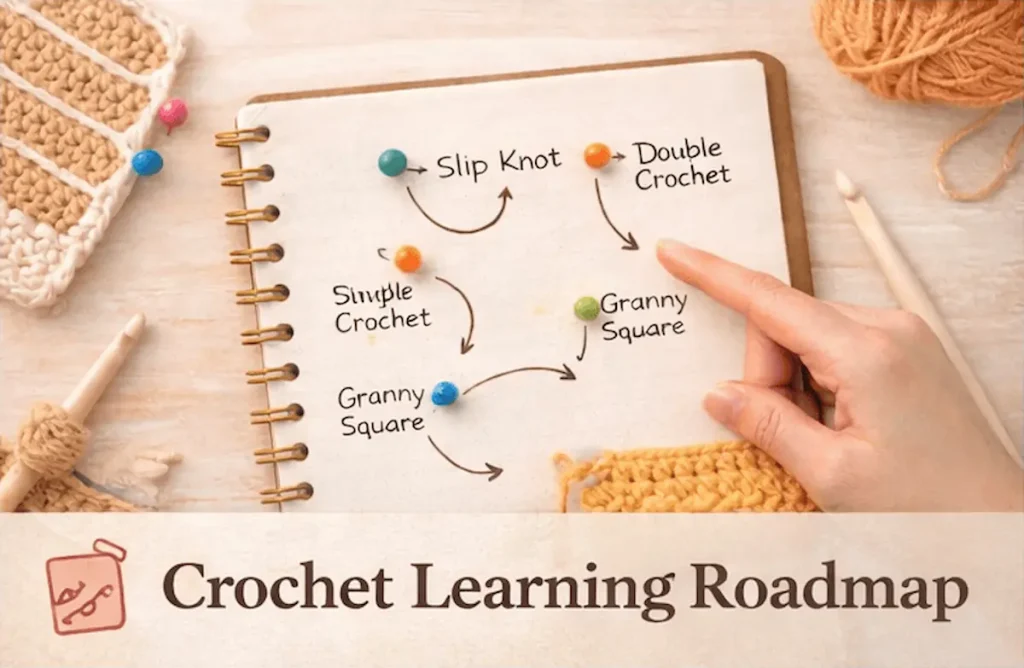
Crochet Learning Roadmap: What to Learn First (Beginner Stages + Timeline)
Quick Answer: What Should Beginners Learn First in Crochet?
Start with tension and grip, then chains, straight rows, three basic stitches, and a small flat project.
Crochet becomes easier when skills are learned in sequence rather than through random tutorials.
But this answer only works when you understand why sequence matters — and how each beginner skill connects to a larger learning system.
This roadmap explains that system.
- Quick Answer: What Should Beginners Learn First in Crochet?
- 1. Skills
- 2. Stages
- 3. Projects
- 4. Independence
- 1. Reduced Hand Tension
- 2. Fewer Sudden Mistakes
- 3. Consistent Stitch Size
- 4. Less Dependence on Tutorials
- 5. Completion Confidence
- Pillar Guides — The Map
- Longtail Guides — The Concepts
- Micro Guides — The Fixes
- Is it normal for crochet to feel hard at first?
- How long does it take to get comfortable with crochet?
- Should beginners learn many stitches early?
- Why do tutorials sometimes make things more confusing?
- When should I try complex projects?
- If Crochet Feels Difficult
- If You Want to Know What to Learn Next
- If You Want to Understand Learning Stages
- Beginner Tools
This Is Not a Tutorial — It Is a Learning System
Most crochet guides teach actions.
This guide teaches progression.
Crochet is not a collection of techniques you memorize one by one.
It is a structured motor skill built through layered adaptation:
control → consistency → recognition → independence
Each stage prepares the brain and hands for the next stage.
When beginners skip stages, progress feels random.
When stages are followed in sequence, improvement becomes predictable.
This article functions as the central learning map for beginner crochet inside the DailyHandmade learning system.
Instead of asking:
“What project should I make next?”
You learn to ask:
“What skill stage am I currently in?”
That shift changes everything.
The Purpose of This Crochet Learning Roadmap
Beginners often believe crochet difficulty comes from complexity.
In reality, most frustration comes from missing structure.
Online tutorials are optimized for entertainment and quick results.
They show finished projects without explaining the invisible skills required beforehand.
As a result, beginners experience:
- uneven progress
- repeated mistakes
- confusion about what to practice
- the feeling of starting over again and again
This roadmap solves that problem by defining:
- the correct learning order
- the relationship between beginner skills
- the stages nearly all crocheters pass through
- how small exercises become long-term independence
The goal is not speed.
The goal is stable skill acquisition.
How This Crochet Learning System Works
This learning system organizes crochet into four connected layers.
1. Skills
Individual physical abilities such as:
- tension control
- chaining
- stitch formation
2. Stages
Groups of skills that emerge together during learning adaptation.
3. Projects
Controlled environments where skills stabilize through repetition.
4. Independence
The point where crocheters can:
- read patterns
- fix mistakes
- learn new techniques without constant guidance
Each layer depends on the previous one.
Projects do not create skill.
Skills make projects possible.
This is why beginners who jump between projects often feel stuck even after weeks of practice.
The Core Principle: Crochet Is Learned Like Handwriting
Crochet looks simple from the outside.
You watch someone on TikTok or YouTube move a hook through yarn effortlessly and assume the process is intuitive.
Then you try.
Your chain is tight.
Your rows wobble.
Your hands feel clumsy.
This happens because crochet is a physical language, not an intellectual one.
Your brain must build coordination between:
- visual recognition
- finger pressure
- motion timing
- tension feedback
In early stages, the brain is translating instructions into movement for the first time.
Mistakes are not failures — they are signals of adaptation.
Understanding this removes the most damaging beginner belief:
Crochet is not talent-based.
It is sequence-based.
Why Random Tutorials Slow Learning
Many beginners unknowingly follow a “project-first” learning path:
- Find a cute project
- Follow steps mechanically
- Encounter confusion
- Restart with another tutorial
This creates fragmented learning because each tutorial assumes different foundational skills.
A structured roadmap reverses this process:
foundation → repetition → clarity → creativity
When skills are learned in sequence:
- mistakes become understandable
- progress becomes visible
- confidence grows naturally
For a deeper explanation of early difficulty, read:
Why Crochet Feels Hard at First
The Beginner Context: What Most New Crocheters Experience
Before learning begins, almost every beginner shares the same internal questions:
- Why does crochet look easy but feel impossible?
- Why are my stitches different every row?
- Am I holding the yarn wrong?
- Why do tutorials work for others but not for me?
These questions are not individual problems.
They belong to a predictable beginner phase.
This roadmap treats beginner confusion as part of the learning system, not something to overcome alone.
Throughout this guide, you will see how each frustration connects to a specific stage — and why those struggles appear at exactly the right time.
How to Use This Roadmap
You do not need to read everything at once.
Instead:
- Identify your current stage
- Practice the skills connected to that stage
- Ignore techniques belonging to later stages
- Return here whenever progress feels unclear
This page acts as the navigation center linking to deeper guides that expand each part of the learning journey.
If you are new here, start with:
Crochet Hub: Start Here
What This Roadmap Will Help You Understand
By the end of this guide, you will know:
- why crochet feels hard at first
- what to learn first (and what to ignore)
- how beginner progress actually works
- the five stages most crocheters experience
- how to move from confusion to independent learning
Most importantly, you will understand where you are in the process — which removes the uncertainty that causes most beginners to quit.
The Beginner Reality: Why Crochet Feels Hard Before It Feels Easy
Almost every beginner enters crochet with the same expectation:
“If I follow the tutorial carefully, my result should look similar.”
When that does not happen, confusion appears immediately.
The important thing to understand is this:
Beginner crochet problems are not random mistakes.
They are predictable adaptation signals.
Your brain and hands are learning coordination patterns that do not yet exist.
During this phase, inconsistency is not evidence of failure — it is evidence of learning in progress.
This section explains the beginner problem landscape so you can recognize:
- what is normal
- what is temporary
- what each difficulty is actually teaching you
Crochet Feels Awkward Because Two Systems Are Learning at Once
Crochet is unusual compared to many crafts because both hands perform different roles simultaneously.
Your hook hand learns movement precision
- inserting the hook correctly
- catching yarn without splitting
- rotating the hook smoothly
- pulling loops through controlled spaces
Your yarn hand learns regulation
- feeding yarn at a consistent speed
- maintaining tension
- adjusting pressure automatically
- staying relaxed while working
At the beginning, neither system trusts the other yet.
So beginners often:
- grip too tightly
- slow down excessively
- overcorrect movements
- tense shoulders without noticing
This awkwardness disappears not because you “figure it out,” but because repetition allows the nervous system to automate coordination.
For a deeper breakdown, read:
Why crochet feels awkward at first
Uneven Stitches Are a Stage — Not a Skill Problem
One of the most discouraging beginner experiences is seeing uneven stitches despite carefully following instructions.
Beginners often assume:
“I must be doing something wrong.”
In reality, uneven stitches usually come from variable tension, not incorrect technique.
Early tension changes constantly because confidence fluctuates:
- you tighten when uncertain
- loosen when relaxed
- pause before difficult insertions
- pull harder after mistakes
This produces fabric that looks inconsistent even when the steps are correct.
Common beginner causes include:
- inconsistent yarn feeding
- hook size mismatches
- unclear stitch visibility
- accidental stitch skipping
- inconsistent turning habits
These issues belong to the control-building phase of learning.
Read more:
Why my crochet stitches look uneven as a beginner
Frogging Is a Sign of Progress, Not Regression
Undoing stitches — called frogging — feels emotionally frustrating because effort appears lost.
However, experienced crocheters frog frequently.
Why?
Because frogging trains one of the most important hidden skills in crochet: stitch recognition.
Each time you undo work, you learn:
- how stitches are constructed
- where mistakes originate
- how loops connect
- how fabric structure behaves
Beginners who frog often are usually developing faster pattern awareness than those who avoid correcting mistakes.
Read:
Is it normal to frog a lot when learning crochet
Physical Discomfort Signals Adjustment, Not Endurance
Pain is one of the most common reasons beginners quit crochet early.
Many assume discomfort means they need stronger hands or more practice time.
The opposite is true.
Beginner discomfort usually results from:
- gripping tools too tightly
- forcing tension instead of guiding it
- using hooks unsuited to hand size
- long practice sessions without breaks
- bent wrist positioning
Crochet should feel controlled, not strained.
Early ergonomic adjustment prevents long-term frustration and allows consistent practice sessions.
Read:
Why crochet hurts my hands as a beginner
Hidden Beginner Mistakes That Slow Learning
Some beginner challenges are not visible during practice but strongly affect progress speed.
Common learning blockers include:
- dark yarn that hides stitch structure
- fuzzy yarn that splits easily
- small hooks that increase tension difficulty
- complex projects introduced too early
- skipping stitch counting
- switching tutorials too frequently
These mistakes do not prevent learning — they simply increase cognitive load beyond what beginners can comfortably manage.
When tools and projects match the correct stage, progress accelerates naturally.
Read:
Beginner crochet mistakes that slow progress
The Crochet Learning Curve Is Non-Linear
Many beginners expect improvement to feel steady.
Crochet progress rarely behaves this way.
Instead, learning typically follows a pattern:
- Initial confusion
- Sudden clarity
- Temporary regression
- Stabilization
- Visible improvement
This happens because motor learning develops in cycles.
The brain alternates between experimentation and consolidation.
A common two-week experience looks like this:
- Day 1: movements feel impossible
- Day 3: coordination suddenly improves
- Day 5: inconsistency returns
- Day 7: edges begin stabilizing
- Day 10: stitches become recognizable
- Day 14: first successful object appears
Understanding this pattern prevents beginners from quitting during normal regression phases.
Read:
Crochet learning curve explained for beginners
Why Beginners Feel Lost About What to Learn First
After encountering early difficulty, most beginners search for answers using project-based questions:
- What should I make next?
- Which stitch should I learn?
- Which tutorial is best?
These questions feel logical but miss the underlying issue.
The real problem is sequence uncertainty.
Without a defined learning order, beginners attempt skills that rely on abilities they have not yet developed.
This creates the illusion that crochet itself is confusing, when the real issue is missing progression structure.
The next section introduces the correct learning order — not as a list of techniques, but as a progression system where each skill prepares the next.
Why Learning Order Determines Crochet Success
Most beginner frustration does not come from difficulty.
It comes from learning skills before their prerequisites exist.
Crochet skills are not independent techniques.
They form a dependency chain where earlier abilities quietly support later ones.
When learned in the correct order:
- movements feel easier
- mistakes become understandable
- projects stabilize faster
When learned out of order:
- beginners compensate with tension
- confusion increases
- progress feels inconsistent
This section explains the logic behind the beginner crochet progression — not just what to learn first, but why the order works.
The Hidden Dependency Structure of Crochet Skills
Every crochet action relies on three foundational capacities:
- Control — managing tension and hand coordination
- Consistency — repeating movements predictably
- Recognition — visually understanding stitch structure
These capacities develop sequentially.
You cannot recognize stitches clearly before creating them consistently.
You cannot create them consistently before controlling tension.
This creates the natural progression:
Control → Consistency → Recognition → Construction
Each stage prepares the learner for the next level of independence.
Step 1: Grip and Comfort Come Before Technique
Beginners often search for the “correct” way to hold yarn or a hook.
In reality, there is no single perfect grip.
The goal of the first stage is stability, not correctness.
A functional grip must be:
- comfortable over time
- repeatable
- relaxed
- pain-free
At this stage, the brain is mapping movement pathways.
Changing grips constantly interrupts adaptation.
Progress signal
You can crochet for several minutes without adjusting your hands repeatedly.
Related guide:
Crochet stage 1: learning tension and grip
Step 2: Tension Is the Foundation Skill
Tension controls nearly every visible outcome in crochet:
- stitch size
- edge straightness
- fabric flexibility
- visual neatness
- ease of insertion
Beginners often focus on stitches first because stitches appear more important.
However, stitches are only shapes formed by controlled tension.
Without tension control:
- chains become tight
- hooks struggle to enter loops
- rows warp unpredictably
Tension improves through repetition rather than correction.
The goal is gradual consistency, not perfection.
Progress signal
Your stitches begin to look similar even when you are not concentrating intensely.
Related reading:
Why crochet feels easy some days and hard others
Step 3: Chains Teach Movement Rhythm
Chains are deceptively simple.
They introduce the rhythm that governs all crochet motion:
insert → yarn over → pull through → reset
Beginners frequently make chains too tight because they focus on control rather than flow.
A tight chain creates multiple downstream problems:
- difficult first rows
- sore hands
- uneven edges
- curling fabric
The chain stage exists to establish movement timing, not to produce perfect results.
Progress signal
You can insert your hook into chains without forcing it.
Related guide:
What to learn first: chain or single crochet
Step 4: Straight Rows Build Structural Awareness
Working in straight rows introduces several invisible skills simultaneously:
- counting stitches
- recognizing row boundaries
- turning consistently
- maintaining edge alignment
Straight rows function as a training environment where mistakes are easy to detect and correct.
Beginners often want to start crocheting in the round immediately because it looks more exciting.
However, rounds hide counting errors and delay stitch recognition development.
Progress signal
Your rectangle remains rectangular without constant correction.
Related guide:
Crochet stage 2: learning straight rows
Step 5: Limiting Stitches Accelerates Learning
A common beginner instinct is to learn many stitches quickly.
This slows progress.
Each new stitch introduces new motion variables.
Too many variations prevent muscle memory stabilization.
The three foundational stitches provide sufficient variation:
- single crochet (control)
- half double crochet (timing)
- double crochet (height awareness)
Together, they teach the core mechanics used across most patterns.
Progress signal
You can switch between these stitches without losing tension consistency.
Related guide:
Best first crochet stitch for beginners
Step 6: Small Flat Projects Stabilize Skill
Projects are not the beginning of learning.
They are stabilization environments.
A good beginner project:
- repeats the same movements
- remains small enough to finish
- reveals mistakes clearly
- builds completion confidence
Examples include:
- dishcloths
- coasters
- simple scarves
- practice squares
Finishing small projects teaches persistence and introduces finishing techniques naturally.
Progress signal
You complete an object that holds its shape after finishing.
Related guide:
What is the easiest first crochet project
Step 7: Pattern Reading Creates Independence
Patterns often appear advanced because of abbreviations and formatting.
In reality, patterns are structured instructions describing familiar actions.
Pattern reading becomes easier only after physical movements feel automatic.
At this stage, learners transition from imitation to interpretation.
Progress signal
You can follow written instructions without constantly watching demonstrations.
Related guide:
Crochet stage 3: learning to read patterns
Step 8: Working in the Round Expands Construction Skills
Crochet in the round introduces shaping logic:
- increases
- decreases
- joining methods
- circular symmetry
Rounds unlock many beginner goals such as:
- hats
- amigurumi
- granny squares
However, rounds rely heavily on stitch recognition and counting skills developed earlier.
Progress signal
Circular projects remain flat or curved intentionally rather than accidentally.
Related guide:
Crochet stage 5: learning shaping and rounds
Step 9: Wearables Introduce Planning and Fit
Wearables combine all previous skills with new concepts:
- sizing
- gauge awareness
- shaping sequences
- finishing precision
At this stage, crocheters begin understanding crochet as construction rather than repetition.
Progress signal
You can adjust slightly when sizing feels incorrect instead of restarting entirely.
Related guide:
Crochet stage 4: making first wearable projects
Step 10: Charts Become Optional Efficiency Tools
Charts represent stitches visually rather than verbally.
They are helpful for visual learners but not required for beginner success.
Charts become useful only after stitch recognition feels natural.
Progress signal
You recognize stitch symbols by structure rather than memorization.
Related guide:
When to start learning crochet charts
How the Progression Connects Together
Seen individually, these steps appear simple.
Seen together, they form a progression system.
- Grip enables tension
- Tension enables chains
- Chains enable rows
- Rows enable stitch recognition
- Recognition enables patterns
- Patterns enable independence
This structure explains why returning to fundamentals often solves advanced frustrations.
When progress feels stuck, the solution is rarely learning something new — it is strengthening an earlier stage.
How Beginners Know They Are Actually Improving
One of the most difficult parts of learning crochet is not the skill itself — it is uncertainty about progress.
Beginners often ask:
- “Am I getting better?”
- “Why does this still feel inconsistent?”
- “When does crochet start feeling natural?”
Without clear progress signals, learners rely on emotional judgment instead of observable evidence.
This creates unnecessary discouragement during normal learning phases.
A structured learning system solves this by defining progress recognition — visible signs that skill development is occurring even before results look perfect.
The Progress Recognition Framework
Improvement in crochet appears in stages long before projects look polished.
Instead of evaluating finished objects, beginners can observe five reliable indicators.
1. Reduced Hand Tension
Early crochet feels physically intense.
Over time, grip pressure decreases automatically.
Progress sign
You notice your hands relaxing without consciously trying.
This indicates motor efficiency developing in the nervous system.
2. Fewer Sudden Mistakes
At first, errors appear randomly:
- skipped stitches
- accidental increases
- uneven rows
As coordination stabilizes, mistakes become predictable rather than surprising.
Progress sign
You can identify mistakes earlier or understand why they happened.
This marks the transition from confusion to awareness.
3. Consistent Stitch Size
Perfect stitches are not required.
Consistency matters more than appearance.
Progress sign
Rows begin to look uniform even when speed increases slightly.
Consistency shows tension regulation improving subconsciously.
4. Less Dependence on Tutorials
Beginners initially pause videos frequently.
Progress sign
You continue crocheting for longer periods without checking instructions.
This indicates movement patterns are becoming internalized.
5. Completion Confidence
Finishing projects feels intimidating early on.
Progress sign
You start believing you can finish before the project is complete.
Confidence here is not emotional optimism — it reflects accumulated skill stability.
Why Progress Often Feels Invisible
Crochet learning involves neurological adaptation rather than intellectual understanding.
Motor skills improve quietly between practice sessions as the brain consolidates movement patterns.
This explains why beginners often experience sudden improvement after rest days.
Learning is occurring even when practice feels repetitive or slow.
Understanding this prevents a common mistake:
abandoning practice just before consolidation occurs.
Predictable Challenges at Each Learning Stage
Every stage introduces a new type of difficulty.
These challenges are not obstacles — they are transition signals.
Stage 1 → Stage 2 Transition
Challenge
tight chains and sore hands
Cause
tension overcontrol
Stage 2 → Stage 3 Transition
Challenge
drifting edges
Cause
incomplete stitch recognition
Stage 3 → Stage 4 Transition
Challenge
confusion reading patterns
Cause
translating language into motion
Stage 4 → Stage 5 Transition
Challenge
shaping errors
Cause
spatial understanding still developing
Recognizing these transitions reduces frustration because difficulty becomes expected rather than alarming.
Why Returning to Fundamentals Accelerates Progress
Advanced crocheters frequently revisit beginner exercises.
This is not regression.
It is reinforcement.
Fundamentals act as calibration tools:
- chains refine tension
- rows restore consistency
- simple stitches reset rhythm
When projects begin feeling difficult again, strengthening earlier skills often restores control faster than learning new techniques.
This principle explains why structured learning systems outperform random exploration.
Concept Relationships Inside Crochet Learning
Crochet skills form interconnected relationships rather than isolated abilities.
Examples:
- Better tension improves stitch recognition
- Stitch recognition improves counting accuracy
- Counting accuracy improves shaping success
- Shaping success improves pattern comprehension
Because skills reinforce each other, small improvements create compound progress over time.
Beginners often underestimate this compounding effect.
A minor improvement in tension can influence nearly every future project.
The Difference Between Practice and Productive Practice
Time spent crocheting does not automatically produce improvement.
Productive practice includes:
- repeating controlled movements
- focusing on one skill at a time
- working at an appropriate difficulty level
- allowing rest between sessions
Unproductive practice often looks like:
- starting complex projects too early
- switching tutorials frequently
- practicing while fatigued
- chasing novelty instead of consistency
The roadmap prioritizes productive practice by aligning exercises with learning stages.
When Advice Does Not Apply
Not every recommendation works equally for all situations.
Examples:
- very textured yarn may hide stitches even for intermediate learners
- tight personal crocheting styles may require larger hooks
- left-handed learners may need mirrored demonstrations
Understanding applicability boundaries prevents beginners from assuming something is wrong when variation is normal.
Crochet allows multiple successful styles as long as foundational principles remain stable.
Predicting Your Next Beginner Challenge
Once learners stabilize straight rows and basic stitches, the next common difficulties are predictable:
- edges improving but tension fluctuating
- confusion transitioning to written patterns
- projects succeeding but feeling slow
- desire to attempt complex designs too early
These signals indicate readiness for the next stage rather than failure in the current one.
The roadmap helps learners move forward intentionally instead of reacting emotionally to difficulty.
Why Structured Learning Creates Independence
The ultimate goal of crochet learning is not mastering specific stitches.
It is developing the ability to learn new techniques independently.
Independence appears when a crocheter can:
- diagnose mistakes
- adjust tension automatically
- interpret unfamiliar patterns
- experiment confidently
This transition happens naturally when progression follows structured stages.
Random learning delays independence because foundational relationships remain unclear.
How to Navigate the Crochet Learning Roadmap
This roadmap is designed to function as a navigation center rather than a one-time article.
You are not expected to master everything in a single reading.
Instead, this page helps you repeatedly answer one essential question:
“What should I focus on next?”
Every beginner challenge connects back to one of three learning directions:
- Return — strengthen an earlier foundation
- Stabilize — practice the current stage longer
- Advance — move to the next skill layer
Knowing which direction to take prevents the most common beginner mistake:
progressing randomly.
Navigation Pathways Inside the Learning System
The DailyHandmade crochet system is structured so each type of guide serves a different purpose.
Pillar Guides — The Map
Pillar articles define the full learning system and progression logic.
They help you understand:
- where you are
- what comes next
- how skills connect
This roadmap is the central pillar for beginner crochet progression.
Longtail Guides — The Concepts
Longtail guides expand one learning stage or concept in depth.
They explain:
- why a problem happens
- when it appears
- how it fits into progression
Examples include:
- Why Crochet Feels Hard at First
- What Should You Learn First in Crochet
- Crochet Learning Stages Explained
When confusion persists beyond a quick fix, move into a longtail guide.
Micro Guides — The Fixes
Micro articles solve single beginner problems quickly.
They provide:
- immediate recognition
- cause explanation
- simple corrective actions
Examples include:
- uneven stitches
- tight chains
- hand discomfort
- skipped stitches
Micro guides help you continue practicing without interruption, then return you to the larger learning path.
How Beginners Should Move Through the System
A healthy learning flow looks like this:
- Start at the roadmap
- Enter a longtail guide to understand a concept
- Use micro guides when specific problems appear
- Return to the roadmap to regain orientation
This loop creates steady progress while preventing overwhelm.
Instead of searching endlessly for new tutorials, you move intentionally within a structured environment.
The Learning Continuity Principle
Crochet progress rarely moves forward in a straight line.
Learners frequently cycle through stages:
- improving tension
- encountering new mistakes
- revisiting fundamentals
- gaining stability again
This cycling is not regression.
It is reinforcement.
The roadmap exists so you always have a stable reference point regardless of where you are in the cycle.
Whenever learning feels confusing, returning here restores context.
Signs You Are Ready to Move Beyond Beginner Stage
You may be transitioning out of beginner status when:
- you recognize mistakes without external help
- patterns feel readable rather than intimidating
- tension adjusts automatically
- finished projects resemble intended shapes
- experimentation feels possible instead of risky
At this point, crochet shifts from instruction-following to creative exploration.
Future roadmap expansions introduce:
- texture
- colorwork
- design thinking
—all built on the same progression principles established here.
Why This System Works Long-Term
Many beginners eventually learn crochet through persistence alone.
However, structured learning reduces unnecessary frustration by aligning practice with how motor skills naturally develop.
This system works because it:
- respects learning stages
- limits cognitive overload
- reinforces fundamentals before complexity
- connects every problem to a clear cause
- provides predictable next steps
Rather than relying on motivation, it relies on structure.
The Role of Tools and Projects in the System
Tools and projects are supportive elements, not starting points.
Within this roadmap:
- tools reduce friction
- projects stabilize skills
- repetition builds confidence
- progression creates independence
When tools or projects feel difficult, the solution is usually adjusting stage alignment rather than changing ability.
Frequently Asked Beginner Questions
Is it normal for crochet to feel hard at first?
Yes.
Early difficulty reflects coordination development, not lack of ability.
How long does it take to get comfortable with crochet?
Most beginners notice clear improvement within the first few weeks of consistent short practice sessions.
Should beginners learn many stitches early?
No.
Limiting stitches accelerates skill stabilization.
Why do tutorials sometimes make things more confusing?
Because tutorials often assume skills you may not have developed yet.
When should I try complex projects?
After straight rows, tension control, and basic pattern reading feel stable.
Next Reads — Continue the Learning Path
If Crochet Feels Difficult
- Why Crochet Feels Hard at First
- Why crochet feels awkward at first
- Crochet learning curve explained for beginners
If You Want to Know What to Learn Next
- What Should You Learn First in Crochet
- The first 5 crochet skills beginners should master
- Best first crochet stitch for beginners
If You Want to Understand Learning Stages
- Crochet Learning Stages Explained
- Crochet stage 1: learning tension and grip
- Crochet stage 2: learning straight rows
- Crochet stage 3: learning to read patterns
Beginner Tools
Each guide expands one part of the same structured learning system, allowing beginners to move from confusion toward confident, independent crochet step by step.
System Identity: The DailyHandmade Learning Approach
This roadmap is part of the DailyHandmade learning system — a structured approach to handmade skill education built on progression rather than randomness.
The goal is simple:
Help beginners replace uncertainty with clarity.
Instead of asking whether you are talented enough to crochet, you learn to recognize:
- where you are in the learning process
- what your challenges mean
- what to do next
When you can identify your stage, understand your challenges, and choose practice intentionally, crochet stops feeling confusing and starts feeling logical.
And once learning becomes logical, independence follows naturally.