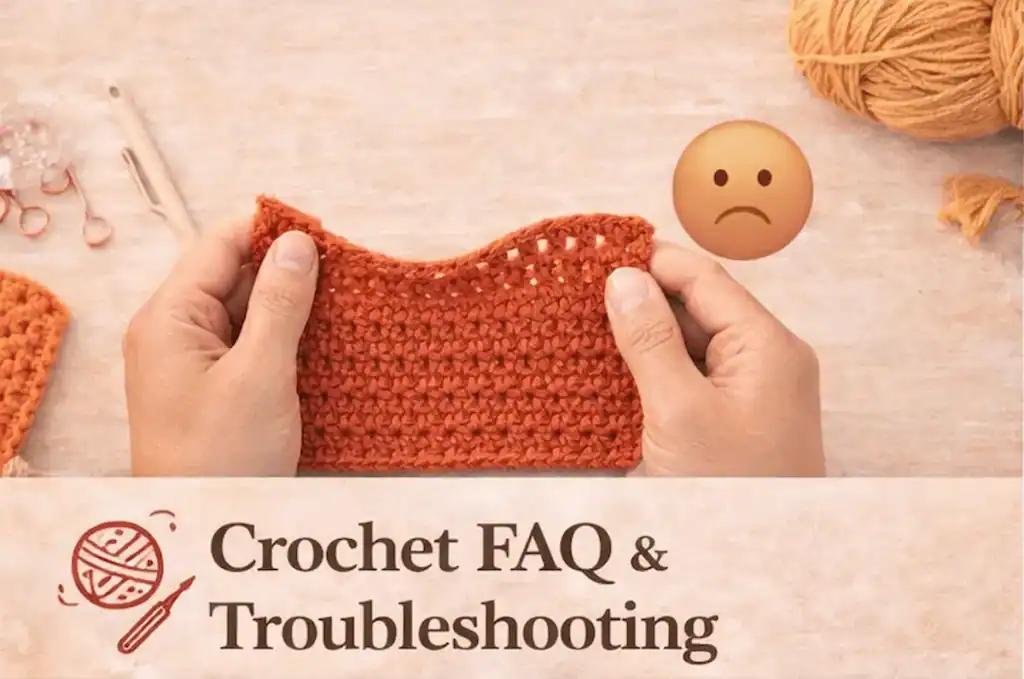
Crochet Troubleshooting for Beginners
Why Crochet Feels Hard Sometimes — And Why That’s Normal
Most crochet guides focus on technique.
They explain stitches, tools, and patterns clearly.
Yet many beginners still experience problems that feel difficult to explain:
- Crochet Suddenly Feels Harder Than Yesterday
- Tension Changes Without Reason
- Hands Feel Clumsy
- Mistakes Increase Late At Night
- Joined Pieces Look Wrong Even When Stitches Are Correct
These experiences are rarely technical failures.
They are human learning effects — natural variations that occur while developing coordination, rhythm, and visual recognition.
This pillar exists to explain the part of crochet beginners rarely hear about:
how real-life conditions affect crochet performance and how to troubleshoot them without losing confidence.
- Why Crochet Feels Hard Sometimes — And Why That’s Normal
- The Hidden Side of Beginner Crochet
- Three Types of Crochet Problems Beginners Experience
- System 1 — Performance Variability
- System 2 — Tension Diagnosis
- System 3 — Assembly and Joining
- Why These Problems Appear After Learning the Basics
- The Crochet Stability Model
- The Beginner Troubleshooting Philosophy
- How This Pillar Fits Into the Crochet Learning System
- How to Use This Guide
- The Beginner Crochet Troubleshooting Framework
- Why Crochet Feels Different From Day to Day
- The Three Categories of “Bad Crochet Days”
- Why Tension Changes Without Warning
- The Beginner Error Amplification Effect
- Emotional Signals in Crochet Learning
- Why Beginners Make More Mistakes When Tired
- The Role of Micro Resets
- When to Stop Crocheting (And Why It Helps)
- Mapping Human Factors to Crochet Outcomes
- Transition to Technical Diagnosis
- Why Crochet Feels Different From Day to Day
- The Three Categories of “Bad Crochet Days”
- Why Tension Changes Without Warning
- The Beginner Error Amplification Effect
- Emotional Signals in Crochet Learning
- Why Beginners Make More Mistakes When Tired
- The Role of Micro Resets
- When to Stop Crocheting (And Why It Helps)
- Mapping Human Factors to Crochet Outcomes
- Transition to Technical Diagnosis
- Why Joining Feels Harder Than Expected
- Seam vs Join: Understanding the Two Systems
- Why Joined Pieces Look Crooked
- The Alignment Principle
- Choosing Beginner-Friendly Joining Methods
- Avoiding Bulky Seams
- Joining Pieces With Different Stitch Counts
- How Joining Completes the Learning System
- Connecting Joining to Earlier Troubleshooting Skills
- Predicting the Next Beginner Challenge
- The Crochet Troubleshooting Navigation System
- Start From Your Current Problem
- The Universal Crochet Fix Workflow
- Progress Signals: How to Know You Are Improving
- When Troubleshooting Becomes Intuition
- How This Pillar Connects to the Crochet Learning System
- System Identity: From Instructions to Understanding
- Final Guidance: The Key to Consistent Progress
- Continue Your Learning Journey
The Hidden Side of Beginner Crochet
Crochet is not only a craft skill.
It combines multiple systems simultaneously:
- Fine Motor Coordination
- Visual Processing
- Rhythm Timing
- Tension Regulation
- Attention And Focus
- Physical Comfort
Because these systems depend on the body and environment, performance changes from day to day.
Predictive Insight
Beginners often believe inconsistency means regression. In reality, fluctuating performance is a required phase before stability develops.
Learning crochet resembles learning a musical instrument more than following instructions.
Three Types of Crochet Problems Beginners Experience
Within the Crochet Hub learning framework, beginner troubleshooting falls into three major categories:
- Performance Variability (Why Crochet Feels Hard Some Days)
- Tension Diagnosis (Too Tight Vs Too Loose)
- Assembly Challenges (Joining Pieces Neatly)
These categories form the structural foundation of this pillar.
Each represents a different stage of learning maturity.
System 1 — Performance Variability
Some crochet problems originate from the learner rather than the project.
Examples Include
- Fatigue
- Reduced Concentration
- Lighting Conditions
- Emotional Stress
- Physical Tension
These factors influence hand coordination directly.
Authority Clarification
A beginner’s tension often changes more due to energy level than technique errors.
Understanding this removes unnecessary self-blame.
System 2 — Tension Diagnosis
Tension becomes the central troubleshooting skill once beginners start completing projects.
Many visible problems trace back to tension imbalance:
- Stiff Fabric
- Floppy Fabric
- Uneven Rows
- Difficult Stitch Insertion
- Inconsistent Sizing
The key shift at this stage is learning to diagnose tension, not just adjust it.
Diagnosis transforms crochet from reactive fixing into intentional control.
System 3 — Assembly and Joining
Joining crochet pieces introduces a new type of difficulty.
Unlike stitching rows, joining requires:
- Alignment Awareness
- Structural Planning
- Tension Consistency Across Pieces
- Visual Symmetry
Beginners often feel confused because pieces look correct individually but incorrect when combined.
Conceptual Clarification
Joining is not an advanced skill — it is a coordination skill that appears later in learning progression.
This pillar reframes joining as a predictable learning stage rather than a finishing problem.
Why These Problems Appear After Learning the Basics
Many beginners expect crochet to become easier once stitches are learned.
Instead, new difficulties appear.
This happens because learning progresses in layers:
- Learning Movements
- Applying Movements Consistently
- Managing Variation
- Assembling Results
Each new layer reveals challenges invisible at earlier stages.
Failure Anticipation
Beginners often interpret new challenges as failure to improve, when they actually indicate progression into deeper learning stages.
The Crochet Stability Model
Crochet development moves toward stability through repetition under varying conditions.
The learning cycle looks like this:
Practice → Variation → Adjustment → Stability
Variation is unavoidable.
Bad crochet days are part of stabilization, not obstacles to it.
Authority Insight
Consistency emerges after experiencing inconsistency repeatedly. The brain learns to compensate automatically over time.
The Beginner Troubleshooting Philosophy
This pillar introduces a core principle used across the Crochet Hub:
Diagnose Before Fixing
Instead of immediately changing tools or restarting work, beginners learn to ask:
- Is This A Focus Issue?
- Is This A Tension Issue?
- Is This An Assembly Issue?
Correct diagnosis reduces unnecessary corrections and protects developing muscle memory.
How This Pillar Fits Into the Crochet Learning System
Within the broader learning architecture:
- Earlier Pillars Teach How To Crochet
- Mistake Pillars Teach Why Problems Happen
- This Pillar Teaches How To Recover And Continue Learning
It acts as the bridge between technical skill and independent problem-solving.
This pillar governs three longtail authority guides:
- Why Crochet Feels Hard Some Days
- How to Tell If You’re Crocheting Too Tight or Too Loose
- How to Join Crochet Pieces
Each expands one troubleshooting dimension introduced here.
How to Use This Guide
You can approach this pillar based on your current experience.
- If Crochet Suddenly Feels Difficult → Explore Performance Variability
- If Fabric Looks Wrong → Diagnose Tension
- If Finished Pieces Don’t Align → Learn Joining Strategies
Predictive Guidance
Most beginners cycle through all three challenges repeatedly. Each cycle strengthens long-term control and confidence.
Crochet becomes easier when fluctuations feel understandable rather than discouraging.
The Beginner Crochet Troubleshooting Framework
This pillar defines the official Beginner Crochet Troubleshooting Framework used across the Crochet Hub.
It organizes crochet problems into three diagnostic systems:
- Human Performance Variability
- Tension Regulation and Diagnosis
- Structural Assembly and Joining
Every troubleshooting situation in beginner crochet can be traced back to one of these systems.
This framework prevents random fixing and replaces it with structured diagnosis.
Instead of asking “What did I do wrong?” beginners learn to ask:
Which system is currently unstable?
This shift transforms frustration into clarity.
Why Crochet Feels Different From Day to Day
One of the most confusing beginner experiences is inconsistency.
You may crochet smoothly one day and struggle the next — even using the same yarn, hook, and pattern.
Beginners often assume they suddenly lost skill.
In reality, crochet performance changes because the human body changes.
Crochet depends on small physical and cognitive systems that fluctuate naturally:
- Muscle Fatigue
- Attention Span
- Visual Focus
- Posture
- Emotional State
- Environmental Conditions
Understanding these influences helps beginners separate skill problems from temporary performance variation.
The Three Categories of “Bad Crochet Days”
Most difficult crochet sessions fall into one of three predictable categories.
Recognizing which category you are experiencing allows faster recovery.
1. Physical Fatigue Days
Crochet requires fine motor control.
When hands or eyes are tired, coordination decreases subtly.
Common Signals
- Stitches Tighten Without Intention
- Hook Insertion Feels Difficult
- Counting Errors Increase
- Tension Becomes Inconsistent
Crochet often feels harder at night because fatigue accumulates throughout the day.
Predictive Insight
Many beginners mistake fatigue-induced tension changes for permanent technique problems and attempt unnecessary corrections.
Rest often fixes what technique cannot.
2. Cognitive Overload Days
Learning a new stitch or pattern increases mental demand.
During these sessions, beginners may notice:
- Slower Stitching
- Frequent Mistakes
- Loss Of Rhythm
- Difficulty Recognizing Stitches
This occurs because working memory is occupied by learning new movements.
Conceptual Clarification
Skill temporarily decreases while new neural pathways form. This regression is a normal stage of learning consolidation.
3. Environmental Disruption Days
Small environmental changes strongly affect crochet performance.
Examples Include
- Poor Lighting
- Uncomfortable Seating
- Different Yarn Texture
- Switching Hook Styles
- Background Distractions
These factors alter posture and tension subconsciously.
Authority Insight
Experienced crocheters often adjust environment before adjusting technique because environmental variables strongly influence consistency.
Why Tension Changes Without Warning
Tension is highly sensitive to body conditions.
It reacts instantly to:
- Stress Levels
- Hand Pressure
- Breathing Patterns
- Speed Of Movement
This explains why tension may look different even within the same project.
Misconception Correction
Changing tension does not mean you forgot how to crochet. It means your coordination system is adapting to changing conditions.
Consistency develops through exposure to variation, not avoidance of it.
The Beginner Error Amplification Effect
When crochet feels difficult, beginners naturally try harder.
Common Reactions Include
- Gripping Yarn Tighter
- Forcing Hook Movements
- Crocheting Faster To “Fix Rhythm”
- Restarting Repeatedly
These responses increase tension imbalance.
Failure Anticipation
Trying harder physically often worsens coordination problems because crochet relies on relaxed movement rather than force.
Improvement usually comes from slowing down, not increasing effort.
Emotional Signals in Crochet Learning
Crochet frustration often follows predictable emotional patterns:
- Confusion
- Self-Doubt
- Overcorrection
- Fatigue
- Disengagement
Recognizing this cycle allows interruption before frustration escalates.
A short reset — stretching hands, adjusting posture, or switching to simpler stitches — often restores performance.
Authority Insight
Emotional regulation becomes a technical skill in long-term crochet learning.
Why Beginners Make More Mistakes When Tired
Counting and stitch recognition depend on attention.
Fatigue reduces attention precision, leading to:
- Missed Stitches
- Incorrect Repeats
- Uneven Edges
- Accidental Increases Or Decreases
These are not knowledge failures but attention limitations.
Applicability Boundary
If mistakes appear primarily late at night or after long sessions, technique adjustments are unlikely to solve the issue.
Shorter sessions produce faster improvement than longer frustrated ones.
The Role of Micro Resets
A short reset interrupts negative feedback loops.
Effective Resets Include
- Pausing For Five Minutes
- Stretching Hands And Shoulders
- Switching To A Familiar Stitch
- Improving Lighting
- Slowing Stitching Pace
These actions restore coordination without restarting the project.
Predictive Guidance
Beginners who learn to reset early avoid burnout and progress more consistently.
When to Stop Crocheting (And Why It Helps)
Stopping is sometimes the most productive decision.
You Should Pause When
- Hands Begin To Hurt
- Tension Worsens Each Row
- Counting Errors Increase Repeatedly
- Frustration Replaces Enjoyment
Motor learning improves during rest periods as the brain consolidates movement patterns.
Authority Clarification
Breaks do not interrupt learning. They strengthen it.
Mapping Human Factors to Crochet Outcomes
| Human Factor | Crochet Effect |
|---|---|
| Fatigue | Tighter Tension |
| Stress | Inconsistent Rhythm |
| Poor Lighting | Missed Stitches |
| Discomfort | Uneven Tension |
| Rushing | Counting Mistakes |
This mapping helps beginners diagnose causes beyond technique.
Transition to Technical Diagnosis
Once beginners understand performance variability, the next step is distinguishing between temporary conditions and true technical problems.
The most important technical diagnosis skill is recognizing whether tension is too tight or too loose.
The following section explains how tension symptoms appear in both hands and fabric — and how to identify them reliably.
Why Crochet Feels Different From Day to Day
One of the most confusing beginner experiences is inconsistency.
You may crochet smoothly one day and struggle the next — even using the same yarn, hook, and pattern.
Beginners often assume they suddenly lost skill.
In reality, crochet performance changes because the human body changes.
Crochet depends on small physical and cognitive systems that fluctuate naturally:
- Muscle Fatigue
- Attention Span
- Visual Focus
- Posture
- Emotional State
- Environmental Conditions
Understanding these influences helps beginners separate skill problems from temporary performance variation.
The Three Categories of “Bad Crochet Days”
Most difficult crochet sessions fall into one of three predictable categories.
Recognizing which category you are experiencing allows faster recovery.
1. Physical Fatigue Days
Crochet requires fine motor control.
When hands or eyes are tired, coordination decreases subtly.
Common Signals
- Stitches Tighten Without Intention
- Hook Insertion Feels Difficult
- Counting Errors Increase
- Tension Becomes Inconsistent
Crochet often feels harder at night because fatigue accumulates throughout the day.
Predictive Insight
Many beginners mistake fatigue-induced tension changes for permanent technique problems and attempt unnecessary corrections.
Rest often fixes what technique cannot.
2. Cognitive Overload Days
Learning a new stitch or pattern increases mental demand.
During these sessions, beginners may notice:
- Slower Stitching
- Frequent Mistakes
- Loss Of Rhythm
- Difficulty Recognizing Stitches
This occurs because working memory is occupied by learning new movements.
Conceptual Clarification
Skill temporarily decreases while new neural pathways form. This regression is a normal stage of learning consolidation.
3. Environmental Disruption Days
Small environmental changes strongly affect crochet performance.
Examples Include
- Poor Lighting
- Uncomfortable Seating
- Different Yarn Texture
- Switching Hook Styles
- Background Distractions
These factors alter posture and tension subconsciously.
Authority Insight
Experienced crocheters often adjust environment before adjusting technique because environmental variables strongly influence consistency.
Why Tension Changes Without Warning
Tension is highly sensitive to body conditions.
It reacts instantly to:
- Stress Levels
- Hand Pressure
- Breathing Patterns
- Speed Of Movement
This explains why tension may look different even within the same project.
Misconception Correction
Changing tension does not mean you forgot how to crochet. It means your coordination system is adapting to changing conditions.
Consistency develops through exposure to variation, not avoidance of it.
The Beginner Error Amplification Effect
When crochet feels difficult, beginners naturally try harder.
Common Reactions Include
- Gripping Yarn Tighter
- Forcing Hook Movements
- Crocheting Faster To “Fix Rhythm”
- Restarting Repeatedly
These responses increase tension imbalance.
Failure Anticipation
Trying harder physically often worsens coordination problems because crochet relies on relaxed movement rather than force.
Improvement usually comes from slowing down, not increasing effort.
Emotional Signals in Crochet Learning
Crochet frustration often follows predictable emotional patterns:
- Confusion
- Self-Doubt
- Overcorrection
- Fatigue
- Disengagement
Recognizing this cycle allows interruption before frustration escalates.
A short reset — stretching hands, adjusting posture, or switching to simpler stitches — often restores performance.
Authority Insight
Emotional regulation becomes a technical skill in long-term crochet learning.
Why Beginners Make More Mistakes When Tired
Counting and stitch recognition depend on attention.
Fatigue reduces attention precision, leading to:
- Missed Stitches
- Incorrect Repeats
- Uneven Edges
- Accidental Increases Or Decreases
These are not knowledge failures but attention limitations.
Applicability Boundary
If mistakes appear primarily late at night or after long sessions, technique adjustments are unlikely to solve the issue.
Shorter sessions produce faster improvement than longer frustrated ones.
The Role of Micro Resets
A short reset interrupts negative feedback loops.
Effective Resets Include
- Pausing For Five Minutes
- Stretching Hands And Shoulders
- Switching To A Familiar Stitch
- Improving Lighting
- Slowing Stitching Pace
These actions restore coordination without restarting the project.
Predictive Guidance
Beginners who learn to reset early avoid burnout and progress more consistently.
When to Stop Crocheting (And Why It Helps)
Stopping is sometimes the most productive decision.
You Should Pause When
- Hands Begin To Hurt
- Tension Worsens Each Row
- Counting Errors Increase Repeatedly
- Frustration Replaces Enjoyment
Motor learning improves during rest periods as the brain consolidates movement patterns.
Authority Clarification
Breaks do not interrupt learning. They strengthen it.
Mapping Human Factors to Crochet Outcomes
| Human Factor | Crochet Effect |
|---|---|
| Fatigue | Tighter Tension |
| Stress | Inconsistent Rhythm |
| Poor Lighting | Missed Stitches |
| Discomfort | Uneven Tension |
| Rushing | Counting Mistakes |
This mapping helps beginners diagnose causes beyond technique.
Transition to Technical Diagnosis
Once beginners understand performance variability, the next step is distinguishing between temporary conditions and true technical problems.
The most important technical diagnosis skill is recognizing whether tension is too tight or too loose.
The following section explains how tension symptoms appear in both hands and fabric — and how to identify them reliably.
Joining Crochet Pieces: The Hidden Beginner Transition
Many beginners believe crochet difficulty ends once stitches and tension improve.
However, a new challenge appears when projects require joining multiple pieces together.
Even when individual pieces look correct, the finished result may appear:
- Crooked
- Bulky
- Uneven At Corners
- Stretched Or Misaligned
This surprises beginners because joining introduces a different type of skill — assembly coordination.
Joining is not simply sewing or crocheting again.
It combines structure, alignment, and tension control simultaneously.
Why Joining Feels Harder Than Expected
Row-by-row crochet builds fabric in one direction.
Joining requires thinking in relationships between pieces.
Beginners must suddenly manage:
- Matching Stitch Counts
- Aligning Edges
- Balancing Tension Across Two Fabrics
- Choosing An Appropriate Joining Method
Conceptual Comparison
Crocheting rows = building.
Joining pieces = construction assembly.
The mental model changes, which makes joining feel unfamiliar even when stitch skills are solid.
Seam vs Join: Understanding the Two Systems
Crochet assembly methods fall into two main categories.
Seams (Needle-Based Joining)
Seams use a yarn needle to connect pieces.
Examples
- Whip Stitch
- Mattress Stitch
Advantages
- Strong Structure
- Flexible Alignment
- Easier Correction During Joining
Best For
- Garments
- Invisible Finishes
- Beginners Learning Alignment Slowly
Joins (Hook-Based Joining)
Joins connect pieces using crochet stitches.
Examples
- Slip Stitch Join
- Single Crochet Join
Advantages
- Faster Execution
- Decorative Texture
- Integrated Structure
Best For
- Blankets
- Granny Squares
- Visible Design Elements
Authority Insight
Neither method is superior universally. The correct choice depends on project goals and beginner comfort level.
Why Joined Pieces Look Crooked
Crooked joins usually originate from structural mismatch rather than poor technique.
Common Causes Include
- Unequal Stitch Counts
- Uneven Tension Between Pieces
- Joining Too Tightly
- Corners Not Aligned Before Stitching
Failure Anticipation
Beginners often pull joins tightly to make seams look neat, unintentionally distorting the fabric.
Balanced tension during joining is more important than tightness.
The Alignment Principle
Successful joining begins before stitching starts.
Preparation Steps Include
- Lay Pieces Flat
- Match Corners First
- Place Stitch Markers At Intervals
- Confirm Stitch Counts
These steps reduce decision-making during joining, allowing smoother execution.
Authority Clarification
Most joining problems originate from preparation errors, not joining technique itself.
Choosing Beginner-Friendly Joining Methods
Certain methods work particularly well during early learning stages.
Whip Stitch Seam
- Simple Motion
- Forgiving Alignment
- Strong Hold
- Slightly Visible Finish
Ideal first joining method.
Mattress Stitch Seam
- Nearly Invisible Result
- Flexible Fabric Movement
- Professional Appearance
Best once beginners understand edge structure.
Slip Stitch Join
- Flat And Clean
- Minimal Bulk
- Easy Rhythm
Effective for granny squares and modular projects.
Applicability Boundary
Highly decorative joins may look appealing but introduce unnecessary complexity for beginners.
Avoiding Bulky Seams
Bulk usually results from stacking too much material in one place.
Common Causes
- Tight Stitching
- Thick Yarn Doubled Unnecessarily
- Incorrect Stitch Placement
Solutions Include
- Joining Through Matching Loops Only
- Maintaining Relaxed Tension
- Choosing Flatter Joining Stitches
Predictive Insight
Bulky seams become more noticeable after blocking or wearing garments, making early alignment decisions important.
Joining Pieces With Different Stitch Counts
Mismatch between pieces is common, especially for beginners.
Instead of restarting work, adjustment strategies include:
- Distributing Extra Stitches Evenly
- Using Markers To Divide Edges Into Sections
- Easing Fabric Gradually During Joining
Conceptual Clarification
Joining allows controlled correction. Small mismatches rarely require remaking pieces.
How Joining Completes the Learning System
Joining represents the transition from making components to finishing projects.
Within the Crochet Hub progression:
- Stitches Create Fabric
- Tension Stabilizes Structure
- Joining Creates Finished Objects
This stage introduces finishing awareness — the ability to evaluate crochet as a whole object rather than individual rows.
Authority Insight
Many beginners experience a confidence leap after successfully joining pieces because projects finally resemble intended designs.
Connecting Joining to Earlier Troubleshooting Skills
Joining relies on skills learned earlier:
| Earlier Skill | Joining Benefit |
|---|---|
| Edge Recognition | Accurate Alignment |
| Tension Control | Smooth Seams |
| Stitch Counting | Matching Pieces |
| Fabric Awareness | Choosing Join Style |
This reinforces the learning system’s cumulative design.
Nothing learned earlier is wasted; each skill prepares the next stage.
Predicting the Next Beginner Challenge
After mastering joining, beginners typically encounter:
- Pattern Interpretation Questions
- Shaping Adjustments
- Project Customization Decisions
Troubleshooting evolves into creative decision-making.
The final section consolidates navigation pathways and reinforces how this pillar supports long-term crochet independence.
The Crochet Troubleshooting Navigation System
Crochet becomes easier when every problem leads to a clear next step.
This pillar acts as a navigation system, not just a collection of answers.
Instead of asking:
“What went wrong?”
you learn to ask:
“Which system is affecting my result?”
This shift transforms confusion into structured learning.
Start From Your Current Problem
Use this guide based on what you are experiencing.
If Crochet Feels Harder Than Usual
Your issue is likely performance variability.
Start with:
Why Crochet Feels Hard Some Days
Focus On
- Rest And Recovery
- Environment Optimization
- Slowing Down
- Resetting Rhythm
Most performance problems resolve without changing technique.
If Your Fabric Looks Wrong
Your issue is likely tension imbalance.
Start with:
How to Tell If You’re Crocheting Too Tight or Too Loose
You Will Learn To Diagnose
- Tight Vs Loose Tension
- Visual And Physical Signals
- Adjustment Without Restarting
Understanding tension reduces multiple problems at once.
If Pieces Don’t Fit Together
Your issue is assembly coordination.
Start with:
Focus On
- Alignment Before Joining
- Matching Stitch Counts
- Choosing Appropriate Join Methods
- Controlling Tension Across Pieces
Joining transforms separate parts into finished projects.
The Universal Crochet Fix Workflow
Apply this system whenever a problem appears.
1. Check Human Factors
Are you tired, distracted, or uncomfortable?
2. Check Tension
Does the fabric feel too tight or too loose?
3. Check Structure
Are stitch counts and edges consistent?
4. Apply Minimal Correction
Adjust gradually without restarting immediately.
This workflow prevents overcorrection and supports continuous learning.
Progress Signals: How to Know You Are Improving
Crochet progress is often subtle.
You are improving when:
- Problems Feel Explainable
- Adjustments Feel Intentional
- Fewer Restarts Are Needed
- Projects Reach Completion More Often
- Confidence Increases Between Projects
Resolution Confirmation
Understanding why something happened is a stronger signal of progress than achieving perfect results.
When Troubleshooting Becomes Intuition
With experience, troubleshooting becomes automatic.
You may notice:
- Adjusting Tension Without Thinking
- Recognizing Errors Early
- Selecting Better Tools And Yarn
- Planning Joins Before Starting Projects
At this stage, crochet becomes more intuitive than instructional.
Applicability Boundary
Even experienced crocheters encounter variation when using new materials or techniques. Troubleshooting remains a continuous skill.
How This Pillar Connects to the Crochet Learning System
Within the Crochet Hub:
- Early Pillars Build Foundations
- Project Pillars Build Experience
- This Pillar Builds Adaptability
Adaptability allows learners to continue progressing without external guidance.
It is the point where crochet becomes self-directed.
System Identity: From Instructions to Understanding
The Crochet Hub is designed as a structured learning system.
Each pillar contributes a different layer:
- Understanding (Concepts)
- Execution (Stitches And Tools)
- Application (Projects)
- Diagnosis (Troubleshooting)
This pillar represents the final beginner stage:
Learning how to continue learning.
Final Guidance: The Key to Consistent Progress
Crochet improves when beginners:
- Accept Variation As Normal
- Diagnose Before Fixing
- Apply Small Adjustments
- Continue Instead Of Restarting
- Finish Projects Consistently
Skill develops through repeated cycles of variation and correction.
Every difficulty you encounter now has a place within a structured system.
Continue Your Learning Journey
To deepen your skills, explore related pillars:
Or move into the longtail guides connected to this pillar for more focused troubleshooting support.
Your next step is no longer guessing.
It is choosing the correct path within the system.