Easy Way to Join Granny Squares for Beginners: No-Stress Assembly
Quick Recognition
It is a bright morning in 2026, and your sofa is covered in a colorful explosion of granny squares. You’ve mastered the best way to join crochet pieces for beginners conceptually, but the sheer volume of squares is starting to feel like a jigsaw puzzle. You think, “I just want to get this done without it twisting or taking a month. What is the actual easy way to join granny squares for beginners?” At Dailyhandmade, we believe the “easiest” method is the one that minimizes Decision Fatigue. When you have 50+ squares, you need a repetitive, rhythmic process that ensures your corners line up every single time.
Direct Answer
The easy way to join granny squares for beginners is the Slip Stitch Join worked through the back loops only. This method allows you to use your crochet hook (no needles required!), creates a neat, slightly raised seam that adds “frame” definition to each square, and is much faster than sewing. In the framework, we prioritize this for Batch Assembly. By working in long, continuous “strips” rather than joining square-by-square, you reduce the number of yarn tails you have to weave in later.
The Perimeter Math: Keeping it Square
In the technical world of Pillar: Crochet FAQ & Troubleshooting, your success depends on the Perimeter Consistency ($P$). A standard granny square has four sides ($s$). If your squares aren’t identical in stitch count, the “easy” join quickly becomes a nightmare.
$$P = 4 \times s$$
| Feature | The Slip Stitch Join | The Single Crochet Join |
| Tool | Crochet Hook | Crochet Hook |
| Speed | Fast (Rhythmic) | Moderate |
| Seam Profile | Low-profile / Flat | Raised / Decorative |
| Ease for Beginners | High | High |
| Stretch | Moderate | Low (Firm) |
3 Strategy Drills for No-Stress Assembly
If you are looking for the easy way to join granny squares for beginners in Pillar: Crochet FAQ & Troubleshooting, use these three workflow drills:
1. The “Strip First” Workflow
Don’t join squares into small blocks.
- The Drill: Lay out your squares in the final grid. Join all the squares of Row 1 into a long strip. Then join Row 2. Once you have all your strips, join the long horizontal seams. This reduces the number of times you have to start and stop your yarn, preventing the uneven crochet joins that come from frequent restarts.
2. The “Back-Loop Only” (BLO) Anchor
Going through all four loops of two squares is bulky and difficult for beginners to see.
- The Drill: Place two squares “Right Sides” together. Slip stitch only through the loop furthest away from you on the front square and the loop closest to you on the back square. This creates a “hinge” that allows the blanket to lay perfectly flat, achieving that flat seam goal effortlessly.
3. The Corner “Jump”
The biggest stress point for beginners is the intersection where four squares meet.
- The Drill: When you reach a corner, chain 1 before moving into the next square. This tiny bit of extra “ease” prevents the center of the cross from bunching up. For a deep dive on this specific fix, see how to join crochet squares at corners.
Dailyhandmade Expert Rescue Signal
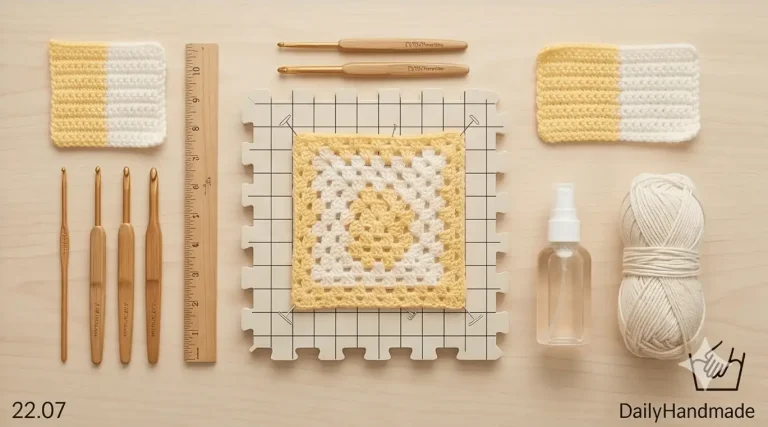
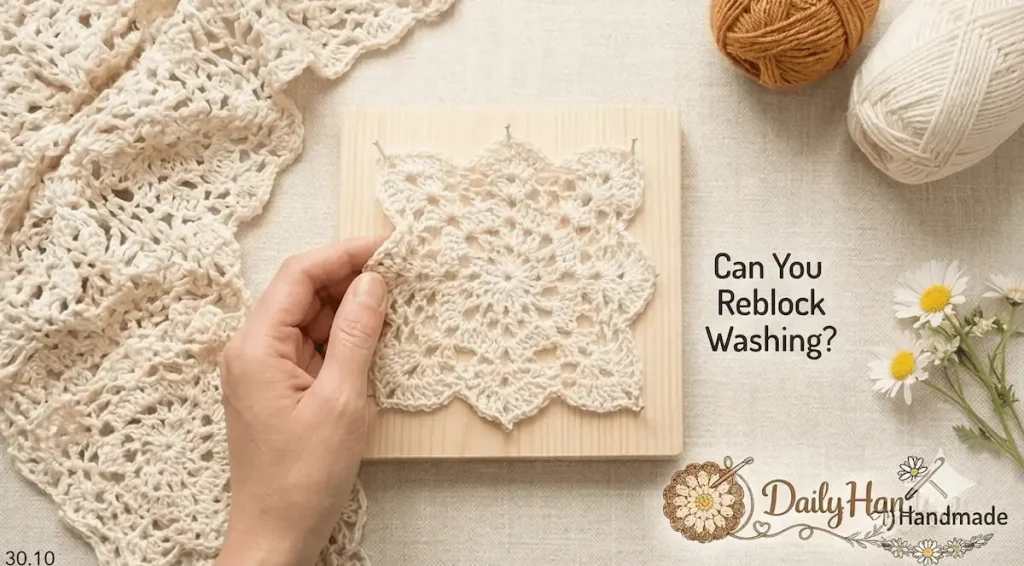
The “Block Before You Join” Rule: In How to Join Crochet Pieces (Best Methods for Beginners), we have a non-negotiable tip: Block your squares first. If your squares are different sizes because of tension changes, even the “easiest” join will look crooked. Wet blocking them to the exact same dimensions ($10cm \times 10cm$, for example) ensures your stitches line up 1-to-1, making the easy way to join granny squares for beginners actually feel easy.
What To Expect Next
You’ve decided on the “Hook Method” for your granny squares. But there’s a debate in the community: Should you use a Slip Stitch or a Single Crochet? One is flatter, one is stronger. In our next chapter of How to Join Crochet Pieces (Best Methods for Beginners), we settle the debate: Slip Stitch vs Single Crochet Join: Which Is Best for Your Project?
Return Path
Mastering the easy way to join granny squares for beginners is a massive leap forward in the Pillar: Crochet FAQ & Troubleshooting journey. To refine your blanket-making skills, explore these related guides:
- Best way to join crochet pieces for beginners
- How to whip stitch crochet pieces together
- Slip stitch vs single crochet join
- How to join crochet squares at corners
- Master Guide: Crochet FAQ & Troubleshooting
I have a relevant follow-up question for you: Are you planning to use the same color yarn as your squares to make the join blend in, or a contrasting color (like black or white) to make the grid pop?