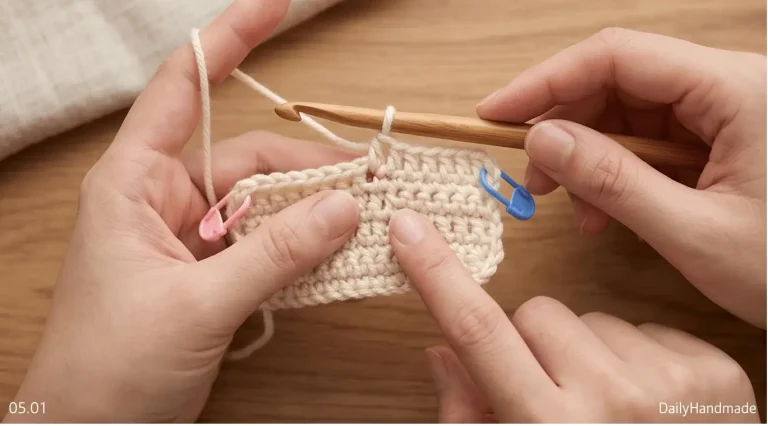

Make Crochet Stitches Tighter Without Changing Hook: Pro Hacks
Quick Recognition
You’re sitting on your sofa, halfway through a project, and you realize those gaps we discussed in Why My Crochet Has Holes: Holes Between Stitches for Beginners are still haunting you. The pattern calls for a 5.0mm hook, and that is exactly what you are using. You know that switching to a smaller hook would help, but you don’t have one in your kit, or perhaps the project requires this specific size to match the yarn weight. You think, “Is my only option to just pull the yarn until my hands hurt?” At Dailyhandmade, we want to stop you right there. Tightening your work isn’t about physical strength; it’s about geometry. Learning how to make crochet stitches tighter without changing hook is the “level up” that separates a hobbyist from a master.
Direct Answer
To make crochet stitches tighter without changing hook, you must focus on controlling the “Golden Loop” and utilizing the tapered throat of your hook. By pulling the initial loop snug against the hook’s shaft and keeping your yarn hand closer to the work, you reduce the “slack” that creates large gaps. In the framework, we emphasize that stitch size is determined by how much yarn you allow into the loop before you close the stitch, not just the physical diameter of the hook itself.
The Anatomy of a “Tight” Stitch
In the technical world of Why My Crochet Fabric Has Holes, we audit your technique based on where the yarn sits on the tool. Use this comparison to see why your stitches might be “growing” unintentionally:
| Technique | Where Yarn Sits | Resulting Stitch | Gap Risk |
| Tip Crocheting | On the narrow “hook” part. | Small but inconsistent. | Medium (yarn splits). |
| Shaft Crocheting | On the widest part of the tool. | Uniform and “standard.” | Low. |
| The “Lifter” | High above the previous row. | Loose, tall, and gappy. | Extreme. |
| The “Snugger” | Parallel to the previous row. | Compact and solid. | Zero. |
3 “Pro Hacks” to Close the Gaps
If you need to make crochet stitches tighter without changing hook in Common Crochet Mistakes (and Fixes), try these three strategy drills to fix your fabric instantly:
1. The “Golden Loop” Squish
The “Golden Loop” is the very first loop you pull up after inserting your hook.
- The Pro Hack: When you pull that loop up, do not lift your hook upward. Instead, pull it just enough so it sits snug against the metal. If you “lift,” you are adding extra millimeters of yarn that turn into holes once the stitch is finished.
2. The “Short Lead” Feed
Look at the distance between your “yarn hand” (the one holding the thread) and the hook. If there is a 4-inch gap of yarn hanging there, that yarn will stretch and sag.
- The Pro Hack: Move your hand closer. Keep the “lead” of yarn between your finger and the hook under 2 inches. This “Short Lead” gives you mechanical advantage, allowing you to keep the yarn taut without needing a “Death Grip” on the hook.
3. Working in the “Throat”
Most hooks are tapered. They are thinner near the “head” and thicker at the “shaft.”
- The Pro Hack: While you should always finish a stitch on the shaft for size consistency, you can tighten a specific “loose” stitch by keeping the loops toward the throat (the skinnier part) as you pull through. This is a subtle trick used by professionals in Why My Crochet Fabric Has Holes to keep their edges looking surgically straight.
Dailyhandmade Expert Rescue Signal
The “Death Grip” Warning: A common mistake when trying to make crochet stitches tighter without changing hook is squeezing the hook until your knuckles turn white. Don’t do this. Excessive force leads to carpal tunnel and hand fatigue. In Common Crochet Mistakes (and Fixes), we teach that tension comes from the yarn-holding hand, not the hook hand. Let your fingers act as the tension “brake” while your hook hand stays relaxed and fluid.
What To Expect Next
You’ve mastered the technique, and your stitches are finally looking tighter. But what if you’ve already finished a “holey” project? Is it too late to save it? In our final chapter of Why My Crochet Fabric Has Holes, we look at the last-ditch rescue: Can blocking fix holes in crochet?
Return Path
Mastering the ability to make crochet stitches tighter without changing hook is a vital “Skill Fix” in Why My Crochet Fabric Has Holes. To keep your journey moving, explore these related guides:
- Can blocking fix holes in crochet?
- Loose tension causes holes in crochet
- Crochet hook too big causes holes
- Master Guide: Common Crochet Mistakes (and Fixes)
I have a relevant follow-up question for you: When you’re trying to tighten your stitches, do you find that your hands start to feel tired or cramped after a few minutes, or are you able to keep a relaxed grip?