
Why is My Crochet Still Curling After Blocking? Troubleshooting the Edge
Quick Recognition
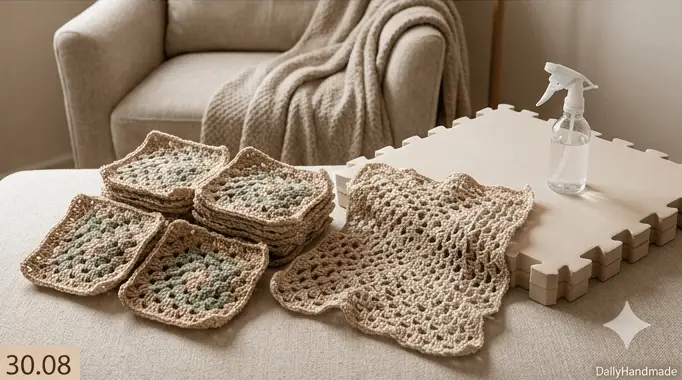
It is a breezy afternoon in April 2026, and you’ve just unpinned your project from your DIY blocking mats for crochet. You followed every step of the best blocking method for crochet beginners, and the yarn felt perfectly dry. But within minutes, the edges begin to roll upward like a scroll. You think, “I did the work, so why is my crochet still curling after blocking?” At Dailyhandmade, we call this Structural Bias. Blocking is a powerful tool for relaxing fibers, but it cannot always rewrite the laws of physics if the tension or stitch pattern is working against you.
Direct Answer
The reason why is my crochet still curling after blocking usually falls into three categories: Insufficient Saturation, Premature Unpinning, or Stitch Imbalance. If the moisture didn’t reach the core of the yarn, the “memory” of the curl remains. If you unpinned while the yarn was even 1% damp, the fibers haven’t “set.” Most commonly, however, certain stitches (like Tunisian Simple Stitch or stockinette-style crochet) naturally have more tension on one side than the other. In the framework, we treat this as a Force Imbalance ($F_i$), where the internal torque of the stitch exceeds the weight of the blocked fiber.
The Physics of the Curl: Internal Torque vs. External Set
In the technical world of Pillar: Crochet Care & Maintenance Guide, we analyze the Net Force ($F_{net}$) at the edge of the fabric. For an edge to stay flat, the Force of the “Set” ($F_s$) must be greater than or equal to the Force of the “Curl” ($F_c$).
$$F_{net} = F_c – F_s$$
| The Problem | The Result | The Dailyhandmade Fix |
| Fiber Memory | Snaps back instantly. | Steam block acrylic crochet safely. |
| Evaporation Gap | Curls after 1 hour. | Increase drying time. |
| Stitch Bias | One side rolls under. | Add a “Counter-Tension” border. |
| Under-Pinning | Scalloped edges. | Use more pins for a straight line. |
3 Strategy Drills to Fix Persistent Curling
If you are asking why is my crochet still curling after blocking in Pillar: Crochet Care & Maintenance Guide, use these three troubleshooting drills to flatten your work for good:
1. The “Deep-Soak” Saturation Check
Surface dampness isn’t enough to reset the “DNA” of the yarn.
- The Drill: If you used Spray Blocking, switch to Wet Blocking. Submerge the project for at least 20 minutes. This ensures the water molecules penetrate the fiber core, allowing for a more permanent stretch. If it’s acrylic, you must use heat to reach the Glass Transition Temperature, as discussed in How to steam block acrylic crochet safely.
2. The “Over-Pinning” Protocol
Gaps between pins allow the yarn to “retreat” into a curl.
- The Drill: Instead of pinning every 2 inches, pin every half-inch. Use a straight edge (like a ruler) on your DIY blocking mats to ensure the pins are perfectly aligned. By forcing the edge into a hyper-straight line during the drying phase, you maximize the “External Set” force.
3. The “Counter-Stitch” Border
Sometimes, the stitch pattern itself is the enemy.
- The Drill: If your project is a simple stitch that naturally leans or curls (like some slip-stitch patterns), you may need to add a single round of Reverse Single Crochet (Crab Stitch) or a Slip Stitch Border around the edge before blocking. This adds a structural “frame” that counteracts the internal torque.
Dailyhandmade Expert Rescue Signal
The “Bone-Dry” Rule: In How to Block Crochet Projects (Wet vs. Steam vs. Spray), we have a saying: “If you think it’s dry, wait four more hours.” Many makers unpin too early because the surface feels dry, but the “heart” of the stitches near the pins is still cool and damp. If the yarn is cool to the touch, it is still evaporating. Unpinning at this stage is the #1 reason why is my crochet still curling after blocking.
What To Expect Next
You’ve finally flattened the edges and your project looks pristine. But a new worry arises: by pinning it so tightly to stop the curl, did you just ruin the size? Does the yarn stay this way forever, or will it shrink back? In our next chapter of How to Block Crochet Projects (Wet vs. Steam vs. Spray), we look at the long-term results: Does Blocking Stretch Crochet Permanently? The Size Truth.
Return Path
Fixing the question of why is my crochet still curling after blocking is a vital troubleshooting step in Pillar: Crochet Care & Maintenance Guide. To ensure your project stays flat forever, explore these related guides:
- Best blocking method for crochet beginners
- How to steam block acrylic crochet safely
- How to dry blocked crochet faster
- Does blocking stretch crochet permanently
- Master Guide: Crochet Care & Maintenance
I have a relevant follow-up question for you: When you notice the curling, is it happening on all four sides of your project, or just on the starting and ending edges?