
How to Whip Stitch Crochet Pieces Together: The Durable Join
Quick Recognition
It is a breezy afternoon in April 2026. You’ve just finished the last square of a heavy Afghan blanket. You’ve reviewed the best way to join crochet pieces for beginners and decided that you need a connection that can survive kids, pets, and the washing machine. You pick up your tapestry needle, but you hesitate. You think, “Do I go through both loops or just one? How do I keep it from puckering?” At Dailyhandmade, we consider the whip stitch the most “honest” join. It doesn’t try to hide; it simply holds everything together with incredible strength.
Direct Answer
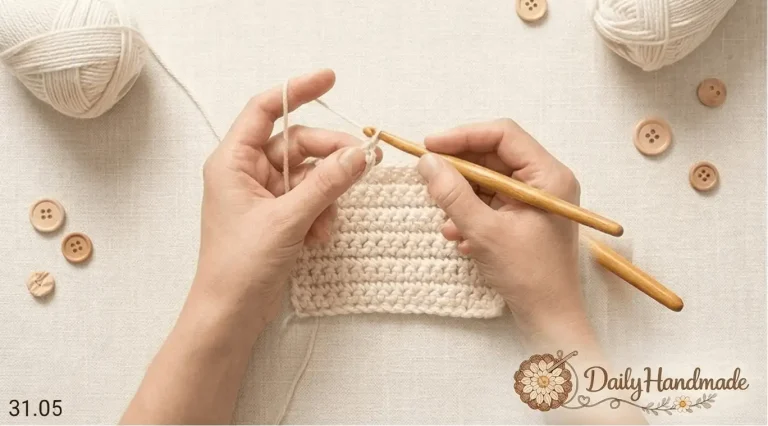
To how to whip stitch crochet pieces together, you align two pieces with their “Right Sides” facing each other and pass a yarn needle through the matching stitches in a continuous spiral motion. By “whipping” the yarn over the top edge of the fabric, you create a series of diagonal wraps that lock the edges together. In the framework, we prioritize this for items requiring high Structural Integrity. While it creates a slightly visible seam, its ease of use makes it the ideal “first join” for any beginner.
The Technical “Wrap” Math: Spacing vs. Tension
In the technical world of Pillar: Crochet FAQ & Troubleshooting, the success of a whip stitch depends on the Stitch Pitch ($P$)—the distance between each wrap. If the pitch is too wide, you get gaps; if it is too narrow, the seam becomes stiff.
$$P \approx \text{Width of 1 Crochet Stitch}$$
| Feature | The Loose Whip | The Dailyhandmade Standard | The Tight Whip |
| Visuals | Visible gaps between pieces. | Clean, even diagonal wraps. | Edge “bunches” up. |
| Flexibility | High (Too much “give”). | Balanced / Secure. | Low (Seam may snap). |
| Best For | Open-work lace. | Blankets & Pillows. | Rugs / Heavy containers. |
3 Strategy Drills for a Professional Whip Stitch
If you are learning how to whip stitch crochet pieces together in Pillar: Crochet FAQ & Troubleshooting , follow these three operational drills:
1. The “Inner-Loop” Trick (The Flatness Hack)
If you want the strength of a whip stitch but hate the bulky ridge, don’t go through both loops of each stitch.
- The Drill: Line up your pieces. Insert your needle only through the Front Loop of the piece closest to you and the Back Loop of the piece furthest away. This allows the seam to “nestle” into the fabric, preventing the bulky ridges that can make a blanket feel uncomfortable.
2. The “Right-to-Left” Flow
Direction matters for consistency.
- The Drill: Always work from the same direction (usually right to left for right-handers). Ensure your needle always enters from the “back” and comes out toward the “front.” This creates a uniform diagonal pattern that looks intentional and professional, rather than a crooked join.
3. The “Corner-Lock” Anchor
The start and end of your seam are the most likely places to fail.
- The Drill: When you start, pass your needle through the first set of stitches twice. This “double wrap” creates a knotless anchor. Do the same at the very end before weaving in your tail. This is especially important when joining squares at corners.
Dailyhandmade Expert Rescue Signal
The “Stretch Test”: In How to Join Crochet Pieces (Best Methods for Beginners), we never finish a seam without the stretch. After every 5 or 6 stitches, grab both pieces of fabric and give them a firm tug horizontally. If the seam doesn’t “give” a little bit, your tension is too tight. A whip stitch should act like a hinge, not a steel bar. If it doesn’t stretch, you’ll likely face uneven joins by the time you reach the end.
What To Expect Next
The whip stitch is strong, but it isn’t shy—you can see those wraps. What if you want a join that is completely, 100% invisible? For garments and high-end decor, we need to move from the spiral to the “ladder.” In our next chapter of How to Join Crochet Pieces (Best Methods for Beginners), we master the magic of the needle: Invisible Mattress Stitch Crochet Tutorial: Hiding Your Seams.
Return Path
Mastering how to whip stitch crochet pieces together is the foundation of the Pillar: Crochet FAQ & Troubleshooting assembly series. To ensure your project stays together, explore these related guides:
- Best way to join crochet pieces for beginners
- Invisible mattress stitch crochet tutorial
- Joining crochet pieces with uneven stitch counts
- Why are my crochet joins uneven
- Master Guide: Crochet FAQ & Troubleshooting
I have a relevant follow-up question for you: When you are seaming, do you use the same yarn you used for the project, or do you prefer a thinner, matching thread to keep the whip stitch even more low-profile?