Crochet Stitch Symbols and Meanings: The Visual Cheat Sheet
Quick Recognition
You’ve looked at your first chart in Reading Crochet Symbol Charts for Beginners: A Visual Guide and realized it looks less like a blanket and more like a collection of math symbols. You see a “T” with a slash, a tiny solid dot, and an “X.” At Dailyhandmade, we know the panic that sets in when you can’t find the “word” version of a stitch. But here is the secret: crochet symbols weren’t chosen randomly. They were designed to look exactly like the physical anatomy of the stitch they represent. Understanding crochet stitch symbols and meanings is simply about learning to see the “skeleton” of the yarn.
Direct Answer
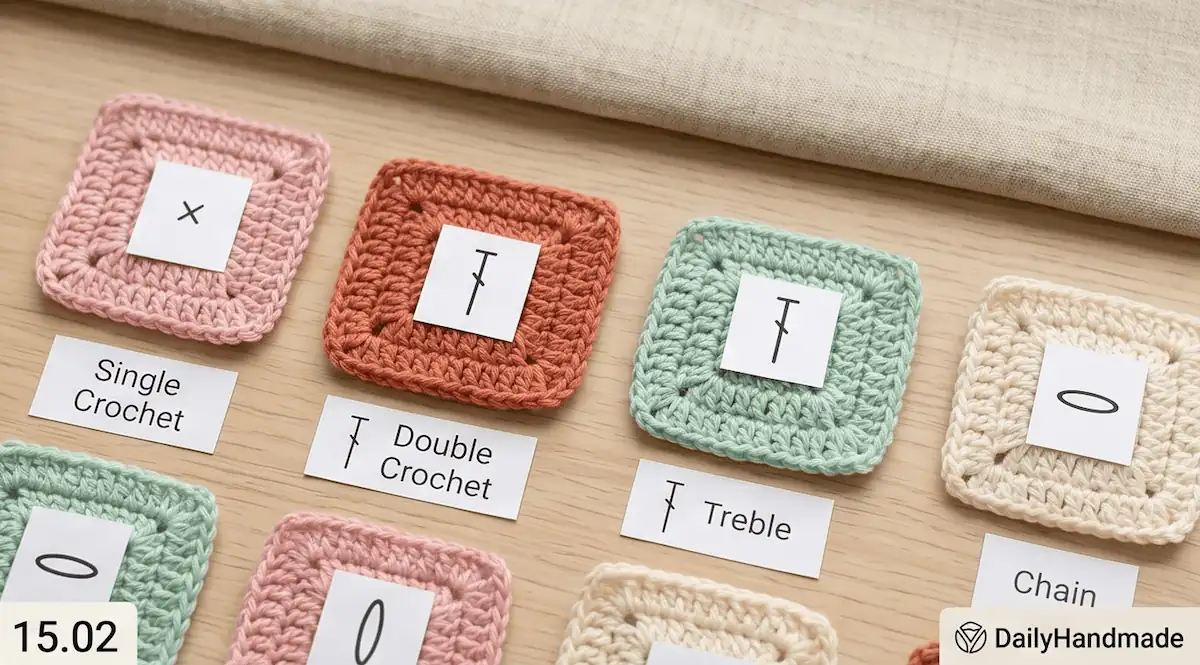
Crochet stitch symbols are standardized icons used in diagrams (charts) to represent specific stitches. For example, a small oval is a Chain, a cross or “x” is a Single Crochet, and a “T” with a horizontal slash is a Double Crochet. In the framework, we use these symbols to bypass language barriers. Whether you are using a pattern from Paris or Tokyo, these icons remain consistent, allowing you to follow the visual logic of the project regardless of the written terminology.
The Universal Visual Cheat Sheet
Use this table as your primary reference for Crochet Pattern Symbols Explained. These are the “Big Six” symbols that form the foundation of almost every chart.
| Symbol Icon | Meaning (US Term) | Visual Logic |
| Small Oval (Open) | Chain (ch) | Looks like a single link in a chain. |
| Small Dot (Solid) | Slip Stitch (sl st) | Represents a tiny, flat joining point. |
| Cross (+) or “x” | Single Crochet (sc) | Represents the short, compact “cross” of the stitch. |
| Tall “T” (No slash) | Half Double Crochet (hdc) | A tall post with no yarn-overs indicated. |
| Tall “T” (1 slash) | Double Crochet (dc) | The slash represents the one “yarn over” used. |
| Tall “T” (2 slashes) | Treble Crochet (tr) | The two slashes represent two “yarn overs.” |
The “Slash” Secret: How to Read Any Post Stitch
One of the most powerful tips we offer at Dailyhandmade for mastering crochet stitch symbols and meanings is the “Slash Rule.”
If you see a vertical bar (the post) with diagonal lines crossing it, those lines are not decorative—they tell you exactly how many times to wrap the yarn around your hook before you start.
- 1 Slash = 1 Yarn Over (Double Crochet).
- 2 Slashes = 2 Yarn Overs (Treble Crochet).
- 3 Slashes = 3 Yarn Overs (Double Treble).
This logic allows you to identify even the most complex “Long Stitches” without ever looking at a pattern key.
Comparison: Visual Symbol vs. Written Logic
| Aspect | Written Abbreviations | Visual Symbols |
| Confusion | US vs. UK terms (dc means different things). | Zero confusion. The icon is universal. |
| Space | Takes up multiple lines of text. | Compact. Shows 10 stitches in 1 inch. |
| Drafting | Easy to mistype a letter. | Logical. Shows exactly where the stitch sits. |
| Memory | Requires memorizing a dictionary. | Requires recognizing a shape. |
3 Hacks to Master This Cheat Sheet
To build your fluency, don’t just memorize the table. Try these Dailyhandmade practice drills:
- The “Key” Match: Whenever you start a new pattern, find its symbol key and compare it to this cheat sheet. If the designer uses a “Dot” for a bobble instead of a slip stitch, highlight it immediately!
- Draw Your Stitches: Take a piece of graph paper and try to draw the symbols for a basic granny square. Connecting the physical act of crocheting to the drawing of the “T” or the “X” solidifies the link in your brain.
- The “V” Anchor: Remember that in a chart, the symbols are placed exactly where the hook goes. If an “X” is sitting directly on top of an “Oval,” you know you are working a single crochet into a chain space.
Dailyhandmade Expert Note: Symbols are the ultimate truth-tellers. If a written pattern is confusing, look for the chart. The chart cannot lie about where a stitch is placed, whereas a written sentence can have a typo.
What To Expect Next
You now have the full alphabet of symbols. But the two most common “letters” in that alphabet—the Single Crochet and the Double Crochet—have some subtle variations you need to recognize. In our next chapter, we zoom in on these two workhorses of the crochet world.
Return Path
Building your crochet stitch symbols and meanings library is the foundation of Crochet Pattern Symbols Explained. To keep advancing your skills, explore these guides:
- Symbol for single and double crochet
- Meaning of arrows in crochet charts
- How to read crochet symbol charts for beginners
- Master Guide: HOW TO READ CROCHET PATTERNS
I have a relevant follow-up question for you: Do you find the “X” or the “T” shapes easier to recognize when you first look at a busy chart? (Most people find the “T”s easier because they stand out like tall trees!)