How Long Does It Take to Get Good at Crochet?
Quick Recognition
When you first start crocheting, every stitch feels like a slow, deliberate struggle. Your hands feel uncoordinated, your stitches look uneven, and the process feels significantly harder than you expected. After a few frustrating sessions, it is natural to ask: “How long will it take before this actually feels good?” This question usually arises when you feel stuck in the “clumsy phase” and can’t yet see a clear path to mastery.
Direct Answer
Most beginners begin to feel “functionally comfortable” with basic crochet stitches after approximately 10 to 20 hours of active practice. During this window, your brain transitions from consciously thinking about every movement to performing them through muscle memory. While total mastery takes longer, this 20-hour mark is typically when crochet shifts from being a confusing task to a relaxing hobby.
Why This Happens
The feeling of slow progress is a result of motor-skill acquisition. Crochet is not just a craft; it is a complex coordination of fine motor movements.
- Cognitive Load: In the beginning, your brain must process three things at once: holding the hook, managing yarn tension, and identifying the correct stitch placement.
- Neural Pathway Building: Because these movements are new, your brain processes them one by one. This “step-by-step” processing is what makes you feel slow. Many learners mistake this necessary biological adaptation for a “lack of talent.” In reality, your hands are simply building the neural connections required for automaticity. Once the movement pattern is repeated enough, the “lag” between your brain and your hands disappears.
How to Improve Faster
To shorten the learning curve, focus on consistency rather than long hours of struggling:
- Prioritize Frequency: Practicing for 15 minutes every day is far more effective for muscle memory than one 4-hour session on the weekend.
- Master One Movement: Do not jump between different stitches. Master the Single Crochet (SC) until you can do it without looking before moving to the next stitch.
- Slow Down for Accuracy: Ironically, moving slower helps your brain “map” the movement more accurately, which leads to faster speeds later.
- Audit Your Tools: If your hook is difficult to grip, you are fighting your equipment as well as the yarn. Using the right tools can reduce physical tension and speed up your comfort level. If you are looking for tools that make the learning process smoother, see: Best crochet hooks for beginners (mp2)
What to Expect Next
Crochet progress happens in stages of “rhythm” rather than sudden perfection. You will know you are getting “good” when:
- The hook begins to move smoothly without catching on the yarn.
- You stop accidentally adding or losing stitches at the end of rows.
- You can maintain a conversation or watch a show while crocheting simple rows.
If you are still struggling with the visual quality of your work or the physical feeling of the hook, these situations are closely related:
- If your stitches still look messy despite your practice time, see: Why my crochet stitches look uneven as a beginner
- If your hands still feel stiff and uncooperative, see: Why crochet feels awkward in the beginning
Return Path
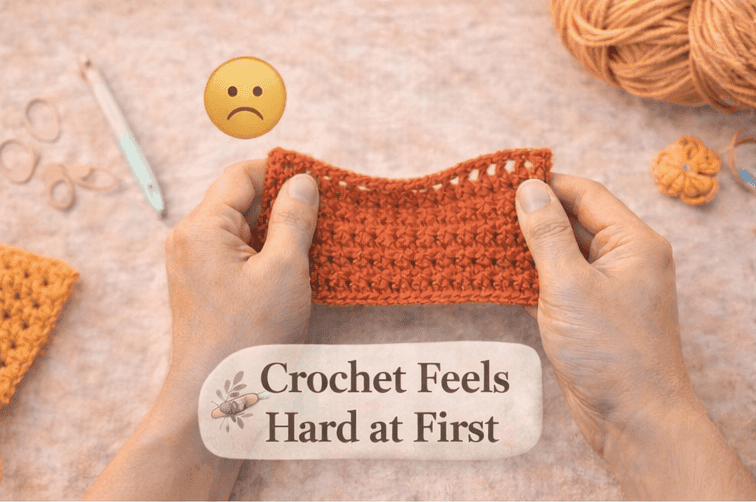
Impatience during the first few hours is the most common reason beginners quit. To understand the full scope of the learning stages and why this initial “hard” phase is actually a sign that you are learning correctly, see our main guide: Why Crochet Feels Hard at First
This guide provides the complete framework for navigating the beginner learning curve and what to expect in the weeks ahead.