Vintage Crochet Symbols vs Modern Symbols: Solving the Gap
Quick Recognition
You’ve inherited a beautiful lace doily pattern from your grandmother’s collection, or you found a stunning 1950s crochet magazine at a thrift store. You open it up, expecting to see the “X”s and “T”s we mastered in The Crochet Symbol for Single and Double Crochet: Decoding Basics, but instead, you see a strange array of dots, thick bars, and tiny flags. At Dailyhandmade, we call this “The Time-Traveler’s Dilemma.” Just because a pattern is old doesn’t mean it’s impossible to read; it just speaks an older dialect. Understanding vintage crochet symbols vs modern symbols is the key to unlocking decades of classic designs that pre-date modern digital standardization.
Direct Answer
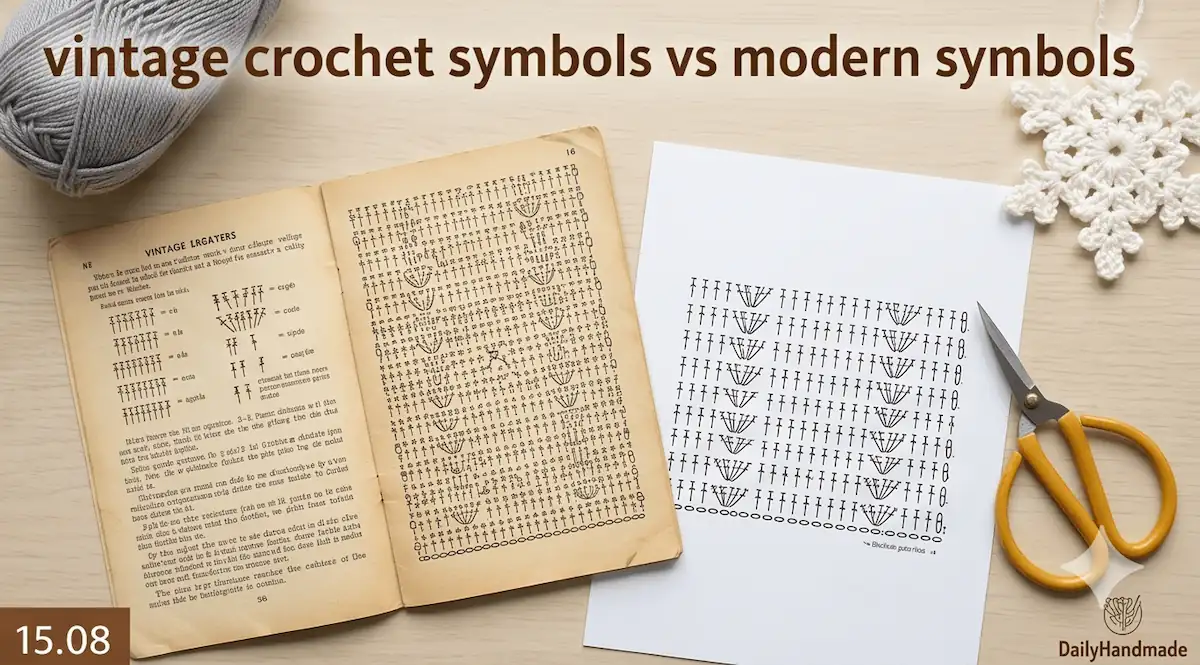
The primary difference between vintage crochet symbols vs modern symbols lies in the standardization of drafting. Modern symbols are largely standardized by organizations like the Craft Yarn Council, using digital icons like “x” for single crochet. Vintage symbols (pre-1990s) were often hand-drawn or followed regional publisher styles, where a single crochet might be represented by a simple vertical stroke (|) or a small dot, and double crochets might have “flags” instead of the modern “slash.” In the framework, we solve this gap by looking for the “Visual Root” of the symbol rather than its exact shape.
The Evolution of the Hook: Old vs. New
In the technical world of Crochet Pattern Symbols Explained, the transition from hand-inked diagrams to computer-generated charts changed the “look” of our language.
| Stitch Type | Modern Symbol (Digital) | Vintage Symbol (Hand-Drawn) | The Logic Shift |
| Single Crochet | x or + | Vertical Bar ( I ) or Dot | Old charts prioritized “line density” over specific icons. |
| Double Crochet | T with 1 Slash | T with a “Flag” ( 🚩 ) | The “slash” replaced the more artistic “flag” for digital clarity. |
| Slip Stitch | Solid Dot ( • ) | Horizontal Line ( — ) | Older patterns used lines to show “joining” points more literally. |
| Chain Stitch | Oval ( 0 ) | Large Circle ( O ) | Modern ovals are thinner to fit more stitches into a tight space. |
Why the Gap Exists (The “Audit” of History)
To master HOW TO READ CROCHET PATTERNS, you have to understand the three reasons why vintage charts look so different:
- Manual Drafting: Before the 1990s, charts were drawn by hand on graph paper. Designers used symbols that were easy to draw with a pen and ruler, leading to many straight lines and simple geometric shapes.
- Lack of Globalization: In the mid-20th century, a crochet magazine in France had no contact with a publisher in New York. Each region developed its own “visual slang.”
- The “Lace” Focus: Many vintage patterns were for incredibly fine thread lace (Doilies). The symbols were often drawn very thin and crowded to represent the delicate nature of the work.
3 Strategies to Solve the Vintage Gap
To master vintage crochet symbols vs modern symbols, use these Dailyhandmade “Historical Translator” hacks:
1. Identify the “Stitch Height” First
In vintage charts, even if the symbol is weird, the height usually stays true. If you see a tall vertical bar with three little flags, and it’s the tallest thing on the page, it’s almost certainly a treble or double-treble crochet. Don’t look at the icon; look at its stature.
2. Cross-Reference the “Written Key”
Many vintage patterns included a small text box that said something like: “Symbol | = dc” (Note: In some very old European patterns, a vertical bar actually meant a double crochet!). Always read the fine print next to the diagram before trusting your modern instincts.
3. Count the “Wraps”
Even in hand-drawn 1940s patterns, the logic of “yarn overs” usually exists. Look for any tiny marks crossing the main vertical line. These are the ancestors of our modern slashes. If there are two marks, you are likely looking at a Treble Crochet.
Dailyhandmade Expert Advice: If you are truly stuck on a vintage chart, look at the photo of the finished item. If the “mystery symbol” creates a big hole in the lace, it’s likely a chain or a tall stitch. If it creates a solid block, it’s a single or half-double crochet.
What To Expect Next
You’ve now conquered the past and the present. You can read words, symbols, and even the “ancient dialects” of crochet. But how do you stop yourself from checking the key every five seconds? In our final chapter of Crochet Pattern Symbols Explained, we look at the brain hacks to memorize these symbols for good.
Return Path
Bridging the gap between vintage crochet symbols vs modern symbols is an advanced skill in Crochet Pattern Symbols Explained. To round out your journey, check out these related guides:
- How to memorize crochet symbols fast
- Why do crochet symbols vary in patterns
- Crochet stitch symbols and meanings
- Master Guide: How to Read Crochet Patterns
I have a relevant follow-up question for you: Do you have an old “heirloom” pattern you’ve been wanting to try, or are you mostly sticking to modern designs for now? (Older patterns often have the most beautiful, intricate results!)