
How to Hand Wash Crochet Safely: Preserving Your Stitches
Quick Recognition
It is 2026, and you’ve just completed a project that used your “precious” yarn—perhaps a hand-dyed silk blend or a delicate mohair. After the Machine Risk Audit, you’ve decided the agitator is simply too dangerous. You stand at the sink, project in hand, feeling a mix of pride and anxiety. You think, “If I scrub this too hard, will it pill? If I twist it, will the stitches stretch forever?” At Dailyhandmade, we view hand washing as a spa day for your yarn. Knowing how to hand wash crochet safely is about gentle pressure and patience, ensuring your work looks just as crisp ten years from now as it does today.
Direct Answer
To how to hand wash crochet safely, you must follow the “Submerge & Press” technique: soak the item in lukewarm water with a pH-neutral detergent, gently press the suds through the fibers without scrubbing, and rinse until the water runs clear. In the framework, the most critical rule is never to wring or twist the fabric. Hand washing preserves the “stitch architecture”—the way each loop leans against the other—preventing the distortion that mechanical washing often causes.
The Hand Wash Anatomy: Step-by-Step
In the technical world of How to Wash Crochet Projects Safely, we break down the manual ritual into three distinct phases. Use this table as your “Sink-Side” checklist:
| Phase | Action | Temperature | Duration |
| 1. The Soak | Submerge completely; no agitation. | Lukewarm (30°C / 86°F) | 15–20 Minutes |
| 2. The Clean | Gentle “pressing” motions only. | Lukewarm | 2–3 Minutes |
| 3. The Rinse | Drain and refill; do not hold under a tap. | Cool | Until suds disappear |
| 4. The Exit | Roll in a dry towel; no twisting. | N/A | 5 Minutes |
3 “Manual Cleaning” Strategy Drills
If you are learning how to hand wash crochet safely in CROCHET CARE AND MAINTENANCE GUIDE, these three hacks will prevent the most common “sink-side” disasters:
1. The “Basin-First” Rule
Never let the water from the faucet hit your crochet directly. The weight of the falling water can stretch delicate stitches before you even begin.
- The Rescue: Fill the basin and mix in the gentle detergent first. Only after the water is still should you gently lay your project on the surface and push it under.
2. The “No-Scrub” Solution
If you have a specific stain, do not rub the fabric together. This causes “Felt-locking,” where the fibers fuse together and become fuzzy.
- The Rescue: Use your fingertips to gently tap the stained area, allowing the detergent to break down the oils without disturbing the stitch definition.
3. The “Burrito” Towel Method
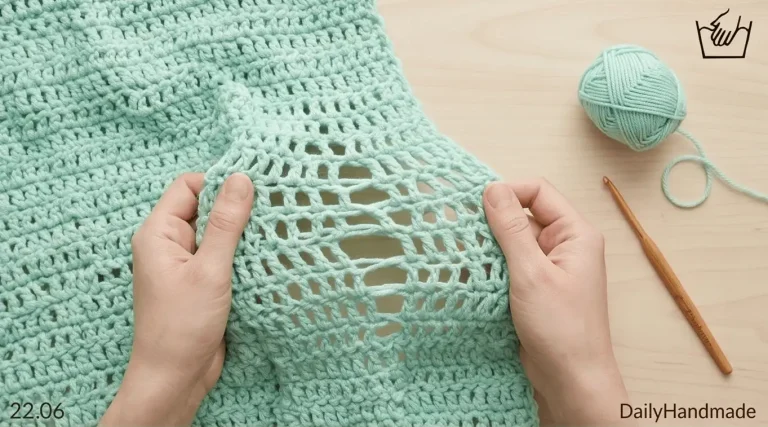
The biggest risk to your project is the weight of the water after the wash. If you lift a heavy, soaking wet blanket, it will stretch.
- The Rescue: Lay the project flat on a white towel. Roll the towel up like a burrito and press down firmly (or walk on it!). This pulls 80% of the moisture out without a single twist of the wrist.
Dailyhandmade Expert Rescue Signal
The “Gravity” Warning: When moving your wet project from the sink to the towel, always support the entire piece with both hands. Never pick it up by an edge or a strap. In How to Wash Crochet Projects Safely, we call this “The Weight Trap.” Water-logged yarn is incredibly heavy and can permanently deform your tension if allowed to hang freely while wet.
What To Expect Next
The “Burrito” roll has removed the water, but now your project is damp and heavy. How do you keep it from growing three sizes while it dries? In our next chapter of How to Wash Crochet Projects Safely, we solve the heavy-lifting mystery: How to Wash Crochet Blanket Without Stretching.
Return Path
Mastering how to hand wash crochet safely is a core skill in How to Wash Crochet Projects Safely. To keep your journey on track, explore these related guides:
- How to wash crochet blanket without stretching
- Is it safe to machine wash crochet?
- Washing cotton crochet items: Avoiding stiffness
- Master Guide: Crochet Care & Maintenance
I have a relevant follow-up question for you: Are you currently dealing with a specific stain you’re worried about, or are you just giving a well-loved project its first general “freshen-up” soak?