Smooth vs Textured Yarn for Learning Crochet: The Winner Is…
Quick Recognition
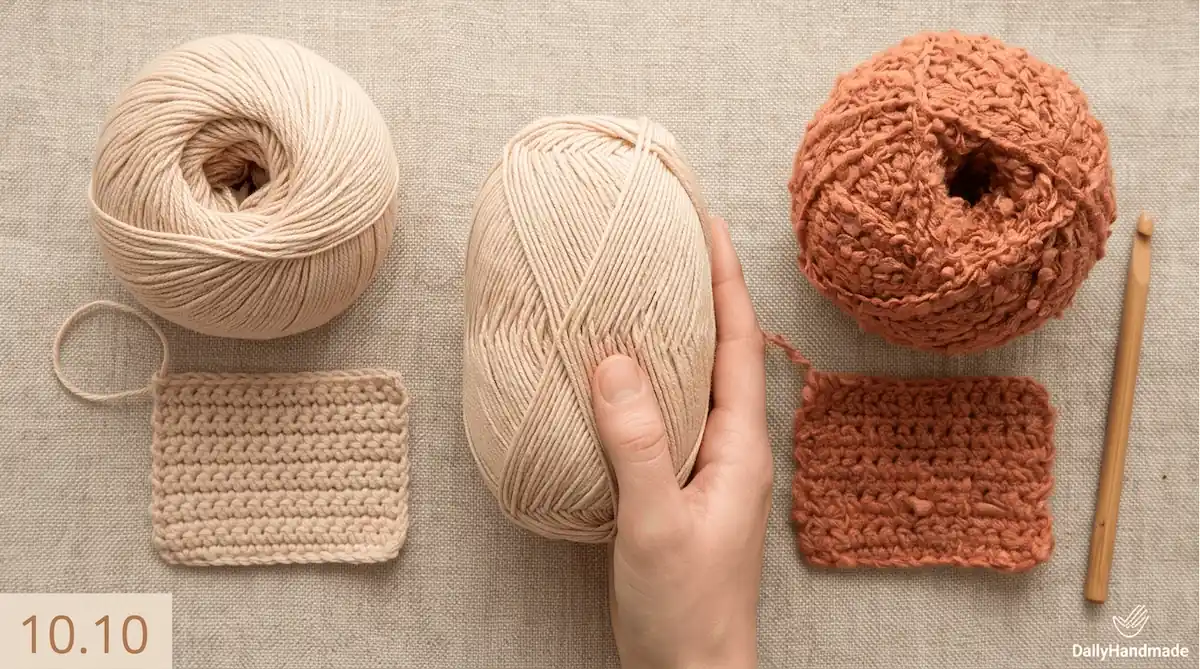
You’re looking at two skeins. One is a perfectly smooth, rope-like cotton in a soft mint green. The other is a stunning, bumpy, “popcorn” textured yarn with little loops and curls sticking out of it. The textured yarn looks expensive, artistic, and modern. The smooth yarn looks… a bit plain. You want your first project to look impressive, so you reach for the texture. But wait—before you check out, you need to understand that in the world of Best Yarn for Crochet Projects, looks can be deceiving. If you can’t see where your hook is going, that “artistic” yarn will quickly become a tangled ball of frustration.
Direct Answer
In the debate of smooth vs textured yarn for learning crochet, the winner is Smooth Yarn, specifically a multi-ply, worsted-weight acrylic or wool blend. While textured yarns (like bouclé, chenille, or “slub” yarn) hide mistakes and look cozy, they also hide the Stitch Anatomy. To successfully navigate Best Yarn For Crochet Beginners (What to Use and Avoid), you must be able to see the “V” at the top of every stitch. Textured yarn camouflages these vital landmarks, making it nearly impossible for a beginner to count rows or identify where to insert the hook.
The Comparison Audit: Smooth vs. Textured
| Feature | Smooth Yarn | Textured Yarn |
| Stitch Visibility | Perfect. You can see every loop. | Poor. Loops are hidden by “fuzz.” |
| Ease of Counting | Easy to see the “V” shapes. | Hard; you have to “feel” for stitches. |
| “Frogging” (Ripping) | Yarn slides apart easily. | Fibers catch/lock; yarn often snaps. |
| Speed of Learning | Fast; you see your errors immediately. | Slow; you spend time “searching” for holes. |
| Final Look | Crisp, clean, and geometric. | Soft, blurry, and organic. |
Why “Smooth” is the Beginner’s Best Friend
In our master guide “Best Yarn For Crochet Beginners (What to Use and Avoid)“, we treat your first project as a “Visual Map.”
- The Top-Loop Target: To move from row to row, you must insert your hook under the two top loops of the stitch below. In smooth yarn, these loops look like a clear bridge. In textured yarn, they look like a random clump of hair.
- The Error Alarm: If you accidentally skip a stitch in smooth yarn, you’ll see a gap instantly. In textured yarn, you might skip five stitches before realizing your project is shrinking.
- Muscle Memory: Learning Pillar #04 is about training your hands to feel the “click” of the hook. Texture creates “false friction” that can trick your hands into thinking the stitch is tight when it’s actually loose.
The Winner’s Protocol: Choosing the Best “Smooth” Yarn
To ensure you are picking the champion of smooth vs textured yarn for learning crochet, follow these final three selection rules:
- The “Rope” Look: Look for yarn that resembles a tiny, tightly twisted rope. If the strands are visible and firm, it’s a “Smooth” winner.
- Avoid the “Halo”: If the yarn has a “haze” or “fuzz” around the main strand (like Mohair), it counts as a textured yarn. Put it back and look for something “Matte” and clean.
- The “Squeeze” Stability: Squeeze the strand between your fingers. A good smooth yarn will feel solid and round. A difficult textured yarn will feel “squishy” or vary in thickness (thick and thin spots).
- (Note: Refer to The Best Yarn Weight for Learning Crochet (Size Matters) for the perfect weight to match your smooth yarn).
What To Expect Next
When you use a smooth yarn, the “learning curve” flattens out. You’ll be able to focus on your Tension and your Stitch Accuracy without the yarn getting in the way. You will know you’ve mastered the smooth vs textured yarn for learning crochet choice when you can look at a row of stitches and name the parts of the stitch as clearly as a diagram in a book.
Return Path
You have now completed all 10 Micro-topics for “Best Yarn For Crochet Beginners (What to Use and Avoid)“! You are fully equipped to walk into any yarn store and make a professional-level choice.
To review your journey through Best Yarn for Crochet Projects, revisit our core guides: