
Crochet Hook Size vs Yarn Label Explained (The Secret Match)
Quick Recognition
You’re looking at the back of a yarn ball. Nestled between the washing instructions and the weight category is a tiny icon of a crochet hook with a number like “5.0mm” or “H-8” next to it. You might think, “Great, that’s the law!” But then you go to a crochet forum, and someone says they used a 4mm hook for that exact same yarn. Another person used a 6mm. If the label says 5mm, who is right? In What Size Crochet Hook Should Beginners Use, we call this “The Manufacturer’s Average.” Understanding crochet hook size vs yarn label explained is about knowing when to listen to the label and when to ignore it.
Direct Answer
The yarn label recommendation is a suggested hook size based on the manufacturer’s testing to achieve a “standard” fabric density (gauge). However, it is not a rule. In Master Guide: Crochet Hooks & Tools, we teach that the “Secret Match” depends on your personal Tension (how tightly you hold the yarn) and your Project Type. If you crochet tightly, you may need a larger hook than the label suggests. If you are making a stiff basket, you’ll need a smaller one.
Decoding the Icons: What to Look For
Before you toss the label in the trash, you need to find the correct data point.
| Icon | What it Means | Beginner Action |
| Hook Icon | The suggested crochet hook size. | Start here. Use this for your first swatch. |
| Needle Icon | Suggested knitting needle size. | Ignore this (unless you also knit!). |
| 10x10cm Square | The “Gauge” or “Tension” square. | Use this to check if your stitches are too small/large. |
| Weight Number | The yarn thickness (e.g., #4 Worsted). | Matches the hook ranges in [Micro_01]. |
Why the Label Might Be “Wrong” for You
At Dailyhandmade, we’ve found three main reasons why the label’s “Secret Match” might fail your Longtail #12 project:
1. The “Human” Factor (Tension)
Everyone’s hands are different.
- The “Strangler”: If you pull your yarn very tight, a 5mm hook on a 5mm-labeled yarn will create a fabric that is stiff and small. You should go up to 5.5mm or 6mm.
- The “Loosie”: If your stitches are naturally very relaxed, the label’s hook will create a floppy mess. You should go down to 4.5mm or 4mm.
2. The “Project” Factor (Intent)
The label assumes you are making a standard scarf or sweater.
- For Amigurumi: You want zero holes so the stuffing doesn’t show. You should almost always use a hook 1.0mm to 2.0mm smaller than the label suggests.
- For Lacy Shawls: You want a light, airy look. You should use a hook 1.0mm to 2.0mm larger than the label suggests.
3. The “Fiber” Factor
Some fibers, like Cotton (from Longtail #11), don’t stretch. The label might suggest a 5mm hook, but because cotton is so unforgiving, many beginners find a 5.5mm hook much easier to use to avoid hand cramps.
The Dailyhandmade “Secret Match” Protocol
Don’t guess—test. Before starting your Pillar #5 masterpiece:
- Check the label: Buy the hook size mentioned on the yarn.
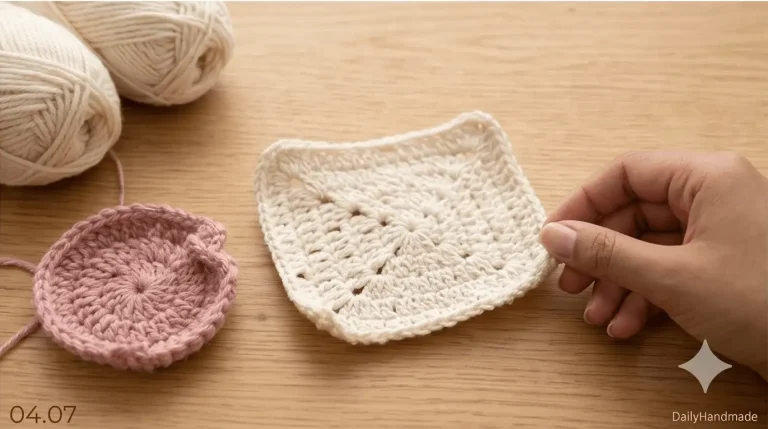
- The 2-Inch Test: Crochet a small square (about 5cm x 5cm).
- Feel the fabric: Is it too stiff? Go up half a size. Is it too holey? Go down half a size.
- Ignore the “Letter”: US labels use letters (H, I, J), but Japanese or European hooks use millimeters. Always trust the Millimeters (mm) on the label, as letters can vary between brands.
Dailyhandmade Pro Tip: Take a photo of your yarn label before you lose it. If you run out of yarn and need to buy more, you’ll need to know that recommended hook size to ensure you buy the exact same weight again!
What To Expect Next
Now that you can translate the yarn label like a pro, it’s time to address the biggest obstacle to perfect crochet: Tension. How can you use your hook size to finally fix those “tight” stitches?
Return Path
Decoding the crochet hook size vs yarn label is a major milestone in What Size Crochet Hook Should Beginners Use. To finalize your perfect toolkit, check out: