Skipping the Last Stitch in Crochet: Why Your Work is Shrinking
Quick Recognition
You start a project with 20 stitches, but by row ten, it looks like your rectangle is slowly turning into a triangle. The sides are leaning inward, and your work is visibly narrower than when you started. If you feel like your project is “shrinking” even though you are following the same movements, you are likely a victim of Edge Erosion. This happens because skipping the last stitch in crochet is an incredibly easy mistake to make when your eyes aren’t yet trained to see the “hidden” anatomy of a row’s end.
Direct Answer
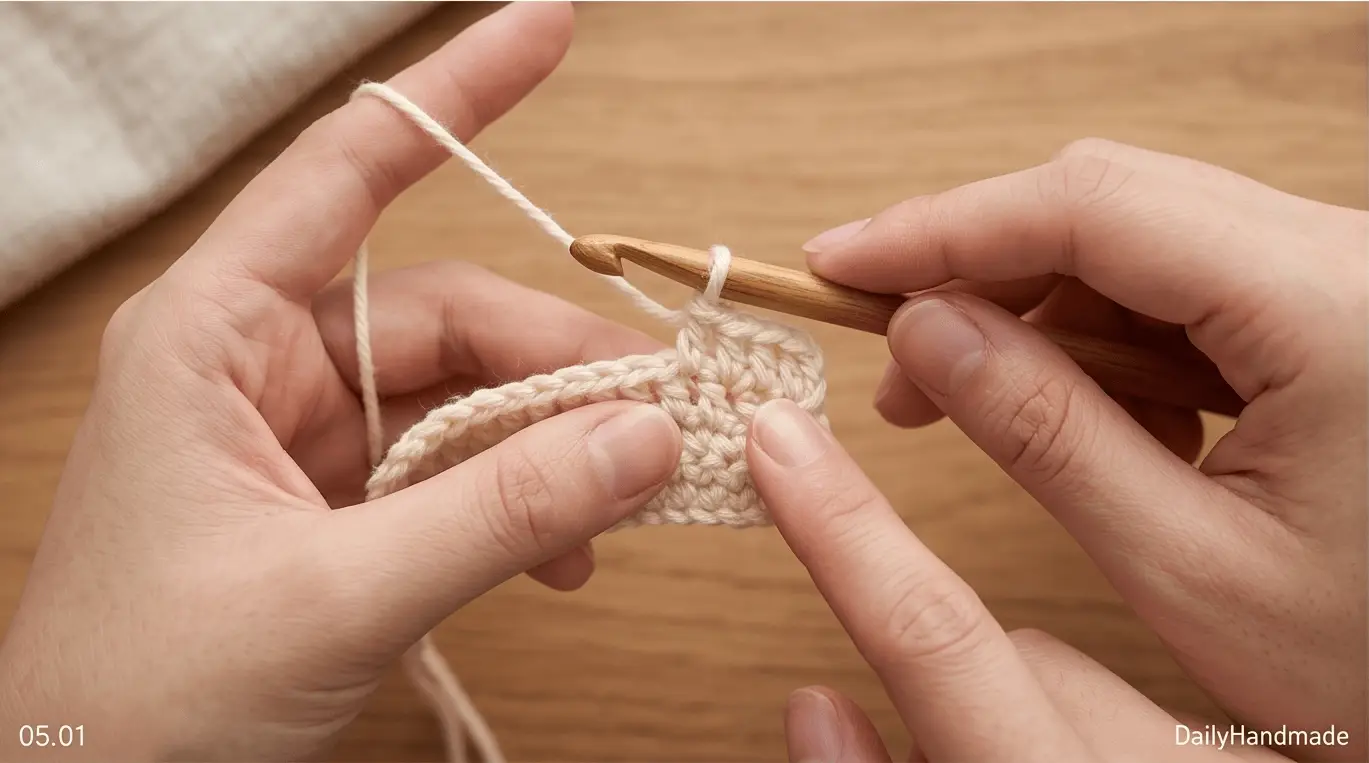
Skipping the last stitch in crochet occurs because the final stitch of a row often leans downward or becomes compressed by the turn of the previous row. Beginners frequently mistake this last “V” for the side of the fabric rather than the top. To stop your work from shrinking, you must learn to identify the final stitch—which often sits at a 45-degree angle—and ensure your hook passes under both loops before you make your turning chain.
Why This Happens (The Optical Illusion)
Mechanically, as you work across a row, the tension of your stitches pulls the fabric. By the time you reach the end, the very last stitch of the row below has been tugged slightly downward by the turning chain. This creates an Optical Illusion of the Corner: the stitch looks like a vertical post rather than a horizontal “V.” If you stop where the work looks like it ends, you are actually one stitch short. Over several rows, this cumulative loss causes the dramatic “shrinking” effect.
How to Fix It (The Edge-Discovery Protocol)
To ensure you never miss that final loop again and keep your edges perfectly vertical, implement these professional checks:
- The “Side-Tilt” Technique (Expert Signal): When you think you’ve reached the end of the row, tilt your work toward you. Look at the very edge from a side profile. You will see a small “V” tucked just below the level of your other stitches. That is your target.
- The “Count-Down” Audit: If your foundation row has 20 stitches, count every single row until you reach 20. If you stop at 19, you have skipped the last stitch. Do not turn your work until that 20th stitch is occupied. (See: Counting Stitches in Crochet: The Secret to Straight Edges for counting mastery).
- Use a “Lead” Marker: Place a stitch marker into the first stitch you make at the start of a row. When you come back across on the next row, that marker is your “Finish Line.” You must crochet into the stitch with the marker before you are allowed to turn. (See: Using Stitch Markers for Straight Edges: The Beginner’s Cheat Code for marker placement).
- Identify the Turning Chain Anatomy: Understand that in some stitches (like double crochet), the turning chain is the last stitch. You must insert your hook into the top of that chain to avoid shrinking. (See: How the Crochet Turning Chain Causes Uneven Edges for turning chain logic).
- Look for the “Bump”: If the edge of your work feels smooth, you might be skipping stitches. A correct edge should have a slight, consistent “bump” where the last stitch and turning chain meet.
What To Expect Next
At first, finding that last stitch will feel like a hunt. You might even think the stitch is “too tight” to enter. However, as your Visual Literacy improves, your eyes will automatically lock onto the corner “V.” You will know you have fixed the problem when your project maintains a perfectly consistent width from the foundation to the final row.
Return Path
Fixing the habit of skipping the last stitch in crochet is the fastest way to stabilize your project’s shape. To see how this fits into the broader diagnosis of crooked work, return to our main guide: Why are my crochet edges slanted
If your edges are straight but still look “messy” or have holes, explore these related fixes:
Why my crochet edges are uneven