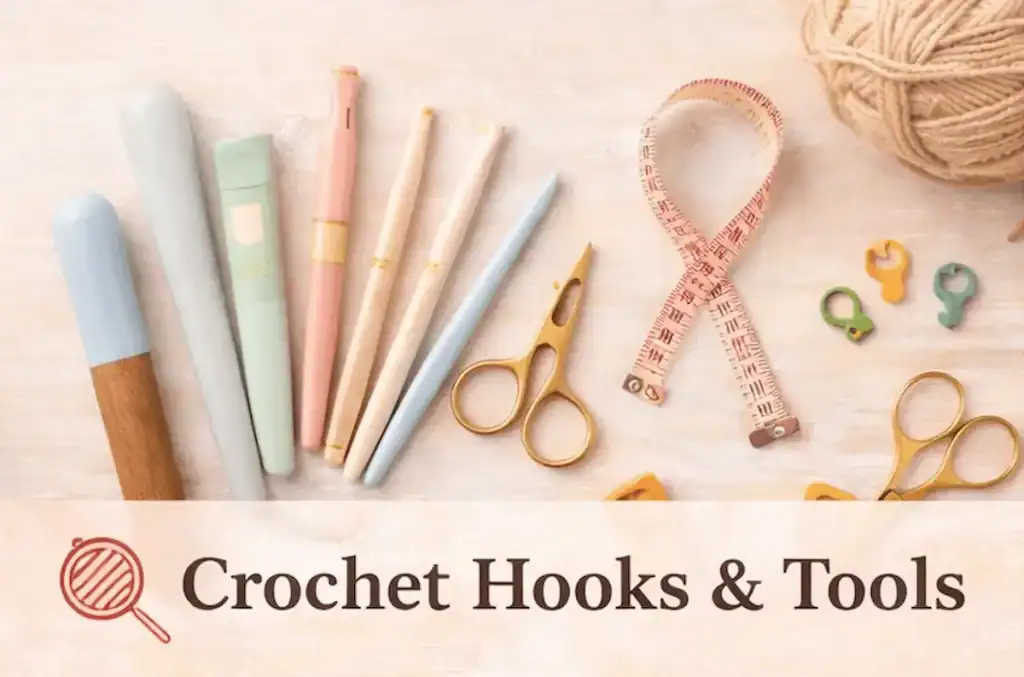
Crochet Hooks & Tools Guide — Hook Size for Beginners + How to Crochet Without Pain
Quick Answer: What Size Crochet Hook Should Beginners Use?
For most beginners, the best starting crochet hook size is 5.0 mm (H/8) or 5.5 mm (I/9) when paired with worsted weight (#4) yarn.
These sizes provide the most balanced learning environment because they make stitches visible, reduce excessive tension, and allow smooth hand movement without overwhelming coordination.
However, hook size is not simply a measurement choice.
It is one of the most influential variables in beginner crochet because it directly shapes how the body interacts with yarn, how fabric forms, and whether learning feels comfortable or frustrating.
This pillar explains how crochet hooks function inside the beginner learning system — not just which hook to choose, but why the right tools dramatically change the learning experience.
- Quick Answer: What Size Crochet Hook Should Beginners Use?
- Why Beginner Crochet Problems Are Often Tool Problems
- The Role of Hooks and Tools Inside the Crochet Learning System
- Why Hook Size Is a System-Level Concept
- Crochet Hooks as Learning Regulators
- The Hidden Goal of Beginner Tool Selection
- Why Crochet Pain Is a Learning Signal
- The Two Core Problems This Pillar Solves
- How This Pillar Fits the Crochet Knowledge Structure
- The Central Insight of This Guide
- What You Will Learn in This Pillar
- Why Beginners Struggle With Crochet Hooks So Often
- The Hook Size Confusion Problem
- Why Beginners Often Crochet Too Tight
- What Happens When a Hook Is Too Small
- What Happens When a Hook Is Too Large
- Why “Right Hook Size” Still Doesn’t Always Work
- Aluminum vs Ergonomic Hooks — Why Comfort Matters Early
- Why Crochet Pain Appears Early
- Wrist Pain vs Hand Cramps — Different Causes
- The Posture Problem Beginners Don’t Expect
- Why Beginners Think Pain Is Normal
- Cognitive Load and Tool Difficulty
- Tool Problems as Learning Signals
- Connecting Tool Issues to the Full Beginner System
- The Correct Learning Order for Crochet Hooks and Tools
- Stage 1 — Size Clarity: Understanding Hook Scale
- Stage 2 — Tension Support: Using Hook Size as a Learning Tool
- Stage 3 — Ergonomic Comfort: Supporting the Body
- Stage 4 — Movement Efficiency
- Stage 5 — Personal Optimization
- Hook Size vs Yarn Label — A Functional Interpretation
- Why Beginners Often Need Larger Hooks Than Recommended
- Understanding Aluminum vs Ergonomic Hooks Through Learning Stages
- Preventing Pain Through Tool Progression
- Tools as Calibration Devices
- Recognizing Readiness to Experiment With Hooks
- How Beginners Know Their Hook Setup Is Improving
- The Hook Comfort Progress Framework
- Why Tool Comfort Accelerates Learning Speed
- Predictable Challenges After Tool Improvement
- The Relationship Between Tools and Troubleshooting
- Applicability Boundaries: Why There Is No Universal “Best Hook”
- Why Pain Often Disappears After Small Adjustments
- Posture Awareness as Advanced Beginner Knowledge
- From Avoiding Pain to Designing Comfort
- Authority Insight: Tools Shape Confidence
- Crochet Tools as Long-Term Companions
- How to Use This Hook & Tools Guide Throughout Your Crochet Journey
- Navigation Pathways Inside the Crochet Tools System
- Pillar Guides — Understanding Systems
- Longtail Guides — Deep Concept Understanding
- Micro Guides — Immediate Problem Resolution
- Recommended Beginner Learning Flow
- Beginner Hook Setup Checklist
- Signs You Are Moving Beyond Beginner Tool Needs
- How This Pillar Connects to the Complete Crochet Learning System
- Why Tool Alignment Builds Long-Term Confidence
- Continue Learning — Recommended Next Reads
- System Identity — The DailyHandmade Learning Approach
Why Beginner Crochet Problems Are Often Tool Problems
Many beginners believe crochet difficulty comes from lack of skill.
In practice, beginners frequently struggle because their tools create resistance before coordination has stabilized.
A learner may follow a tutorial perfectly and still experience difficulty if:
- The Hook Size Fights Their Natural Tension
- The Hook Handle Causes Grip Strain
- Yarn And Hook Mismatch Increases Friction
- Posture Forces Inefficient Movement
- Muscles Compensate Through Tight Gripping
Crochet becomes difficult not because stitches are complex, but because the physical interface between hands and materials is misaligned.
Within the DailyHandmade learning system, tools are treated as learning infrastructure, not accessories.
The Role of Hooks and Tools Inside the Crochet Learning System
Beginner crochet develops across interconnected pillars:
- Pillar #1 — Learning Progression
Defines what skills develop and when. - Pillar #2 — Hand Mechanics
Establishes how hands coordinate movement. - Pillar #3 — Fabric Behavior
Explains how stitches respond structurally. - Pillar #4 — Yarn Selection
Optimizes learning feedback through materials.
Pillar #5 — Hooks & Tools (this guide) completes the system by defining how tools translate movement into fabric safely and efficiently.
Hooks act as the physical bridge between intention and outcome.
When tools match the learner’s stage, crochet feels smooth.
When tools mismatch, crochet feels like resistance.
Why Hook Size Is a System-Level Concept
Hook size influences nearly every beginner outcome simultaneously:
- Stitch Size And Clarity
- Ease Of Insertion
- Tension Consistency
- Fabric Density
- Learning Speed
- Hand Comfort
- Risk Of Fatigue Or Pain
Because one adjustment affects multiple variables, hook size cannot be treated as a minor technical detail.
It determines whether beginners experience crochet as fluid motion or constant struggle.
This is why hook size belongs at pillar level rather than as isolated troubleshooting advice.
Crochet Hooks as Learning Regulators
Hooks regulate interaction between three forces:
- Hand Movement
- Yarn Resistance
- Fabric Formation
A smaller hook increases resistance and control demands.
A larger hook increases flexibility but reduces structural stability.
The correct beginner hook balances both forces, allowing learners to focus on coordination rather than compensation.
This balance explains why 5.0–5.5 mm hooks consistently support early learning.
The Hidden Goal of Beginner Tool Selection
The purpose of beginner tools is not precision or speed.
It is reducing unnecessary difficulty.
Good beginner tools:
- Make Stitches Easier To See
- Allow Relaxed Grip Pressure
- Reduce Wrist Strain
- Forgive Tension Inconsistency
- Encourage Longer Comfortable Practice
Poor tool choices increase cognitive and physical load simultaneously, slowing adaptation.
Learning improves fastest when tools remove friction rather than add complexity.
Why Crochet Pain Is a Learning Signal
Many beginners assume discomfort is normal and must be pushed through.
Within healthy skill development, this assumption is incorrect.
Mild fatigue may occur during adaptation, but persistent pain signals imbalance between:
- Tool Design
- Hook Size
- Grip Mechanics
- Posture
- Practice Duration
Pain indicates compensation — the body working harder than necessary to achieve movement.
Understanding tool influence allows beginners to correct environment rather than forcing technique.
The Two Core Problems This Pillar Solves
This guide addresses two major beginner challenges:
1. Hook Size Confusion
Beginners struggle to interpret yarn labels, hook ranges, and conflicting advice.
This pillar clarifies:
- Why Hook Recommendations Vary
- How Hook Size Interacts With Tension
- What Happens When Hooks Are Too Small Or Too Large
- How Beginners Should Adjust Intentionally
2. Crochet Pain and Fatigue
Many learners experience:
- Hand Cramps
- Wrist Discomfort
- Finger Fatigue
- Shoulder Tension
These issues often originate from tool mismatch rather than incorrect technique.
Understanding ergonomic principles prevents beginners from associating crochet with discomfort.
How This Pillar Fits the Crochet Knowledge Structure
Within the crochet hub hierarchy:
- Pillars Define Systems
- Longtails Explain Core Concepts
- Micros Solve Precise Problems
This pillar governs the Beginner Hooks & Ergonomics cluster, including:
Longtail Guides
Micro Topics
- Hook Size Comparisons
- Hook Vs Yarn Label Interpretation
- Tight Stitches Despite Correct Size
- Aluminum Vs Ergonomic Hooks
- Hand Pain Causes
- Posture Corrections
- Stretches And Prevention Strategies
This article establishes the conceptual framework connecting all related guides.
The Central Insight of This Guide
Crochet learning becomes dramatically easier when three conditions align:
- Yarn Provides Clear Feedback
- Tools Support Relaxed Movement
- The Body Moves Without Strain
Earlier pillars addressed yarn and mechanics.
This pillar ensures the physical interface supporting both is optimized.
When hook size and ergonomics match the learner, crochet shifts from effortful control to natural rhythm.
What You Will Learn in This Pillar
By completing this guide, beginners will understand:
- Which Hook Size To Start With And Why
- How Hook Size Relates To Yarn Labels
- Signs A Hook Is Too Small Or Too Large
- How Hook Choice Influences Tension
- Differences Between Aluminum And Ergonomic Hooks
- Why Crochet Can Cause Pain
- How Posture And Grip Prevent Fatigue
- And How Tools Support Long-Term Crochet Comfort
Most importantly, learners will understand how tool choice integrates into the broader crochet learning system.
The next section explores the beginner tool problem landscape — explaining why hook size confusion and hand pain appear early and how these experiences reflect normal learning adaptation rather than failure.
Why Beginners Struggle With Crochet Hooks So Often
Many beginners assume crochet hooks are simple tools — just different sizes of the same object.
In reality, crochet hooks strongly influence how learning feels during the earliest stages. Small differences in size, shape, or handle design can completely change tension behavior, comfort, and stitch formation.
Early crochet learning already challenges coordination and attention. When tools introduce additional resistance, beginners experience compounded difficulty.
Typical beginner reactions include:
- Stitches Feeling Impossibly Tight
- Hooks Difficult To Insert Into Stitches
- Hands Tiring Quickly
- Uneven Fabric Despite Careful Effort
- Confusion About Recommended Hook Sizes
These experiences rarely indicate lack of ability. They usually signal a mismatch between tools and learning stage.
The Hook Size Confusion Problem
Yarn labels often recommend a hook size range, yet beginners quickly discover that following the label does not always produce expected results.
This creates uncertainty:
- Why Does My Fabric Look Different From Tutorials?
- Why Are My Stitches Tight Even With The Suggested Hook?
- Why Do Others Use Different Hook Sizes For The Same Yarn?
The confusion arises because hook size recommendations assume an average tension, but tension varies naturally between individuals.
Two beginners using identical yarn and hooks can produce completely different fabric density.
Hook size therefore functions as an adjustable variable rather than a fixed rule.
Why Beginners Often Crochet Too Tight
Tight tension is one of the most universal beginner experiences.
Several factors contribute simultaneously:
- Unfamiliar Hand Coordination
- Desire For Control
- Uncertainty About Loop Size
- Fear Of Losing Stitches
- Gripping Tools Too Firmly
When tension tightens, a correctly sized hook suddenly feels too small.
Symptoms include:
- Difficulty Inserting The Hook
- Resistance Pulling Yarn Through
- Curled Fabric
- Hand Fatigue
Beginners often blame themselves instead of recognizing that hook size and tension interact dynamically.
Increasing hook size slightly often restores comfort immediately.
What Happens When a Hook Is Too Small
A hook that is too small relative to yarn or tension increases resistance throughout the stitching process.
Fabric outcomes include:
- Dense, Stiff Texture
- Limited Flexibility
- Strong Curling Tendency
- Difficult Frogging
Physical outcomes include:
- Finger Fatigue
- Wrist Strain
- Slower Rhythm Development
Beginners describe this sensation as “fighting the yarn.”
The body compensates by increasing force, which further tightens tension and amplifies difficulty.
What Happens When a Hook Is Too Large
A hook that is too large reduces resistance excessively.
Fabric becomes:
- Loose
- Holey
- Unstable
- Visually Inconsistent
Beginners may feel stitches slipping off or losing shape easily.
Although movement feels easier initially, lack of structure makes learning stitch anatomy harder because loops lack clear definition.
The correct beginner experience balances ease and clarity.
Why “Right Hook Size” Still Doesn’t Always Work
Many beginners experience frustration when using the recommended hook size but still producing tight or uneven stitches.
This occurs because hook size interacts with multiple factors simultaneously:
- Natural Hand Tension
- Yarn Fiber Elasticity
- Hook Surface Friction
- Movement Rhythm
- Emotional Focus During Learning
Hook size alone cannot override tight grip or nervous stitching patterns.
This insight connects directly to Pillar #2 (hand mechanics) and Pillar #3 (tension behavior).
Tools support learning, but coordination still develops gradually.
Aluminum vs Ergonomic Hooks — Why Comfort Matters Early
Traditional aluminum hooks prioritize smooth glide and affordability.
However, their thin handles require stronger grip pressure to stabilize movement.
Beginners often compensate by squeezing harder, leading to:
- Finger Fatigue
- Hand Cramps
- Reduced Endurance
Ergonomic hooks introduce thicker handles that distribute pressure across the hand.
This reduces muscle activation required for stabilization, allowing beginners to focus on coordination rather than maintaining grip.
Misconception Correction
Ergonomic hooks do not improve technique directly. They reduce strain so technique can develop more easily.
Why Crochet Pain Appears Early
Pain frequently appears during beginner stages because the nervous system attempts to control unfamiliar motion through muscular tension.
Common beginner discomfort includes:
- Hand Cramps
- Wrist Soreness
- Finger Stiffness
- Shoulder Tension
These symptoms usually arise from compensation patterns:
- Gripping Too Tightly
- Bending Wrists Excessively
- Crocheting Without Arm Support
- Practicing Too Long Without Breaks
Pain indicates inefficiency rather than necessary effort.
Wrist Pain vs Hand Cramps — Different Causes
Understanding the difference helps beginners adjust correctly.
Hand Cramps
Often caused by:
- Tight Grip
- Thin Hook Handles
- Excessive Finger Tension
Adjustment focuses on grip relaxation and ergonomic support.
Wrist Pain
Often caused by:
- Bending Wrist Repeatedly
- Using Wrist Motion Instead Of Finger Motion
- Unsupported Elbows
- Collapsed Posture
Adjustment focuses on posture and movement distribution.
Recognizing these distinctions prevents incorrect fixes.
The Posture Problem Beginners Don’t Expect
Crochet appears sedentary, but posture strongly influences comfort.
Common beginner posture habits include:
- Leaning Forward Excessively
- Raising Shoulders Unconsciously
- Holding Work Too Low
- Unsupported Arms
These positions increase muscular effort required for fine hand control.
A simple change — supporting elbows with a pillow — often reduces strain immediately by stabilizing arm weight.
Why Beginners Think Pain Is Normal
Many learners assume discomfort is part of skill acquisition because improvement requires effort in other activities.
Crochet differs because efficiency, not strength, determines success.
Pain usually indicates that tools or setup require adjustment.
Ignoring early discomfort often reinforces inefficient movement patterns that become harder to correct later.
Healthy crochet should feel sustainable.
Cognitive Load and Tool Difficulty
When hooks or tools create resistance, beginners must divide attention between:
- Controlling Pain Or Discomfort
- Managing Tension
- Remembering Instructions
- Counting Stitches
This overload slows learning dramatically.
Reducing tool friction frees mental capacity for understanding stitches and rhythm.
Tools therefore influence cognitive learning, not only physical comfort.
Tool Problems as Learning Signals
A key mindset shift occurs when beginners interpret discomfort as feedback.
Examples:
- Tight Stitches → Hook Size Or Grip Adjustment Needed
- Hand Cramps → Handle Thickness Mismatch
- Wrist Pain → Posture Or Motion Imbalance
- Uneven Stitches → Tension Adaptation Still Developing
Tools reveal learning conditions rather than personal limitations.
Recognizing these signals enables faster progress and safer practice.
Connecting Tool Issues to the Full Beginner System
Hook and pain problems connect directly to earlier pillars:
- Pillar #2: Grip And Coordination Influence Tension
- Pillar #3: Fabric Behavior Reveals Tool Effects
- Pillar #4: Yarn Properties Interact With Hook Size
This pillar integrates all previous systems by optimizing the physical interface between them.
When tools align with yarn and movement, learning becomes significantly smoother.
The next section introduces the hook and tool progression system — explaining how beginners should evaluate hook size, ergonomics, and comfort in the correct developmental order.
The Correct Learning Order for Crochet Hooks and Tools
Beginners often try to solve crochet difficulty by changing many tools at once — switching hook sizes repeatedly, buying multiple hook types, or experimenting randomly with ergonomic options.
While understandable, this approach slows learning because tool understanding develops progressively.
Within the DailyHandmade learning system, hook mastery follows a structured progression:
Size Clarity → Tension Support → Ergonomic Comfort → Movement Efficiency → Personal Optimization
Each stage builds awareness required for the next. Skipping stages causes confusion because beginners attempt comfort optimization before understanding how hooks influence fabric behavior.
Stage 1 — Size Clarity: Understanding Hook Scale
The first objective is not finding a perfect hook, but understanding how hook size changes fabric.
At this stage, beginners learn to recognize the relationship between:
- Hook Diameter
- Loop Size
- Stitch Visibility
- Fabric Density
Using a consistent beginner size (typically 5.0–5.5 mm) allows learners to build a stable reference point.
Without a baseline, comparisons become meaningless.
Progress Signal
You can predict whether fabric will become tighter or looser before changing hook size.
Misconception Correction
Changing hook size frequently early in learning delays adaptation because the nervous system cannot stabilize movement patterns.
Stage 2 — Tension Support: Using Hook Size as a Learning Tool
Once basic familiarity exists, hook size becomes a tool for regulating tension rather than merely matching yarn labels.
Beginners discover:
- Slightly Larger Hooks Reduce Tight Tension
- Slightly Smaller Hooks Increase Structure
- Small Adjustments Create Noticeable Fabric Changes
A common beginner strategy is increasing hook size by 0.5 mm when tension feels restrictive.
This adjustment reduces resistance and allows relaxation without forcing technique changes immediately.
Applicability Boundary
Hook size adjustments should remain small. Large jumps introduce new variables that obscure learning feedback.
Progress Signal
Tension improves with minor adjustments rather than dramatic changes.
Stage 3 — Ergonomic Comfort: Supporting the Body
After hook size begins supporting tension, physical comfort becomes the dominant factor influencing practice duration.
Beginners often notice fatigue appearing during longer sessions despite improved technique.
At this stage, ergonomic considerations become meaningful:
- Thicker Handles Reduce Grip Pressure
- Balanced Weight Stabilizes Movement
- Comfortable Texture Improves Control
Ergonomic hooks do not change stitch formation directly. They reduce muscular effort required to maintain control.
Failure Anticipation Insight
Many beginners purchase ergonomic hooks too early expecting instant improvement. Comfort benefits appear only after basic coordination stabilizes.
Progress Signal
You can crochet longer without increased hand fatigue.
Stage 4 — Movement Efficiency
As coordination improves, learners begin distributing movement across fingers, hands, and forearms rather than relying primarily on the wrist.
Hooks now influence movement rhythm.
Smooth glide allows:
- Consistent Pull-Through Motion
- Reduced Stopping Between Stitches
- Developing Stitching Rhythm
At this stage, tool preference begins emerging naturally because learners can perceive subtle differences in glide and balance.
Predictive Insight
Speed increases automatically when movement becomes efficient — not when learners attempt to crochet faster intentionally.
Stage 5 — Personal Optimization
Only after experiencing multiple yarns and projects does personal preference become meaningful.
Learners begin selecting hooks based on:
- Hand Size
- Grip Style
- Project Duration
- Fiber Type
- Desired Fabric Texture
Tool choice becomes individualized rather than prescriptive.
At this stage, challenging tools no longer disrupt learning because foundational understanding exists.
Hook Size vs Yarn Label — A Functional Interpretation
Yarn labels provide recommended hook ranges to achieve standard fabric density.
However, beginners benefit from understanding labels as starting points rather than rules.
Hook choice depends on:
- Natural Tension
- Project Purpose
- Comfort Level
- Learning Goals
Examples:
- Larger Hook → Softer Drape
- Smaller Hook → Firmer Structure
Understanding intention replaces confusion when results differ from expectations.
Why Beginners Often Need Larger Hooks Than Recommended
Beginners frequently crochet tighter than experienced crocheters.
Using a slightly larger hook compensates for this tendency by:
- Increasing Loop Size
- Reducing Resistance
- Encouraging Relaxed Movement
- Improving Stitch Visibility
This adjustment accelerates coordination development without forcing conscious tension correction.
Understanding Aluminum vs Ergonomic Hooks Through Learning Stages
Aluminum Hooks — Clarity and Glide
Best for:
- Learning Stitch Anatomy
- Smooth Yarn Movement
- Short Practice Sessions
They provide clear tactile feedback but require stronger grip stabilization.
Ergonomic Hooks — Endurance and Comfort
Best for:
- Longer Sessions
- Learners Prone To Cramping
- Sustained Practice
They reduce strain but may initially feel unfamiliar due to handle thickness.
Applicability Boundary
Neither hook type is universally superior. Effectiveness depends on learning stage and physical response.
Preventing Pain Through Tool Progression
Pain prevention follows a predictable sequence:
- Choose Appropriate Hook Size
- Maintain Relaxed Grip
- Support Arms And Posture
- Introduce Ergonomic Tools If Needed
- Incorporate Breaks And Stretches
Addressing earlier steps often resolves discomfort before ergonomic changes become necessary.
Tools as Calibration Devices
Hooks function similarly to calibration instruments.
Correct calibration allows learners to:
- Detect Tension Differences
- Interpret Fabric Behavior
- Maintain Rhythm
- Build Consistent Muscle Memory
Incorrect calibration forces compensation, slowing adaptation.
Viewing tools as calibration devices reframes hook choice as part of skill development rather than equipment preference.
Recognizing Readiness to Experiment With Hooks
Learners are ready to explore different hook types when:
- Tension Remains Stable Across Sessions
- Stitches Remain Consistent After Switching Hooks
- Discomfort Rarely Appears
- Yarn Differences Become Easier To Manage
At this point, experimenting with materials enhances creativity instead of creating instability.
The next section expands into authority-level understanding — helping learners recognize progress signals, anticipate tool-related challenges, and understand how ergonomic awareness supports long-term crochet sustainability.
How Beginners Know Their Hook Setup Is Improving
Improvement in crochet tools rarely feels dramatic. Beginners often expect a clear moment when the “perfect hook” suddenly solves all problems.
In reality, progress appears through subtle physical and behavioral changes.
Instead of asking, “Did I buy the right hook?”, learners begin noticing:
- Stitches Forming More Easily
- Reduced Hand Tension
- Smoother Rhythm
- Longer Comfortable Practice Sessions
These signals indicate alignment between tools, yarn, and movement — the real goal of beginner tool selection.
The Hook Comfort Progress Framework
Across beginner learning experiences, tool mastery develops through predictable indicators.
1. Reduced Grip Pressure
Early learners stabilize unfamiliar motion by squeezing the hook tightly.
Progress Signal
The hook rests naturally in the hand rather than being actively controlled.
This indicates improved coordination supported by appropriate hook size and handle comfort.
2. Easier Stitch Insertion
Beginners frequently struggle inserting the hook into stitches.
Progress Signal
Insertion feels smooth without forcing movement.
This usually reflects balanced tension combined with appropriate hook size.
3. Longer Practice Without Fatigue
Early sessions may cause tired fingers or wrists quickly.
Progress Signal
You crochet longer without noticing discomfort increasing.
Endurance improves because tools reduce unnecessary muscular effort.
4. Stable Stitch Appearance
Fabric begins looking more consistent across rows.
This improvement often results from tool alignment rather than sudden technical advancement.
Correct hook setup stabilizes loop formation automatically.
5. Reduced Attention to the Tool Itself
Beginners initially think constantly about how they hold the hook.
Progress Signal
Attention shifts away from the hook toward stitch structure or pattern flow.
Automation begins when tools stop demanding conscious management.
Why Tool Comfort Accelerates Learning Speed
Comfort increases repetition, and repetition strengthens motor learning.
The relationship follows a consistent pattern:
Comfortable Tools → Longer Practice → More Repetition → Stronger Coordination → Faster Improvement
When tools cause strain, practice duration decreases even if motivation remains high.
Comfort therefore directly influences learning efficiency.
Predictable Challenges After Tool Improvement
As learners gain confidence, new tool-related questions naturally appear:
- Experimenting With Different Hook Materials
- Trying Smaller Hooks For Tighter Fabric
- Switching Hook Types For Specific Yarns
- Crocheting Longer Sessions
Temporary discomfort may reappear during these transitions.
This does not indicate regression. It reflects adaptation to new movement demands.
Failure Anticipation Insight
Every change in hook weight, shape, or size requires brief recalibration of muscle memory.
The Relationship Between Tools and Troubleshooting
Tool awareness strengthens diagnostic ability developed in Pillar #3.
Learners begin recognizing patterns such as:
- Curling Linked To Small Hook Size
- Loose Fabric Linked To Oversized Hook
- Fatigue Linked To Thin Handles
- Uneven Tension Linked To Grip Pressure
Instead of repeatedly changing technique, learners adjust tools intelligently.
Troubleshooting becomes faster and more precise.
Applicability Boundaries: Why There Is No Universal “Best Hook”
A critical authority insight is that no crochet hook works best for everyone.
Effective tool choice depends on:
- Hand Size And Flexibility
- Grip Style
- Yarn Fiber
- Project Duration
- Tension Habits
For example:
- Some Learners Prefer Lightweight Aluminum For Speed
- Others Require Ergonomic Handles For Comfort
- Dense Projects May Benefit From Smaller Hooks
- Relaxed Drape May Require Larger Hooks
Understanding boundaries prevents rigid thinking and encourages adaptable decision-making.
Why Pain Often Disappears After Small Adjustments
Beginners sometimes experience dramatic relief after simple changes:
- Increasing Hook Size Slightly
- Switching To Ergonomic Handles
- Supporting Elbows
- Relaxing Grip Pressure
These improvements occur because crochet efficiency depends more on alignment than strength.
Small environmental changes reduce compensation patterns immediately.
Posture Awareness as Advanced Beginner Knowledge
Although posture advice appears basic, recognizing posture influence marks an important developmental stage.
Learners begin noticing connections between:
- Shoulder Tension And Stitch Tightness
- Wrist Angle And Fatigue
- Arm Support And Rhythm Stability
Crochet becomes a whole-body activity rather than a hand-only task.
This awareness supports long-term sustainability.
From Avoiding Pain to Designing Comfort
Early beginners try to eliminate discomfort.
Later learners design environments that support comfort proactively:
- Choosing Supportive Seating
- Adjusting Lighting
- Organizing Tools Within Reach
- Scheduling Breaks Intentionally
This transition marks movement toward sustainable crafting habits.
Authority Insight: Tools Shape Confidence
Confidence in crochet grows when movement feels reliable.
Reliable movement depends on tools that support natural coordination.
When tools align correctly:
- Mistakes Feel Manageable
- Experimentation Feels Safe
- Practice Becomes Enjoyable
- Progress Becomes Predictable
Tools therefore influence psychological learning as much as physical execution.
Crochet Tools as Long-Term Companions
Unlike consumable materials, hooks remain with learners throughout their crochet journey.
Over time, crocheters often develop strong familiarity with specific hooks because consistent tools reinforce muscle memory.
Consistency supports rhythm.
Rhythm supports fluency.
Understanding this relationship helps beginners view tool selection as foundational rather than temporary.
The final section connects this pillar to the broader crochet ecosystem, navigation pathways, and the learner’s next steps within the DailyHandmade learning system.
How to Use This Hook & Tools Guide Throughout Your Crochet Journey
This pillar is designed to function as a long-term reference, not a one-time setup guide.
Hook size, comfort, and posture questions reappear throughout crochet learning because tools interact differently as skills evolve, yarn changes, and projects become more complex.
Whenever crochet begins to feel:
- Unusually Tight
- Physically Tiring
- Inconsistent
- Difficult To Control
- Or Painful
return to this guide and reassess the tool system before assuming technique failure.
Ask:
- Is My Hook Size Supporting My Natural Tension?
- Is My Grip Relaxed Or Compensating?
- Is My Hook Comfortable For My Session Length?
- Is My Posture Helping Or Resisting Movement?
These questions reconnect tools to learning progression and prevent unnecessary frustration.
Navigation Pathways Inside the Crochet Tools System
The DailyHandmade crochet hub organizes knowledge so learners always know where to go next depending on their problem or goal.
Each content level serves a distinct function.
Pillar Guides — Understanding Systems
Pillars explain how crochet works as an integrated learning environment.
They provide:
- Conceptual Understanding
- Progression Logic
- Decision Frameworks
- Learning Orientation
This article governs Beginner Hook Size & Pain-Free Crocheting, explaining how tools influence learning comfort and fabric outcomes.
Pillars answer:
“Why does this tool choice matter within the larger learning system?”
Longtail Guides — Deep Concept Understanding
Longtail articles expand the two core systems introduced here.
LT12 — What Size Crochet Hook Should Beginners Use
Explores:
- Hook Sizing Logic
- Yarn Label Interpretation
- Tension Relationships
- Beginner Adjustment Strategies
LT13 — Why Crochet Hurts Your Hands
Explores:
- Pain Causes
- Ergonomic Principles
- Posture Mechanics
- Prevention Strategies
Longtails provide complete conceptual understanding without fragmenting the pillar structure.
Micro Guides — Immediate Problem Resolution
Micro articles solve precise issues encountered during practice.
Hook Size
- Best Crochet Hook Size For Worsted Weight Yarn
- What Happens If Crochet Hook Is Too Small
- What Happens If Crochet Hook Is Too Big
- Crochet Hook Size Vs Yarn Label Explained
- Best Hook Size For Beginner Tension
- Aluminum Vs Ergonomic Hooks For Beginners
- Why Stitches Are Tight With The Right Hook Size
Hand Pain
- Why My Hand Cramps When Crocheting
- Why My Wrist Hurts When Crocheting
- How To Crochet Without Wrist Pain
- Best Ergonomic Crochet Hook For Hand Pain
- Crochet Posture Tips For Beginners
- How Tight Grip Causes Crochet Pain
- Crochet Stretches For Hands And Wrists
After resolving a specific issue, learners return to this pillar to maintain system understanding.
Authority flow remains:
Micro → Longtail → Pillar
which strengthens learning continuity across the crochet hub.
Recommended Beginner Learning Flow
A structured learning sequence keeps tools aligned with skill development:
- Follow The Crochet Learning Roadmap
- Build Comfortable Hand Mechanics
- Understand Fabric Behavior And Tension
- Choose Learning-Friendly Yarn
- Optimize Hooks And Ergonomics Using This Pillar
- Use Longtail Guides For Deeper Understanding
- Use Micro Guides For Quick Troubleshooting
- Return To Practice And Reassess Comfort Regularly
This loop transforms crochet from trial-and-error into guided progression.
Beginner Hook Setup Checklist
Use this checklist when setting up or troubleshooting tools:
Hook Size
- Around 5.0–5.5 mm For Worsted Weight Yarn
Hook Comfort
- Handle Feels Relaxed In Your Hand
- No Finger Dents After Practice
Grip
- Firm But Relaxed
- No Squeezing Required
Posture
- Wrists Neutral
- Shoulders Relaxed
- Elbows Supported
Session Length
- Start With 10–15 Minutes
- Increase Gradually
If most conditions feel comfortable, your tool setup supports learning effectively.
Signs You Are Moving Beyond Beginner Tool Needs
Learners begin transitioning beyond beginner tool dependency when:
- Tension Remains Stable Across Hook Changes
- Discomfort Rarely Appears
- Yarn Differences Feel Manageable
- Posture Adjustments Happen Automatically
- Tools Feel Interchangeable Rather Than Critical
At this stage, tools support creativity instead of determining success.
How This Pillar Connects to the Complete Crochet Learning System
Each beginner pillar supports a different dimension of crochet mastery:
- Pillar #1 — Learning Roadmap: Direction
- Pillar #2 — Hand Mechanics: Movement Control
- Pillar #3 — Fabric Behavior: Interpretation
- Pillar #4 — Yarn Selection: Learning Environment
- Pillar #5 — Hooks & Tools (This Guide): Physical Interface Optimization
Together they create a complete beginner framework:
Understand → Control → Interpret → Optimize Materials → Optimize Tools
This structure allows learners to progress confidently without relying on scattered tutorials.
Why Tool Alignment Builds Long-Term Confidence
Confidence emerges when crochet feels predictable and comfortable.
The right hook setup allows beginners to:
- Focus On Learning Rather Than Discomfort
- Practice Longer Without Fatigue
- Recognize Mistakes Earlier
- Enjoy Consistent Results
Tools remove friction so learning effort produces visible improvement.
Continue Learning — Recommended Next Reads
Longtail Guides
Helpful Beginner Buying Guides
Supporting Foundations
- Crochet Learning Roadmap
- Hand Mechanics & Comfort
- Fabric Behavior & Troubleshooting
- Beginner Yarn Guide
System Identity — The DailyHandmade Learning Approach
This article is part of the DailyHandmade learning system, a structured framework designed to replace random learning with predictable progression.
The system teaches beginners to understand relationships:
- Between Tools And Hands
- Between Yarn And Tension
- Between Posture And Comfort
- Between Decisions And Outcomes
When tools stop fighting the learner, crochet becomes sustainable.
And when learning becomes sustainable, creativity becomes natural.