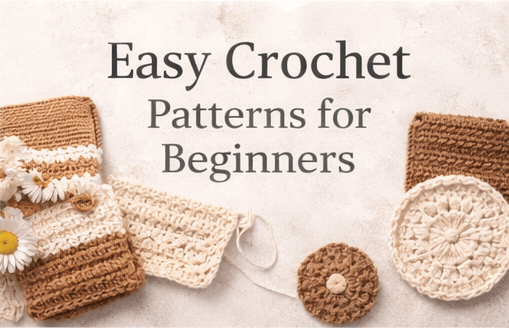

Easy Crochet Projects for Beginners
The Learning System Behind Your First Finished Projects
Most beginners believe crochet skill comes from practicing stitches repeatedly.
In reality, crochet skill develops through finishing structured projects.
Chains and practice swatches teach movement.
Projects teach control, consistency, and decision-making — the real foundations of crochet progress.
This guide is not simply a list of beginner projects.
It is a learning system that explains:
- Why Certain Projects Accelerate Learning
- How Projects Build Skills In A Predictable Order
- How Beginners Move From Confusion To Confidence
- How Small Finishes Compound Into Real Crochet Ability
If you have ever felt stuck practicing without improving, the problem is rarely effort — it is usually project selection.
- The Learning System Behind Your First Finished Projects
- The Beginner Trap: Staying in Practice Mode
- Learning Crochet as a System (Not Random Projects)
- What Makes a Project “Beginner-Friendly” (System Definition)
- The Project-Based Learning Model
- Why Finishing Matters More Than Perfection
- The Role of Quick Wins in Skill Development
- How This Pillar Fits Into the Crochet Learning System
- How to Use This Guide
- Why Beginners Struggle With Crochet Projects (Even When They Know the Stitches)
- The Five Hidden Beginner Problems
- The Emotional Cycle of Beginner Crochet
- Why Practice Swatches Alone Do Not Solve These Problems
- The Beginner Problem Map
- Why Certain “Popular Beginner Projects” Fail Beginners
- The Role of Learning Safety
- Predicting Your Next Beginner Problem
- Transition: From Problems to Structured Progression
- The Beginner Project Ladder: How Skills Actually Build Over Time
- Why Crochet Skill Develops Through Sequencing
- Stage 1 — Control Projects (Learning How Crochet Feels)
- Stage 2 — Consistency Projects (Building Rhythm)
- Stage 3 — Structure Projects (Understanding Form)
- Stage 4 — Confidence Projects (Independent Learning Begins)
- The Skill Transfer Principle
- How Long Each Stage Typically Lasts
- Choosing Projects Based on Current Signals
- The Confidence Feedback Loop
- When to Move Up (And When Not To)
- The Project Ladder Overview
- Transition to Authority Expansion
- Project Categories as Learning Tools (Not Just Ideas)
- Pathway 1 — Choosing the Right First Project
- Pathway 2 — Single Crochet as a Control System
- Pathway 3 — Quick Projects as Learning Accelerators
- How These Pathways Work Together
- The Role of Yarn and Tools in Project Success
- Common Beginner Project Mistakes (System Perspective)
- Authority Expansion Across the Crochet Hub
- Predicting the Next Learning Transition
- The Beginner Project Navigation System
- Where to Start Based on Your Current Experience
- Navigation to Supporting Guides
- Micro Guides — Problem-Level Support
- How This Pillar Reinforces the Crochet Learning System
- Progress Recognition: How to Know You’re Improving
- When to Move Beyond Beginner Projects
- The Identity of the Crochet Learning System
- Final Guidance: The Real Secret to Learning Crochet Faster
- Continue Your Learning Journey
The Beginner Trap: Staying in Practice Mode
Many beginners follow the same cycle:
- Make Chains
- Crochet A Few Rows
- Notice Mistakes
- Undo Everything
- Watch Another Tutorial
- Restart From Zero
After weeks, they still feel like beginners.
This happens because practice alone does not expose the full crochet process.
A finished project introduces skills that practice swatches never require:
- Maintaining Tension Over Time
- Recognizing Stitch Structure
- Managing Edges
- Counting Consistently
- Turning Work Correctly
- Finishing And Evaluating Results
Crochet improvement happens when learning becomes contextual, not repetitive.
Projects provide that context.
Learning Crochet as a System (Not Random Projects)
Within the crochet learning framework, beginner progress follows a predictable structure:
Skill → Application → Feedback → Adjustment → Confidence
Projects act as the bridge between understanding stitches and developing real skill.
Each beginner-friendly project exists for a reason:
Project Type → Skill Developed
- Small Flat Items → Tension Consistency
- Repetitive Rows → Stitch Recognition
- Quick Projects → Finishing Confidence
- Structured Items → Edge Control
- Slightly Larger Pieces → Endurance And Rhythm
A project is not chosen because it looks cute.
It is chosen because it trains a specific stage of learning.
This distinction explains why some beginners improve rapidly while others feel stuck despite practicing frequently.
What Makes a Project “Beginner-Friendly” (System Definition)
A beginner-friendly project is not defined by simplicity alone.
It is defined by learning safety.
A project becomes beginner-friendly when it:
- Allows Visible Progress Quickly
- Tolerates Imperfect Tension
- Minimizes Counting Complexity
- Avoids Shaping Decisions
- Produces A Usable Result Even With Mistakes
Projects that demand precision too early create frustration instead of learning.
Predictive Insight
Many beginners quit crochet not because it is difficult, but because their first project required skills they had not yet developed.
Choosing correctly removes unnecessary difficulty.
The Project-Based Learning Model
Crochet learning progresses through four functional stages.
Stage 1 — Control
You learn how yarn and hook interact.
Best learning format:
Small, repetitive projects.
Primary goal:
Produce even stitches, not perfection.
Stage 2 — Consistency
You begin recognizing stitches automatically.
Projects introduce longer rows and repetition.
You learn:
- Rhythm
- Counting Habits
- Visual Correction
Stage 3 — Structure
Projects start teaching form.
You encounter:
- Edges
- Corners
- Borders
- Finishing Techniques
Mistakes become learning signals instead of failures.
Stage 4 — Confidence
You no longer ask, “Can I do this?”
Instead, you ask, “Which project should I make next?”
At this stage, crochet becomes self-directed learning.
Why Finishing Matters More Than Perfection
A finished imperfect project teaches more than ten unfinished perfect attempts.
Finishing introduces skills beginners rarely anticipate:
- Weaving In Ends
- Evaluating Tension
- Understanding Yarn Behavior
- Recognizing Improvement Between Projects
Failure Anticipation
Many beginners delay finishing because they believe mistakes invalidate the project. In reality, unfinished work prevents learning closure — the moment where improvement becomes visible.
Completion creates feedback.
Feedback creates progress.
The Role of Quick Wins in Skill Development
Fast projects are not shortcuts.
They are learning accelerators.
Quick projects provide:
- Rapid Feedback Loops
- Low Emotional Risk
- Frequent Completion Experiences
- Measurable Improvement
Instead of waiting weeks to feel progress, beginners experience improvement within hours.
This repeated success stabilizes motivation — a critical but often ignored learning factor.
Applicability Boundary
Quick projects help early learning but cannot replace larger projects forever. Eventually, longer work builds endurance and planning skills. The system intentionally progresses toward that stage.
How This Pillar Fits Into the Crochet Learning System
This pillar functions as the Project Selection Authority Hub inside the Crochet Hub.
It connects three major learning pathways:
- Choosing The Right First Project → Understanding Beginner Readiness
- Single-Stitch Learning Projects → Developing Control Safely
- Quick Projects For Fast Progress → Building Confidence Through Completion
Each pathway expands into dedicated longtail guides that explore concepts in depth, while micro articles solve specific beginner problems encountered along the way.
You are not expected to read everything at once.
Instead, this pillar acts as a navigation system guiding you toward the next logical learning step.
How to Use This Guide
You can approach this pillar in three ways:
- If You Have Never Finished A Project → Start With Choosing Your First Project
- If Stitches Feel Inconsistent → Focus On Single Crochet Projects
- If Motivation Is Dropping → Begin With Quick Wins
Predictive Guidance
Your next frustration will likely come from either tension inconsistency or project size selection. Both are addressed through the structured progression explained throughout this guide.
Crochet learning becomes easier when each project matches your current stage — not your future goals.
Why Beginners Struggle With Crochet Projects (Even When They Know the Stitches)
Most beginner frustration does not come from difficulty learning stitches.
It comes from a mismatch between skill level and project choice.
A beginner may already know how to chain and make single crochet stitches, yet still feel unable to complete a project. This creates confusion:
- “I Know The Stitches — So Why Does Everything Still Feel Hard?”
The answer is simple: crochet projects introduce problems that tutorials rarely prepare beginners for.
Projects combine multiple skills simultaneously:
- Stitch Execution
- Tension Control
- Counting Awareness
- Edge Management
- Endurance
- Finishing Decisions
When these appear together too early, beginners interpret normal learning friction as failure.
Understanding the common problem landscape removes this misunderstanding.
The Five Hidden Beginner Problems
Across thousands of beginner experiences, project difficulties consistently fall into five predictable categories.
Recognizing these patterns helps beginners diagnose issues correctly instead of blaming themselves.
1. Project Size Misjudgment
Beginners often choose projects based on inspiration rather than learning readiness.
Common examples include:
- Full Blankets
- Complex Wearables
- Detailed Amigurumi
- Multi-Color Patterns
These projects are not impossible — they are simply too large for early feedback cycles.
Learning Insight
Skill improves fastest when feedback arrives quickly. Large projects delay feedback, slowing learning even when effort is high.
A project that takes 20 hours hides improvement signals for too long.
2. Tension Instability
Beginners frequently believe uneven stitches mean they lack talent.
In reality, tension inconsistency is a natural neurological phase.
Your hands are learning three simultaneous controls:
- Yarn Feeding
- Hook Rotation
- Pull-Through Pressure
Projects reveal tension problems more clearly than swatches because inconsistency accumulates across rows.
Predictive Insight
Almost every beginner experiences tension instability during their first 3–5 finished projects. Improvement occurs through repetition across completed pieces, not endless restarting.
3. Edge Confusion
Edges are one of the earliest structural challenges beginners face.
Typical symptoms:
- Shrinking Rows
- Widening Rows
- Slanted Sides
- Accidental Stitch Loss
These problems occur because beginners cannot yet visually identify the first and last stitch of a row.
Tutorials explain stitches individually, but projects require visual recognition within context.
Projects with simple repetition allow edge recognition to develop naturally.
Applicability Boundary
Complex patterned edges or shaping amplify confusion and should be avoided in early projects.
4. Motivation Collapse
Crochet learning is emotional as well as technical.
Motivation often drops when:
- Progress Feels Slow
- Mistakes Appear Repeatedly
- Projects Look Imperfect
- Finishing Feels Intimidating
Beginners frequently restart instead of finishing because restarting temporarily removes discomfort.
However, restarting resets learning progress.
Misconception Correction
Restarting is often perceived as improvement, but excessive restarting prevents exposure to finishing skills — a critical stage of development.
5. Perfection Expectation
Many beginners compare their first projects to experienced crocheters online.
This creates an unrealistic benchmark.
Early crochet skill should aim for:
- Completion
- Usability
- Improvement Visibility
Not perfection.
Failure Anticipation
If beginners expect straight edges immediately, they often abandon projects just before the learning breakthrough occurs.
The Emotional Cycle of Beginner Crochet
Understanding the emotional learning cycle helps normalize experiences that feel personal but are universal.
Most beginners move through this pattern:
- Excitement — Starting First Project
- Confusion — Stitches Look Uneven
- Doubt — Comparison With Others
- Adjustment — Slowing Down And Learning Rhythm
- Completion — First Finished Item
- Confidence — Willingness To Try Again
Projects are designed to move learners through this cycle repeatedly until confidence stabilizes.
Each completion shortens the doubt phase.
Why Practice Swatches Alone Do Not Solve These Problems
Practice swatches isolate stitches.
Projects integrate decisions.
Swatches teach:
- Movement Repetition
Projects teach:
- Decision Consistency
For example:
A swatch does not require:
- Counting Rows Over Time
- Maintaining Attention For Extended Periods
- Finishing Techniques
- Evaluating Usability
Projects introduce real-world constraints that transform knowledge into skill.
System Clarification
Crochet ability emerges from solving small problems repeatedly inside meaningful contexts. Projects create those contexts.
The Beginner Problem Map
The following map shows how beginner frustrations connect to learning stages:
Beginner Problem → Root Cause → Correct Project Type
- Stitches Uneven → Tension Development Phase → Small Repetitive Projects
- Edges Messy → Stitch Recognition Incomplete → Flat Rectangular Projects
- Losing Motivation → Feedback Too Slow → Quick Projects
- Projects Feel Overwhelming → Scope Too Large → 1–3 Hour Items
- Work Looks Messy → Tool Or Yarn Mismatch → Beginner-Friendly Materials
This mapping allows beginners to select projects strategically instead of emotionally.
Why Certain “Popular Beginner Projects” Fail Beginners
Some widely recommended beginner projects unintentionally create barriers.
Examples include:
- Intricate Granny Square Variations
- Amigurumi With Tight Stitches
- Garments Requiring Sizing Decisions
These introduce hidden complexity:
- Shaping Logic
- Stitch Placement Precision
- Tension Sensitivity
Conceptual Comparison
A project can use simple stitches yet still be cognitively complex.
Beginner friendliness depends on decision load, not stitch difficulty.
The Role of Learning Safety
Learning safety describes how forgiving a project is when mistakes occur.
Safe beginner projects share three properties:
- Mistakes Are Difficult To Notice
- Correction Is Simple
- Progress Remains Visible
Dishcloths, scarves, and squares succeed because they tolerate imperfection while still teaching structure.
Unsafe beginner projects punish small errors early, discouraging continuation.
Predicting Your Next Beginner Problem
Based on learning progression, beginners typically encounter problems in this order:
- Uneven Tension
- Edge Inconsistency
- Project Boredom Or Fatigue
- Finishing Uncertainty
- Desire For More Complex Designs
This pillar anticipates each stage and directs you toward projects that prepare you before frustration appears.
Authority Insight
Effective learning systems reduce surprise. When learners expect challenges, they interpret them as progress signals rather than failure.
Transition: From Problems to Structured Progression
Now that the beginner problem landscape is clear, the next step is understanding how projects should be ordered.
Projects are not random ideas.
They form a progression ladder that gradually introduces complexity while reinforcing confidence.
The following section explains how beginner crochet projects function as a structured skill progression system — and how each project prepares you for the next stage.
The Beginner Project Ladder: How Skills Actually Build Over Time
Crochet progress rarely feels linear to beginners.
One project feels easy.
The next suddenly feels impossible.
This happens when projects are chosen randomly instead of following a skill progression system.
In structured learning, projects act like steps on a ladder. Each step introduces one new challenge while reinforcing previous skills.
Too large a step creates frustration.
Too small a step creates stagnation.
The goal is controlled progression.
Why Crochet Skill Develops Through Sequencing
Crochet involves layered coordination:
- Hand Movement
- Visual Recognition
- Counting Awareness
- Tension Regulation
- Pattern Interpretation
These abilities mature at different speeds.
A well-sequenced project order allows one ability to grow while others remain stable.
System Clarification
Beginners do not fail because projects are difficult. They struggle when multiple new skills are introduced simultaneously.
The progression model reduces cognitive overload by controlling complexity.
Stage 1 — Control Projects (Learning How Crochet Feels)
At the beginning, the brain is still translating instructions into physical motion.
Primary Learning Goal
Develop hand familiarity and stitch rhythm.
Best Project Characteristics
- Small Size
- Flat Structure
- Repetitive Rows
- Minimal Counting
- Quick Completion
Recommended Project Types
- Coasters
- Dishcloths
- Small Squares
- Simple Mug Cozies
Skills Developed
- Consistent Yarn Tension
- Recognizing Stitch Tops
- Turning Rows Correctly
- Maintaining Focus Across Rows
Predictive Insight
During this stage, uneven edges are normal. Attempting to fix them perfectly slows learning. Improvement comes naturally after several finished pieces.
Completion frequency matters more than appearance.
Stage 2 — Consistency Projects (Building Rhythm)
Once stitches begin to look recognizable, beginners enter the consistency phase.
Here, learning shifts from:
“How do I make stitches?” → “How do I keep them even?”
Projects now extend duration slightly.
Recommended Characteristics
- Longer Rows
- Repeated Patterns
- Low Decision-Making
Ideal Projects
- Scarves
- Headbands
- Repeated-Row Shawls
- Rectangular Panels
Skills Developed
- Rhythm Memory
- Automatic Counting Habits
- Tension Stabilization
- Visual Correction Of Mistakes
Misconception Correction
Many beginners believe scarves are boring. In reality, scarves function as advanced tension training tools disguised as simple projects.
They teach endurance — an essential but invisible skill.
Stage 3 — Structure Projects (Understanding Form)
After consistency develops, beginners become ready for structural awareness.
Projects introduce shape while remaining predictable.
New Learning Elements
- Corners
- Borders
- Joining Pieces
- Simple Assembly
Suitable Projects
- Granny Squares
- Tote Bags
- Simple Blankets
- Modular Items
What changes here is not stitch difficulty but decision awareness.
You begin noticing:
- Where Stitches Belong
- How Edges Influence Shape
- How Tension Affects Structure
Failure Anticipation
Beginners often believe mistakes increase at this stage. In reality, awareness increases. You are seeing errors that previously went unnoticed.
This signals progress, not regression.
Stage 4 — Confidence Projects (Independent Learning Begins)
At this stage, crochet stops feeling fragile.
You no longer rely entirely on tutorials.
Projects May Include
- Wearable Accessories
- Hats
- Larger Blankets
- Beginner Garments
Learning Focus
- Adapting Patterns
- Selecting Yarn Intentionally
- Correcting Mistakes Independently
Confidence emerges because earlier stages built reliable foundations.
Applicability Boundary
Skipping directly to this stage often leads to burnout. Confidence projects require accumulated experience, not just instruction.
The Skill Transfer Principle
Each project should transfer one skill forward.
Example progression:
Project → Skill Gained → Enables Next Step
- Coaster → Tension Awareness → Scarf Consistency
- Scarf → Row Control → Structured Squares
- Granny Square → Corner Logic → Blankets & Bags
- Tote Bag → Durability Understanding → Wearables
Learning becomes cumulative rather than repetitive.
Authority Insight
Beginners often underestimate how much knowledge transfers between projects. Even imperfect projects permanently upgrade hand coordination.
How Long Each Stage Typically Lasts
Time varies widely, but progression usually follows completion count rather than calendar time.
Approximate pattern:
- Stage 1: 2–4 Finished Projects
- Stage 2: 2–3 Medium Projects
- Stage 3: 1–2 Structured Builds
- Stage 4: Ongoing Exploration
The key measurement is not hours practiced but projects completed.
This explains why beginners who finish frequently improve faster than those who repeatedly restart.
Choosing Projects Based on Current Signals
Instead of asking:
“What project should I make?”
Ask:
“What problem am I currently experiencing?”
Current Experience → Correct Project Type
- Stitches Uneven → Small Repetitive Items
- Edges Messy → Rectangular Projects
- Bored Easily → Quick Projects
- Ready For Challenge → Structured Builds
- Confident Finishing → Larger Items
This converts project choice into diagnostic learning.
The Confidence Feedback Loop
Projects create a self-reinforcing cycle:
Finish → See Improvement → Gain Confidence → Attempt Next Project → Learn Faster → Finish Again
Confidence is not motivation alone.
It is evidence accumulated through completion.
System Clarification
Confidence emerges from predictable progress. The project ladder ensures progress remains visible.
When to Move Up (And When Not To)
A beginner is ready to advance when:
- Stitches Look Mostly Even
- Counting Mistakes Are Rare
- Finishing Feels Manageable
- Frustration Decreases Between Rows
You are not ready simply because a project looks exciting online.
Boundary Knowledge
Advancing too early creates learning gaps that reappear later as persistent problems (tight tension, uneven edges, confusion with patterns).
Progression protects future learning speed.
The Project Ladder Overview
A simplified progression path looks like this:
Level 1 — Quick Wins (1 Hour)
- Coasters
- Mug Cozies
- Small Squares
Level 2 — Short Builds (2–3 Hours)
- Dishcloths
- Headbands
- Small Pouches
Level 3 — Weekend Projects
- Scarves
- Tote Bags
- Baby Blankets (Small)
Level 4 — Extended Projects
- Wearables
- Full Blankets
- Complex Builds
Each level reinforces the previous one.
Skipping levels reduces learning stability.
Transition to Authority Expansion
Now that the progression system is clear, the next step is understanding how different categories of beginner projects support this learning model.
Not all beginner projects teach the same skills.
Some accelerate control.
Some build speed.
Some strengthen confidence.
The next section expands the system by connecting project categories to the broader crochet learning ecosystem and authority structure of this hub.
Project Categories as Learning Tools (Not Just Ideas)
Beginner crochet projects are often presented as inspiration lists.
However, within a structured learning system, project categories serve a deeper purpose:
They function as targeted training environments.
Each category strengthens a different dimension of crochet skill.
Understanding these categories allows beginners to choose projects intentionally instead of randomly.
This pillar organizes beginner projects into three primary authority pathways:
- First Project Selection
- Single-Stitch Skill Development
- Quick Project Acceleration
Together, these pathways form the core project-learning ecosystem inside the Crochet Hub.
Pathway 1 — Choosing the Right First Project
The first finished project has disproportionate influence on long-term learning success.
A well-chosen first project creates momentum.
A poorly chosen one often causes early abandonment.
The purpose of first projects is not aesthetic achievement.
It is learning stabilization.
A correct first project should:
- Finish Quickly
- Tolerate Mistakes
- Reinforce Stitch Recognition
- Create Visible Progress Early
Typical successful first projects include:
- Dishcloths
- Coasters
- Simple Squares
- Short Scarves
System Clarification
The first project establishes the learner’s relationship with crochet. Early success teaches the brain that effort produces results, which increases persistence in later stages.
This pathway expands through the longtail guide:
How to Choose Your First Crochet Project
That guide explores readiness signals, project evaluation criteria, and beginner decision mistakes in depth.
Pathway 2 — Single Crochet as a Control System
Single crochet is often underestimated because it appears simple.
In reality, it functions as a control-building mechanism.
Single crochet teaches:
- Precise Hook Placement
- Consistent Yarn Tension
- Stitch Visibility
- Structural Stability
Because stitches are dense and clearly defined, errors become easier to detect and correct.
Conceptual Comparison
Tall stitches allow faster progress visually but hide tension inconsistencies. Single crochet slows the process just enough to develop control.
Projects built entirely from single crochet create safe learning environments.
Examples include:
- Dishcloths
- Scarves
- Beginner Bags
- Washcloths
- Small Blankets
These projects reinforce foundational mechanics before complexity increases.
This pathway expands into:
Easy Crochet Projects Using Only Single Crochet
which explores how repetition strengthens motor memory and prepares beginners for multi-stitch patterns.
Applicability Boundary
Single crochet alone cannot teach all crochet skills. Eventually learners must encounter height variation and pattern reading. The system introduces those only after control stabilizes.
Pathway 3 — Quick Projects as Learning Accelerators
Quick projects are often mistaken for shortcuts.
Within the learning system, they function as feedback engines.
Quick completion produces rapid learning cycles:
Attempt → Finish → Evaluate → Improve → Repeat
This repetition accelerates skill acquisition more effectively than long unfinished projects.
Typical quick projects include:
- Scrunchies
- Mug Cozies
- Coasters
- Keychain Charms
- Small Pouches
Authority Insight
Frequent completion reduces fear of mistakes. When projects finish quickly, experimentation becomes safe.
Quick projects also teach finishing skills repeatedly — a stage many beginners avoid.
This pathway expands into:
Quick Crochet Projects for Beginners
where time-based learning strategies and motivation cycles are explored more deeply.
How These Pathways Work Together
Each pathway supports a different learning dimension:
Pathway → Primary Skill → Learning Effect
- First Project → Readiness Alignment → Reduces Early Frustration
- Single Crochet → Control & Precision → Stabilizes Technique
- Quick Projects → Completion Frequency → Builds Confidence
Together they create balanced development.
Skipping any pathway creates predictable weaknesses:
- Skipping First-Project Guidance → Overwhelm
- Skipping Control Projects → Messy Stitches
- Skipping Quick Projects → Motivation Loss
System reinforcement occurs when learners rotate between pathways rather than staying in only one.
The Role of Yarn and Tools in Project Success
Beginners often attribute project difficulty to skill level when tools are the real cause.
Project outcomes depend heavily on material choice.
Beginner-friendly materials typically include:
- Worsted Weight (#4) Yarn
- Light Colors
- Smooth Texture
- Medium Hook Sizes (5.0–5.5 mm)
Failure Anticipation
Dark or fuzzy yarn hides stitch structure, delaying visual learning. Beginners frequently interpret this as personal inability rather than visibility limitation.
Correct materials accelerate recognition — a critical early learning factor.
Dedicated buying guides support this stage:
These resources reinforce tool alignment without interrupting learning flow inside this pillar.
Common Beginner Project Mistakes (System Perspective)
Certain mistakes repeatedly slow progress regardless of learner motivation.
- Choosing Projects That Are Too Large
- Choosing Projects Requiring Perfect Edges
- Starting With Difficult Yarn
- Avoiding Finishing Steps
Misconception Correction
Beginners often believe restarting improves results. Structured progression shows improvement comes from finishing and moving forward.
Authority Expansion Across the Crochet Hub
This pillar does not exist independently.
It connects horizontally and vertically within the Crochet Hub learning architecture.
Vertical Relationships
- Hub Introduces Crochet Learning
- Pillar Defines Project-Based Progression
- Longtails Explain Project Categories
- Micros Resolve Specific Beginner Problems
Horizontal Reinforcement
Occurs through related pillars:
- Learning Roadmap
- Yarn Selection
- Tension Control
- Beginner Tools
This interconnected structure ensures learners always have a next step without leaving the learning ecosystem.
Authority Clarification
A pillar gains authority not by length but by acting as a stable navigation center across multiple learning paths.
Predicting the Next Learning Transition
After completing several beginner projects, learners typically experience a shift:
They stop asking:
“What should I make?”
and begin asking:
“How can I improve what I make?”
This marks the transition from project selection to technique refinement — addressed in other pillars within the hub.
The final section of this guide consolidates navigation pathways and reinforces how this pillar supports long-term crochet growth.
The Beginner Project Navigation System
Crochet learning becomes overwhelming when beginners try to learn everything at once.
This pillar solves that problem by acting as a navigation layer, not just an information page.
Instead of asking readers to follow a fixed order, the system allows multiple entry points depending on current needs.
You can begin from any of the following situations:
- You Have Never Finished A Crochet Project
- Your Stitches Look Inconsistent
- You Lose Motivation Halfway Through Projects
- You Want Faster Progress
- You Are Ready To Attempt Larger Builds
Each situation connects to a specific learning pathway.
Where to Start Based on Your Current Experience
Use this diagnostic guide to choose your next step.
If You Have Never Finished a Project
Start with first-project guidance.
Your goal is completion, not complexity.
Recommended pathway:
How to Choose Your First Crochet Project
This stage establishes learning stability and removes unnecessary difficulty.
If Your Crochet Looks Uneven or Messy
Focus on control-based projects.
Repetition builds tension awareness and stitch recognition.
Recommended pathway:
Easy Crochet Projects Using Only Single Crochet
These projects strengthen foundational mechanics without introducing new complexity.
If You Lose Motivation Easily
Choose fast-finish projects.
Frequent completion restores learning momentum.
Recommended pathway:
Quick Crochet Projects for Beginners
Quick wins rebuild confidence through visible progress.
If You Want a Clear Progression Plan
Follow the Beginner Project Ladder introduced earlier:
- Quick Wins
- Short Builds
- Weekend Projects
- Extended Projects
This sequence minimizes overwhelm while maintaining steady skill growth.
Predictive Insight
Most beginners experience renewed motivation immediately after their third completed project because progress becomes visible across comparisons.
Navigation to Supporting Guides
This pillar governs three longtail clusters and their related micro problem solutions.
Longtail Guides
- How to Choose Your First Crochet Project
- Easy Crochet Projects Using Only Single Crochet
- Quick Crochet Projects for Beginners
Each longtail expands one learning dimension introduced here.
Micro Guides — Problem-Level Support
Micro articles resolve specific beginner questions encountered during projects, such as:
- Selecting Beginner-Friendly Projects
- Understanding Why Projects Curl
- Fixing Messy Results
- Choosing Appropriate Yarn
- Managing Project Duration
These guides provide immediate solutions without interrupting progression.
System Clarification
Micros solve symptoms.
Longtails explain concepts.
This pillar maintains the learning model that connects them.
How This Pillar Reinforces the Crochet Learning System
Within the Crochet Hub, learning follows a predictable structure:
Understand → Practice → Finish → Reflect → Advance
This pillar occupies the Finish stage.
Earlier pillars teach tools, yarn, and stitches.
Later pillars refine technique and expand creativity.
Projects transform knowledge into experience.
Authority Reinforcement
A learning system becomes reliable when each stage has a defined purpose. This pillar ensures beginners do not remain trapped between learning stitches and building real skill.
Progress Recognition: How to Know You’re Improving
Beginners often miss signs of improvement because changes occur gradually.
You are progressing when:
- Stitches Become Easier to Recognize
- Counting Requires Less Concentration
- Rows Feel More Rhythmic
- Finishing Feels Less Intimidating
- Mistakes Are Easier to Fix
Resolution Confirmation
If your newest project looks slightly better than your previous one — even imperfectly — the system is working.
Progress in crochet appears through comparison over time, not instant perfection.
When to Move Beyond Beginner Projects
Eventually, beginner projects stop feeling challenging.
Signs you are ready to advance:
- You Finish Projects Consistently
- Tension Remains Mostly Even
- Instructions Feel Easier to Interpret
- Curiosity Replaces Anxiety
At this point, learners naturally transition toward:
- Pattern Reading
- Shaping Techniques
- Wearable Construction
- Texture Exploration
This transition connects to other pillars within the Crochet Hub that expand technical depth.
Applicability Boundary
Remaining exclusively in beginner projects too long can slow development. The system encourages progression once foundational stability appears.
The Identity of the Crochet Learning System
This site is not organized as isolated tutorials.
It is designed as a structured handmade skill education system where every article supports predictable learning progression.
Core Principles of the System
- Beginners Learn Through Completion
- Projects Teach Faster Than Repetition Alone
- Confidence Grows From Visible Progress
- Complexity Increases Gradually
- Guidance Always Points to the Next Logical Step
This pillar represents the moment where learners shift from practicing crochet to becoming crocheters.
Final Guidance: The Real Secret to Learning Crochet Faster
Crochet improves fastest when you:
- Choose Small Projects
- Finish Them Completely
- Accept Imperfection
- Compare Progress Across Projects
- Move Forward Intentionally
Skill grows through accumulation, not perfection.
Every finished project becomes part of your learning foundation.
If you ever feel stuck again, return to the project ladder, select a smaller step, and rebuild momentum through completion.
Continue Your Learning Journey
Return to the broader learning system:
Or continue deeper into project-focused learning through the longtail guides connected to this pillar.
Your next improvement is not hidden in a harder technique — it is waiting inside your next finished project.