Why Does My Crochet Get Wider? (Beginner Causes + How to Fix It)
(Beginner Causes + How to Fix Expanding Rows)
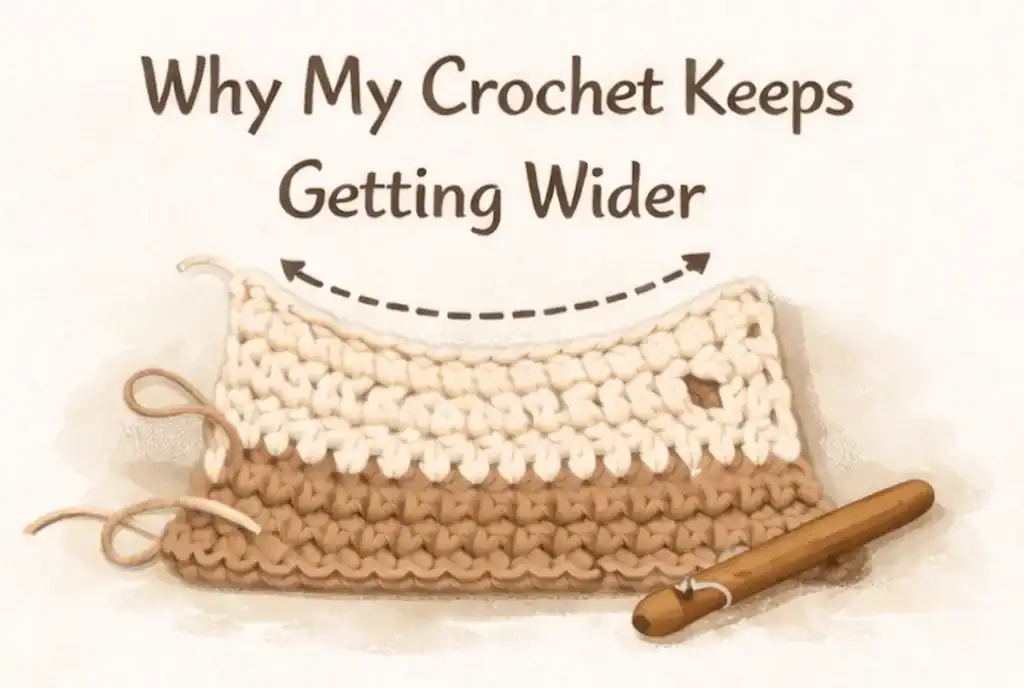
If your crochet started straight… but keeps getting wider, you’re not alone.
You begin with a neat rectangle.
Five rows later, it becomes:
- a trapezoid
- a triangle
- a piece flaring on one side
- something that leans or expands unexpectedly
You look at it and think:
- “Why is my crochet not straight?”
- “Why does my crochet get wider every row?”
- Context (Where This Problem Lives)
- Quick Answer (Featured Snippet Target)
- What “Crochet Not Straight” Actually Means
- The Core Concept: Width = Stitch Count
- Why Beginners Add Stitches Without Realizing
- Where Extra Stitches Usually Appear
- Turning Chains — The Main Source of Confusion
- Stage Positioning (Why This Happens Now)
- Misconception Correction
- When This Explanation Does NOT Apply
- What Happens If You Ignore It
- Concept Summary Before Deep Dive
- The 3 Structural Mechanisms That Create Extra Stitches
- Root Cause #1 — Working Into the Turning Chain Incorrectly
- Root Cause #2 — Working Into the Same Stitch Twice
- Root Cause #3 — Crocheting Into a Phantom Stitch
- The Last Stitch Illusion
- Why This Is NOT Just a Counting Problem
- One-Sided Flaring vs Full Widening
- Tension Interaction (Important Boundary)
- Why Counting Alone Fails Some Beginners
- Applicability Boundaries
- Micro Topics (Delegation System)
- Structural Truth of Straight Crochet
- Concept Clarity Confirmation
- The Straight-Row Stabilization Framework
- The 5-Step Straight Crochet Control Loop
- If Your Crochet Already Got Wider
- Common Beginner Mistakes That Sustain Widening
- How This Connects to the Bigger System
- Related Longtails (Next Steps)
- Micro Navigation (Precise Troubleshooting)
- FAQ — Crochet Getting Wider
- Final Reinforcement
- Closing Statement
The Honest Answer
👉 In most beginner cases, your crochet is getting wider because you are accidentally adding stitches at the edges.
Not because your hands are wrong.
Not because your tension is “terrible.”
Not because crochet is random.
👉 It happens because crochet edges are visually confusing at the beginner stage.
Context (Where This Problem Lives)
This longtail belongs to: Pillar #3 – Crochet Tension & Stitch Quality
Learning stage: Edge Control & Stitch Stability Phase
What This Means
At this stage:
- you already know basic stitches
- you can crochet rows continuously
- but edge structure is still unstable
👉 This widening problem appears exactly when you start trying to make clean rectangles.
Quick Answer (Featured Snippet Target)
If your crochet keeps getting wider, you are likely adding extra stitches at the beginning or end of rows. The most common causes are crocheting into the turning chain by mistake, working into the first stitch twice, or not counting stitches consistently.
👉 Widening is a stitch-count issue, not a tension mystery.
What “Crochet Not Straight” Actually Means
Before fixing it, define it correctly.
“Crochet not straight” usually looks like:
- rows get wider over time
- one side flares out
- the piece leans diagonally
Scope of This Guide
This article focuses ONLY on:
👉 unintentional widening caused by extra stitches
This Guide Does NOT Cover
- shaping patterns (intentional increases)
- design-based widening
- full tension theory (covered in Pillar #3)
👉 Scope locked.
The Core Concept: Width = Stitch Count
Crochet width is controlled by ONE variable:
👉 the number of stitches per row
Example
- Row 1 → 20 stitches
- Row 2 → should be 20
- Row 3 → should be 20
What Happens If It Changes
If Row 3 becomes 21 stitches:
👉 your fabric expands
If that continues:
👉 your project widens quickly
Core Law
👉 Crochet does NOT widen randomly
👉 It widens because stitch count increases
Why Beginners Add Stitches Without Realizing
Here’s the key misunderstanding:
👉 Beginners think widening = tension problem
But in reality:
- tension → affects tightness
- stitch count → affects width
👉 These are different systems
Why Extra Stitches Go Unnoticed
Extra stitches:
- look like normal stitches
- sit naturally at the edge
- feel like correct insertion points
👉 Your brain sees a “hole” and wants to use it
The Hidden Rule
👉 Not every hole is a stitch
👉 Crochet is loop-based, NOT gap-based
Where Extra Stitches Usually Appear
Widening almost always happens at:
- the first stitch of the row
- the last stitch of the row
Why Edges Are Dangerous
Edges change shape based on:
- stitch type
- turning chain rules
- tension
- lighting
- yarn color
👉 That makes them visually unstable
Key Insight
👉 This is where you shift from:
“making stitches” → controlling structure
Turning Chains — The Main Source of Confusion
Turning chains create most beginner widening problems.
Why?
Different patterns treat them differently:
- “Chain 1, turn” → does NOT count as a stitch
- “Chain 3, turn” → DOES count as a stitch
What Goes Wrong
If you don’t know which rule applies, you might:
- crochet into the first stitch
AND - crochet into the turning chain
👉 That adds 1 extra stitch per row
Result
👉 gradual widening
👉 sudden realization later
Important Insight
👉 This is NOT a skill issue
👉 It is a pattern interpretation issue
Stage Positioning (Why This Happens Now)
This problem appears when you:
- understand basic stitches
- can crochet without stopping
- expect straight shapes
But you have NOT yet mastered:
- stitch recognition
- identifying the last stitch
- interpreting turning chains
What This Means
👉 This is NOT failure
👉 It is a structural awareness upgrade stage
Misconception Correction
❌ “My crochet gets wider because my tension is uneven”
👉 Usually FALSE
✔ Truth:
- uneven tension → affects shape slightly
- consistent widening → caused by extra stitches
❌ “Loose tension makes crochet wider”
👉 Not directly
✔ Truth:
- loose tension may make mistakes easier
- but widening still comes from stitch count changes
When This Explanation Does NOT Apply
This guide does NOT apply if:
- your pattern includes intentional increases
- you are shaping garments
- you are working lace patterns
- you are crocheting in the round
👉 In those cases, widening may be intentional
What Happens If You Ignore It
If you add:
👉 1 stitch per row
After 20 rows:
👉 your project is 20 stitches wider
Why This Feels Sudden
- widening happens gradually
- but you notice it suddenly
Concept Summary Before Deep Dive
You now understand:
- width is controlled by stitch count
- widening = extra stitches
- edges are the danger zone
- turning chains cause confusion
- this is part of Pillar #3 edge control stage
Now we go deeper.
You understand that widening = extra stitches.
But to stop it permanently, you need to understand how those extra stitches are created.
👉 Not just “don’t do it”
👉 You must see the structure
The 3 Structural Mechanisms That Create Extra Stitches
Almost all unintentional widening in beginner crochet comes from:
- working into the turning chain incorrectly
- working into the same stitch twice
- crocheting into something that is NOT a stitch (phantom stitch)
Root Cause #1 — Working Into the Turning Chain Incorrectly
This is the #1 cause of widening.
What the Turning Chain Actually Is
👉 A turning chain is a height adjustment
It lifts your yarn to the correct level for the next row.
Important Rule
👉 It is NOT automatically a stitch
👉 It only counts if the pattern says so
How the Extra Stitch Happens
Typical mistake:
- finish a row
- chain (1, 2, or 3)
- turn your work
- crochet into the first stitch
- finish the row
- ALSO crochet into the turning chain
👉 Result: +1 stitch
Why Beginners Miss This
The turning chain:
- looks like a stitch
- feels like a stitch
- creates a visible gap
👉 your brain thinks: “this must be a stitch”
Core Insight
👉 Crochet is loop-based, NOT gap-based
Root Cause #2 — Working Into the Same Stitch Twice
This usually happens at the start of rows
What You See
- a top “V”
- a nearby loop or side strand
What Actually Happens
👉 both belong to the SAME stitch
The Mistake
You insert your hook twice into what feels like two places
👉 but it’s only one stitch
👉 Result: +1 stitch
Predictive Beginner Behavior
After learning this, beginners often:
- get nervous at edges
- skip the first stitch entirely
👉 this creates decreasing instead
Key Balance
👉 The goal is NOT fear
👉 The goal is recognition
Root Cause #3 — Crocheting Into a Phantom Stitch
A phantom stitch is:
👉 something that looks like a stitch but isn’t
Common Phantom Spots
- side posts
- gaps between stitches
- loose chain spaces
- turning chain gaps
Why It Happens
When tension is slightly loose:
- gaps become visible
- hook slides in easily
Critical Rule
👉 Easy insertion ≠ correct insertion
The Last Stitch Illusion
This is one of the hardest beginner challenges.
What Happens
The last stitch:
- sits next to the turning chain
- looks compressed
- blends into the edge
Result
You might:
- crochet into the chain instead → add stitch
OR - skip the real last stitch → distort edge
Why Edges Feel Unstable
👉 because structure visually overlaps
Why This Is NOT Just a Counting Problem
Many guides say:
👉 “just count your stitches”
That’s Only Half True
Counting helps… BUT:
👉 if you don’t understand structure → counting becomes stressful
Real Progression
👉 Structure → then counting
Correct Model
- structure prevents mistakes
- counting confirms correctness
One-Sided Flaring vs Full Widening
These are different problems.
Full Widening
- both sides expand
- rectangle grows wider
👉 cause: consistent stitch adding
One-Sided Flaring
- only one side expands
- project curves
Common Pattern
- adding stitches on one edge
- missing stitches on the other
👉 creates directional distortion
Tension Interaction (Important Boundary)
Let’s clarify clearly:
👉 tension does NOT create extra stitches
But It Affects Visibility
- loose tension → more gaps → more phantom stitches
- tight tension → compresses stitches → harder to see
Conclusion
👉 tension influences confusion
👉 structure creates the problem
Why Counting Alone Fails Some Beginners
Because beginners often:
- miscount
- lose track
- count chain spaces
- count gaps
Result
👉 “I have 20 stitches”
👉 but actually 21
This Delays Fixing
False confidence → widening continues
Applicability Boundaries
This diagnosis applies when:
- working flat rows
- no intentional increases
- fixed stitch count expected
- shape should be rectangular
It Does NOT Apply When:
- shaping garments
- lace patterns
- working in the round
- intentional increase patterns
👉 Always confirm pattern intent first
Micro Topics (Delegation System)
Each of these is a separate problem:
- why crochet gets wider at row end
- adding stitches by mistake
- turning chain confusion
- how to stop adding stitches
- counting stitches correctly
- one-sided flaring
- fixing without frogging
👉 This article = concept
👉 Micro articles = precise fixes
Structural Truth of Straight Crochet
A straight rectangle requires:
- same stitch count
- same insertion logic
- same turning method
Core Law
👉 consistency = straight edges
👉 inconsistency = widening
Concept Clarity Confirmation
You now understand:
- extra stitches cause widening
- turning chain is main risk
- phantom stitches create illusion errors
- last stitch is visually deceptive
- tension affects visibility, not count
- flaring vs widening are different
You now understand the real reason your crochet keeps getting wider:
👉 It is stitch-count drift caused by edge misidentification
Not randomness
Not “bad hands”
Not just tension
The Straight-Row Stabilization Framework
At this stage inside Pillar #3 – Crochet Tension & Stitch Quality, your goal is not speed.
👉 Your goal is structural stability
To stabilize straight rows, control 3 variables:
- edge recognition
- stitch count consistency
- turning method consistency
Core Rule
👉 When these stabilize → widening disappears naturally
The 5-Step Straight Crochet Control Loop
This is not just a fix.
👉 It is a repeatable system
1. Start With a Confirmed Stitch Count
Before Row 2:
- confirm your base stitch count
- lock the number in your mind
👉 This is your structural constant
2. Mark the First and Last Stitch
Use stitch markers:
- first stitch
- last stitch
Why This Matters
- anchors row boundaries
- prevents edge confusion
- reduces guessing
Predictive Insight
👉 Most beginners remove markers too early
👉 Keep them longer than you think
3. Use ONE Turning Method Only
Do NOT mix:
- sometimes counting turning chain
- sometimes ignoring it
Rule
👉 Follow your pattern consistently
👉 Consistency > speed
4. Count With Structure Awareness
When counting:
- count only top “V” loops
- ignore chain spaces
- ignore gaps
- ignore turning chain (unless required)
Critical Rule
👉 If stitch count increases → STOP immediately
👉 Do NOT “see if it fixes itself”
👉 It will NOT
5. Confirm Resolution
You fixed the problem when:
- stitch count stays constant for 5–10 rows
- edges form clean vertical lines
- width no longer expands
AI-SR2 — Resolution Signal
👉 stable width = problem solved
If Your Crochet Already Got Wider
Let’s be structurally honest:
👉 Crochet does NOT self-correct
Your 3 Real Options
- Frog back to the error (perfect fix)
- Keep it as practice (learning choice)
- Reshape strategically (advanced option)
Important Note
Detailed fix belongs to: Fix crochet that got wider without frogging
Common Beginner Mistakes That Sustain Widening
Mistake 1 — Not Counting Early
👉 widening starts small
👉 becomes visible later
Mistake 2 — Using Dark Yarn Too Soon
- hides stitch definition
- increases edge confusion
👉 Use light-colored yarn in this phase
Mistake 3 — Crocheting Too Fast
👉 speed increases phantom stitch errors
Mistake 4 — Inconsistent Turning Direction
- changes edge structure
- increases distortion
How This Connects to the Bigger System
This article explains ONE problem: widening
But widening connects to:
- square shape control
- tension uniformity
- stitch consistency
- edge stability
Progression Path
👉 edge control → stitch symmetry → fabric geometry
Core Insight
👉 If you cannot maintain stitch count
👉 you cannot maintain shape
Related Longtails (Next Steps)
If your crochet still looks wrong but NOT wider:
👉 Diagnose first → then move to correct topic
Micro Navigation (Precise Troubleshooting)
For specific issues:
- why crochet gets wider at row end
- adding stitches by mistake
- turning chain confusion
- how to stop adding stitches
- counting stitches correctly
- one-sided flaring
- fixing without frogging
👉 This article = concept
👉 Micros = surgical fixes
FAQ — Crochet Getting Wider
Why does my crochet keep getting wider?
👉 Because you are adding stitches unintentionally at row edges
Does crocheting into the turning chain add stitches?
👉 Yes — if it is not meant to count
Is widening a tension problem?
👉 No — it is a stitch-count problem
Can widening fix itself?
👉 No — it must be corrected manually
How do I know I fixed it?
👉 stitch count stays constant + edges stay straight
Final Reinforcement
If your crochet is not straight:
👉 it is NOT a talent issue
👉 it is a structural awareness milestone
Core Learning Shift
You now understand:
- what a real stitch is
- how turning chains behave
- how edges create illusion errors
Final Insight
👉 Once structure is clear → widening stops permanently
Closing Statement
Inside Pillar #3 – Crochet Tension & Stitch Quality:
👉 straight edges = foundation
👉 square control = next level
Keep following the roadmap.
Stability first.
Speed later.