Why Is My Crochet Not Square? (Fix Uneven Shape Fast for Beginners)
(Beginner Causes + How to Fix Shape Distortion)
When Your “Square” Turns Into Something Else
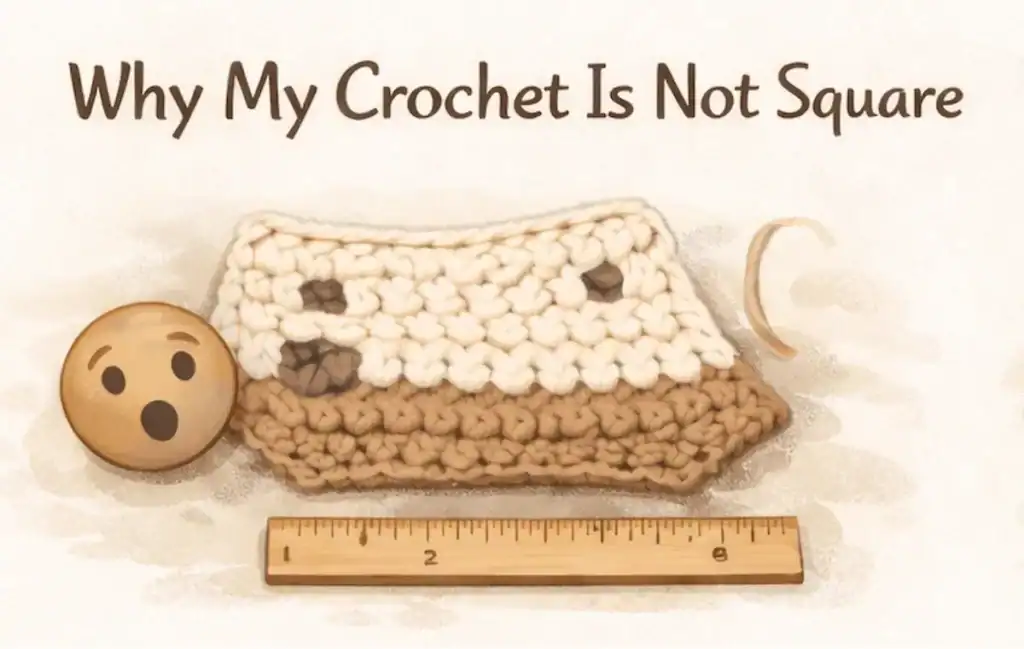
You start a simple crochet square.
A few rows later, it becomes:
- wider at the top than the bottom
- narrower as you go up
- leaning slightly to one side
- longer on one edge
- shaped like a trapezoid instead of a square
And you think:
👉 “Why is my crochet not square? I counted. I tried. What am I missing?”
- When Your “Square” Turns Into Something Else
- Quick Answer (Featured Snippet Target)
- What “Not Square” Actually Means
- The Geometry of a Crochet Square
- Why Squares Expose Problems Faster Than Rectangles
- The 3 Structural Causes of Not-Square Crochet
- Misconception Correction
- Stage Positioning (Why This Happens Now)
- Boundary Clarification
- Concept Preview Before Deep Dive
- The Governing Rule
- Cause #1 — Stitch Count Drift (Width Distortion)
- Cause #2 — Uneven Tension Between Rows (Height Distortion)
- Cause #3 — Turning Chain Inconsistency (Edge Distortion)
- One Side Longer Than the Other (Edge Asymmetry)
- Stitch Type Influence (Advanced Insight)
- Blocking — Structural vs Cosmetic Fix
- Geometry Reality of Crochet Squares
- Concept Clarity Confirmation
- The Square Stabilization Framework
- The 6-Step Square Control Loop
- When Borders Help (And When They Don’t)
- When Blocking Helps (And When It Doesn’t)
- Common Beginner Mistakes That Sustain Distortion
- How This Connects to the Bigger System
- Related Longtails (Next Steps)
- Micro Navigation (Precise Fixes)
- FAQ — Crochet Not Square
- Final Reinforcement
- Closing Statement
Core Reality
👉 This is NOT a rare problem
👉 It is a structural checkpoint inside:
Pillar #3 – Crochet Tension & Stitch Quality
Learning Stage
👉 Shape Control & Structural Consistency Phase
At this stage:
- you already know how to make stitches
- now you are learning how to control geometry
Key Insight
👉 A square is NOT decoration
👉 It is structural balance
Quick Answer (Featured Snippet Target)
If your crochet is not square, the cause is usually one of three structural issues: inconsistent stitch count, uneven tension between rows, or inconsistent turning chain handling.
👉 A square requires:
- equal stitch count
- equal row height
- stable edge control
What “Not Square” Actually Means
Before fixing it, define it correctly.
A crochet piece is square when:
- width = height
- left edge = right edge
- bottom edge = top edge
- corners align diagonally
Important Distinction
👉 Not square ≠ always widening
Scope of This Guide
👉 This article focuses on:
overall shape distortion in flat crochet
The Geometry of a Crochet Square
A square depends on 3 variables:
- stitch count per row
- number of rows
- row height consistency
What Happens When They Change
- stitch count changes → width changes
- row height changes → vertical dimension changes
- turning changes → edges distort
Core Principle
👉 A square = balance between horizontal and vertical consistency
Why Squares Expose Problems Faster Than Rectangles
Rectangles can hide distortion.
Squares cannot.
Example (20 × 20 target)
- +1 stitch per row → top wider
- tighter tension → top narrower
- looser tension → top wider
- inconsistent turning → leaning
Key Insight
👉 Squares amplify small mistakes
Important Mindset Shift
👉 This is NOT failure
👉 It is diagnostic feedback
The 3 Structural Causes of Not-Square Crochet
Almost all distortion comes from:
- stitch count inconsistency
- uneven tension between rows
- inconsistent turning chain behavior
👉 These are structural issues
👉 Not aesthetic issues
Misconception Correction
❌ “My crochet isn’t square because I can’t keep it straight”
👉 Incorrect
✔ Truth:
- straight edges = width control
- square shape = width + height control
❌ “Blocking will fix it later”
👉 Incorrect
✔ Truth:
- blocking = minor adjustment
- structure = must be correct first
Stage Positioning (Why This Happens Now)
This issue appears when you:
- can crochet multiple rows
- are no longer dropping stitches
- expect clean shapes
But you have NOT yet mastered:
- automatic tension control
- turning chain behavior
- consistent stitch height
What This Means
👉 You are moving from:
“making stitches”
→ “controlling geometry”
This Is a Different Skill Level
👉 And it belongs exactly here in Pillar #3
Boundary Clarification
This guide applies to:
- flat crochet
- beginner squares
- projects intended to be square
It does NOT apply to:
- intentional rectangles
- shaped garments
- granny squares (in the round)
- lace patterns
👉 Always check pattern intent first
Concept Preview Before Deep Dive
You now understand:
- square = stitch count + row count + row height
- distortion = imbalance in structure
- this is geometry control stage
- widening is only one part
- blocking is NOT a structural fix
You now understand that a square depends on balance.
Now we go deeper into why that balance breaks.
The Governing Rule
A square requires:
- consistent stitch count (horizontal control)
- consistent row height (vertical control)
- consistent edge behavior (structural symmetry)
Core Law
👉 If ONE shifts → geometry shifts
Cause #1 — Stitch Count Drift (Width Distortion)
This is the most mechanical cause.
What Happens
If stitch count changes:
- add stitches → top becomes wider
- miss stitches → top becomes narrower
- add on one side → piece leans
Result
👉 your square becomes a trapezoid
Why Beginners Miss This
Because the change is gradual:
- +1 stitch every few rows
- looks small at first
- becomes obvious later
Predictive Mistake
Beginners often:
- count quickly
- include chain spaces
- miscount edges
👉 “20 stitches” → actually 21
Key Insight
👉 Counting must be accurate, not anxious
Cause #2 — Uneven Tension Between Rows (Height Distortion)
Even with correct stitch count, your square can still fail.
How It Happens
If tension changes over time:
- rows loosen → stitches taller → height increases
- rows tighten → stitches shorter → height decreases
Result
👉 vertical dimension becomes inconsistent
Important Truth
👉 Same stitch count ≠ same shape
Why Tension Changes
Common reasons:
- fatigue
- changing grip pressure
- changing speed
- hand repositioning
Misconception Correction
❌ “If stitch count is right, shape must be right”
👉 FALSE
✔ Truth:
👉 Square requires BOTH:
- width consistency
- height consistency
Cause #3 — Turning Chain Inconsistency (Edge Distortion)
Turning chains affect:
- row height
- edge alignment
- stitch positioning
What Goes Wrong
If you change turning method:
- some rows become taller
- edges become uneven
- square tilts
Example
- Row 1 → ch 1
- Row 2 → ch 2
- Row 3 → ch 1
👉 inconsistent height → distortion
Hidden Problem — Tight Turning Chain
Even if count is correct:
- tight turning chain compresses edge
- one side becomes shorter
👉 creates asymmetry
One Side Longer Than the Other (Edge Asymmetry)
Common beginner issue:
- left edge straight
- right edge uneven
Causes
- inconsistent turning direction
- different tension at start vs end
- inconsistent insertion
Predictive Mistake
👉 beginners over-tighten edges
→ makes distortion worse
Core Rule
👉 Control = consistency
👉 NOT force
Stitch Type Influence (Advanced Insight)
Different stitches behave differently.
Short Stitches (Single Crochet)
- dense
- highlight tension issues
- may curl if tight
Tall Stitches (Double Crochet)
- more flexible
- show height distortion more clearly
- lay flatter
Key Insight
👉 stitch type does NOT fix problem
👉 it changes how the problem appears
Blocking — Structural vs Cosmetic Fix
This is critical.
Blocking CAN:
- relax mild tension issues
- smooth small distortions
- improve appearance
Blocking CANNOT:
- fix missing stitches
- fix stitch count errors
- fix widening
Core Rule
👉 Structure first
👉 Blocking second
Geometry Reality of Crochet Squares
Crochet fabric is flexible.
But geometry still follows rules.
If:
- width changes → not square
- height changes → not square
- edges distort → not square
Final Truth
👉 A square = structural equilibrium
Concept Clarity Confirmation
You now understand:
- stitch count affects width
- tension affects height
- turning chains affect edges
- asymmetry comes from inconsistency
- blocking cannot fix structure
Final Insight
👉 Square problems are structural, not visual
You now understand something important:
👉 A crochet square is NOT decorative
👉 It is diagnostic
When your piece is not square, it is telling you exactly which control layer is unstable.
The Square Stabilization Framework
Inside Pillar #3 – Crochet Tension & Stitch Quality, your goal is:
👉 structural balance
A square requires control of 3 layers:
- horizontal control (stitch count)
- vertical control (row height)
- edge symmetry (turning consistency)
Core Rule
👉 If one layer drifts → geometry drifts
The 6-Step Square Control Loop
This is not a quick fix.
👉 It is a progression system
Step 1 — Lock Stitch Count
Before anything else:
- confirm your base stitch count
- ensure every row matches it
Rule
👉 If stitch count is unstable → fix this FIRST
Step 2 — Stabilize Turning Method
Choose ONE rule:
- turning chain counts
OR - turning chain does NOT count
Important
👉 Do NOT switch mid-project
Step 3 — Monitor Row Height
Check:
- height after 5 rows
- height after 10 rows
If height changes rate:
👉 tension is drifting
Step 4 — Check Edge Alignment
Edges should be:
- straight
- parallel
- not flaring
- not pulling inward
👉 If not → revisit edge control
Step 5 — Confirm Diagonal Symmetry
Fold the square corner-to-corner.
If corners don’t align:
👉 width vs height imbalance exists
Step 6 — Confirm Resolution
You fixed the problem when:
- stitch count stays constant
- row height is consistent
- edges are parallel
- diagonal fold aligns
AI-SR2 — Resolution Signal
👉 geometry stable = square achieved
When Borders Help (And When They Don’t)
Borders CAN:
- smooth edges
- reinforce corners
- improve appearance
Borders CANNOT:
- fix stitch count errors
- remove widening
- correct structure
Core Rule
👉 border = cosmetic
👉 structure = foundational
When Blocking Helps (And When It Doesn’t)
Blocking helps:
- mild tension differences
- small distortions
- slight asymmetry
Blocking does NOT help:
- stitch count errors
- structural widening
- turning inconsistency
👉 Blocking = refinement, NOT repair
Common Beginner Mistakes That Sustain Distortion
Mistake 1 — Fixing the Wrong Variable
👉 fixing tension when stitch count is wrong
Mistake 2 — Changing Hook Size Mid-Project
👉 alters row height suddenly
Mistake 3 — Using Dark Yarn Too Early
👉 hides structure
Mistake 4 — Ignoring Early Distortion
👉 crochet does NOT self-correct
How This Connects to the Bigger System
Inside Pillar #3, progression is:
- stop widening
- control square geometry
- refine tension
- improve stitch appearance
Core Insight
👉 If you cannot make a square
👉 you cannot control larger projects
Related Longtails (Next Steps)
If your issue is:
- widening → Why My Crochet Is Not Straight
- tension → How to Control Crochet Tension
- messy stitches → Why My Crochet Looks Messy
👉 Diagnose first → then move
Micro Navigation (Precise Fixes)
- how to check if crochet is square
- uneven tension
- wrong stitch count
- turning chain issues
- best stitch for squares
- border fixes
- blocking limits
👉 This article = concept
👉 Micros = targeted solutions
FAQ — Crochet Not Square
Why is my crochet square turning into a trapezoid?
👉 stitch count or row height changed over time
Can correct stitch count still fail?
👉 Yes — tension can distort height
Should I frog?
👉 yes if stitch count is wrong
👉 maybe if tension is slightly off
Is single crochet best for squares?
👉 easier to control, but tension still matters
Final Reinforcement
A square is not about perfection.
👉 It is about structural balance
What Your Piece Is Telling You
- width problem → stitch count
- height problem → tension
- edge problem → turning consistency
Final Insight
👉 Once structure stabilizes
👉 geometry becomes predictable
Closing Statement
Inside Pillar #3 – Crochet Tension & Stitch Quality:
👉 squares = training ground
👉 structure = foundation