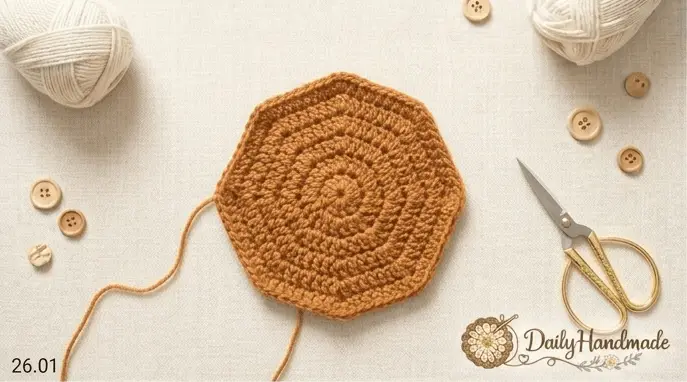
Why Is My Crochet Circle Wavy? The Geometry of Flat Rounds
Quick Recognition
It is a quiet afternoon in 2026. You are sitting down to crochet a beautiful circular rug or a simple coaster. You’ve finished Round 5, but instead of laying perfectly flat on the table, the edges are rippling and ruffling like a Victorian collar. You think, “I’m following the pattern, so why is my crochet circle wavy?” At Dailyhandmade, we want to reassure you: your hook isn’t broken, but your geometry is slightly “off.” Working in the round is a delicate balance of math and tension. When a circle waves, it is the yarn’s way of telling you that you’ve created more surface area than the radius of the circle can support.
Direct Answer
The fundamental reason why is my crochet circle wavy is because there are too many stitches in the outer rounds. In geometric terms, the circumference of your circle is growing faster than its radius. When you add too many increases, the excess fabric has nowhere to go but “up and out,” creating ripples or waves. In the framework, we call this “The Ruffle Effect.” It is the opposite of “bowling” (where the circle curls into a cup), and it almost always points back to a math error in your increase count.
The Geometry of a Flat Plane: The $2\pi r$ Rule
In the technical world of Working in the Round, every flat circle must follow the laws of Euclidean geometry. The relationship between the circumference ($C$) and the radius ($r$) is defined as:
$$C = 2\pi r$$
To keep a crochet circle flat, each round must add just enough stitches to account for the increasing circumference without exceeding it.
| The Round State | The Stitch Math | The Visual Result |
| Flat Plane | Circumference matches the radius growth. | Perfect, flat circle. |
| Wavy/Ruffled | Circumference > $2\pi r$ | Excess fabric creates waves. |
| Bowling/Cup | Circumference < $2\pi r$ | Fabric pulls inward like a bowl. |
3 Culprits Behind the “Ruffle Effect”
If you are diagnosing why is my crochet circle wavy in Working in the Round, check these three common structural errors:
1. Excessive Increase Counts
The most common mistake is adding too many increases per round. For example, if you are working in Double Crochet (DC), the standard is usually 12 increases per round.
- The Error: If you accidentally add 14 or 16 increases, you are forcing the edge of the circle to expand too quickly. We dive deeper into this in Crochet circle too many increases.
2. Tension Inconsistency
Sometimes the math is right, but the execution is loose.
- The Error: If your tension becomes significantly looser as the circle grows, each stitch takes up more physical space than the one below it. Even with the correct count, this “tension bloom” can cause ruffling. This is often more visible after a wash, as seen in How to reshape crochet after washing.
3. Incorrect Hook-to-Yarn Ratio
If your hook is too large for your yarn, the stitches become floppy and lack the structural integrity to hold a flat plane.
- The Error: Oversized stitches occupy more area than the geometric formula allows. To fix this, you may need to consult our guide on The best yarn for flat crochet circles
Dailyhandmade Expert Rescue Signal
The “Table Test”: In Why My Crochet Circle Is, we use the “Table Test” to catch waves early. After every round, lay your circle on a completely flat, hard surface. Give it a gentle pat. If the edges don’t settle immediately or if you see “hills” forming in the fabric, you have a waving problem. Catching it at Round 3 is a quick fix; catching it at Round 20 usually requires “frogging” (ripping back).
What To Expect Next
We’ve identified that “too much fabric” is the cause of the ripple. But where exactly did the math go wrong? Was it a single rogue stitch or a fundamental misunderstanding of the pattern? In our next chapter of Why My Crochet Circle Is, we look at the specific math of the error: Crochet Circle Too Many Increases: Identifying the Ripple Cause.
Return Path
Understanding why is my crochet circle wavy is the first step in mastering Working in the Round. To keep your rounds perfectly flat, explore these related guides:
- Crochet circle too many increases
- How to fix wavy crochet circle
- Flat crochet circle increase formula
- Master Guide: Working in the Round
I have a relevant follow-up question for you: When your circle starts to wave, is it a gentle ripple across the whole piece, or is it a sudden, aggressive ruffling that only started in the most recent round?