
Why is Fuzzy Yarn Hard to Crochet? (The Invisible Loop Problem)
Quick Recognition
You’re at the store and you see it: a skein of yarn so soft, so fluffy, and so cloud-like that you have to make a blanket out of it immediately. It’s labeled “Bouclé,” “Chenille,” or simply “Faux Fur.” You take it home, make your first chain, and then… disaster. You can’t see where to put your hook for the second row. You feel around with your fingers, stabbing blindly into the fluff, only to end up with a tangled knot. If you feel like you’re crocheting in the dark, you’ve encountered the Invisible Loop Problem. Understanding why is fuzzy yarn hard to crochet is the ultimate “save-your-sanity” lesson for beginners.
Direct Answer
The reason why is fuzzy yarn hard to crochet is that the “halo” (the fuzzy fibers sticking out) completely obscures the Stitch Anatomy. In Best Yarn for Crochet Projects, we learn that successful crochet relies on seeing the “V” on top of the stitch. Fuzzy, textured, or novelty yarns hide these “Vs” under a layer of fluff, making it impossible to count your stitches or identify where to insert your hook. For a beginner, this turns a relaxing hobby into a high-stress guessing game.
The “Invisible Loop” Comparison Table
At Dailyhandmade, we categorize yarn by how “visible” its structure is. See where fuzzy yarn falls:
| Yarn Texture | Visual Clarity | Best For… | Beginner Rating |
| Smooth / Plied | High | Learning Stitches | ⭐⭐⭐⭐⭐ |
| Mercerized Cotton | Highest | Precision Work | ⭐⭐⭐⭐ |
| Bouclé / Curly | Low | Experienced Makers | ⭐ |
| Faux Fur / Eyelash | Zero | Advanced Textures | 🚫 (Avoid!) |
Why It’s a “Trap” (The Visual Literacy Logic)
In our master guide Best Yarn For Crochet Beginners (What to Use and Avoid), we talk about “training your eyes.” If you use fuzzy yarn too early, you aren’t training your eyes—you’re just guessing.
- You Can’t Count: When the stitches blend together into a solid mass of fluff, you won’t know if you have 10 stitches or 15. This leads to wonky, triangular projects.
- Frogging is Impossible: “Frogging” (ripping out stitches) is part of learning. Fuzzy yarns have tiny “teeth” that lock together. If you make a mistake, trying to rip it out usually results in the yarn snapping or tangling into a permanent knot.
- The “Blind Stabbing” Habit: Beginners who start with fuzzy yarn often develop the habit of “feeling” for holes instead of “seeing” stitches. While this is a skill used for some advanced textures, it prevents you from learning the fundamental structure of crochet.
How to Avoid the Trap (The Dailyhandmade Protocol)
If you already bought the fuzzy yarn, don’t throw it away! Just put it in your “Challenge Bin” for later. To stay on track with Pillar #04, follow these rules:
- The “V” Visibility Test: Before buying, pull a few inches of yarn out of the skein. If you can’t see the individual strands twisted together, it’s too fuzzy for a beginner.
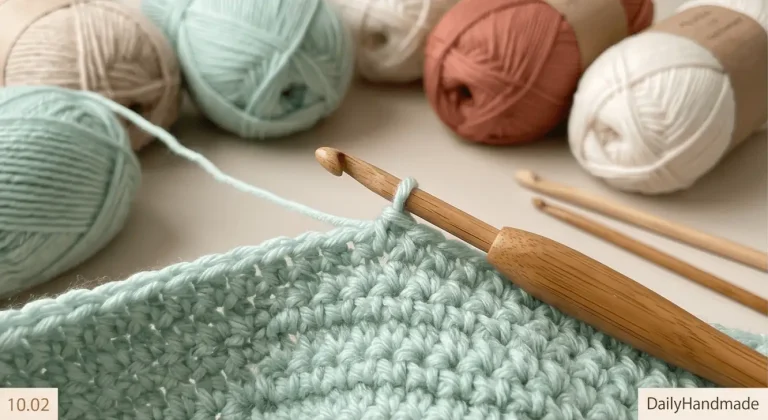
- Stick to “Smooth” Solids: Choose a yarn that looks like a tiny rope. This ensures that every time you make a stitch, you can see exactly where the hook went in and where it came out.
- The “Feel” Method (If You Must): If you absolutely insist on using fuzzy yarn, pair it with a Smooth Strand. Crochet with one strand of fuzzy yarn and one strand of plain, smooth yarn held together. The smooth yarn will act as a “guide wire” so you can see your stitches.
- Save it for Borders: Use fuzzy yarn for the very last row of a project (the border) rather than the whole piece. It adds the softness you want without the structural headache.
What To Expect Next
Once you switch back to a smooth yarn, you will feel like a weight has been lifted. You’ll be able to see your “Vs,” count your rows, and actually progress through your pattern. You will know you’ve graduated from the “Invisible Loop” struggle when you can look at a smooth row of stitches and name every part of the stitch anatomy.
Return Path
Understanding why is fuzzy yarn hard to crochet is a rite of passage for every maker. Now that you’ve avoided the fluff trap, let’s look at another common issue: the “splitty” nature of certain natural fibers.