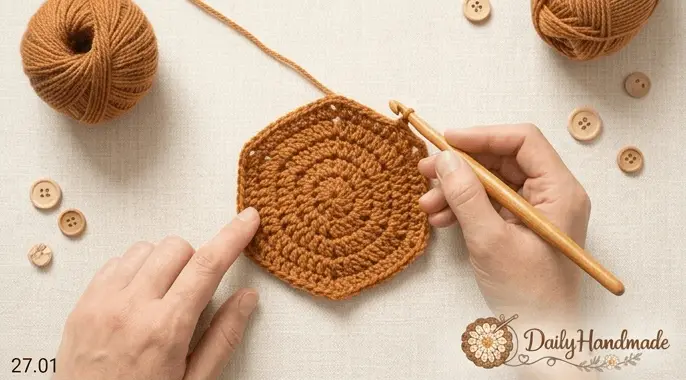
Why Does My Crochet Circle Look Like a Hexagon? The Corner Crisis
Quick Recognition
It is a quiet afternoon in 2026. You’ve spent hours working on a beautiful circular rug or a large mandala. You followed the flat crochet circle increase formula perfectly—no waves, no ruffles. But as you step back to admire your work, you realize it’s not a circle at all. It has six distinct “points” and six flat sides. You think, “I counted every stitch, so why does my crochet circle look like a hexagon?” At Dailyhandmade, we call this the “Polygon Trap.” While Why My Crochet Circle Is Wavy dealt with the number of stitches, the hexagon crisis is all about placement. You’ve accidentally turned your increases into structural pillars that are pushing the fabric out into a six-sided shape.
Direct Answer
The reason why does my crochet circle look like a hexagon is that you are stacking your increases directly on top of each other in every round. In a standard crochet circle, you usually start with a base of 6 or 12 stitches. When you place an increase in the same relative spot every time you go around, you create a vertical line of “double stitches.” These stacked points create more physical bulk than the surrounding single stitches, which forces the fabric to peak outward, creating 6 (or 12) corners. In the framework, this is a Placement Error, not a math error.
The Geometry of the Stack: Circle vs. Polygon
In the technical world of Working in the Round, we look at the internal angles of your project. A true circle has an infinite number of infinitesimal points. A hexagon, however, consists of 6 points where the interior angle is 120°.
| Feature | The True Circle | The Accidental Hexagon |
| Increase Placement | Randomized or Staggered. | Stacked vertically. |
| Edge Appearance | A smooth, continuous curve. | Flat sides with visible “corners.” |
| Force Distribution | Even pressure across the edge. | Concentrated pressure at increase points. |
| Geometry Rule | $C = 2\pi r$ | Sum of interior angles = 720°. |
3 Reasons Your Circle is Growing Corners
If you are investigating why does my crochet circle look like a hexagon in Working in the Round, look for these three structural culprits:
1. The “Auto-Pilot” Increase
Most patterns are written for simplicity: “Round 4: (2 SC, Inc) repeat.”
- The Problem: If you always perform the “Inc” (increase) at the very end of your repeat, that increase will always land on top of the increase from the previous round. This creates stacked increases crochet circle, which act like the “ribs” of an umbrella, stretching the fabric into a polygon.
2. The 6-Stitch Starting Base
If you start your circle with exactly 6 stitches (common for Single Crochet), the math is very “square.”
- The Problem: With only 6 increase points per round, the “flat sides” between the corners are very long. This makes the flat sides much more obvious than they would be in a circle starting with 12 or 18 stitches.
3. High Stitch Definition Yarn
As we explored in best yarn for flat crochet circles, some yarns show every detail.
- The Problem: Mercerized cotton and stiff acrylics have zero “halo” or fuzz to hide the stitch structure. If your increases are stacked, these yarns will highlight the “bump” of the increase, making your hexagon look even sharper.
Dailyhandmade Expert Rescue Signal
The “Clock Face” Audit: In Why Crochet Circle Turns Into a Hexagon, we use the clock face method to check for corners. Lay your project flat. Do you see points at 12, 2, 4, 6, 8, and 10 o’clock? If the points are perfectly symmetrical, you have a placement problem. If the points are random, you might just have a tension issue. Identifying the symmetry is the first step toward keeping your crochet circle round.
What To Expect Next
We’ve identified the “why”—it’s the vertical alignment of your increases. But how do these “stacks” actually physically warp the fabric? Is there a way to see the error as you stitch so you can stop it before it’s too late? In our next chapter of Why Crochet Circle Turns Into a Hexagon, we look at the mechanic of the mistake: Stacked Increases Crochet Circle: Why Your Rounds Have Points.
Return Path
Answering why does my crochet circle look like a hexagon is the foundation of mastering Working in the Round. To smooth out your edges, explore these related guides:
- Stacked increases crochet circle
- How to stagger increases in crochet circle
- Why your crochet circle has flat sides
- Why is my crochet circle wavy?
- Master Guide: Working in the Round
I have a relevant follow-up question for you: When you look at your “hexagon,” can you actually see a vertical line or “ridge” where the increases are stacked on top of each other, or do the corners just seem to appear out of nowhere?