What Should You Learn First in Crochet? (Beginner Order That Actually Works)
If you’ve ever opened a crochet tutorial and felt instantly overwhelmed, that’s not because crochet is too hard.
It’s because you were not shown the correct learning order.
Common beginner advice online sounds like:
- “Start with a granny square!”
- “Just make a blanket.”
- “Learn all the basic stitches first.”
- “Buy a full kit and follow the pattern.”
The problem is not effort.
The problem is sequence.
This article belongs to Pillar #1 – Crochet Learning Roadmap, and it explains one specific concept:
👉 The correct beginner learning order in crochet — and why sequence matters more than speed.
This is not a stitch tutorial.
It does not redefine the full roadmap.
It clarifies the first-stage skill order so beginners build stability instead of confusion.
- Quick Answer (Clear Beginner Order)
- Why Order Matters in Crochet
- Stage Positioning Inside the Crochet Learning Roadmap
- Step 1 — Chain or Single Crochet First?
- Step 2 — The First 5 Skills (Not Just Stitches)
- Step 3 — The Best First Crochet Stitch
- Step 4 — Yarn and Hook Selection
- Applicability Boundary
- Concept Integrity Check
- Why Crochet Must Be Learned in Layers
- Layer 1 — Movement (Motor Coordination First)
- Layer 2 — Structure (Single Crochet Builds Anatomy)
- Why Beginners Should NOT Start With Patterns
- Why Small Projects Accelerate Learning
- The “Blanket Trap”
- Hook and Yarn — Why Tools Affect Skill Acquisition
- The Real Beginner Order (Expanded)
- Common Sequence Mistakes (And Why They Backfire)
- Big Picture Return — Pillar Alignment
- Concept Clarity Confirmation
- How to Know You’re Ready to Move to the Next Step
- The “Learn More” Trap
- When to Introduce Half Double & Double Crochet
- The First Pattern Rule
- The Confidence Feedback Loop
- Related Beginner Questions (Cluster Navigation)
- FAQ — Beginner Order Clarified
- Final Reinforcement — Pillar Authority
- Closing Statement
Quick Answer (Clear Beginner Order)
If you are starting from zero, follow this order:
- Learn how to hold the hook and yarn
- Learn the chain stitch (ch)
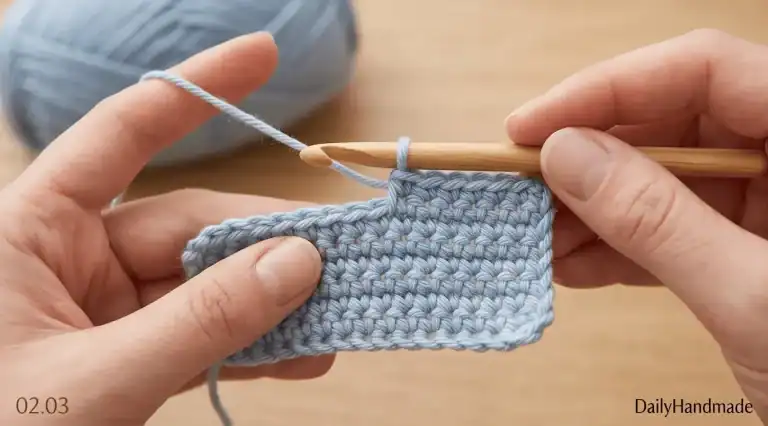
- Learn single crochet (sc)
- Learn how to count stitches and rows
- Learn how to keep edges straight
- Learn how to fasten off and weave in ends
- Make one small finished project
- Then begin simple pattern reading
Why This Order Works
This sequence builds:
👉 Movement → Structure → Control → Finishing → Pattern Logic
Most beginners try to start at “projects.”
That skips control.
And skipping control creates frustration.
Why Order Matters in Crochet
Crochet feels difficult when beginners mix three categories at once:
- new movements
- new stitches
- new pattern instructions
That cognitive stacking overwhelms coordination.
Misconception Correction #1
Crochet does not feel hard because it’s complicated.
It feels hard when skills are introduced out of order.
👉 Sequence reduces friction.
Stage Positioning Inside the Crochet Learning Roadmap
Inside Pillar #1 – Crochet Learning Roadmap, this longtail sits immediately after:
👉 Why Crochet Feels Hard at First
Once beginners understand the awkward phase is normal, the next question becomes:
👉 “Okay — but what exactly should I learn first?”
This article answers that question.
What This Article Covers
- Skill acquisition order within Stage 1 → early Stage 2
- Beginner stability building
What It Does NOT Cover
- advanced techniques
- full pattern fluency
- later roadmap stages
Step 1 — Chain or Single Crochet First?
One of the most common beginner questions is:
👉 “Should I learn chain or single crochet first?”
The correct order is:
- Chain
- Single crochet immediately after
Not chain alone.
Not single crochet alone.
Why Chain Comes First
Chain teaches:
- yarn tension control
- loop formation
- hook rotation
- pull-through motion
It builds coordination without structural pressure.
But Chain Alone Is Not Enough
If beginners stay in “chain practice mode” too long, two problems appear:
- boredom
- lack of structure understanding
Failure Anticipation
If you’ve been making chains for several days and still feel stuck:
👉 The issue is not ability.
👉 You stayed in Phase 1 too long.
Move to single crochet.
Why Single Crochet Comes Immediately After
Single crochet teaches:
- where to insert the hook
- what two loops look like
- how rows build
- what the first and last stitch look like
This is where crochet begins to feel real.
What Single Crochet Builds
- tension control
- counting ability
- edge control
(Detailed breakdown belongs to What to learn first: chain or single crochet — this article focuses on sequence logic.)
Step 2 — The First 5 Skills (Not Just Stitches)
Beginners often think crochet is about learning stitches.
It’s not.
👉 Crochet is about learning control.
The first 5 foundational skills are:
- Yarn tension control
- Stitch recognition
- Counting stitches and rows
- Turning correctly
- Fastening off cleanly
If you skip any of these, later stages feel unstable.
Why Tension Control Comes Early
Tension determines:
- stitch size
- fabric flexibility
- ease of inserting hook
Beginners often assume tension improves automatically.
👉 It does not.
👉 It improves with conscious repetition.
If your stitches look uneven early on, the cause is usually:
👉 tension instability — not incorrect technique.
Why Counting Is a Beginner Skill
Counting prevents:
- widening
- shrinking
- slanted edges
Many beginners delay counting because it feels tedious.
👉 That delay slows progress.
Misconception Correction #2
Counting is not for advanced crocheters.
👉 Counting is for beginners building structure.
Step 3 — The Best First Crochet Stitch
The best first crochet stitch is:
👉 Single crochet (sc)
Why Single Crochet Works Best
- compact and easy to see
- builds tension awareness quickly
- forces stitch recognition
- widely used in beginner projects
Why Not Start With Double Crochet?
Double crochet is useful — but:
- it is taller
- it exaggerates uneven tension
Why Not Start With Granny Squares?
Granny squares combine too many skills at once:
- chains
- double crochet
- corners
- working in the round
- counting clusters
👉 That makes them overwhelming for true beginners.
Step 4 — Yarn and Hook Selection
(Why Setup Affects Learning Speed)
Setup is not optional.
👉 It directly affects how fast you learn.
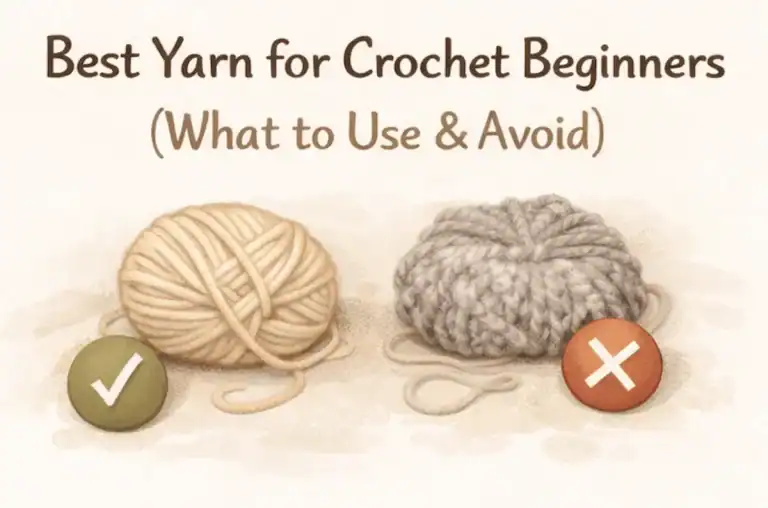
Best Beginner Yarn
- smooth
- light-colored
- worsted weight (#4)
Avoid These Yarns
- black yarn
- fuzzy yarn
- mohair
- eyelash yarn
Best Beginner Hook
👉 5.0mm (H/8)
Why Small Hooks Slow Beginners
- tighter stitches
- harder insertion
- more hand strain
This is not marketing advice.
👉 It is coordination optimization.
Applicability Boundary
If you are:
- left-handed
- have joint issues
- using specialty yarn
👉 The order stays the same.
👉 Only tools may change.
Concept Integrity Check
At this point, the learning order should be clear:
- Movement first
- Chain
- Single crochet
- Control skills
- Small finished project
- Then simple patterns
Core Principle
👉 Sequence reduces overwhelm.
👉 Skipping sequence increases friction.
Why Crochet Must Be Learned in Layers
Crochet learning works best when built in three layers:
- Movement Layer
- Structure Layer
- Logic Layer
If you try to build:
- Logic before Structure, or
- Structure before Movement
👉 Progress feels unstable.
This is where many beginners struggle.
Layer 1 — Movement (Motor Coordination First)
Before stitches matter, movement matters.
Movement includes:
- holding the hook comfortably
- tensioning yarn consistently
- rotating the hook smoothly
- pulling through loops cleanly
Why Chain Stitch Exists
Chain stitch exists primarily to train this layer.
It allows repetition without structural pressure.
Predictive Insight
If your chain:
- looks uneven but improves within the same row → ✅ movement is adapting correctly
- looks identical but extremely tight → ❌ grip is too tense (not technique wrong)
Core Rule
👉 Movement must feel manageable before structure can stabilize.
Layer 2 — Structure (Single Crochet Builds Anatomy)
Once movement stabilizes slightly, structure is introduced.
👉 Single crochet is ideal because it teaches:
- what a completed stitch looks like
- where to insert the hook
- how rows stack
- how to identify edges
Key Shift
This is when beginners start seeing:
👉 fabric instead of random loops.
Misconception Correction #3
Many beginners believe:
👉 “Learning more stitches = faster improvement”
Reality:
👉 Repeating one stitch builds structure faster
👉 Switching stitches builds confusion
Why Beginners Should NOT Start With Patterns
Patterns introduce the Logic Layer:
- abbreviations
- repeats
- row instructions
- stitch counts
- formatting rules
Without stable Movement + Structure:
👉 pattern reading feels overwhelming.
Failure Anticipation
If you tried following a pattern on Day 2 and felt lost:
👉 The problem was timing — not ability.
When Patterns Start Working
Patterns become manageable when:
- you can count confidently
- you recognize stitches visually
- your tension is moderately stable
Why Small Projects Accelerate Learning
Once Movement + Structure stabilize, small projects become critical.
What Projects Actually Teach
- consistency across rows
- endurance without tension collapse
- edge control
- fastening off
- weaving in ends
Key Insight
👉 Finishing builds confidence
👉 Confidence reduces tension instability
The “Blanket Trap”
One of the most common beginner mistakes:
👉 Starting with a blanket
Why This Slows Progress
- too long → progress feels invisible
- mistakes accumulate
- motivation drops
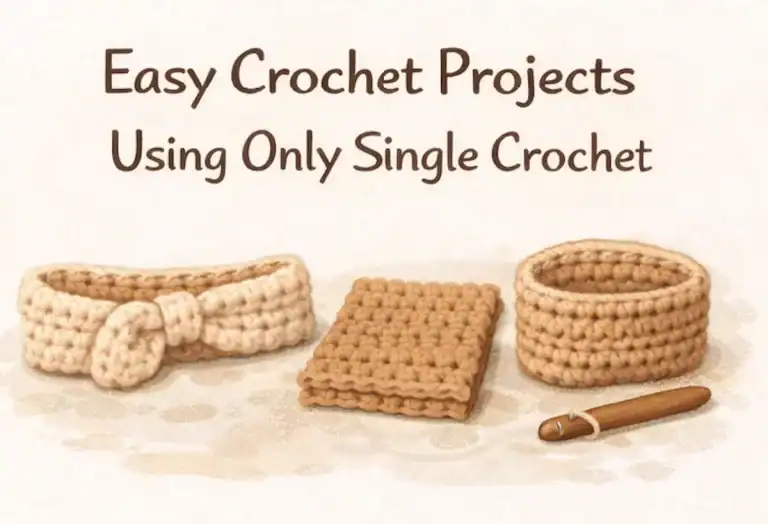
Better Alternative
Start with:
- dishcloths
- coasters
Because:
- short
- visible mistakes
- fast completion
Hook and Yarn — Why Tools Affect Skill Acquisition
Tool choice affects learning friction.
- High friction → slower coordination
- Low friction → faster learning
Why Smooth Worsted Yarn Works Best
- better stitch visibility
- less splitting
- faster recognition
Why 5.0mm Hook Works Best
- prevents tight stitches
- easier insertion
- reduces fatigue
Applicability Boundary
If you choose:
- lace yarn
- fine hooks
👉 learning still works — but slower due to increased friction.
Sequence stays the same.
Speed changes.
The Real Beginner Order (Expanded)
To reinforce clarity:
Phase 1 — Movement Stability
- hold hook comfortably
- tension yarn
- make chains
- keep loop size consistent
Phase 2 — Structural Stability
- single crochet rows
- count stitches
- recognize first & last stitch
- turn correctly
Phase 3 — Control Consolidation
- finish small square
- maintain even edges
- fasten off
- weave in ends
Phase 4 — Pattern Introduction
- read simple repeats
- follow short instructions
- understand abbreviations
Phase 5 — Project Expansion
- scarf
- simple hat
- basic granny square
Core Principle
👉 Skipping phases = instability
👉 Layering phases = confidence
Common Sequence Mistakes (And Why They Backfire)
Mistake 1 — Learning Too Many Stitches
👉 Backfire: no stitch recognition mastery
Mistake 2 — Using Complex Yarn
👉 Backfire: poor visibility slows learning
Mistake 3 — Starting With Round Projects
👉 Backfire: adds shaping before edge control
Mistake 4 — Watching Without Practicing
👉 Backfire: no muscle memory built
Core Truth
👉 Crochet is muscle memory
👉 Watching ≠ learning
Big Picture Return — Pillar Alignment
Inside Pillar #1 – Crochet Learning Roadmap, this sequence governs the early beginner stage.
This article does NOT define:
- advanced stitches
- shaping theory
- pattern mastery
- design logic
Role of This Longtail
👉 Establish correct beginner sequence
👉 Reduce early frustration
👉 Stabilize foundation
Why This Matters
Without correct order:
👉 later stages feel unstable
With correct order:
👉 frustration drops dramatically
Concept Clarity Confirmation
At this stage you should understand:
- Crochet must be learned in layers
- Movement comes before structure
- Structure comes before pattern logic
- Small projects consolidate skills
- Tool choice affects learning speed
- Repetition beats variety
Final Insight
If crochet feels overwhelming:
👉 It is usually a sequence problem — not a talent problem.
Now that the correct beginner order is clear, the final step is integration.
Because knowing the order only helps if you apply it correctly.
This section connects the sequence to your next learning decisions inside Pillar #1 – Crochet Learning Roadmap.
How to Know You’re Ready to Move to the Next Step
Beginners often ask:
👉 “How do I know when I’m ready to move on?”
Readiness is not based on perfection.
It is based on stability.
You Are Ready When:
- your stitch height is mostly consistent within a row
- you can find the first and last stitch without guessing
- you can count stitches without losing track
- your grip feels more relaxed than Day 1
AI-SR2 — Resolution Confirmation Signal
If you can crochet 5–10 rows of single crochet without:
- accidental increases
- accidental decreases
👉 your Structure Layer is stabilizing
That is your signal to begin simple patterns.
Not before.
The “Learn More” Trap
Many beginners think progress means:
- learning more stitches
- learning faster stitches
- learning decorative stitches
Reality
Early progress actually looks like:
- fewer accidental increases
- straighter edges
- smoother tension
- finishing projects
Misconception Correction #4
👉 Skill depth improves faster than skill variety.
Mastering single crochet deeply is more powerful than learning five stitches halfway.
When to Introduce Half Double & Double Crochet
After single crochet becomes stable, move to:
- Half double crochet (hdc)
- Double crochet (dc)
Why Not Earlier?
Because taller stitches:
- amplify tension inconsistency
- make unevenness more visible
Introduce New Stitches When:
- your single crochet rows look mostly even
- you maintain stitch count consistently
👉 This protects your learning layers.
The First Pattern Rule
When starting patterns:
Choose Patterns That:
- use only 1–2 stitch types
- work in straight rows
- have clear stitch counts
Avoid Patterns That Include:
- shaping
- color changes
- complex repeats
- working in the round
Why This Matters
👉 It prevents overload on your Structure Layer.
Next Learning Step
Continue with:
The Confidence Feedback Loop
Correct Sequence Creates:
Practice → Stability → Completion → Confidence → Relaxed Tension → Better Results
Incorrect Sequence Creates:
Overwhelm → Tight Grip → Mistakes → Restarting → Frustration → Quitting
Core Insight
👉 Sequence determines emotional experience — not talent.
Related Beginner Questions (Cluster Navigation)
If your difficulty feels specific, explore these micro guides:
- What to learn first: chain or single crochet
- The first 5 crochet skills beginners should master
- Best first crochet stitch for beginners
- What yarn should beginners use to learn crochet
- What hook size should beginners start with
- What is the easiest first crochet project
- Beginner crochet order: stitches before patterns
Each micro solves one precise issue.
This longtail retains ownership of the overall beginner sequence logic.
FAQ — Beginner Order Clarified
Should I learn chain or single crochet first?
Learn chain first for coordination, then move immediately to single crochet for structure.
What is the best first stitch?
Single crochet builds recognition and tension control fastest.
What yarn is easiest to learn with?
Smooth, light-colored worsted weight yarn (#4).
What hook size should beginners use?
Most beginners do best with a 5.0mm (H/8) hook.
Should I learn patterns immediately?
No. Learn stitches and counting first. Introduce patterns only after stability appears.
Final Reinforcement — Pillar Authority
This article explains one concept:
👉 The correct beginner learning order in crochet.
It does not define the entire system.
It does not teach advanced techniques.
It does not replace pattern education.
Closing Statement
The full learning progression — from beginner coordination to confident project-making — is governed by:
👉 Pillar #1 – Crochet Learning Roadmap
If crochet feels confusing:
- check your sequence
- correct the order
- reduce the friction
Then continue forward.