
Should I Block Crochet Motifs Before Joining? The Assembly Logic
Quick Recognition
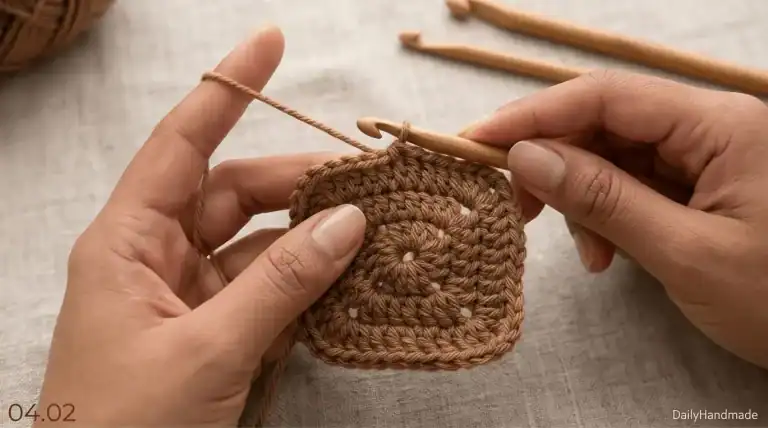
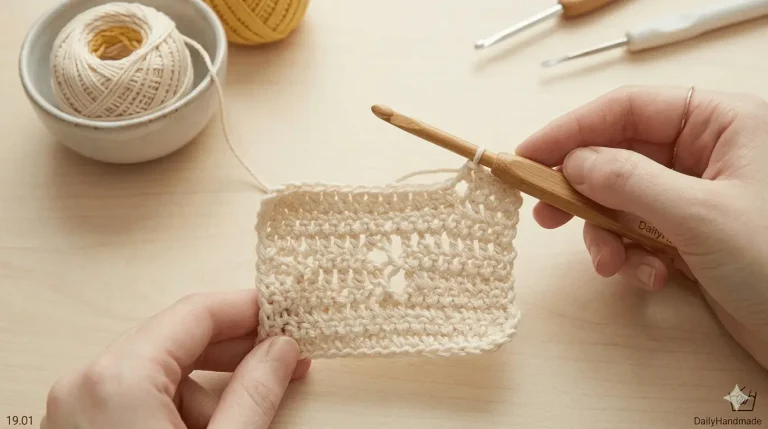
It is a bright morning in April 2026, and your coffee table is disappearing under a mountain of 64 granny squares. You’ve already looked into the best way to join crochet pieces for beginners, but as you pick up the first two motifs, you notice they aren’t exactly the same shape. One is slightly trapezoidal, and the other has edges that curl like a potato chip. You think, “Will seaming them together fix this, or will it just make a lumpy blanket? Should I block crochet motifs before joining?” At Dailyhandmade, we consider this the “Foundation Audit.” In Pillar: Crochet Care & Maintenance Guide, we emphasize that blocking is the only way to ensure your mathematical stitch counts translate into physical symmetry.
Direct Answer
In almost every scenario, the answer to should i block crochet motifs before joining is a resounding Yes. Blocking individual motifs standardizes their dimensions, flattens curling edges, and opens up decorative stitches. This makes the subsequent assembly process 50% faster because your stitches will line up 1-to-1 without you having to “stretch and pull” as you sew. In the framework, we prioritize Matching Efficiency ($M_e$)—ensuring every motif reaches the same geometric target before they are structurally linked.
The Logic of the Join: Matching Efficiency ($M_e$)
In the technical world of Pillar: Crochet Care & Maintenance Guide, we calculate the Matching Efficiency ($M_e$). If your motifs are not blocked, the variance in side lengths creates “Assembly Friction,” leading to puckered seams.
$$M_e = \frac{1}{\sum_{i=1}^{n} |L_i – L_{target}|}$$
Where $L_i$ is the actual length of a motif side and $L_{target}$ is your goal size (e.g., $10cm$).
| Timing Option | The Visual Result | Ease of Assembly | The Dailyhandmade Verdict |
| Block Before | Perfectly straight, crisp grid lines. | Highest (Stitches align 1:1). | Gold Standard. |
| Block After | Can hide minor tension issues. | Moderate (Must “fudge” edges). | Best for organic/freeform shapes. |
| No Blocking | “Homemade” look (lumpy/curled). | Low (Frustrating to sew). | Only for non-essential projects. |
3 Strategy Drills for Assembly Timing
If you are debating should i block crochet motifs before joining in Pillar: Crochet Care & Maintenance Guide , use these three drills to streamline your workflow:
1. The “Template Consistency” Check
Before you pick up your needle for joining granny squares, perform this test.
- The Drill: Stack 5 motifs on top of each other. If the corners don’t line up perfectly or if some are wider than others, you must block. Use a blocking board or DIY hack to pin them all to a single, identical template. This eliminates the uneven crochet joins that ruin the look of a finished blanket.
2. The “Edge Relaxation” Protocol
Curled edges are the enemy of a flat seam.
- The Drill: If your motifs are curling (common with solid squares), use spray blocking to flatten just the outer two rounds. This makes it significantly easier to see the “V” of the stitches when you are performing an invisible mattress stitch. If you don’t block first, you are seaming “blind” into curled yarn.
3. The “Vertical Stacking” Efficiency
Beginners fear that blocking 100 motifs will take weeks.
- The Drill: You don’t need 100 mats. Use the “Stacking Hack” where you pin one square to your DIY blocking mats, then place the next square on top, using long pins or skewers to keep them aligned. You can block 10-15 squares in a single stack, ensuring they all dry to the exact same footprint simultaneously.
Dailyhandmade Expert Rescue Signal
The “Seam-Stretch” Warning: In How to Block Crochet Projects (Wet vs. Steam vs. Spray), we always remind makers: If you join unblocked squares and then block the entire blanket, your seams might not stretch at the same rate as your yarn. This can cause the squares to “poof” out while the seams stay tight, creating a “waffle” effect. To avoid this, should i block crochet motifs before joining is usually answered with: “Block first to avoid structural regret.”
What To Expect Next
You’ve blocked your squares, joined them into a masterpiece, and used it for a month. Now it’s time for its first wash. Does all your blocking work disappear in the water? In our final chapter of How to Block Crochet Projects (Wet vs. Steam vs. Spray), we look at the maintenance cycle: Can You Reblock Crochet After Washing? Restoring the Shape.
Return Path
Deciding should i block crochet motifs before joining is a critical “Workflow” choice in Pillar: Crochet Care & Maintenance Guide. To ensure your project assembly is professional, explore these related guides:
- Best blocking method for crochet beginners
- Blocking granny squares without a blocking board
- Why is my crochet still curling after blocking
- Best way to join crochet pieces for beginners
- Master Guide: Crochet Care & Maintenance
I have a relevant follow-up question for you: Are you currently working on a large blanket with many small motifs, or a smaller project like a bag where you only have a few pieces to connect?