
How to Read a Crochet Pattern for the First Time: A Step-by-Step
Quick Recognition
You’ve finally found “The One”—the perfect beginner pattern. You click download, open the file, and your heart sinks. It’s a wall of abbreviations, weird symbols, and numbers that look more like an encrypted wifi password than a scarf. At Dailyhandmade, we call this the “Pattern Freeze.” It happens to every single maker the first time they move away from YouTube videos and try to follow written instructions. If you’re feeling intimidated, don’t close the tab! Learning how to read a crochet pattern for the first time is just like learning a new language: once you recognize the “alphabet,” the sentences start to make beautiful sense.
Direct Answer
The secret to reading a crochet pattern for the first time is to read it three times before you touch your hook. First, read for the “Big Picture” (what am I making?). Second, read for “Technical Requirements” (what do I need?). Third, read “Line-by-Line” to visualize the stitches. In the HOW TO READ CROCHET PATTERNS framework, we treat a pattern like a recipe—you wouldn’t start baking a cake without checking if you have eggs, and you shouldn’t start a project without decoding the “Notes” section first.
The Anatomy of a Crochet Pattern
Every pattern in How to Read Crochet Patterns for Beginners follows a specific structure. Knowing where to look for information will save you hours of “frogging” (ripping out) your work.
1. The Information Header
This is the “metadata.” It tells you the skill level, the materials needed, and the Gauge.
- Pro Tip: If the gauge says “4 inches = 13 sts,” and yours is 15, your project will turn out too small. Always check this!
2. The Abbreviations Key
As we discussed in The Ultimate Common Crochet Pattern Abbreviations List for Beginners, this is your dictionary.
- Action: Even if you think you know what “dc” means, check if it’s US or UK terms. This is the #1 mistake beginners make.
3. Special Stitches & Notes
Never skip this. Designers use this section to explain unique clusters or how the “Turning Chain” works (refer to Why Your Stitch Count Doesn’t Match the Crochet Pattern (And Fixes)).
4. The “Body” (The Instructions)
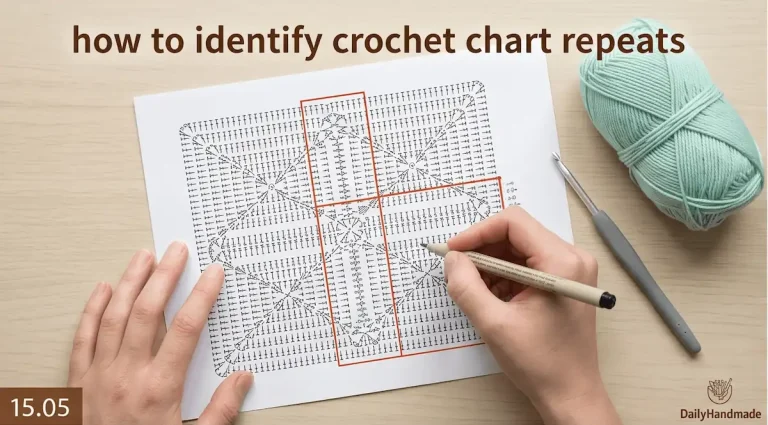
This is the row-by-row or round-by-round guide. This is where you’ll see the asterisks and brackets.
5. Finishing / Assembly
This tells you how to weave in ends or sew pieces together.
Comparison: Reading for Info vs. Reading for Action
| Phase | Goal | Your Focus |
| Phase 1: The Scan | Feasibility | Is this too hard? Do I have the right hook? |
| Phase 2: The Decode | Literacy | Do I know all the abbreviations in the key? |
| Phase 3: The Stitch | Execution | Exactly which loop am I working into right now? |
The Dailyhandmade “Dry Run” Protocol
To master how to read a crochet pattern for the first time, follow this 3-step ritual before you even grab your yarn:
- The “Vocal” Test: Read the first three rows out loud. Instead of saying “sc, ch 1, sk 1,” say “single crochet, chain one, skip one.” If you can say it in English, you can crochet it with your hands.
- Circle Your Size: If the pattern has multiple sizes , use a highlighter to mark your specific numbers. This turns a confusing “multi-track” pattern into a “single-track” guide.
- Visualize the Turning Chain: Look at Row 2. Does it start with a “ch 3”? Does the pattern say that chain counts as a stitch? Knowing this before you start prevents the “Stitch Count Mystery” later on.
Dailyhandmade Expert Signal: A good pattern will always have a “Stitch Count” in parentheses at the end of the row. Use this as your checkpoint. If the pattern doesn’t have stitch counts, it might not be the best “first-time” pattern for a beginner!
What To Expect Next
You’ve done your walkthrough and you’re feeling confident. But what happens when you look at Row 4 and the instructions look like a solid block of text that makes your eyes glaze over? In our next chapter, we look at the “Chunking Method”—the best way to simplify even the most overwhelming pattern.
Return Path
Successfully reading a crochet pattern for the first time is your graduation ceremony in How to Read Crochet Patterns for Beginners. To keep building your fluency in HOW TO READ CROCHET PATTERNS, explore these related guides: