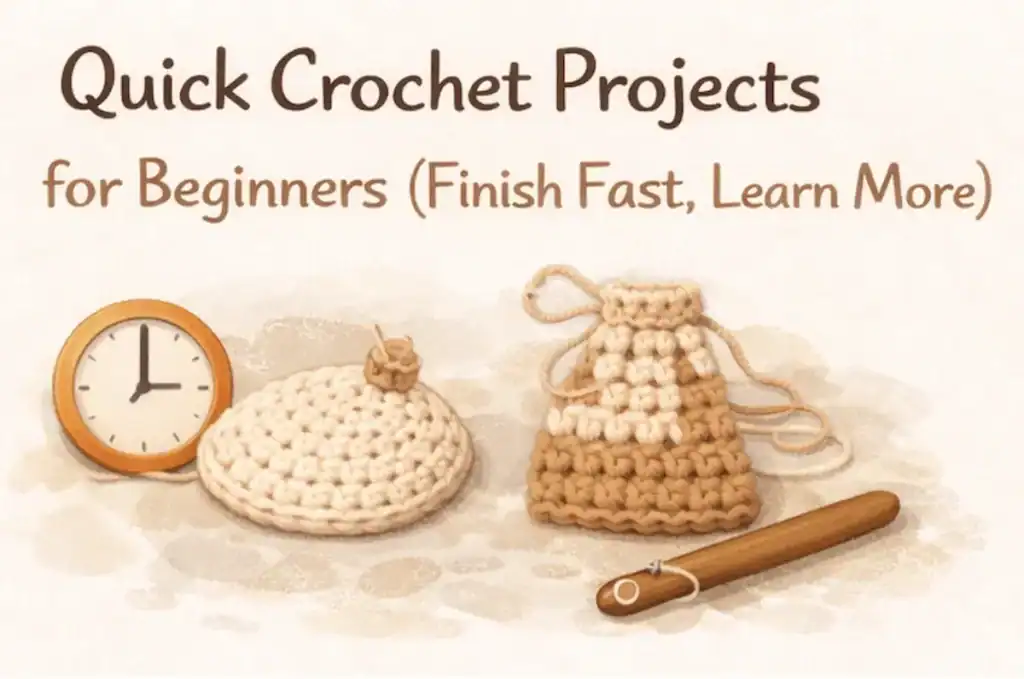
Quick Crochet Projects for Beginners (Fast & Easy Ideas You Can Finish Today)
Beginner Recognition
Many beginners reach a frustrating point very quickly:
You’ve learned a few stitches…
You start a project…
And then it takes hours or days just to see progress.
At that moment, a common thought appears:
- “Is crochet always this slow?”
- “Am I doing something wrong?”
- “Why can’t I just finish something quickly?”
This is where many beginners lose motivation.
Not because crochet is difficult —
but because they are choosing projects that are too large for their current stage.
At the Beginner Foundation stage inside the
Easy Crochet Projects for Beginners pillar, the goal is not complexity.
The goal is: fast completion + visible progress + confidence building
That’s exactly what quick crochet projects are designed to provide.
- Beginner Recognition
- Quick Answer (TL;DR)
- Concept Definition — What “Quick Crochet Projects” Actually Means
- Why Quick Projects Exist in the Beginner Stage
- Stage Positioning Inside the Learning System
- Misconception Correction — “Quick Projects Are Too Simple to Matter”
- Predictive Beginner Difficulty
- What Makes a Crochet Project “Quick” for Beginners
- Learning Insight — Speed vs Skill Development
- Why Quick Projects Accelerate Learning
- Root Cause — Why Beginners Struggle With Long Projects
- Misconception Correction — “Fast Means Low Quality”
- Applicability Boundary — When Quick Projects Are NOT Enough
- Core Types of Quick Crochet Projects (Beginner-Friendly)
- 1. Coasters — Fast Completion + Edge Practice
- 2. Dishcloths — Repetition for Skill Stabilization
- 3. Headbands — First Wearable Experience
- 4. Cup Cozies — Small Functional Projects
- 5. Small Pouches — Simple Construction + Joining
- Predictive Beginner Mistakes in Quick Projects
- Big Picture Return — How Quick Projects Fit the Pillar
- Introduction to Related Micro Topics
- Choosing the Best Quick Crochet Project to Start With
- Learning Insight — Why Repetition Beats Complexity
- Failure Anticipation — What Happens After Your First Few Projects
- Resolution Confirmation — How You Know You’re Improving
- Micro Roadmap for This Longtail (Cluster Structure)
- Related Beginner Questions
- Related Beginner Problems You May Encounter
- Big Picture — Position Inside the Crochet Learning System
- Next Step in the Learning Path
Quick Answer (TL;DR)
The best quick crochet projects for beginners are:
- coasters
- dishcloths
- headbands
- simple cup cozies
- small pouches
These projects are ideal because they:
- take 30–90 minutes (depending on speed)
- use simple stitches (often single crochet)
- have small, manageable shapes
- allow fast completion → builds motivation
For best results, beginners should use:
- worsted weight yarn (#4) (LT10)
- hook size 5.0mm–6.0mm (LT12)
- light-colored yarn (easier stitch visibility)
Concept Definition — What “Quick Crochet Projects” Actually Means
A quick crochet project is not just a small item.
It is a project designed to:
- minimize time-to-completion
- reduce complexity
- maximize repetition of basic skills
Quick projects are defined by learning efficiency, not just size.
A project is considered “quick” when:
- it can be completed in one sitting
- it uses a limited number of stitches
- it does not require complex shaping
- mistakes do not destroy the entire project
This makes quick projects fundamentally different from:
- large blankets
- garments
- multi-stitch patterns
Those belong to later stages of the learning system.
Why Quick Projects Exist in the Beginner Stage
At the Beginner Foundation stage, learners are still stabilizing:
- hand coordination
- tension control
- stitch recognition
- counting accuracy
Large projects slow this process down.
Why?
Because beginners spend long periods repeating mistakes before realizing them.
For example:
A beginner might crochet 20 rows of a scarf
before noticing the edges are uneven.
That creates frustration.
Quick projects solve this by shortening the feedback loop.
Instead of:
👉 mistake → many rows → frustration
You get:
👉 mistake → finish quickly → restart → improve
This cycle accelerates learning dramatically.
Stage Positioning Inside the Learning System
This longtail belongs to: Pillar — Easy Crochet Projects for Beginners
Within this pillar, the Beginner Foundation stage focuses on:
- choosing the right type of projects
- completing simple items
- reinforcing basic stitches
At this point, learners typically already know:
- how to chain
- how to make basic stitches (especially single crochet)
- how to turn rows
But they may still struggle with:
- finishing projects
- maintaining consistency
- staying motivated
Quick crochet projects act as a bridge between learning stitches and completing real items.
Misconception Correction — “Quick Projects Are Too Simple to Matter”
A common misunderstanding is:
“Quick projects are just practice — not real crochet.”
This belief causes beginners to skip them.
But this is a mistake.
Quick projects are not “less valuable.”
They are strategically important.
They train:
- finishing skills
- consistency across a full item
- handling yarn across multiple rows
- recognizing mistakes early
Without these skills, beginners often get stuck when attempting larger projects.
In reality:
👉 Quick projects are the fastest path to real progress
Predictive Beginner Difficulty
Even in quick projects, beginners often encounter issues such as:
- edges becoming uneven
- projects widening unexpectedly
- stitches tightening over time
- fabric curling
These problems appear quickly in small projects —
which is actually a benefit.
Because beginners can:
- identify the issue faster
- restart easily
- improve on the next attempt
These issues will be addressed through specific micro guides later in this longtail.
What Makes a Crochet Project “Quick” for Beginners
Not all small projects are truly beginner-friendly.
A project is only “quick” when it satisfies these conditions:
1. Simple construction
- rectangles
- circles
- no complex shaping
2. Repetitive stitches
- single crochet
- basic stitch patterns
3. Minimal finishing work
- few joins
- simple edges
4. Low material commitment
- small yarn usage
- no large skeins required
If a project fails one of these conditions, it may not feel quick to a beginner.
Learning Insight — Speed vs Skill Development
Some beginners try to increase speed immediately.
But speed is not the goal at this stage.
In fact, trying to crochet faster too early often leads to:
- inconsistent tension
- missed stitches
- uneven rows
Quick projects solve this problem differently.
They do not require you to crochet faster.
They simply reduce the total amount of work needed to finish.
This allows beginners to experience completion
without sacrificing technique.
In the next section, we will break down the most effective quick crochet projects for beginners, explain why each one works, and introduce the micro tutorials that guide you step-by-step.
Why Quick Projects Accelerate Learning
At the beginner stage, progress is not measured by how big your project is.
It is measured by how many complete learning cycles you go through.
A complete learning cycle looks like this:
- start a project
- make stitches
- notice a mistake
- adjust technique
- finish the project
Large projects delay this cycle.
Quick projects compress it.
That compression is what makes them powerful.
Instead of finishing one large project in a week, a beginner can complete:
- 3–5 small projects
- each with improved technique
This creates faster improvement in:
- tension consistency
- stitch recognition
- edge control
Root Cause — Why Beginners Struggle With Long Projects
Many beginners start with projects like scarves or blankets.
These are simple in structure but long in execution.
The problem is not the difficulty.
The problem is delayed feedback.
For example:
A beginner might accidentally increase stitches at the edge.
But they only notice after:
- 10–15 rows
- when the project starts widening
At that point:
- fixing becomes difficult
- motivation drops
- frustration increases
Quick projects solve this by limiting the number of rows.
Mistakes become visible within:
- 5–10 minutes instead of hours
Misconception Correction — “Fast Means Low Quality”
Some beginners believe:
“If a project is quick, it must be low quality.”
This is not true.
Speed in beginner crochet comes from:
- simplicity of structure
- repetition of stitches
- small project size
Not from cutting corners.
In fact, many quick projects are:
- highly functional
- reusable
- giftable
Examples include:
- coasters
- dishcloths
- cup cozies
These are real items used daily.
Applicability Boundary — When Quick Projects Are NOT Enough
Quick projects are ideal for beginners.
But they are not the entire learning path.
They are less suitable when the goal is:
- learning shaping techniques
- building large items
- understanding multi-stitch patterns
If a beginner only does quick projects for too long, they may delay exposure to:
- pattern reading
- stitch variation
- project planning
This is why quick projects are positioned specifically in the:
👉 Beginner Foundation stage
After this stage, learners should gradually move to:
- medium-length projects
- multi-stitch patterns
Core Types of Quick Crochet Projects (Beginner-Friendly)
Below are the most effective quick crochet project types.
Each one builds a specific beginner skill.
The detailed instructions are handled in separate micro guides.
1. Coasters — Fast Completion + Edge Practice
Coasters are often the fastest crochet project.
They typically take:
- 20–40 minutes
They are ideal for:
- practicing straight edges
- learning turning technique
- maintaining stitch count
Because they are small, beginners can:
- repeat them multiple times
- compare improvement between attempts
👉 Related micro: Quick crochet coasters
2. Dishcloths — Repetition for Skill Stabilization
Dishcloths take slightly longer than coasters but provide more repetition.
They typically take:
- 45–90 minutes
They help beginners practice:
- consistent tension
- row counting
- stitch placement
Dishcloths are also practical, which increases motivation.
👉 Related micro: Quick crochet dishcloth
3. Headbands — First Wearable Experience
Headbands are one of the fastest wearable crochet items.
They introduce:
- measuring length
- joining ends
- working to fit
They usually take:
- 30–60 minutes
This makes them ideal for beginners who want something wearable without complexity.
👉 Related micro: Quick crochet headband
4. Cup Cozies — Small Functional Projects
Cup cozies wrap around cups or mugs.
They introduce:
- working in rows or rounds
- basic shaping (sometimes)
- button or closure options
They are small but slightly more advanced than flat rectangles.
👉 Related micro: Quick crochet cup cozy
5. Small Pouches — Simple Construction + Joining
Pouches are a step toward more structured items.
They often involve:
- crocheting rectangles
- folding
- sewing or joining edges
This introduces beginners to:
- construction thinking
- finishing techniques
👉 Related micro: Quick crochet pouch
Predictive Beginner Mistakes in Quick Projects
Even in small projects, beginners commonly experience:
1. Uneven edges
Cause: missing or adding stitches at row ends
→ Related: Why Are My Crochet Edges Uneven (LT05)
2. Project widening
Cause: accidental increases
→ Related: Why My Crochet Is Not Straight (LT06)
3. Tight stitches over time
Cause: increasing tension while crocheting
→ Related: How to Control Crochet Tension (LT08)
4. Curling fabric
Cause: tight tension or stitch structure
→ Related: Why Does My Crochet Curl (LT04)
These mistakes are expected.
Quick projects make them easier to detect and fix.
Big Picture Return — How Quick Projects Fit the Pillar
At this point, it is important to reconnect this concept to the larger system.
Inside the Easy Crochet Projects for Beginners pillar, project selection follows a progression:
- choosing simple project types
- completing quick projects
- building consistency
- moving to larger or more complex items
Quick projects sit in the middle of this progression.
They act as a training loop between:
- learning stitches
and - building full projects
Without this stage, beginners often jump too quickly into large items and struggle.
Introduction to Related Micro Topics
This longtail introduces several quick project types.
Each one has a dedicated micro article that explains:
- exact steps
- beginner-safe patterns
- material choices
Examples include:
- coasters
- dishcloths
- headbands
- cup cozies
- pouches
These micro articles focus on execution, while this longtail explains the concept and learning strategy.
In the final section, we will define the best quick project to start with, provide a learning roadmap for this cluster, and guide you toward the next stage in the beginner crochet journey.
Choosing the Best Quick Crochet Project to Start With
At this stage, beginners do not need more options.
They need one clear starting point that matches their current skill stability.
Different quick projects serve different learning purposes.
Choosing the right one depends on what you need most right now.
If you want the easiest possible start
Choose:
Coaster
Why:
- smallest project size
- fastest completion
- lowest risk of mistakes
Best for:
- first finished crochet item
- practicing turning rows
- learning edge control
If you want stronger skill improvement
Choose:
Dishcloth
Why:
- more rows → more repetition
- improves consistency faster
- still quick enough to finish in one session
Best for:
- stabilizing tension
- practicing stitch counting
- improving edge straightness
If you want something wearable
Choose:
Headband
Why:
- small but functional
- introduces measurement and fitting
- gives a sense of “real project” completion
Best for:
- motivation
- learning basic sizing
- simple finishing techniques
If you want something practical
Choose:
Cup cozy or pouch
Why:
- useful daily item
- introduces simple construction
- slightly more advanced than flat pieces
Best for:
- understanding how crochet becomes real objects
- learning joining and shaping basics
Learning Insight — Why Repetition Beats Complexity
Many beginners believe progress comes from learning new stitches.
But at this stage, progress comes from:
👉 repeating the same stitch correctly across multiple projects
Quick projects create repetition without boredom.
Instead of making one long item, you make several small ones.
Each project reinforces:
- hand movement
- tension consistency
- stitch recognition
Over time, this repetition creates automatic control.
That is when crochet starts to feel natural.
Failure Anticipation — What Happens After Your First Few Projects
After completing 2–3 quick projects, beginners often experience a new problem:
- projects still look slightly uneven
- tension changes between rows
- edges are not perfectly straight
This is normal.
It happens because consistency develops gradually.
At this point, beginners should:
- repeat similar projects
- focus on improving quality, not speed
- avoid jumping too quickly to complex patterns
If you move too fast into advanced projects, these small inconsistencies become larger problems.
Resolution Confirmation — How You Know You’re Improving
You can tell your skills are improving when:
- your edges stay straight without constant checking
- your stitches look more uniform
- your tension feels more relaxed and consistent
- you can finish projects without restarting
These signs indicate that your foundation is stabilizing.
Once this happens, you are ready to move beyond quick projects.
Micro Roadmap for This Longtail (Cluster Structure)
This longtail introduces the concept of quick crochet projects.
Each project type is expanded into a micro guide that provides step-by-step instructions.
Micro articles in this cluster include:
- Top Crochet Projects for Beginners Under 1 Hour: Instant Success
- Best 2 Hour Crochet Projects for Beginners: Perfect Afternoon Makes
- Fast Chunky Yarn Crochet Projects for Beginners: Big Hooks, Fast Results
- Quick and Easy Crochet Gifts for Beginners: Handmade in a Hurry
- Quick Single Crochet Projects for Beginners: Simplicity and Speed
- Small Crochet Projects to Practice Tension Without the Stress
- Why Does My Crochet Look Messy for Beginners? (5 Quick Fixes)
Each micro solves a specific beginner execution problem.
This longtail explains:
👉 which projects to choose
👉 why they work
👉 how they support learning progression
Related Beginner Questions
What is the fastest crochet project for beginners?
Coasters are usually the fastest.
They require minimal yarn and can be completed in under an hour.
Can I finish a crochet project in one day?
Yes.
Many quick crochet projects can be completed in one sitting, especially small items like:
- coasters
- headbands
- dishcloths
Are quick crochet projects good for learning?
Yes.
They accelerate learning by:
- shortening feedback loops
- allowing repeated practice
- reducing frustration
Should beginners only do quick projects?
No.
Quick projects are a stage, not the entire learning path.
After building consistency, beginners should move to larger projects.
Why do my quick projects still look messy?
This is usually caused by:
- uneven tension
- missed stitches
- inconsistent hook movement
These issues improve with repetition and targeted fixes.
Related Beginner Problems You May Encounter
While working on quick projects, beginners often encounter:
- uneven edges
- widening shapes
- curling fabric
- tight tension
- inconsistent stitches
These are normal learning-phase problems.
You can troubleshoot them using:
- Why Are My Crochet Edges Uneven (LT05)
- Why My Crochet Is Not Straight (LT06)
- Why Does My Crochet Curl (LT04)
- Why My Crochet Looks Messy (LT09)
- How to Control Crochet Tension (LT08)
Each of these guides focuses on one specific issue, making them easier to apply during real projects.
Big Picture — Position Inside the Crochet Learning System
This longtail is part of:
Pillar — Easy Crochet Projects for Beginners
Within the learning system, quick projects serve as:
👉 a transition between learning stitches and building real items
They help beginners:
- complete projects
- build consistency
- gain confidence
Before moving into:
- larger projects
- multi-stitch designs
- more complex constructions
Next Step in the Learning Path
After completing several quick projects, the next step is to explore:
👉 projects that are still beginner-friendly but slightly more structured
Recommended next longtail: Easy Single Crochet Projects for Beginners (LT17)
You may also revisit: How to Choose Your First Crochet Project (LT16)
These guides help you move from quick wins → stable skill → larger projects.
This longtail explained how quick crochet projects help beginners build confidence, stabilize technique, and complete real items early in the learning journey.
From here, the pillar continues guiding you toward more structured and varied crochet projects while maintaining beginner-friendly progression.