
Practice Reading Crochet Patterns for Beginners: Build Your Skills
Quick Recognition
You’ve gathered your hooks and your yarn, and you’ve downloaded a beautiful pattern. But every time you try to start, you end up “frogging” (ripping out) your work because you misunderstood a line. You feel like you’re failing at crochet, but you’re actually just struggling with the language. At Dailyhandmade, we believe that reading a pattern is a separate skill from making a stitch. If you want to stop the frustration, you need to practice reading crochet patterns for beginners without the pressure of having a hook in your hand. It’s like a musician reading a score before they sit at the piano—it builds a mental map of the project.
Direct Answer
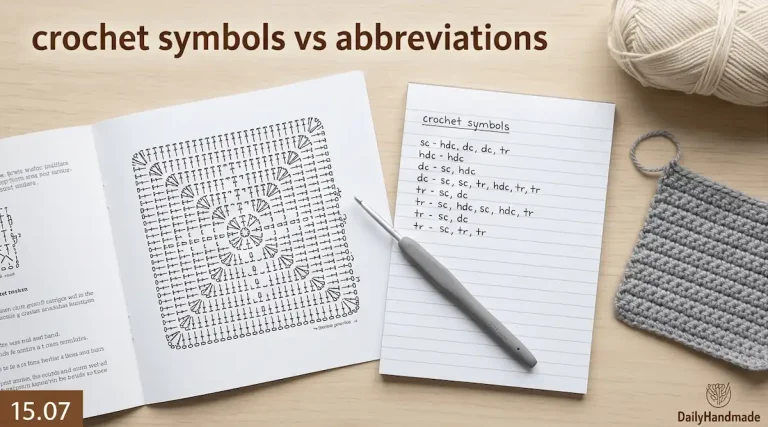
To practice reading crochet patterns for beginners, you should engage in Active Visualization and Shorthand Translation. This means taking a printed pattern and “crocheting it in your head.” By translating every abbreviation and symbol into full English sentences and tracing the logic of the rows, you build the neural pathways needed for “pattern literacy.” In HOW TO READ CROCHET PATTERNS, we call this “Mental Crochet,” and it is the fastest way to eliminate errors before they happen.
The “Yarn-Free” Skill Building Routine
To master How to Read Crochet Patterns for Beginners , spend 10 minutes a day on these three “reading-only” drills:
1. The “Vocal” Translation Drill
Take a complex row from a pattern and read it out loud.
- The Goal: Do not use the abbreviations. If the pattern says
*sc 2, inc; rep from * to end, you say: “Single crochet two times, then work two single crochets into the next stitch. Now, go back to the start and do it again until I reach the end of the row.” - Why it works: Hearing the instructions in your own voice forces your brain to process the logic rather than just scanning the letters.
2. The “Finger Trace” Method
Lay your pattern on the table. Instead of a hook, use your index finger to “draw” the stitches in the air as you read.
- The Goal: Visualize where the “V” of the stitch is and where you would insert the hook.
- Why it works: It connects your visual reading to your physical motor skills, making the actual crochet session feel much more familiar.
3. The “Stitch Count” Prediction
Cover the stitch count at the end of the row (the number in parentheses). Read the row instructions and try to calculate the final number yourself.
- The Goal: If the row starts with 20 stitches and the pattern says
inc in every st, you should predict 40. - Why it works: It forces you to understand the math of the pattern, which makes you a much more independent maker.
Comparison: Active Making vs. Mental Practice
| Feature | Active Crocheting | Mental Practice (Reading) |
| Focus | Physical movement and tension. | Syntax, logic, and structure. |
| Frustration Level | High (errors lead to frogging). | Low (errors lead to re-reading). |
| Speed | Slow and methodical. | Fast (can “read” a whole scarf in 5 mins). |
| Result | A physical object. | Total confidence and skill longevity. |
The Dailyhandmade “Readiness” Audit
Before you officially “graduate” from HOW TO READ CROCHET PATTERNS, ask yourself these three questions while looking at a new pattern:
- Do I recognize every abbreviation? (If not, go back to The Ultimate Common Crochet Pattern Abbreviations List for Beginners).
- Do I see where the “repeats” start and stop? (If not, check the asterisks in Crochet Pattern Repeats Asterisk Meaning: Never Miss a Row).
- Can I explain Row 1 to a friend? If you can explain the row clearly, you are ready to pick up your hook.
Dailyhandmade Expert Note: Many professional designers “read” through an entire pattern while lying in bed or riding the bus. This mental rehearsal is why they rarely make mistakes. Think of practicing reading crochet patterns for beginners as your secret “training ground.”
What To Expect Next
You have now completed the entire How to Read Crochet Patterns for Beginners curriculum. You’ve mastered the alphabet, the syntax, the structure, and the practice. You are no longer just a “yarn-puller”—you are a “Pattern Reader.” With these skills, you are ready to explore the vast world of Pillar #07: Advanced Techniques & Texture.
Return Path
You have completed all 10 Micro-topics for How to Read Crochet Patterns for Beginners. Your fluency in HOW TO READ CROCHET PATTERNS is now complete.
Review the full logic of the series:
- Abbreviations List
- Meaning of Parentheses
- How to keep track of rows
- How to read a pattern for the first time
Series Complete! You have the knowledge and the confidence.
I have a relevant follow-up question for you: Now that you’ve mastered reading patterns, do you feel ready to start your first “garment” project (like a sweater or vest), or would you rather stick to accessories like blankets and scarves for a little longer?