
How to Tell If You Crochet Too Loose: Identifying “Ghost Holes”
Quick Recognition
It’s 2026, and you’ve finally relaxed your “Death Grip” from How to Tell If You Crochet Too Tight: The Stitch Definition Test. But now, as you look at your progress, you notice something unsettling. Your stitches don’t look like neat little “V”s anymore—they look like sagging hammocks. You can see your sofa through the middle of your blanket, and the edges are waving like they’re underwater. You wonder, “Is it supposed to be this… holey?” At Dailyhandmade, we call this “The Noodle Effect.” While loose tension is easier on your wrists, it can compromise the beauty and warmth of your work. Learning how to tell if you crochet too loose is essential to keeping your stitches crisp and your fabric solid.
Direct Answer
You can how to tell if you crochet too loose by looking for “Ghost Holes”: accidental gaps at the base of your stitches that allow light (and stuffing) to leak through. Other signs include a lack of stitch definition, where the yarn looks “blurred” rather than distinct, and a fabric that flares outward as you work. In the framework, loose tension happens when your “yarn-holding hand” isn’t providing enough friction, allowing the loops to become much larger than the crochet hook’s diameter.
The “Ghost Hole” Audit: 3 Signs of Loose Tension
In the technical world of How to Tell If You’re Crocheting Too Tight or Too Loose, we use these three diagnostic tests to see if your tension has gone into “over-relax” mode:
1. The “Light Leak” Test
Hold your work up to a window or a lamp.
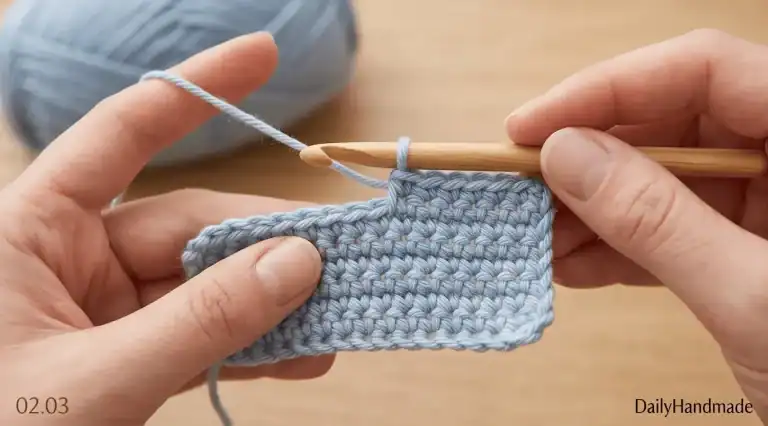
- The Sign: Correct tension should create a dense fabric. If you see irregular, large gaps (Ghost Holes) between the vertical posts of your stitches, your yarn isn’t being pulled snug enough to fill the space.
2. The “Stitch Blur” Check
Look at your stitches from a distance of about two feet.
- The Sign: You should be able to clearly see each individual stitch. If the rows look “shaggy” or the stitches seem to blend into a messy, unstructured cloud, your loops are too floppy to hold their shape.
3. The “Width Flare” Measurement
Lay your project flat and measure the width at the starting row and the current row.
- The Sign: If you haven’t intentionally added stitches, but the project is getting wider and wider, your tension is loosening. Loose stitches take up more horizontal space than tight ones.
Comparison: Loose vs. Balanced Tension
In CROCHET FAQ AND TROUBLESHOOTING, we use this chart to help you find the “Goldilocks” zone:
| Visual Feature | Too Loose (The Noodle) | Balanced (The Silk Glide) |
| Gaps | Large “Ghost Holes” everywhere. | Minimal; solid fabric. |
| Drape | Floppy; has no structure. | Flexible but holds its shape. |
| Row Count | Rows look unusually tall. | Matches the pattern gauge. |
| Edge Line | Wavy or “ruffled” edges. | Surgically straight. |
Dailyhandmade Expert Rescue Signal
The “Finger Wrap” Fix: If you’ve confirmed you’re a “Loose Crocheter,” don’t just pull harder with your hook. In How to Tell If You’re Crocheting Too Tight or Too Loose, we recommend adding an extra wrap of yarn around your pinky or index finger. This creates “passive tension,” which acts as a brake for the yarn without making your hand cramp.
What To Expect Next
You’ve diagnosed the “Ghost Holes.” But how does this tension struggle affect your body? Whether you’re too tight or too loose, your hands will tell the story. In our next chapter, we look at the physical toll: Crochet Too Tight Symptoms: When Your Hands and Fabric Suffer.
Return Path
Identifying how to tell if you crochet too loose is a critical skill for any CROCHET FAQ AND TROUBLESHOOTING expert. To keep your stitches in check, explore these related guides:
- Crochet too loose symptoms: Distorted stitches
- How to tell if you crochet too tight
- Fixing crochet fabric that is floppy and stretchy
- Master Guide: CROCHET FAQ AND TROUBLESHOOTING
I have a relevant follow-up question for you: When you look at your “Ghost Holes,” do they seem to happen mostly at the beginning and end of your rows, or are they scattered all through the middle of your fabric?