
How to Tell if Your Crochet is Square (The Measurement Guide)
Quick Recognition
You’ve been working on a granny square or a dishcloth for an hour. To your eyes, it looks “mostly” right, but when you set it down on the table, something feels off. Is one side slightly longer? Is that corner actually 90 degrees, or is it a bit “soft”? If you find yourself constantly rotating your work, trying to find an angle where it looks straight, you are dealing with Geometric Uncertainty. Before you can fix a wobbly project, you need a objective way of how to tell if crochet is square.
Direct Answer
To definitively tell if your crochet is square, you must look beyond the “eye test.” The most accurate methods involve the Triangle Fold Test (folding one corner to the opposite side to see if the edges align perfectly) and Diagonal Measurement. If the distance from the top-left corner to the bottom-right corner is identical to the distance from the top-right to the bottom-left, your project is mathematically square. If these numbers differ, your stitch count or tension is causing a geometric “lean.”
Why This Happens (The Optical Illusion)
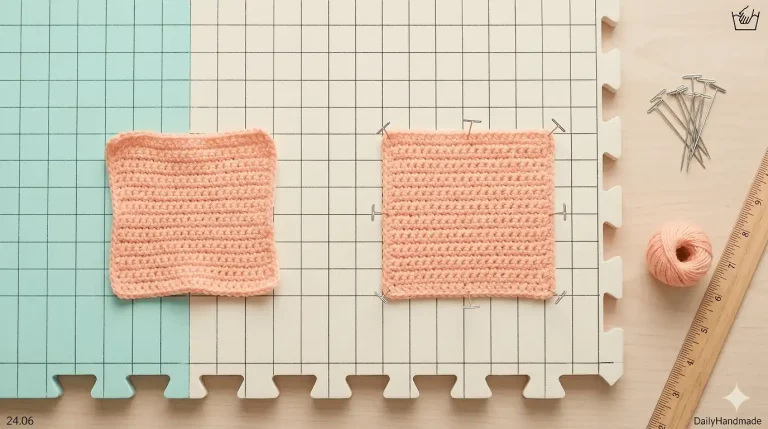
In Pillar #03: Crochet Stitches Explained, we learn that stitches are not perfect cubes; they are often taller than they are wide (especially double crochet). This means that 10 rows of 10 stitches will almost never create a perfect square. Because yarn is stretchy and flexible, your eyes can easily be fooled by the “squish” of the fabric. You might think it’s square while you’re holding it, but gravity and the surface of a table will reveal the truth: your “square” is actually a rectangle or a trapezoid.
How to Fix It (The Measurement Protocol)
Stop guessing and use these four diagnostic checks to verify your work’s geometry:
- The Triangle Fold (The Gold Standard): Take the bottom-left corner of your work and fold it up to meet the top-right edge. If the edges line up perfectly and form a clean triangle with no overlapping “overhang,” your piece is a perfect square.
- The “X” Measurement (The Engineer’s Check): Use a ruler or measuring tape. Measure diagonally from corner to corner.
- Square: Measurement A = Measurement B.
- Trapezoid/Parallelogram: One diagonal will be significantly longer than the other.
- The Table-Edge Alignment: Place your project in the corner of a hard-surface table. Align the bottom and one side with the table’s edges. This instantly reveals if your corners are a true 90 degrees or if they are “flaring” out.
- The Stitch-to-Row Ratio Audit: Consult Pillar #03 to understand your specific stitch height. For example, in single crochet, you often need more rows than stitches (e.g., 12 rows for 10 stitches) to achieve a square shape.
- The “Relax” Test: Lay the work flat and walk away for 5 minutes. When you come back, look at it with “fresh eyes.” Often, our eyes “correct” the shape while we are working, but the fibers will settle into their true, wobbly shape once left alone.
What To Expect Next
Once you use these tests, you might be surprised to find that your “perfect” square is actually half an inch off. Don’t panic! This is the first step toward mastery. You will know you’ve improved your Visual Literacy when you can spot a non-square edge before you even pick up the ruler.
Return Path
Determining how to tell if crochet is square is just the beginning of solving your project’s shape issues. To understand the root causes behind these geometric failures, return to the master diagnostic list for this cluster: Why my crochet is not square
If your tests showed your work isn’t square, find the culprit in these specific guides: