How to Stagger Increases in Crochet Circle: The Key to Roundness
Quick Recognition
It is a bright morning in 2026, and you’ve just realized that your “circle” has six very annoying corners. You’ve diagnosed the problem as stacked increases crochet circle. You think, “I know I need to move the increases, but won’t that mess up my count? How do I move them without getting lost?” At Dailyhandmade, we call this the “The Great Shift.” Staggering is the professional secret that separates a “homemade” look from a “handmade” masterpiece. Knowing how to stagger increases in crochet circle projects is the only way to keep the flat sides from ruining your geometry.
Direct Answer
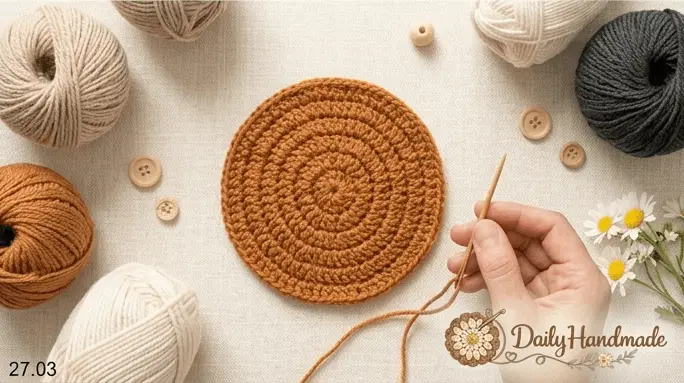
To how to stagger increases in crochet circle rounds, you must offset the placement of your increase stitches so they do not sit directly atop the increases of the previous round. The most common method is the “Split-Even Rule”: on even-numbered rounds, you split the initial set of plain stitches in half, placing the first increase earlier in the sequence. In the Pillar framework, this redistributes the structural tension. By moving the “bulky” increase stitches, you prevent them from forming a vertical pillar, allowing the yarn to flow into a natural, continuous curve.
The Staggering Formula: Even vs. Odd Rounds
In the technical world of Working in the Round, we use a simple shift in the sequence ($S$) for even rounds ($n$) where the number of plain stitches between increases is even.
Standard Pattern:
$$(n-2) \text{ sts, } 1 \text{ Inc}$$
Staggered Pattern (for even $n$):
$$\frac{n-2}{2} \text{ sts, } 1 \text{ Inc, } (n-2) \text{ sts… finish with } \frac{n-2}{2} \text{ sts.}$$
| Round | Standard Pattern (Stacks) | Staggered Pattern (Smooth) |
| Round 3 | (1 sc, inc) x 6 | (1 sc, inc) x 6 (Odd rounds stay same) |
| Round 4 | (2 sc, inc) x 6 | (1 sc, inc, 2 sc… finish with 1 sc) |
| Round 5 | (3 sc, inc) x 6 | (3 sc, inc) x 6 |
| Round 6 | (4 sc, inc) x 6 | (2 sc, inc, 4 sc… finish with 2 sc) |
3 Strategy Drills for Perfect Staggering
If you are mastering how to stagger increases in crochet circle geometry in Working in the Round, follow these three operational drills:
1. The “Split-the-Difference” Method
This is for your even-numbered rounds (R4, R6, R8, etc.).
- The Drill: If the round calls for 4 single crochets followed by an increase, start the round with 2 single crochets and then do your increase. Then, continue with the normal “4 sc, inc” pattern for the rest of the circle. You will end the round with the remaining 2 single crochets. This “shifts” the increase to the middle of the previous round’s flat section.
2. The “Odd-Round Anchor”
You don’t need to stagger every single round to see a massive improvement.
- The Drill: Keep your odd-numbered rounds (where you have 1, 3, or 5 stitches between increases) exactly as the pattern says. The natural “offset” of the odd numbers often provides enough variety that the hexagon look won’t be as sharp. Focus your staggering efforts specifically on the even rounds.
3. The Visual “Gap” Check
Don’t just trust the numbers; trust your eyes.
- The Drill: Before you make an increase, look at the round below. Is your hook positioned directly over the “V” of an increase from the previous row? If yes, move it. Slide your increase one or two stitches to the left or right. As long as you maintain the total flat crochet circle increase formula, the exact placement within the round doesn’t matter for the math—it only matters for the shape.
Dailyhandmade Expert Rescue Signal
The “Stitch Marker” Safety Net: When learning how to stagger increases in crochet circle projects, it is very easy to lose your “start of round” because the sequence looks different. In Why Crochet Circle Turns Into a Hexagon, we insist on using a stitch marker for the first stitch of the round, regardless of whether it’s a plain stitch or an increase. This ensures your total count remains perfect even while your pattern is shifting.
What To Expect Next
You’ve broken the stack! Your circle is finally looking round. But what if you’ve already finished several rounds and can still see those weird “flat sides”? Is there a way to diagnose exactly where the curve died? In our next chapter of Why Crochet Circle Turns Into a Hexagon, we perform a geometric audit: Why Your Crochet Circle Has Flat Sides: Stopping the Polygon Effect.
Return Path
Mastering how to stagger increases in crochet circle techniques is the “magic key” to Working in the Round. To continue your journey toward the perfect curve, explore these related guides:
- Why your crochet circle has flat sides
- Stacked increases crochet circle
- How to keep crochet circle round
- Why is my crochet circle wavy?
- Master Guide: Working in the Round
I have a relevant follow-up question for you: Do you find it easier to remember the “Split-Even” math, or would you prefer a more “randomized” approach where you just eyeball the placement to avoid the stacks?