
How to Read Crochet Diagrams in the Round: Finding the Center
Quick Recognition
It is a breezy afternoon in April 2026, and you’ve already mastered how to read crochet diagrams in rows. You’re ready to start a beautiful sunflower motif or a winter beanie. But when you look at the chart, it isn’t a square grid—it’s a sunburst of symbols radiating from a single point. You think, “Where do I even put my hook first? Does it matter if I go clockwise or counter-clockwise?” At Dailyhandmade, we call this “Mandala Logic.” In How to Read Crochet Patterns, we teach you that a circular chart is a map of expansion, where every “round” builds a larger perimeter around a fixed core.
Direct Answer
To master how to read crochet diagrams in the round, you must start at the Dead Center and read Counter-Clockwise (for right-handed makers). Unlike flat rows that switch direction, circular charts are usually read in a continuous outward spiral or in joined rings that always follow the same direction. In the framework, we focus on identifying the Join-and-Rise—the specific point where a round ends with a slip stitch and “climbs” to the next level with a turning chain.
The Science of Expansion: The Stitch Ratio
In the technical world of How to Read Crochet Patterns, circular charts rely on the Expansion Ratio ($E_r$). To keep a circle flat, the number of stitches must increase at a mathematically predictable rate as the radius ($r$) grows.
$$E_r = \frac{\text{Stitches in Current Round}}{\text{Stitches in Previous Round}}$$
| Feature | Flat Row Logic | Circular Round Logic |
| Starting Point | Bottom corner (Left or Right). | The Exact Center. |
| Reading Direction | Zig-zag (Alternating). | Counter-Clockwise (Consistent). |
| Visual Symbol | Edge numbers ($1, 2, 3$). | Round numbers near the join. |
| Primary Goal | Straight edges. | Flat, non-wavy expansion. |
3 Strategy Drills for Circular Chart Success
If you are learning how to read crochet diagrams in the round in How to Read Crochet Patterns, implement these three navigation drills:
1. The “Foundation Ring” Audit
The center isn’t just a point; it’s the anchor for your consistent tension.
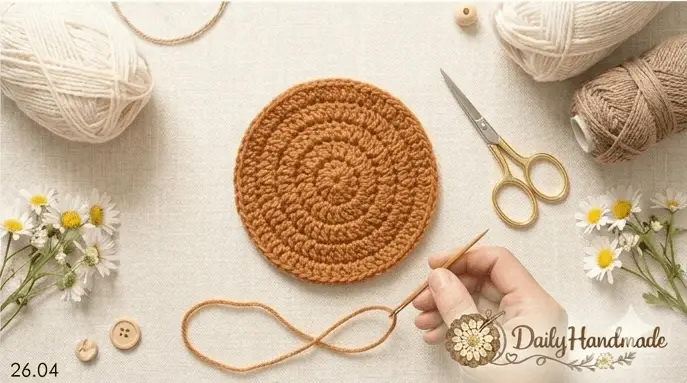
- The Drill: Look at the very center of the diagram. You will see a small circle of ovals or a single “Magic Ring” symbol. This is your starting line. Count the symbols touching this center ring—this is your “Round 1” count. If you miss even one stitch here, the entire geometry of the mandala will be skewed.
2. The “Counter-Clockwise” Compass
Standard diagrams are designed for the natural flow of a right-handed hook.
- The Drill: Place your finger on the first stitch of Round 2. Trace the path of the stitches with your eyes. You should find yourself moving to the left (Counter-Clockwise). This is the #1 rule for how to read crochet diagrams in the round. If you try to go clockwise, your stitches will be backward and your basic symbols will look distorted.
3. The “Join and Rise” Detection
How do you know when a round is over?
- The Drill: Look for a vertical “seam” of symbols. You will see a filled dot (slip stitch) connected to a vertical stack of ovals (chains). This “Step-up” indicates the end of one round and the beginning of the next. Use your ergonomic hook to keep these joins tight, otherwise, your circle will have a visible, gapping seam.
Dailyhandmade Expert Rescue Signal
The “Magic Ring” Mystery: In How to Read Crochet Charts (Diagram Symbols for Beginners), we often see beginners confused by a “spiral” chart that has no slip stitches. This is called “Continuous Rounds.” If the symbols just keep going without a clear join-and-rise point, you are working in a spiral. In this case, always use a physical stitch marker on your work to match the “imaginary” start of the round on your diagram!
What To Expect Next
You’ve mastered the path of the hook in both rows and rounds. But what happens when the visual chart says one thing and the written text says another? Why is there a “translation gap” between the picture and the words? In our next chapter of How to Read Crochet Charts (Diagram Symbols for Beginners), we audit the inconsistencies: Crochet Chart vs Written Pattern Differences: Why They Don’t Always Match.
Return Path
Learning how to read crochet diagrams in the round is a major “Navigation” milestone in How to Read Crochet Patterns. To continue your technical education, explore these related guides:
- Understanding crochet chart diagrams for beginners
- Basic crochet diagram symbols explained
- How to read crochet diagrams in rows
- Common crochet chart reading mistakes
- Master Guide: How to Read Crochet Patterns
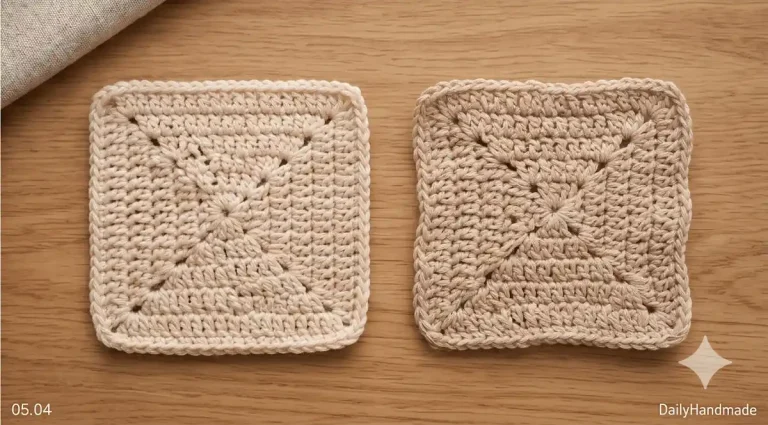
I have a relevant follow-up question for you: Are you currently trying to read a granny square chart where the rounds are very clear, or a complex mandala with many different stitch types?