How to Read Crochet Diagrams in Rows: Turning Logic
Quick Recognition
It is a quiet morning in April 2026, and you’ve already got the basic crochet diagram symbols explained. You have your ergonomic hook ready, but as you look at the flat chart for a scarf, you realize the numbers are jumping from side to side. You think, “Wait, do I read from left to right or right to left? Why is Row 1 on the right and Row 2 on the left?” At Dailyhandmade, we call this “The Path of the Hook.” In How to Read Crochet Patterns, we teach you that a chart isn’t just a picture; it’s a chronological map of your hand movements.
Direct Answer
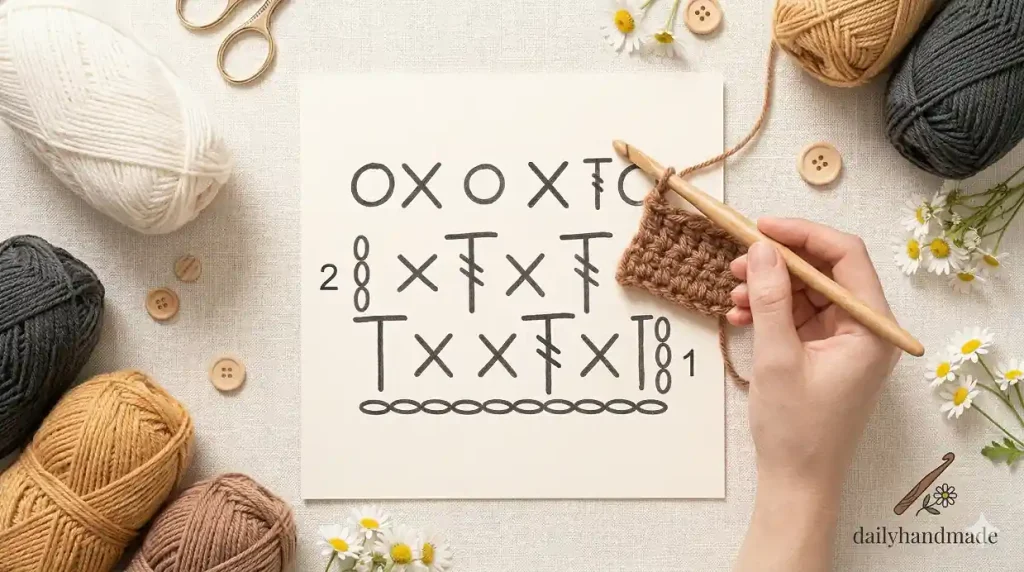
To master how to read crochet diagrams in rows, you must follow the Zig-Zag Rule. For right-handed crocheters, Odd Rows (1, 3, 5) are read from Right to Left, representing the Right Side (RS) of your work. Even Rows (2, 4, 6) are read from Left to Right, representing the Wrong Side (WS). The diagram mimics the physical act of turning your work. In the framework, we focus on Turning Logic—identifying the chain symbols at the edges that “lift” you to the next level.
The Science of Row Parity: Movement Logic
In the technical world of How to Read Crochet Patterns, we analyze Row Parity ($R_p$). The direction of your reading ($D$) is determined by whether the row number ($n$) is odd or even.
$$D = \begin{cases} \text{Right to Left} & \text{if } n \text{ is odd} \\ \text{Left to Right} & \text{if } n \text{ is even} \end{cases}$$
| Row Type | Direction | Fabric Side | Visual Indicator |
| Foundation | Left to Right | Bottom edge | The long string of chain symbols. |
| Odd Rows (1, 3, 5) | Right to Left | Right Side (RS) | Number usually placed on the right. |
| Even Rows (2, 4, 6) | Left to Right | Wrong Side (WS) | Number usually placed on the left. |
3 Strategy Drills for Flat Chart Navigation
If you are learning how to read crochet diagrams in rows in How to Read Crochet Patterns, implement these three navigation drills:
1. The “Number Anchor” Audit
The numbers aren’t just for counting; they are your compass.
- The Drill: Look at the row numbers on the edges of the chart. Always start reading the row from the side where the number is placed. If the “1” is on the right, your eyes (and hook) move toward the left. If the “2” is on the left, your eyes move toward the right. This prevents the common crochet chart reading mistakes of mirroring your pattern.
2. The “Turning Chain” Elevator
The edges of a chart can be the most confusing part.
- The Drill: Look at the very end of a row. You will see a vertical stack of small ovals (chains). These are your “turning chains.” In a diagram, these chains are drawn exactly where they are worked—at the beginning of the new row to provide height. If you don’t “climb” these chains, your edges will pinch inward, a common issue we solve in crochet still curling.
3. The “Highlighter Path” Drill
Don’t trust your eyes to stay on the right line.
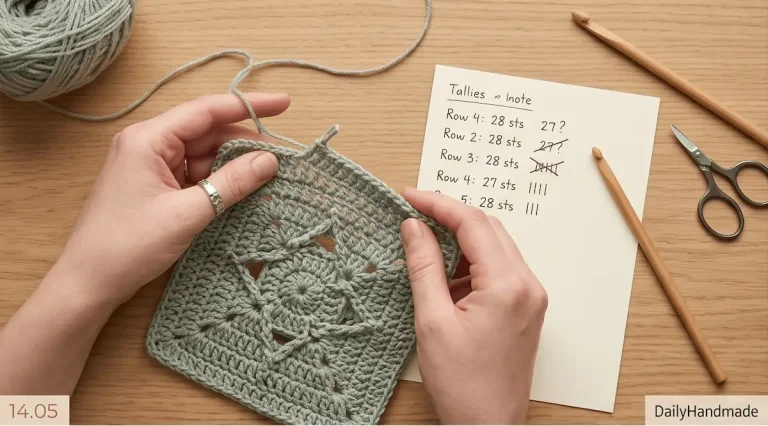
- The Drill: Use a physical highlighter or a digital mark to “cross off” rows as you finish them. Because charts are spatially dense, it is easy to accidentally skip a line or read Row 3 twice. By marking the path, you ensure that your consistent tension isn’t ruined by a structural skip.
Dailyhandmade Expert Rescue Signal
The “Lefty” Flip: In How to Read Crochet Charts (Diagram Symbols for Beginners), we always provide a disclaimer for left-handed makers: Most published charts are designed for righties. If you are left-handed, you must do the opposite: read Odd Rows from Left to Right and Even Rows from Right to Left. It feels counter-intuitive at first, but your fabric will thank you for the correct orientation!
What To Expect Next
You’ve mastered the zig-zag of flat rows, but what happens when the rows don’t end? How do you read a chart that moves in a never-ending spiral or a perfect circle? In our next chapter of How to Read Crochet Charts (Diagram Symbols for Beginners), we look at the “Mandala Logic”: How to Read Crochet Diagrams in the Round: Finding the Center.
Return Path
Learning how to read crochet diagrams in rows is a major “Logic” milestone in How to Read Crochet Patterns. To continue your visual education, explore these related guides:
- Understanding crochet chart diagrams for beginners
- Basic crochet diagram symbols explained
- How to read crochet diagrams in the round
- Common crochet chart reading mistakes
- Master Guide: How to Read Crochet Patterns
I have a relevant follow-up question for you: Are you currently working on a flat project like a scarf where the edges need to be perfectly straight, or are you just practicing swatches for now?