How to Dry Blocked Crochet Faster: Safe Speed-Drying Tips
Quick Recognition
It is a breezy afternoon in April 2026, and your beautiful lace shawl is pinned tightly to your diy blocking mats for crochet. You’ve followed the best blocking method for crochet beginners, but as the hours tick by, the yarn remains stubbornly damp. You think, “I want to wear this tonight! Is there any safe way to move this along without shrinking the wool or melting the acrylic?” At Dailyhandmade, we understand that patience is a finite resource. In Pillar: Crochet Care & Maintenance Guide, we treat drying as a thermodynamic process—by increasing airflow and decreasing humidity, you can cut your wait time by 70%.
Direct Answer
To how to dry blocked crochet faster, you must maximize the Evaporation Rate ($E$) through three main levers: mechanical moisture extraction (The Towel Roll), forced convection (Electric Fans), and humidity control (Dehumidifiers). Never use direct high heat (like a hair dryer on ‘Hot’ or a radiator) as it can cause fibers to become brittle or lose their permanent stretch. In the framework, we prioritize “Active Airflow” over “Passive Heat.”
The Science of the Dry: Evaporation Mechanics
In the technical world of Pillar: Crochet Care & Maintenance Guide, evaporation speed is governed by the difference between the vapor pressure at the yarn surface ($P_w$) and the ambient air ($P_a$).
$$E = K \cdot A \cdot (P_w – P_a)$$
Where $E$ is the evaporation rate, $K$ is the mass transfer coefficient (airflow), and $A$ is the surface area.
| Method | Safety Level | Speed Increase | Best For |
| The “Towel Burrito” | 10/10 | Instant (Pre-pinning) | All natural fibers. |
| Floor Fans | 10/10 | 3x Faster | Large blankets & Sweaters. |
| Dehumidifier | 9/10 | 2x Faster | Humid climates/basements. |
| Hair Dryer (Cool) | 8/10 | Variable | Small motifs/Granny squares. |
| Direct Sunlight | 4/10 | Fast | Danger: UV Fading Risk. |
3 Strategy Drills for Faster Drying
If you need to know how to dry blocked crochet faster in Pillar: Crochet Care & Maintenance Guide, implement these three professional drills:
1. The “Towel Burrito” Extraction
The biggest mistake is pinning a “dripping” wet project.
- The Drill: Before you ever touch your blocking board, lay your damp crochet on a clean, white towel. Roll it up like a burrito and step on it. Your body weight forces the core moisture out of the yarn and into the towel. This removes roughly 50% of the water before the clock even starts.
2. The “Forced Convection” Shield
Stagnant air is the enemy of drying.
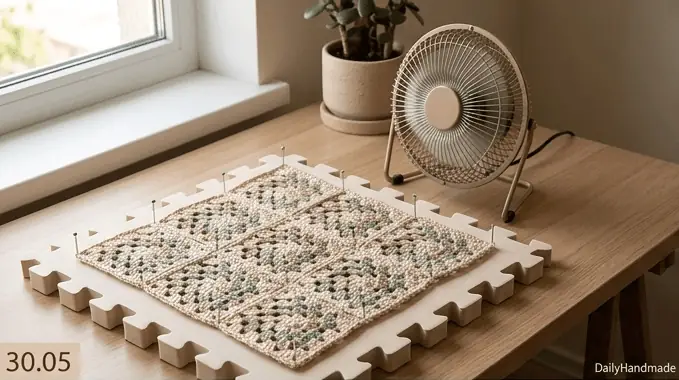
- The Drill: Position a standard oscillating floor fan about 3 feet away from your blocking mats. Set it to a medium speed. By constantly replacing the “saturated” air around the damp yarn with “dry” ambient air, you prevent a micro-climate of humidity from forming over your work.
3. The “Elevated Grid” Setup
Air needs to reach the bottom, too.
- The Drill: Instead of placing your DIY mats directly on the floor, prop them up on two chairs or a laundry drying rack. This allows air to circulate under the mats (if they are porous) or at least around the edges, significantly decreasing the total time compared to laying them on a cold, non-breathable surface like tile.
Dailyhandmade Expert Rescue Signal
The “Sun-Fade” Warning: In How to Block Crochet Projects (Wet vs. Steam vs. Spray), we strictly advise against drying bright or dark-colored natural fibers in direct afternoon sun. While the heat of the sun makes how to dry blocked crochet faster a reality, the UV rays act as a bleach. Your vibrant navy sweater could end up with “sun-stripes” where the light hit the folds. Always dry in a shaded, well-ventilated area.
What To Expect Next
The clock has finished, the yarn is dry, and you unpin your work… only to see that the edges are still rolling up like a scroll. Did you do something wrong? In our next chapter of How to Block Crochet Projects (Wet vs. Steam vs. Spray), we tackle the “Rebound Effect”: Why is My Crochet Still Curling After Blocking? Troubleshooting the Edge.
Return Path
Learning how to dry blocked crochet faster is an essential “Efficiency” skill in Pillar: Crochet Care & Maintenance Guide. To ensure your project finishing is flawless, explore these related guides:
- Best blocking method for crochet beginners
- How to steam block acrylic crochet safely
- DIY blocking mats for crochet
- Why is my crochet still curling after blocking
- Master Guide: Pillar: Crochet Care & Maintenance Guide
I have a relevant follow-up question for you: Are you currently drying your project in a room with high humidity (like a laundry room) or in a dry, climate-controlled space?